Tag: bernanke

  • Why Interest Rates Must Not Rise

    In May 2014 many of us were shocked by a report that Ben Bernanke, who had recently departed the Fed, told a group of wealthy investors that he did “not expect the federal funds rate…to rise back to its long-term average of around 4%” in his lifetime.

    I remember feeling Bernanke’s statement represented both extraordinary hubris and wishful thinking. Surely, the trillions being pumped into the financial system would drive inflation to levels that would produce higher rates.  After all, I reasoned, the bond market isn’t as easily manipulated as is the stock market.

    Last year, I called attention to the fact that the cost of servicing the US debt had broken out to new highs [see: Why Rising Rates are a Problem This Time.]  Even though interest rates had fallen dramatically, the spiraling debt had send annual interest expense on that debt to roughly $450 billion in FY 2017.

    Bernanke’s 2014 words came back to me as I did the math.

    Clearly, if rates were to normalize the interest expense would be unmanageable… Between 2000 and 2007, the average interest rate was 4.84%.  On the current $20.6 trillion balance, that would mean an annual interest expense of roughly $1 trillion.

    Of course he was confident in his prediction!  He understood that rates could never be allowed to rise.  A return to normalcy — and, I don’t believe this to be an exaggeration — would absolutely destroy the economy.

    I had always found the Treasury’s increasing dependence on short-term, floating rate and inflation-indexed borrowings a bit unsettling. Why not lock in a boatload of 30-yr bonds at 2.1%?  Now we know.

    In their wisdom (or desperation…time will tell) the central bankers and those maxing out America’s Gold Card have bet our very futures that Bernanke was right — that everything will be okay in the end…as long as the end never gets here.

    By the way, here’s an update of the above chart…which has been appropriately renamed.


  • Charts I’m Watching: Mar 21, 2013

    ORIGINAL POST:  9:25 AM

    The EURUSD is still trying to change trajectories (purple channel to red), but hasn’t been able to break out yet.

    The dollar is similarly facing a change in direction if the red channel can hold.

    Judging from the futures, SPX is set to react off the neckline and TL we’ve been talking about for several days. Though, daily RSI still shows a little more upside potential.

    I’ll play along on the downside, but will be looking to see if it gains support at the purple channel midline.

    UPDATE:  09:23 AM

    That should do it for the short side, going full long again here at 1550.7 with stops at 1548ish.  Always fun, trying to catch a falling knife…

    The 15 min RSI shows support with SPX here at the .500 Fib.
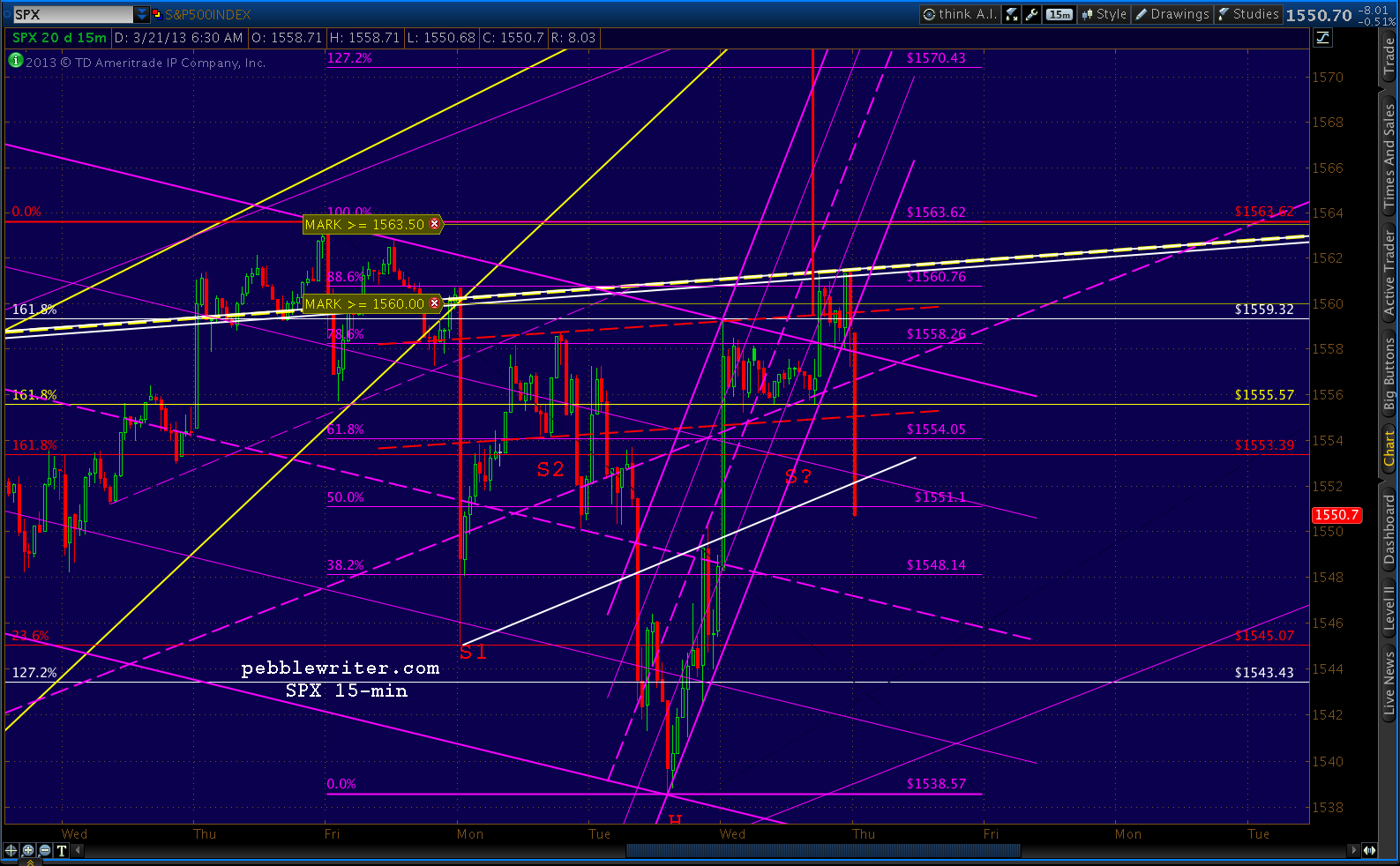
    Fresh charts in a few…

    UPDATE:  9:50 AM

    If SPX reverses here, it leaves a much nicer right shoulder for the IH&S we discussed yesterday.  And, the revised purple channel looks more sustainable.

    Existing home sales, Philly Fed and Leading Economic Indicators are due out at 10 EDT.

    UPDATE:  10:01 AM

    Data better than expected on Philly Fed and Conference Board Leading Indicators, a miss on NAR existing home sales.

    The leading indicators look a lot more positive than the current, which barely moved.

    No charts for the NAR, but sales came in at 4.98 million vs expectations of 5.0 million.  Inventory increased from 4.3 to 4.7 months, which flies in the face of the most commonly heard argument that a shortage of product was driving prices higher.

    There are no doubt pockets of actual product shortages, just as there are many with a huge excess.  But, the price increases have more to do with math than with supply and demand at the moment.

    The NAR, like everyone else, reports average (median) prices.  The entire market could remain at a standstill, but if the bottom 5-10% (in price) of houses are bid up, the average price increases.  It wouldn’t affect the average house, just the average price of all houses.

    That’s why many average homeowners remain underwater and unable to sell their houses for the asking price despite the “good news” from the NAR/MSM.  So, what’s happening to bid up prices on the low end?  Enter our friends at the Fed.

    As Bloomberg reported a few days ago, big institutional money is chasing single-family homes.  With the stock market at all-time highs, bonds at 2% and much of the rest of the world in questionable economic condition, the new bubblicious investment is housing.

    Blackstone, which put $3.5 billion to work buying 20,000 houses, just increased its credit line by another $1.5 billion.  Colony Capital owns 7,000 units and is raising another $2.2 billion.  American Homes-4-Rent owns 10,000, and is buying up more.

    Institutions represent a large percentage of the buyers in many markets which have rebounded the most:  Miami (30%), Phoenix (23%), Charlotte (21%), Las Vegas (19%.)   But, will the dead cat bounce translate into profits for investors?

    As fools rush in, rents are falling in many of the markets in play — making it tough to derive much cash flow.  Colony Capital will be buying another $2.2 billion worth of houses, even though their current portfolio occupancy is only 53%.  In an environment of 2% 10-year treasuries, the 4-5% cash-on-cash yield might look pretty good — especially coupled with some degree of inflation protection.

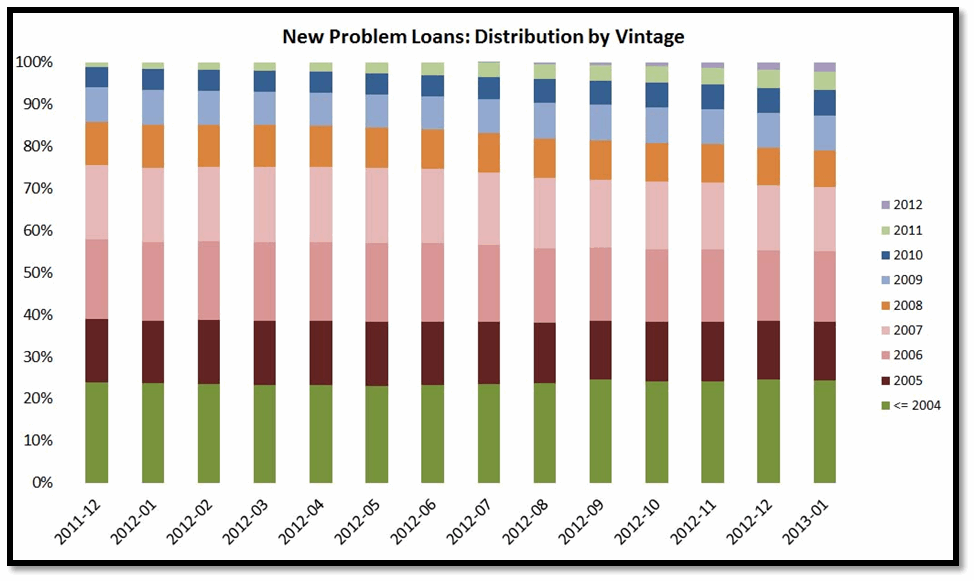
    I can’t help but think this is another big bubble in the making — courtesy of the Fed’s ZIRP.  Even after 5,000,000 foreclosures since the 2006 peak, new delinquencies continue to surface — including a steady contingent of older, more seasoned loans as this LPS chart shows:
    Global Economic Intersection ran a nice piece Tuesday posing a thought-provoking idea:

    “The housing market is therefore the hostage of economic growth and not the signal of economic growth.”

    The evidence of yet another liquidity-fueled, lack-of-any-better-alternatives bubble is here.  Investors must decide whether to button their chin straps and get in the game, or watch from the sidelines as the greater fools slug it out the red zone.  Stay tuned.

    UPDATE:  2:05 PM

    With the move down through 1548, I gave SPX a little more wiggle room to the .618 of the last move up at 1547.35.  It bounced, but couldn’t hold, prompting me to take a short-term short to cover my core long position.

    I’m closing the short here at the .786 of 1543.75 for a small gain.  More charts, revised channels coming up.

    The bullish case needs 1546.27 to hold firm.

    UPDATE:  2:30 PM

    Hard to keep up with charting this morning, with things moving rather quickly and dropping a little further than I expected.  Looks like the .786 will hold, but let’s make that the new stop.

    The 60 min RSI has found midline support at a potential falling channel (purple) and a rising channel which isn’t as convincing as I’d like (yellow.)

    UPDATE:  5:30 PM

    Weakness everywhere around the close.  I’m going to lay out the bullish and bearish scenarios, but from a chart pattern standpoint, this is a toss-up.

    Taking a look around the indices, I see a lot of indices at make or break points.  I just revisited RUT, a great case in point.  Drawn from the 98 and 02 lows, one channel makes a great case for the upside being done.

    The daily chart CU shows just how precisely we’ve tagged the top of that channel and the TL’s the make up the rising wedges.

    Drawing the channels off the 98 and 09 lows, however, shows RUT has already pushed above and backtested the channel top (in purple.)

    Throw in some Harmonic Patterns and things get really interesting…

    There was a big reversal at the .786 of the 2007-2009 crash, so we should expect a Butterfly Pattern to play out at the 1.272 of 996.26, right?

    But, look at all the TL’s of resistance we’d have to push through first…

    Besides the trend lines, the purple 1.618 hasn’t really caused a reaction yet.  The white 1.618 has, but not much of one.  And, note that the yellow pattern calls for a run to the 1.618 at 1033.  Mixed signals, to say the least.

    More in the morning…


  • Bernanke Speaks

    PLEASE NOTE THAT MEMBERSHIP RATES ARE SET TO INCREASE ON MARCH 4.

    *   *   *   *   *   *   *   *

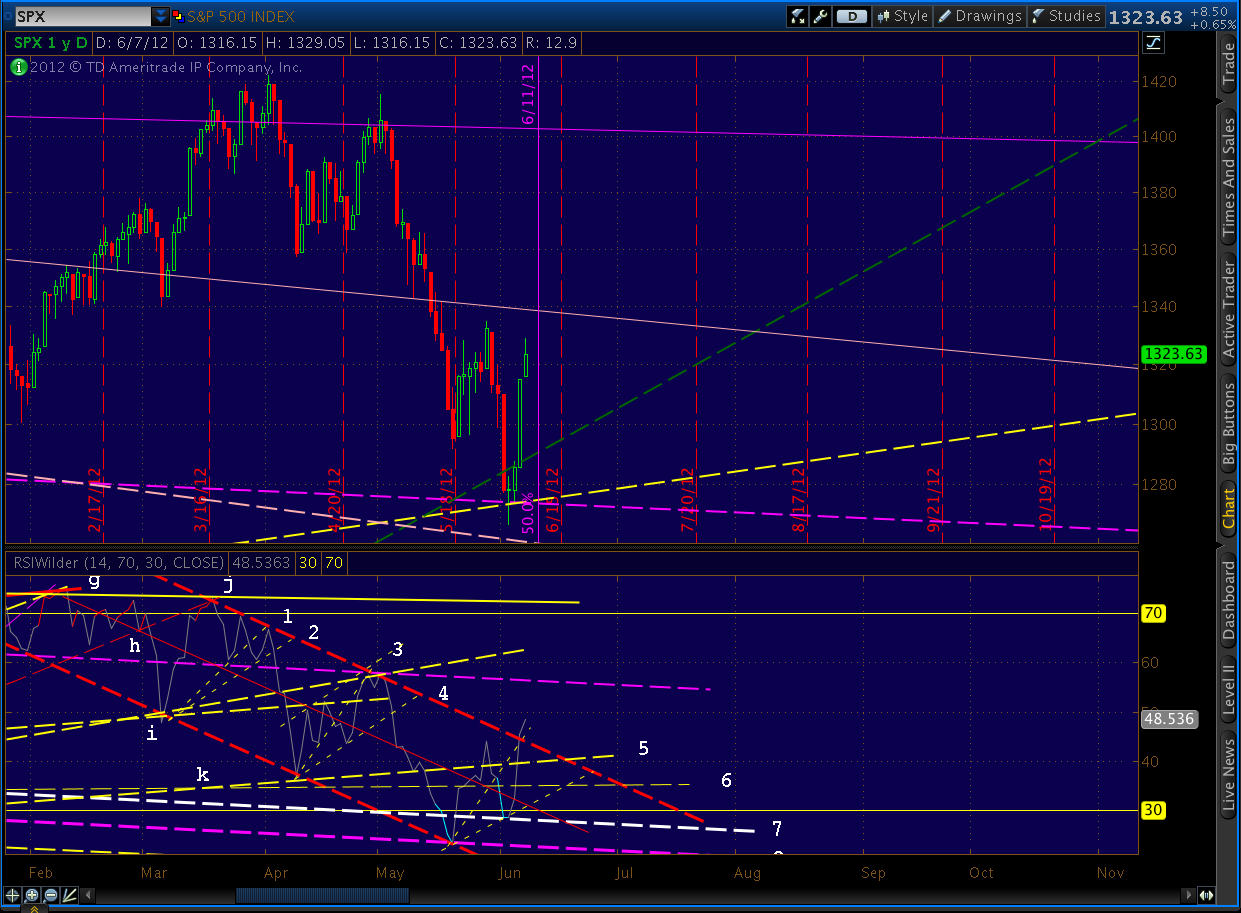
    A new day, a new bounce.  As we discussed late yesterday, SPX has reached the bottom of the purple channel that’s guided it since 1343.  So, naturally, we’ll get some reaction — probably at least to the white midline at 1495.

    Whether it sticks or not is pretty much up to Ben.  Press conference at 10AM EST.

    The yellow channel on the 30-min RSI shows decent support here.  Looks like resistance at the purple midline, though, likely in conjunction with the white midline mentioned above.

    I’ll be surprised, though, if we don’t make it all the way back to 1497 for a proper back test of the H&S neckline – yellow dashed line.

    UPDATE:  09:40 AM

    That’s close enough for me.  I’m closing my ST long position taken yesterday (3:50PM update) at 1490 for a 6-pt gain and will let my core short position ride — for now.

    Many Bernanke pep rallies have left me feeling like a crash test dummy.  I’ve learned to keep my stops tight or stay on the sidelines all together.  For intrepid day traders, I suggest staying nimble.  A breakout or breakdown is to be expected.

    But, we did just complete a H&S Pattern, and that counts for something — as do the incomplete harmonic patterns.  We’ll take a look as soon as the Bearded One is done scolding Congress for messin’ up a good thing.

    UPDATE:  12:30 PM

    Equities are clinging to gains following Bernanke’s testimony — which was mostly a non-event.  IMO, he said nothing to help the bulls’ or bears’ case, which means Italy and the sequester will likely drive prices over the next several days.

    We should continue to see periodic bounces over the balance of the day, but the onus is on the bulls now to turn the trend.  We’ll keep an eye on the 5 and 15-min RSI charts to determine breakouts that merit an intra-day long, and revisit the daily charts to get a sense of intermediate-term possibilities.

    continued for members(more…)

  • But, When It Was Bad…

    In my younger days I played Rubgy, a drinking party with a little sport thrown in to make it legit.  I don’t know if it’s still so, but back in those days, when the parties (always with the opposing side, much more civilized than American football) reached a certain level of inebriation, someone would start up with some limericks.   Who knows why…

    They were always off color, often hilarious, and sometimes even made sense in spite of the fact that the guy delivering it was, by then, completely arseholed.  There were no less than a dozen variations on the Longfellow poem There Was a Little Girl.

    There was a little girl,
        Who had a little curl,
    Right in the middle of her forehead.
        When she was good,
        She was very good indeed,
    But when she was bad she was horrid.

    One of the cleaner variations finished with “and when she was bad she was incredible.”

    As I watched the news roll in over the past 12 hours, I couldn’t get that poem out of my head.  Got an economic boo-boo?  Not to worry, the Fed will kiss it and make it all better.   We’re all so conditioned to that idea that no one bats an eye when it’s reported like as did CNBC:

    Frankly, I’m surprised they even threw in the word “possibly.” It’s probably only because, as Cramer assures us, this enormous GDP contraction from the previous quarter was a “one-off” event.

    More details on the report — the first negative quarter since 2009 — shortly.  But, the chart from Briefing.com clearly illustrates a lower low to go with the Q3 lower high.  Sorry, folks, but that’s a trend that points downward — especially when you layer in a sequestration and tax increase coming up next quarter.

    Of course, this horrid economic news pales in comparison to the importance of the Blackberry 10 launch.  Which, of course, will hopefully distract our attention from the craptastic AMZN earnings report — which, almost got the stock back to where it was two days ago…imagine if they’d had two positive footnotes in there! — and Boeing, the future of which is sitting on tarmacs in the form of fifty 110,000 kg paperweights (with another 800 on order.)

    The market’s reaction to all this?  Off a whopping 3 points on SPX and 20 on the Dow.  Oh, well, I suppose it could be up 10.  I’m taking on odds on how many minutes it takes for the BB-10 launch to replace the GDP headlines on CNBC.com…

    continued for members(more…)

  • Ay, There’s the Rube

    Oil is often viewed as a proxy for economic health.  In a growing economy, energy consumption increases.  This increased demand generally pressures prices higher.  Likewise, a decline in oil prices often accompanies declining demand.

    That’s a greatly oversimplified view, of course.  It ignores such important issues such as Middle East tensions, weather and refinery anomalies, etc.

    But, the most important of these external factors is the US dollar — the currency by which oil is traded globally (for now.)

    A weakening dollar is great for the many US companies that export overseas.  In general, it makes dollar denominated assets — such as stocks, real estate, etc — more attractive to overseas investors which helps the US attract and retain capital.

    But, it makes foreign-sourced oil much more expensive.  This isn’t an issue if you travel everywhere via America’s world-class public transportation system.  But, it really sucks for the guy with a 3-ton SUV — or anyone who consumes anything made overseas, for that matter.  Imports are about 18% of GDP.

    So, what’s a central banker to do?  Boost stocks and investment in US assets, and there’s a pretty good chance you blow the budget of every American consumer.  (Of course, it only really affects those who eat and drive — hey, buy a Chevy Volt already!)

    Boost the dollar to make gas and food more affordable for the 50 million Americans living in poverty (1 in 5 children, 2 in 5 African American children), and you risk a true disaster — a stock market decline.

    Never fear… Bernanke and his fellow Guardians of the American Dream know whose bread to butter.

    The chart below shows how crude light, the US dollar and the S&P 500 correlated over the past seven years.  In 2006 and 2007, oil and the stock market soared pretty much in sync while the dollar took it on the chin.  When SPX topped in late 2007, oil kept right on soaring — because the dollar was still plunging.  Nationwide, gas hit $4.12/gallon in the summer of 2008.

    We’re all conditioned to think of dollar strength as a function of risk off.  But, as the financial crisis worsened, the dollar couldn’t catch a bid.  Money fled to the euro, the swiss franc, the sterling — anywhere but the dollar. There were several best-sellers on bookstore (remember those? shelves that advised putting every last cent into the euro.

    From October 2007, when SPX peaked, until July 2008, stocks and the dollar moved pretty much in tandem.  But, as euro zone problems became more apparent, the dollar finally bottomed.  In August, as stocks began sliding again, the dollar finally took off.  Now deemed a safe haven, DX soared 27% by March of 2009, while stocks shed another 54% in value (58% in all.)

    Of course, this did a number on oil — already reeling from declining global demand.  CL plunged an astounding 78% in only six months — from 147 to 33.  Fortunately for the stock market — and especially the oil industry — Ben Bernanke came to the rescue.  The first round of QE was a resounding success and both promptly reversed.

    In the first three months alone, CL more than doubled to 73.  SPX added on a respectable 44%.  And the dollar took one for the team, shedding an initial 13% on its way to an 18% loss.

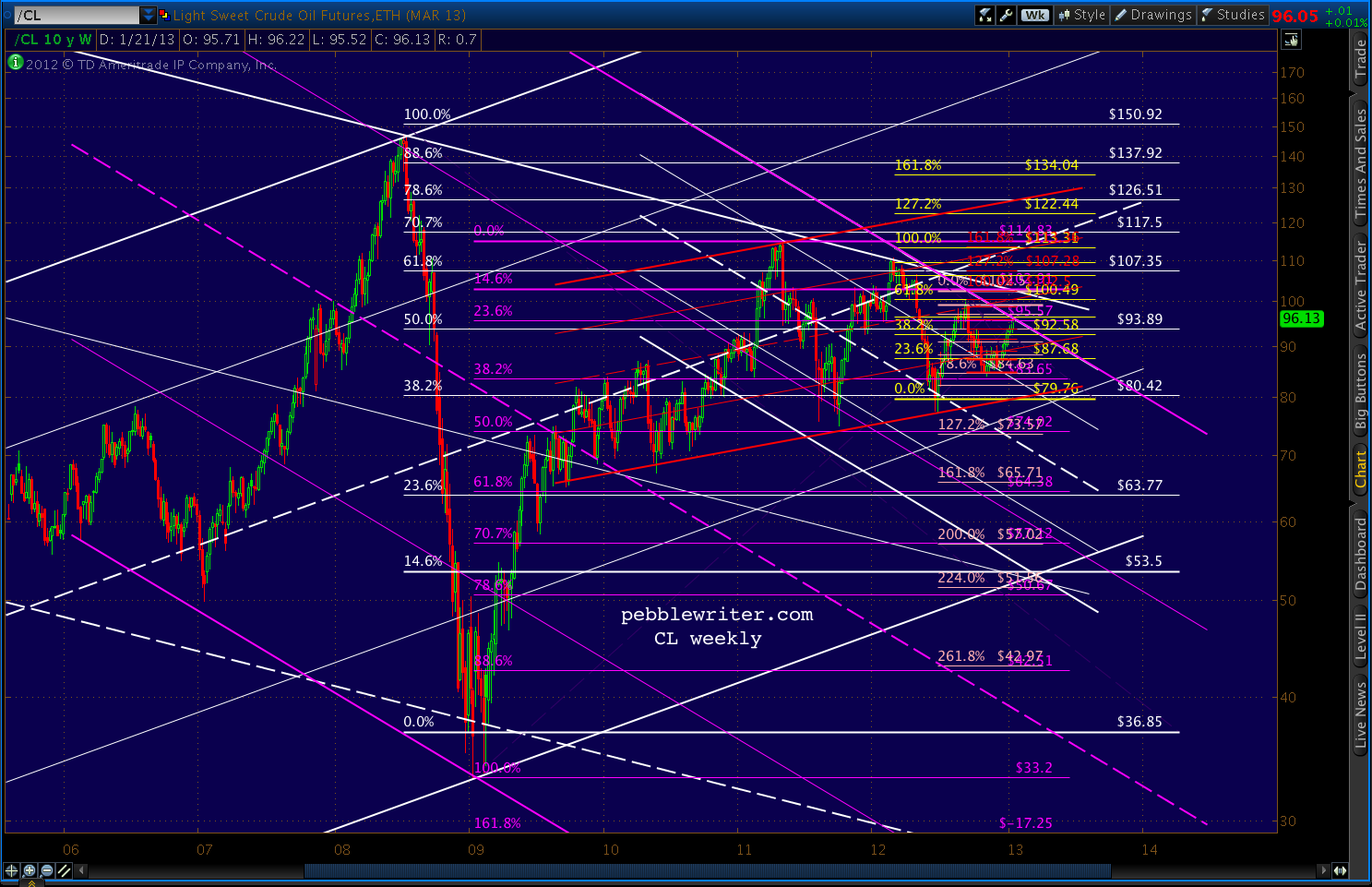
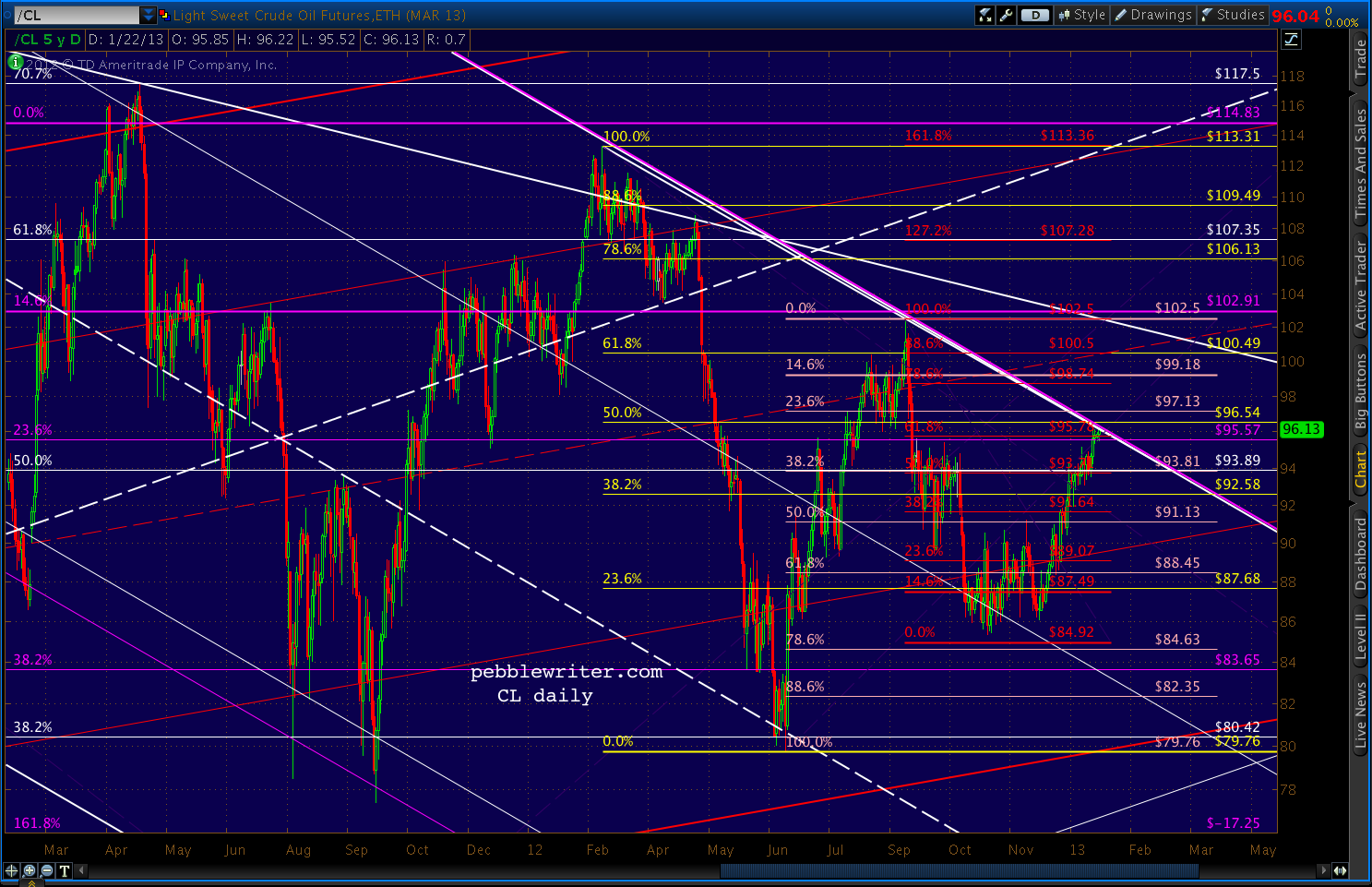
    So, why the history lesson?  By now most of you have noticed a slight discrepancy over the past 3 1/2 years.  Oil and the dollar have formed triangles.  They’ve had their ups and downs, but in general the highs have been getting lower and the lows getting higher.  I use the term “coiling” because eventually prices won’t be able to compress anymore.

    This pent-up energy will eventually be released in the form of sharply higher or lower prices, though it won’t necessarily happen tomorrow.   Both have drawn close to one side of the pattern, but there’s still plenty of room for a reversal.

    Oil, if it doesn’t suddenly shoot higher, will probably bounce back down.  Likewise, the dollar is poised to bounce higher.

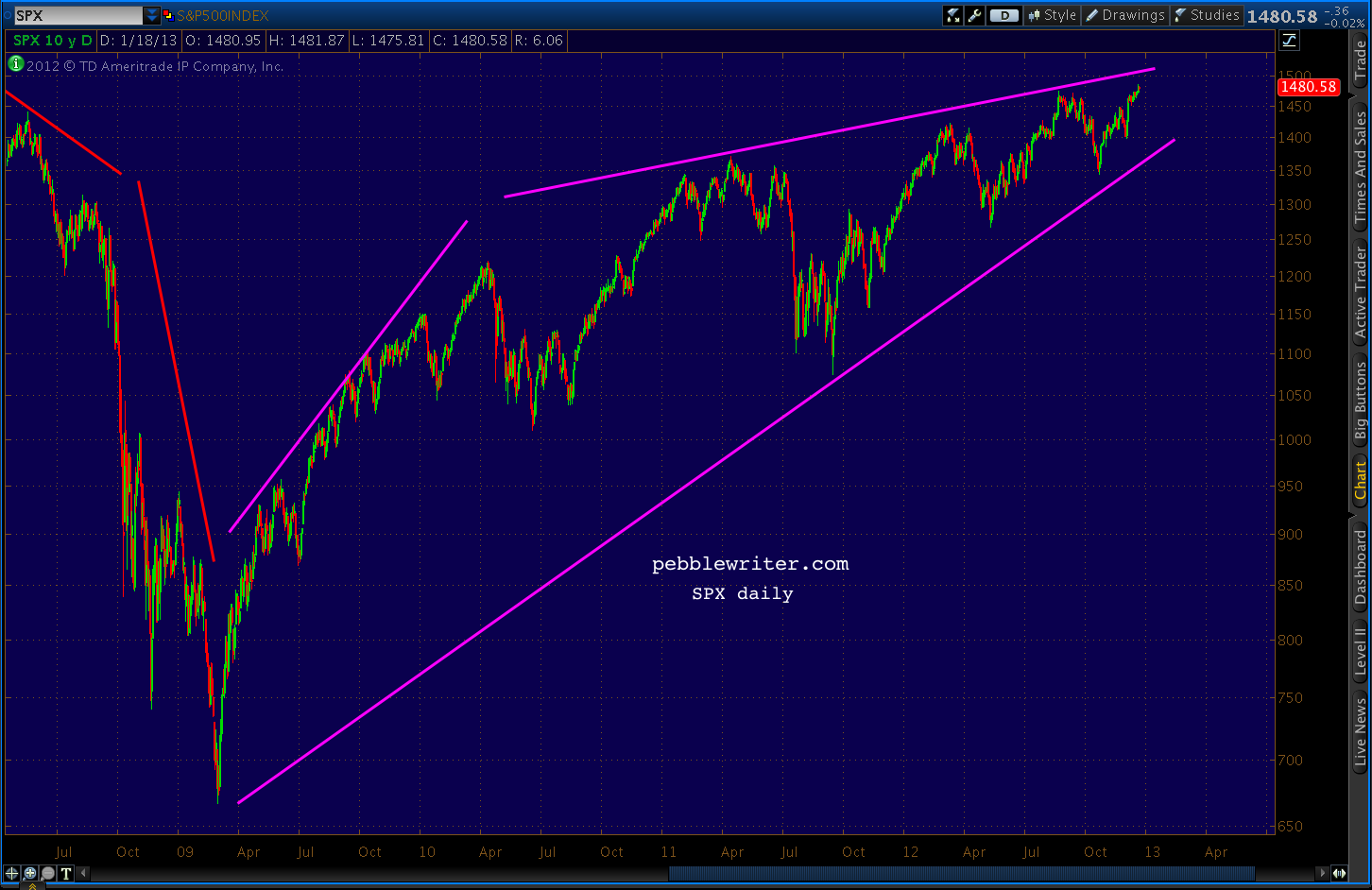
    Stocks, on the other hand, have made a series of higher highs and higher lows in what’s known as a rising wedge.  These patterns also can’t last forever, and they almost always resolve to the downside.

    Prices are much closer to the upper bound than the lower, which also suggests the next major move will be lower.  In fact, when rising wedges break down, they typically target their origin. Needless to say, a return to 2009 or even 2010 prices would be a huge blow to the rosy scenario TPTB are crafting.

    Does oil offer any hints as to which way prices are likely to go?   I’m drawn to a few periods in particular.  From June 2009 to May 2010, oil gained 19% compared to SPX’s 27%.  Yet, they both shed roughly 20% in the May – June 2010 correction.

    We had another round of QE, which collapsed the dollar and sent stocks up 36% and oil up 70% through May 2011.  This time, SPX corrected 22% and oil 35% (through Oct 2011.)

    At that point, CL sold off strongly — dropping 23% through the end of June.  SPX, however, lagged.  It lost 8%, then promptly regained 90% of it in the next three weeks (compared to CL’s 40% retracement.)  When the slide continued, however, SPX caught up — in spades.

    It lost 80% of its gains from June 2010, while CL only lost about half that.  SPX then went on to make three new highs in a row, adding 38% through today’s close.

    CL managed an 88% retracement of its May-October losses for a 47% gain through Feb 2012, and has made two lower highs (each a 61.8% retracement of the previous high) since then.  Total gain from Oct 2011: 27%.  And, it’s been a fairly neutral currency market.

    I can’t help wondering what the oil and currency markets know that the stock market doesn’t.  A look at the CL charts indicates more downside.  Will SPX again play catch-up?

    Even ignoring what I suspect about the dollar and equity markets, CL presents a bearish picture.

    Whether it breaks down or out, CL is obviously at a turning point.  We’ll keep an eye on it…


  • Down the Jackson Hole

    As we anxiously await Bernanke’s big show, the market is putting on a little show — reaching the 1409 target we mentioned yesterday (and then some.)

    If Bernanke disappoints, as nearly everyone now seems to think he will, that should just about do it for this retracement.

    As I’ve posted for the past several days, I’m largely in cash (save for a small speculative short position that’s strangely barely moved this morning, and to which I’m adding at 1410.70.)

    More after Bernanke’s comments.


    UPDATE:  12:30 PM

    The EURUSD hit our 1.2617 target this morning.  We first ID’d this level on August 22 [see: Charts I’m Watching], and it looked very touch and go up until this morning’s ramp.

    We could even go a bit higher to tag the 1.618 of the little red Crab Pattern — which is the .886 of the larger yellow Bat Pattern at 1.2666.  Most of the time after EURUSD 60-min RSI peaks, we get another lesser RSI peak that corresponds with a higher price peak (known as negative divergence.)

    But, the daily RSI is still back-testing the channel its been in for over a month (note the negative divergence on the daily) and fell out of on Aug 29.  I see RSI closing at or below the white channel and falling back to find support — initially at the purple channel line before breaking down further.

    A break thru the bottom of the white price channel (currently at 1.2388) will confirm the downside thrust has continued.  Until then, there is plenty of support at the various channel lines.  I don’t see an immediate plunge in value — probably not until the German Constitutional Court ruling on the ESM on Sep 12.

    Note that we’ve officially exceeded the red dashed channel line by a bit.  If we get a reversal today or even in the next few days, this is of little consequence. The channel has been violated temporarily before in its battles with the purple channels.

    UPDATE:  12:45 PM

    The dollar has come very close to hitting our target this morning, falling to 80.96 versus our target range of 80.83-80.88 also discussed on Aug 22 [see: Charts I’m Watching.]  Like the EURUSD, one last thrust lower to complete the tag is possible if the past custom of positive divergence were to repeat.

    The daily RSI has probably broken out of the falling wedge it’s been in since May.  In any case, we’re at or very near the bottom for the dollar.

    Recall that we’re in the final stages of a pullback in a larger uptrend with potential over the next few months to 87.076.  For those with the patience to ride out the inevitable swings, this should be a relatively safe place to earn nearly 10% in a few months.

    I expect prices to snap back into the purple channel and resume their climb; although a dip corresponding to a politically related equity surge is to be expected somewhere along the way.  If/when stocks sell off, we’ll get the greatest move in the dollar.

    If the stock market correction is serious enough, look for the long-awaited threatened QE3 to knock the dollar for a loop.  I wrote extensively about DX yesterday.  For more detail, see Managing Expectations.


    UPDATE:  3:00 PM

    The S&P 500 is hanging in there after a pretty wild ride.  SPX closed yesterday at 1399.80, soared to 1410.72 on the opening, fell back to 1398.96, soared again to 1413.09, and has since settled back around the the 1404.64 Fib level — where it’s inching higher.

    The markets were clearly not thrilled with Bernanke’s remarks this morning.  But, I suspect there was a sizable short position at yesterday’s close given Lockhart’s “QE3 is a close call” remarks.  It seems like everyone was thinking the same thing: no QE announcement tomorrow (today.)  In retrospect, it was a great opportunity for a short squeeze.

    In the end, Jackson Hole was a non-event.  Bernanke left the door open for QE3.  Depending on how you parse his words, it might even be slightly more likely.  VIX has settled back down, the dollar didn’t fall off a cliff, and the market is trading roughly where it has been for the past three weeks.

    Count today as the 18th session in a row to trade within 5 points of the fan line from 2007, the 15th to touch it, and the 7th to straddle it.  Clearly, the market is trying to make up its mind whether this is the end of the ride or the beginning of the next leg up.  I’ll spend this weekend trying to sort that out, but in the meantime, some charts are in order.


    SPX has formed the early stages of another leg down.  The red channel to the right is the same slope as the larger channel to the left.  If we are heading down, we can expect this channel to broaden; so, the top isn’t necessarily in.   The first peak in the former red channel was exceeded twice before the channel was done forming just the left side of its eventual full width.  We’ll come back to those red channel lines in a moment.

    The dashed yellow line that formed the neckline for the small H&S pattern (indicating 1370) over the past couple of weeks is parallel to a number of other important channel lines — shown above in red.  For the sake of illustration, I’ve changed them all to yellow in the chart below — and added a few more parallel lines.

    It’s easy to see how influential they’ve been over the past several months.  But, in reality, they and their cousins have been influential for years.

    The latest H&S neckline mentioned above stopped a rally in Feb of 1996, touching off three back-to-back Butterfly Patterns in a row that governed the market’s movements for a full seven months.

    The red channels mentioned above guided many of the corrections over the past 20 years.  Most of them were relatively minor, but one stands out from the rest — the crash from 2007.

    There are three more systems of channels I want to chart — along with updating the harmonic picture. But, I’m running out of time before the close.

    I’m going to go ahead and close out my short from this morning before the close here at 1404.50 and reevaluate the next move forward.

    I’ll have lots more charts either later this evening or tomorrow morning — along with a forecast.


  • Moment of Truth

    As Ben Bernanke scolds Congress for how pitiful a job they’ve done on fiscal policy, SPX has staged an important break out.

    Daily RSI broke out of the channel that goes back to January.  It has done a phenomenal job of providing guidance, and a clean break out is unlikely to occur without at least a back test.  If fact, don’t be surprised if RSI closes back within the channel, given that we’ve just reached the .382 Fib level.

    Of course, it’s ALL up for grabs in the event Bernanke actually tips his hand — beyond “we have lots of options” and “all options are on the table.”  Let’s see if we can make some sense of the path forward.

    continued…

    (more…)

  • There is Nothing Wrong…

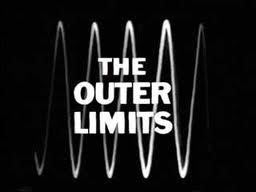
    I can picture it clearly:  It’s 1963 and 10-year old Benny Bernanke sits staring at the black & white Zenith in the living room of his East Jefferson Street house, captivated by the voice of Vic Perrin…

    “There is nothing wrong with your television set.  Do not attempt to adjust the picture.  We are controlling transmission.  We will control the horizontal.  We will control the vertical.  We can change the focus to a soft blur, or sharpen it to crystal clarity.  For the next hour, sit quietly and we will control all that you see and hear. You are about to participate in a great adventure.  You are about to experience the awe and mystery which reaches from the inner mind to the outer limits.”

    click on the image for a trip down memory lane

    These were the formative years for the future leader of the financial world.  The idea that anyone could completely alter someone else’s reality must have captivated him then, as it clearly does now.

    How else to explain the market’s rise after one of the world’s biggest banks admitted to [tip: think icebergs] a $2 billion trading loss on what they insisted was a matched book?

    Now, $2 billion isn’t going to ruin JP Morgan Chase.  They have $1.2 trillion in assets and $112 billion in Tier 1 capital.  The ruinous aspect of this news is that they, as some of the smartest guys in the room, have lost control of their derivatives trading.

    As every aspiring muppet-master knows, JPM has the largest derivatives portfolio of any US bank — an astounding $78 trillion as of June 2011.  This represents a startling 663 times their Tier 1 capital, meaning a miniscule 0.15% move in the value of their derivatives portfolio would wipe out all Tier 1 capital [see: The Wipeout Ratio.]

    Needless to say, the Plunge Protection Team has been mobilized.  In yesterday’s conference call, Jamie Dimon as much as admits that the worst is yet to come:

    “Net income in Corporate likely will be more volatile in future periods than it has been in the past.”

    It’s as clear as the worry lines on Blythe Masters’ face that they have no idea how ugly this might get [read: much, much worse.]  And, if this guy — the Prince of Wall Street — has such tenuous control on the goings-on in his Chief Investment Office, what are we to think about the rest of his $78 trillion in derivatives?  How about the other $630 trillion held by other bankers? [see: City of Dreams]

    click on the above to watch

    In one of Bernanke’s first televised post-fed meeting interviews, Dimon joined in the Q&A, bashing Bernanke for the litany of regulations and reforms that were preventing the financial community from recovering from the financial crisis.  Needless to say, there was no mention made of his role leadership in creating the crisis.

    This is analogous to bailing your kid out of jail, only to have him complain about how long the drive home is taking.  I was impressed by Bernanke’s restraint as he provided a thoughtful response, while no doubt thinking: “I saved your sorry ass, and this is how you repay me!?”

    There’s an old adage in banking: if I owe you $100 and can’t repay it, I’m in trouble.  If I owe you $1 million and can’t repay it, you’re in trouble.  While the TARP loans have long since been repaid, Wall Street’s survival is still very much in the hands of its enablers — the Fed.

    As the guy ostensibly at the controls, Bernanke must feel more than a little perturbed that things aren’t going according to plan.  I wonder if Vic Perrin’s words ran through his mind yesterday as listened to the JPM call.  I wonder, as he called Dimon to lay down the law (“no, really, I mean it this time — no more bailouts!”) whether he heard those familiar words from the other end of the line…

    “There is nothing wrong with Wall Street.  Do not attempt to adjust the picture.  We are controlling transmission….”

  • What Do Bankers Dream Of?

    When Wells Fargo CEO John Stumpf sleeps, he dreams — like all good bankers — about numbers.  He probably doesn’t dream about the number 600 — the number of foreclosure packages signed each day by his robosigners.  He probably doesn’t dream about 14,420 — the number of conveyance claims fraudulently submitted to HUD in exchange for $1.7 billion from the FHA [Inspector General report.]

    And, he almost certainly doesn’t dream about his share of the laughably small $25 billion penalty he and his fellow bankers might have to pay to slough off legal liability for the millions of Americans they’ve helped make homeless (don’t know why they’re bellyaching…they’re all getting $2,000!)

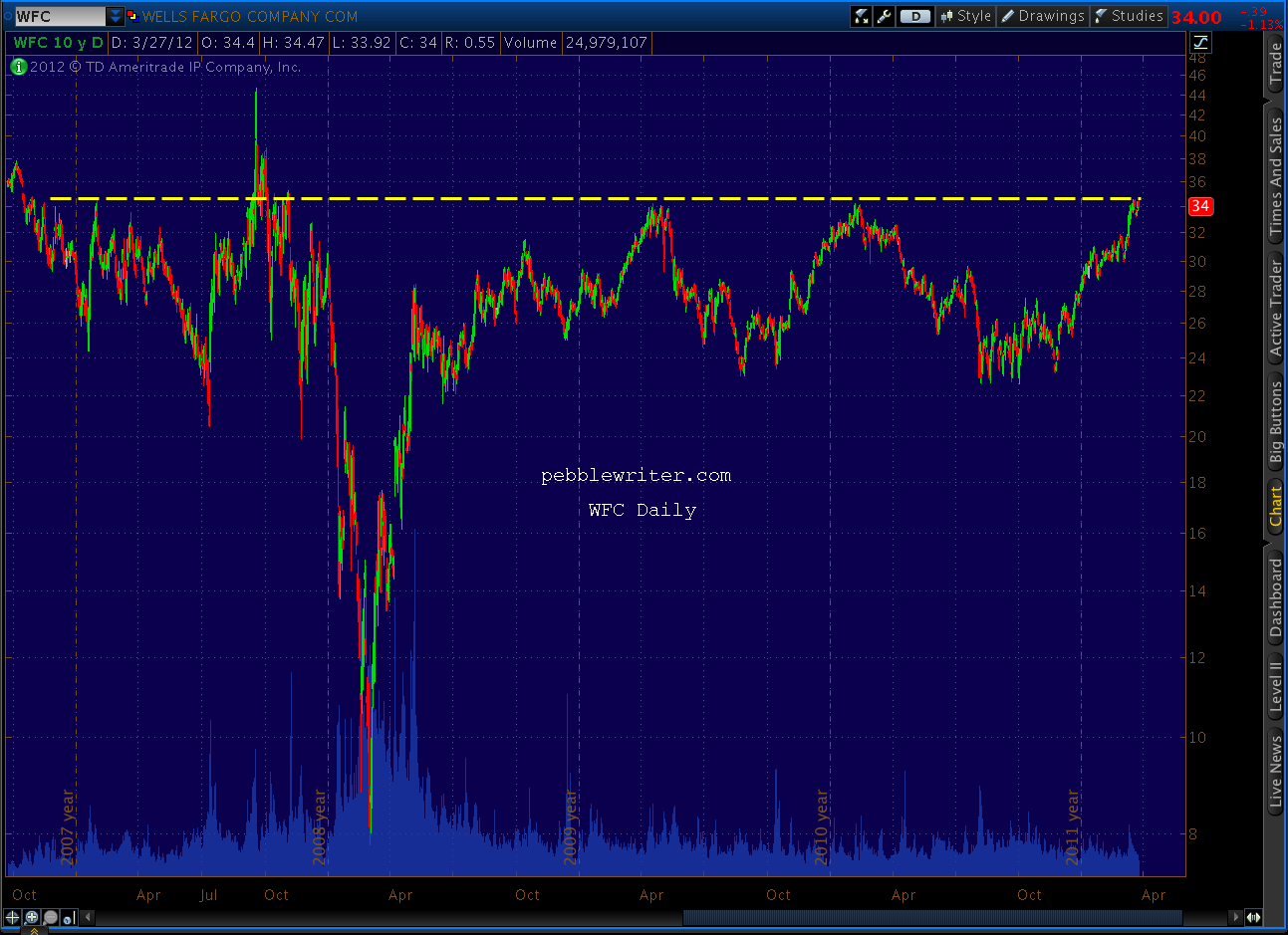
    No, I imagine the number he fixates on is 35 — the third rail around which his stock seems to go into spasms every time it gets close.   I’m exaggerating, of course; it’s only happened three of the last four times since November 2007.  The other time, in September ’08, the stock soared right through 35 to nearly 45.  That would be great — except it plunged to 7.80 six months later.

    See that yellow resistance line?  At least that’s what we call it.  To Stumpf, it’s a 625-volt reminder of all the ugliness of the past five years: bailouts, Occupy Wall Street protests, and that humiliating testimony before Congress (what’s a fella gotta do to buy off a few Congressmen?)

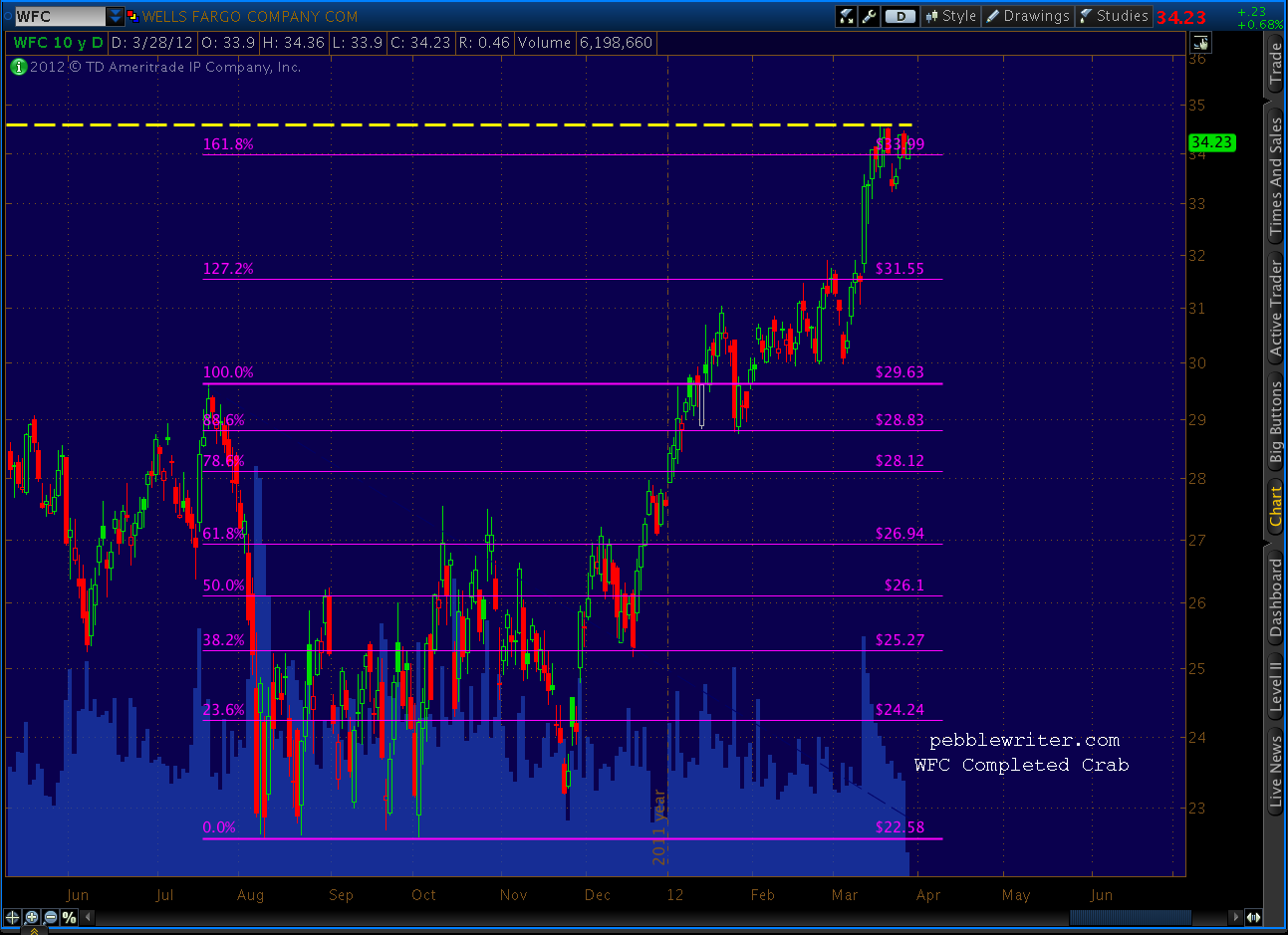
    Stumpf might be dreaming about 35 a lot this week, as the stock’s edging toward that buzzing rail yet again.  It’s really crummy timing for the stock to have completed a bearish Crab Pattern.

    And, darn it, did the SEC have to pick this week to file that subpoena to compel him to hand over the documents he promised in regards to a $60 billion fraud investigationNow, with earnings coming up in a couple of weeks?

    That reminds me of another number, 13 — as in the number of times WFC got zapped after reporting earnings in the last 17 quarters.  Earnings reports that came in the vicinity of that third rail have been particularly eventful.

    Let’s not forget 6,867,990 — the number of shares of Stumpf’s WFC stock and options that’ll be worth considerably more if the 35 price point is breached.  A 22 cent bump will make up for the horrendous pay cut he’s suffered over the past two years (from $21.3 million to $19.8 million, and we all know how tough it is to live on a lousy $54,000 a day!)

    Hey, how about $85 million — the amount the Federal Reserve Bank fined Wells Fargo last year?

    And, $25 billion — the low-interest loan the Fed slipped Wells Fargo a few years back when its survival seemed iffy.

    Which brings to mind $29.4 million, the amount the money-center banks spent on lobbying in 2010 (not including the ABA.)

    Then there’s $19.8 billion — the amount of hyper-hypothecation exposure on Wells Fargo’s books,  17% of Tier 1 capital?

    Which reminds me — $1,274,000,000 in pre-tax trading losses for 2011.

    And, lest we forget — $2.8 trillion notional in derivatives on the books.

    I could go on all night, but I think you see where I’m going with this.  We should all keep John Stumpf in our thoughts and prayers; with all those numbers to think about, the poor guy might have trouble getting a good night’s sleep.   Somehow, I think he’ll manage as long as he sees $35 in the rear-view mirror…and soon.