
Tag: bat

  • Is It or Isn’t It a Recession?

    ECRI’s Weekly Leading Indicator (WLI) came out Friday at 130.2 — up from 129.6 the week before.  Further, they reported that the index’s annualized growth rate increased from 8.2 the previous week to 8.9% — the highest since May 2010.  I wondered: are they retracting their Sep 2011 recession forecast?  Are things really getting better?


    CAN’T WE ALL JUST GET ALONG?

    There’s currently an argument raging between various economists and analysts as to whether the US is still in/dipping back into a recession or is on the mend. ECRI is pretty sure we’re in one, while folks like Doug Short and, of course, the mainstream media think not.

    There’s no question that we’ve seen an uptick in several economic measures. My own thesis is that most of these have been not secular, but cyclical swings.  In other words, I don’t yet see evidence of a sustainable trend change, only natural swings from one side of a channel or wedge to the other.

    Here’s an example I posted last week. Total Confidence has traced out a pretty solid-looking channel, while the Present and Expectations indices have formed expanding wedges (and are nowhere near their upper bounds, especially given the recent downturns.)

    underlying chart from briefing.com


    Hardly a day goes by when I don’t second guess myself.  Is all the “good news” just one big, well-coordinated head fake or am I missing something?  I spent much of the weekend studying ECRI’s historical WLI (who says technical analysts don’t live exciting lives!?) and found a lot to think about.  First, a brief primer on Harmonics.


    HARMONICS

    Regular readers of pebblewriter.com (heck, even the irregular ones) know all about Harmonics and that the corrections experienced in April 2010, May 2011 and Sep 2012 correspond to the important Fib levels of 61.8%, 78.6% and 88.6%.

    For the uninitiated, measure the drop from SPX 1576 (Oct 2007) to 666 (Mar 2009) and multiply it by a Fibonacci 61.8% and you get 1228.74.  SPX reached 1219.80 in April 2010 (within 10 points) and promptly sold off by 17% over the next three months.

    In May 2011, SPX peaked about 10 points away from the 78.6% Fib level (completing a Gartley Pattern) and plunged 21.6%.  And, in September 2012, SPX reached the 88.6% Fib level (completing a Bat Pattern) and corrected by almost 9%.

    Those of us who follow Harmonics were well aware of each of these downturns well in advance [see: HERE, HERE and HERE] and profited nicely from the market’s plunges.  Those who rely solely on fundamentals or [involuntary shudder] the mainstream media…not so much.


    THINGS THAT MAKE YOU GO “COOL!”

    While I had noticed the WLI’s channel-like general decline before, I never noticed that it also complied with the rules of Harmonics.  From its all-time high of 143.73 in Jun 2007, the WLI plunged to a low of 105.40 in Mar 2009.

    Like SPX, it found its footing (thanks to QE1) and started higher.  Its first big pause was in Oct 2009 at the 61.8% Fib level.  It paused again in Jan 2010 near the 70.7% Fib, and eventually reached the 78.6% level in April — completing a Gartley Pattern as SPX had finally retraced 61.8% of its drop.

    One could infer from the mismatched Fib levels that the economy — as measured by ECRI’s leading indicators — was ahead of the market at this point. The WLI had retraced 78.6% of its drop, while SPX had only retraced 61.8%.  In any case, they both suffered from the removal of the QE drip – SPX shedding 17% and WLI 11%.

    When the Fed realized their patient would flatline without more QE, they were back with QE2.  The market took off, reaching the 78.6% Fib in May 2011.  This also completed a Crab Pattern, a 161.8% extension of the amount of the Apr-Jul 2010 slide.

    The WLI, however, retraced only 78.6% of its slide since its 2010 high.  In other words, the market was now officially ahead of the economy.

    Following the expiration of QE2, SPX plunged 21.6% to 1074 through October 2011, while WLI gave up 8.9%.  From there, SPX climbed to 1474 primarily on Fed jawboning and promise of more QE — which it finally delivered the day before the 1474 high.

    The timing was no doubt an effort to send the SPX soaring right through the 88.6% Fib retracement of the 1576 – 666 crash.  I seriously doubt that “two points over” was what they had in mind (the market sold off anyway, correcting a respectable 8.8% to 1343.)

    The WLI, in the meantime, topped out at 127.77 — only an 88.6% retracement of its decline from its previous high in 2011.  Again, the market was outpacing the economy.


    IS IT OR ISN’T IT?

    The world of market prognosticators is, as always, divided.  There are those who believe the economy is improving, and the market – as a leading indicator itself – is all the proof we need.  Then, there are those who believe the market is priced well in excess of levels justified by the underlying economy — which remains in or is dipping back into a recession.

    Whether QE has “saved” the economy or not, I don’t know of any respected economist or technician who doubts that it has significantly goosed (i.e. “manipulated”) the markets. And, we should pay attention to the disconnect between the markets and the economy as evidenced by the SPX/WLI comparison.

    The WLI just hit an important Fib level (88.6%) after demonstrating that it does, indeed, pay attention to such things.  This occurred at the same time that the S&P 500 hit several important Fib levels and is thus, by my reckoning at least, poised to correct [see: Satisfaction.]

    We all know the old truism “the market isn’t the economy.” However, another quarter of negative GDP following the tax hikes recently enacted and spending cuts in the works would certainly remind investors that the market and economy are, indeed, joined at the hip.

    I care about the economy because I have children.  The Fed’s unprecedented experiment in QE will quite possibly end very badly for the country, for my children and for yours.  But, there ain’t much We the People can do to influence Fed policy.  They don’t answer to us or our political “leaders.” So, we play the cards we’re dealt.

    As an investor, my goal is to capitalize on whatever the market throws at us — regardless of how manipulated it might be, and regardless of what economists call the current business cycle. If depression or hyper-inflation come along, we’ll hopefully see it coming and be well-positioned.

    Are we still in or dipping back into a recession? Will the current QE4-ever result in another 2009-2011 run, or does the market’s yawn last September signal the end of QE’s effectiveness?  We’ll find out in time.  In the meantime, we have some very good tools at our disposal that have provided excellent returns in a very difficult market.  I’ll continue to call it as I see it, and appreciate having you all along for the journey.

     *   *   *   *   *   *   *   *

  • Charts I’m Watching: Feb 5, 2013

    The dollar is taking a breather after a strong reversal off the latest .886 and channel bottom, but appears ready to break out.

    The EURUSD back-tested the broken channel line and rising wedge lower bound, and is likely about done.

    SPX fell 19-pts after we shorted last Friday.  We positioned for an intra-day bounce, but SPX added only 4 points before falling back to complete a little H&S pattern at the close.

    continued for members(more…)

  • Charts I’m Watching: Feb 4, 2013

    The US dollar bounced off the .886 of its Sep – Nov 2012 run…again.  This is the fourth time it has found support in the 78.725 – 79 range, though each subsequent bounce has been lower than the previous one.

    The result is a descending triangle that arrives at the bottom of an uptrend (the white channel below) and a 2nd back-test of the latest channel (red) that was originally broken out of on Jan 2.

    The primary driver has been euro zone weakness, with the EURUSD back-testing the midline of the white channel after a bull run that equaled that of this past Aug-Sep.

    Though, the yen is also pitching in — reaching our secondary price target well in advance of the forecasted date range.

    SPX was off over 10 points this morning, making our decision to short Friday at 1514 appear to have been the right move.  SPX is heading toward the next lower purple channel line, where it will likely get at least a bounce in the 1500-1501 range or the .886 Fib at 1498.77.

    The question is whether the market is just taking a breather or beginning something more significant.  I’ll spend the next hour or so examining the road ahead.

    continued for members(more…)

  • But, When It Was Bad…

    In my younger days I played Rubgy, a drinking party with a little sport thrown in to make it legit.  I don’t know if it’s still so, but back in those days, when the parties (always with the opposing side, much more civilized than American football) reached a certain level of inebriation, someone would start up with some limericks.   Who knows why…

    They were always off color, often hilarious, and sometimes even made sense in spite of the fact that the guy delivering it was, by then, completely arseholed.  There were no less than a dozen variations on the Longfellow poem There Was a Little Girl.

    There was a little girl,
        Who had a little curl,
    Right in the middle of her forehead.
        When she was good,
        She was very good indeed,
    But when she was bad she was horrid.

    One of the cleaner variations finished with “and when she was bad she was incredible.”

    As I watched the news roll in over the past 12 hours, I couldn’t get that poem out of my head.  Got an economic boo-boo?  Not to worry, the Fed will kiss it and make it all better.   We’re all so conditioned to that idea that no one bats an eye when it’s reported like as did CNBC:

    Frankly, I’m surprised they even threw in the word “possibly.” It’s probably only because, as Cramer assures us, this enormous GDP contraction from the previous quarter was a “one-off” event.

    More details on the report — the first negative quarter since 2009 — shortly.  But, the chart from Briefing.com clearly illustrates a lower low to go with the Q3 lower high.  Sorry, folks, but that’s a trend that points downward — especially when you layer in a sequestration and tax increase coming up next quarter.

    Of course, this horrid economic news pales in comparison to the importance of the Blackberry 10 launch.  Which, of course, will hopefully distract our attention from the craptastic AMZN earnings report — which, almost got the stock back to where it was two days ago…imagine if they’d had two positive footnotes in there! — and Boeing, the future of which is sitting on tarmacs in the form of fifty 110,000 kg paperweights (with another 800 on order.)

    The market’s reaction to all this?  Off a whopping 3 points on SPX and 20 on the Dow.  Oh, well, I suppose it could be up 10.  I’m taking on odds on how many minutes it takes for the BB-10 launch to replace the GDP headlines on CNBC.com…

    continued for members(more…)

  • Trading with Harmonics

    The first of a two-part article on harmonics trading strategies.

    Part 1.  January 28, 2013

    Harmonics are a great source of information about the market, but they don’t tell you how or when to trade any more than do MACD crosses or breadth indicators.  So, how do you use them?  This discussion of the basic process might serve as a good starting place for beginners.

    I consider harmonics like trade alerts.  That is, every time we approach an important Fib level, I stop and consider whether the market is likely to react or not, then make a trade decision accordingly.

    There are pages for each specific pattern under the Learn>Harmonics tag on the Home Page.  But, they all relate to one another.  Let’s walk through a real world example.

    SPX has fallen from 1576 to 666 and seems to have bottomed (how to know it’s bottomed is the real trick.)  I draw a Fibonacci Retracement grid on the price range (100% for 1576, 0% for 666) and make sure every important level is showing as on the chart below.  For a discussion of Fibonacci levels, click here.


    ThinkorSwim makes this very easy with a built-in drawing tool, as do many other platforms.  If your platform doesn’t provide it, you might want to think about changing, or at least opening up a TOS account to facilitate your charting (and, no, they don’t pay me to say that.)  You can read about harmonics and study the charts I post, but there’s no substitute for doing your own charting.

    Back to our example: because we went long at the very bottom, we set our sights on the higher Fib levels.   All harmonic patterns are marked using the letters X, A, B, C and D.The inception point (high) is X, the low is A.  B is the first reversal, C is the next, and D is the completion. The location of the reversals relative to specific Fib levels tells us what kind of pattern we probably have.

    Suppose we’ve watched SPX climb all the way up to 956, where there’s a 9% correction down to 869.  Because this reversal occurred below the .618 Fib level, we might have a Bat Pattern on our hands.  Bat Patterns complete at the .886 (1472) so we’ll make a note of that for future purposes and consider 956 a potential Point B.

    We sail right through the .382 and .500 levels, then experience another 9% correction at just above the .500 (1150 to 1044.)  Again, it’s below .618, so it could be signalling a Bat Pattern.  But, it’s a relatively minor reaction, so we treat it as only a potential Point B.

    Now we’re approaching the .618 at 1228.74 — the most important of the Fib levels.  Because the two prior reversals were pretty tame, we might suspect more from this one. We begin to contemplate a short position, and look for other signs of a reversal.

    Because we’ve been watching closely, we notice a smaller Crab Pattern setting up as we approach the .618 (the purple pattern below.)  It features a Point D at 1215.93 — slightly below our .618 at 1228.74.  So, we feel pretty confident about this being a good trade entry.

    Are there other chart patterns such as a rising wedge, channel, fan line, etc. that also hint at a reversal?  In fact, there’s a nice channel that’s formed over the past 9 months, not to mention a broken RSI channel (in red) just shy of the Crab completion.  And, we’re nearing the 1240 target of the Inverted Head & Shoulders pattern completed at the 2009 bottom.

    These would all be good reasons to consider a short.  Taken together, they make for a pretty compelling argument.  Where, though?  Other traders are watching the same charts we are, so there’s a chance the reversal will come a little early.  We don’t wait to wait too long and miss the top.  But, of course, every point too early is a point of lost profit.

    In the end, timing is a judgement call based on many factors, including liquidity, risk tolerance, the type of instruments we’re trading, other positions in the portfolio, etc. and is worthy of its own article.

    Let’s assume we make the decision to open a short position around 1213 on the April 15 — in case SPX doesn’t make it all the way to 1215 or 1228.  We feel pretty good about our decision when SPX is down to 1186 the following day and 1183 the next.  That’s a 2.5% move in two days — not bad.

    On the third day, however, our plan is looking iffy.  SPX gaps up on the open and hits 1208.  Three days later, it pops above the Crab target of 1215.93 and tags 1217, seemingly in search of the .618 at 1228.74.

    Suddenly, we’re underwater by 15 points or 1.25%.  Is it time to bail?  Again, it depends on the type of investor you are.  Options traders might have closed their puts for large profits already, while swing traders might be happy as long as SPX doesn’t exceed 1230-1235.  Buy and hold types might have used the Fib level as a warning of a potential downturn and hedged or lightened up on their long positions.

    Checking our charts, we can see that neither the price nor the RSI channels have been broken to the upside.  In fact, the little red RSI channel which helped convince us of the downside potential shows the latest push higher came with a lower RSI score (negative divergence) and a pretty pathetic back test.  So, we’re inclined to hang in there.

    It turns out to be a great decision.  The following day, RSI plunges through the midline of the purple channel.  SPX plunges 38 points from its high, stabilizes for four days, then really starts falling apart.  On May 4, SPX reaches the white channel midline, a possible bounce spot.  We’ve already made 4.5% since shorting at 1213 less than 3 weeks ago.  Time to bolt?

    To be continued…

  • New Charts: 10-yr Notes

    First, an important caveat:  I’m not a bond guy.  Never have been, never will be — at least with long bonds under 8%.  I find the idea of sinking even one dollar into a security (on credit watch, mind you) that guarantees less than 2% for 10 years ridiculous.

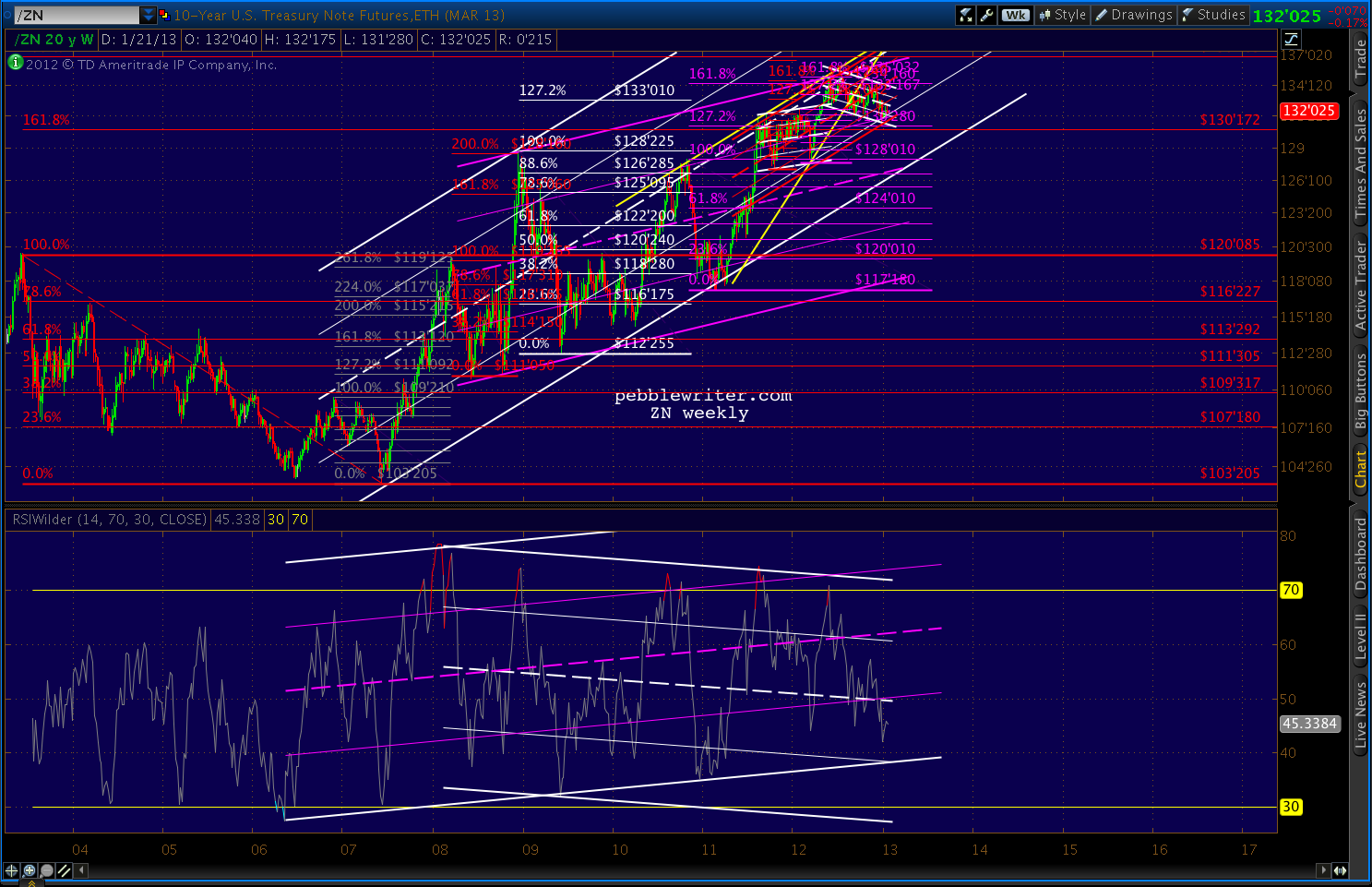
    But, different strokes and all that.  Plus, bonds can be a good window on equities and currencies, so I don’t mind charting them once in a while.  The 10-yr has obviously been on a tear for several years.  It’s settled back from the 2008-09 spike into the bottom half of a channel that dates back to 2005 (white.)

    The big question is whether the white channel is still in charge, or the less aggressively sloped purple one has taken over.  Making things interesting, there’s a pretty well-formed rising wedge that broke down in August.

    But, the RW is slightly suspect because the July 25 high was slightly exceeded on Nov 16 and Dec 6, meaning there are two higher highs and a higher low in place since the August break (though both highs came on negative divergence relative to the July high.)

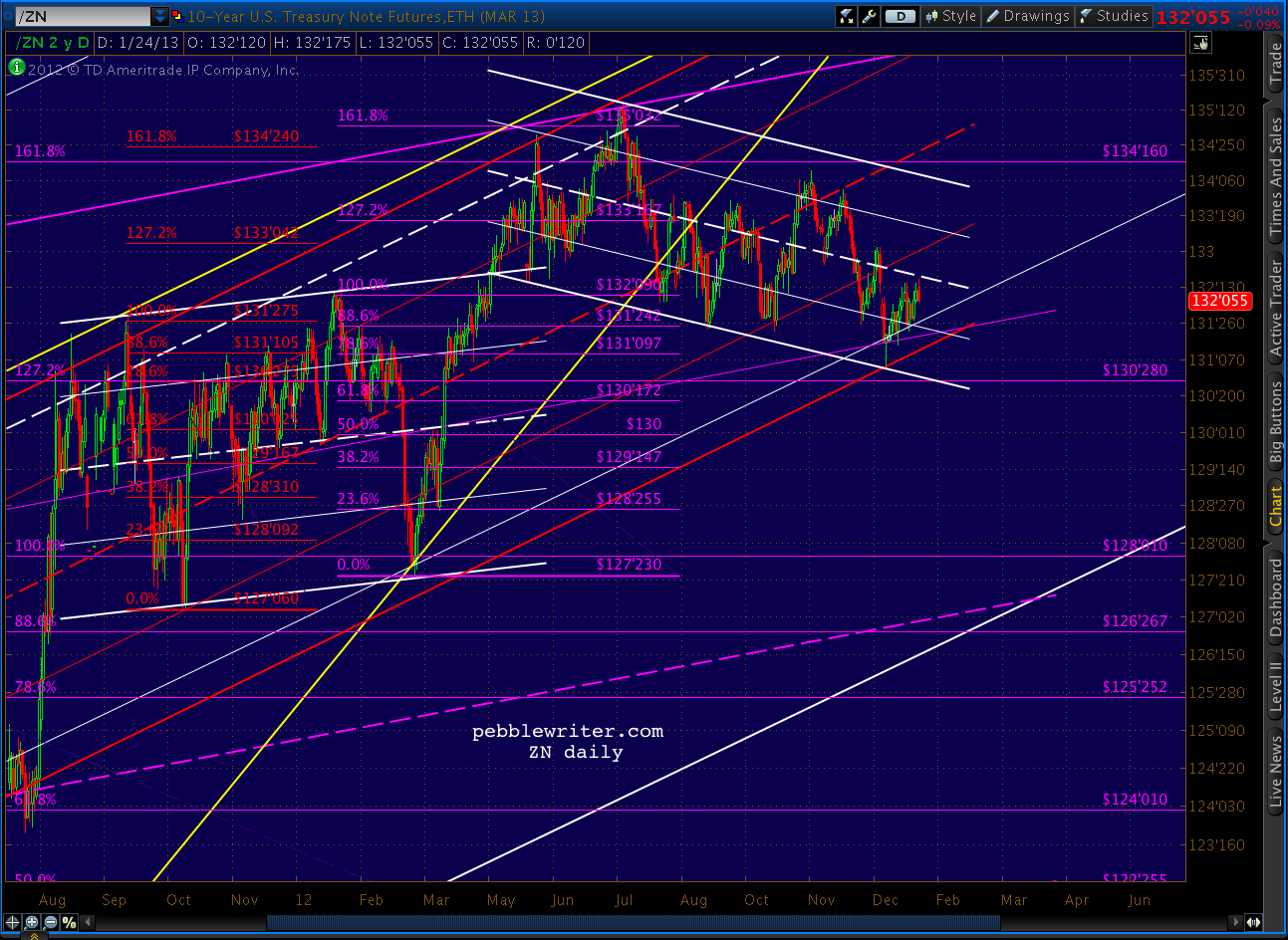
    Harmonics have performed pretty well with the 10-yr note.  The chart below shows a big Crab (grey), followed by another Crab (red), a Bat (white) and another Crab (purple.)  Each previous Crab Pattern completion has been followed by a significant retreat, so we should suspect one here with the purple pattern completion.


    The only potential hitch is whether the white pattern is still in play.  Bats can and do go on to form Crabs, and the white 1.618 is way up at 138’170 — a 4.5% increase from current levels.

    There is a significant amount of negative divergence on the daily and weekly channels, so I expect prices to fall.  But, obviously, a strong equities sell-off would turn that assumption on its head.

    A return to the top of the red channel, for instance, would take daily RSI to the purple midline.  On negative divergence, that could easily line up with the white 1.618.

    The close-up shows a potential channel since the most recent Crab Pattern reversal and the impact of the white 25% channel line.

    Otherwise, the bottom of the white channel and the middle of the purple channel intersect at the 126-127 area (the purple .886 is 126’267 and the white .886 is 126’285) around the middle of March – about where things were in March 2012.

    Stay tuned.

    *  *  *  *  *  *  *  *  *
    Just got this one in my inbox, an oldie but goodie…

    A successful trader parked his brand new Porsche in front of the office in order to better show it off to his colleagues. As he got out, a delivery truck came along too close to the curb and smashed into the driver’s side.

    The trader immediately grabbed his cell and dialed 9-1-1. Five minutes later a policeman pulled up.  Before he could even ask any questions, the trader started screaming how his car, which he just picked up that day, was completely ruined and would never be the same again.

    After the trader finally finished ranting, the policeman shook his head in disbelief.
    “I can’t believe how materialistic you Wall Street guys are,” he said. “You’re so focused on your possessions you don’t notice anything else.”

    “What the hell are you talking about!?” asked the trader.  The policeman replied, “Didn’t you realize that your left arm is missing from your elbow down? It must have been torn off from when the truck hit you.”

    The trader looked down in absolute horror.  “Holy Shit!” he screamed. “Where’s my Rolex!?”

  • Now What?

    First, a quick overview…

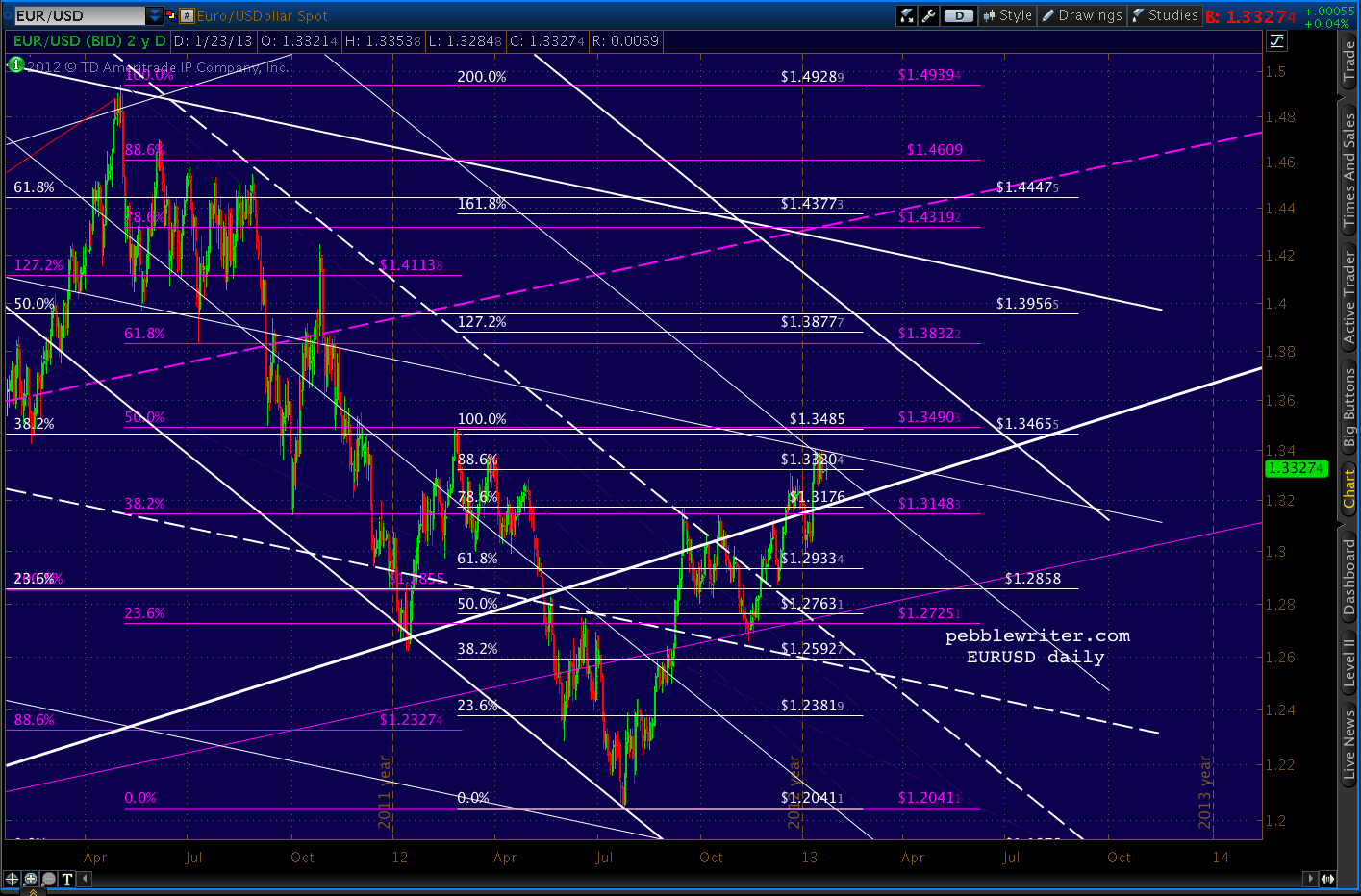
    The dollar got clobbered overnight, knocking it temporarily out of the white channel that’s guided it since Jan 11.

    But, interestingly, its RSI channel is doing just fine, thank you.

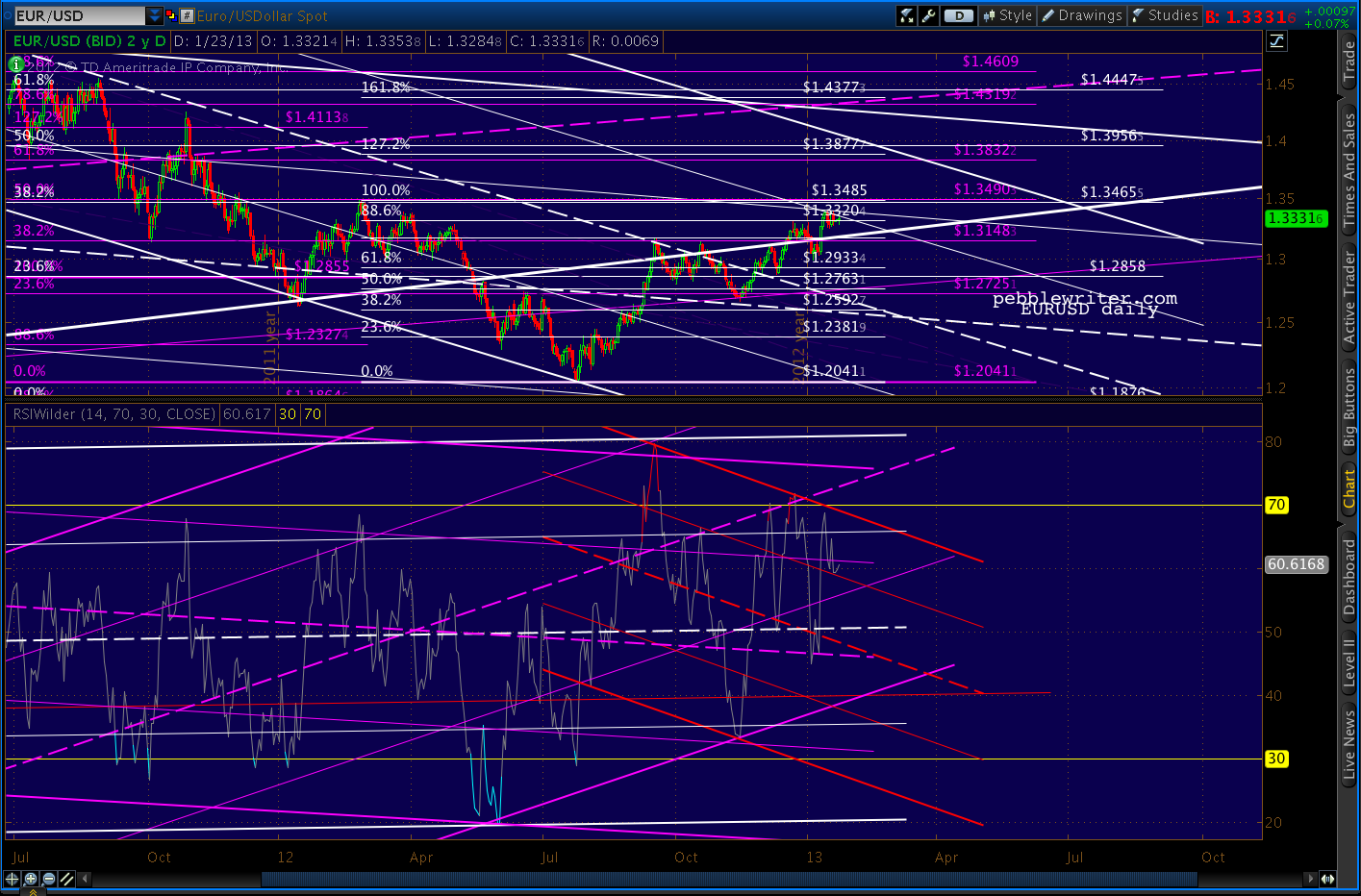
    The EURUSD continues to levitate, but still hasn’t broken the last important interim top put in on Feb 24.  It is also bumping up against two 25% channel lines, so could very well stall out here at the .886.

    There is still ample negative divergence regardless of which channel ultimately wins out.


    With the market exceeding the recent 1474 highs, the analog that did so well for us since last April is officially dead.  This begs the question: “now what?”  I see three big issues hanging over the market right now:

      1. earnings season —  AAPL in particular
      2. the US budget/debt ceiling imbroglio
      3. new highs justified?

    Earnings

    GOOG and IBM both gapped up this morning, but the earnings that can really move the market — AAPL — comes after the close.  We’ll take a fresh look at the AAPL chart later today.

    Budget/Debt-Ceiling

    In a few hours, the House will probably pass a measure to postpone the debt ceiling debate until May.  Reid and Obama have both said they’re on board, so this appears to be a done deal.  If House Republicans don’t fall in line, as occurred with “Plan B,” the market will sell off precipitously.

    New Highs

    The market’s strength has caught many off guard, including yours truly.  Many are calling for new all-time highs for SPX. The 2007 high of 1576 is now only 84 points away, so a few good sessions could do it.

    We’ll take a fresh look, focusing on the harmonic and chart pattern picture as well as the establishment agenda.  “What’s that?” you say.  Say all you want about random walks, CAPM, dividend discount models and Dow Theory.  Like any government-managed enterprise, the market is subject to the policy goals and needs of those who attempt to control it.

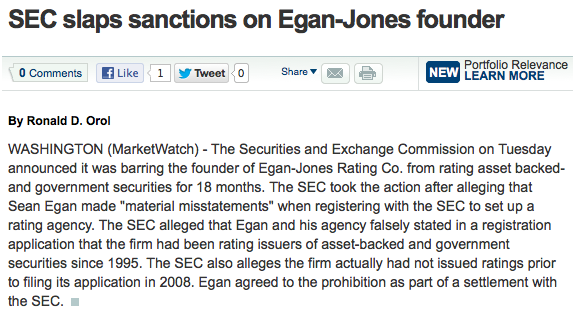
    Even to my cynical ears, this sounds a bit like rants from the tin-foil hat crowd.  But, consider the news on Egan-Jones yesterday.  This is one of the biggest stories of the month, yet predictably earned only this from WSJ/Marketwatch:

    CNBC was slightly more generous, yet still presented only the SEC’s side of the story.  It’s a story that deserves to be told because it speaks volumes about the degree to which the market is presently being controlled.  And, I’m not just talking about quantitative easing, though I suppose we’d have to consider QE exhibit #1.

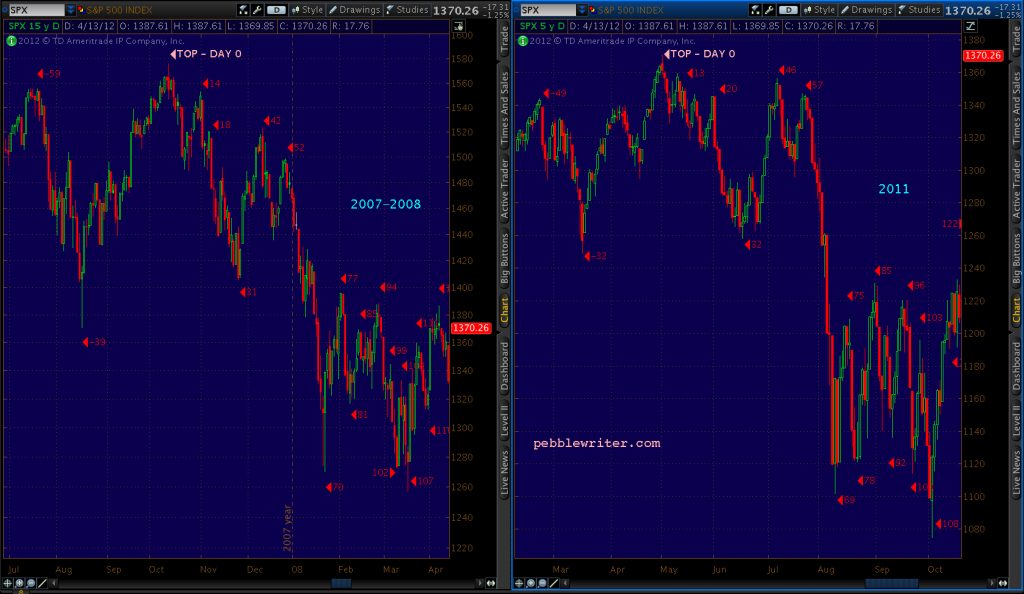
    Last summer the market crashed 22%.  It was an analog (replay) of the 2007 top, so we saw it coming in plenty of time to profit quite handsomely.  But, it was a huge wake-up call for The Powers That Be (TPTB) or Plunge Protection Team, Wall Street Cabal — whatever you want to call it.

    With virtually unlimited power and unlimited resources, why couldn’t they prevent something like that from happening?  More importantly, if the top was a replay of the 2007 top, might the rest of 2011 play out like 2008-2009?

    It didn’t, because they learned from the crash of July-August.  First, they tweaked the markets just enough to bust important chart patterns that were playing out.  Second, they tweaked the rules to provide for more time to contain any damage which might otherwise occur (circuit breakers, etc.)  Third, they attacked those who had “caused” the crash.

    S&P CEO Deven Sharma was one of the first victims.  In the wake of the 2007 financial crisis, S&P was rightly pilloried for having pulled its punches — particularly on mortgage and banking related debt.  This was no surprise to anyone who’s ever worked on Wall Street — which pays for these supposedly unbiased views.

    An infamous exchange between two S&P analysts in April 2007 aptly illustrates:

    “BTW, that deal is ridiculous.”

    “I know, right . . . model def(initely) does not capture half the risk.”

    “We should not be rating it.”

    “We rate every deal. It could be structured by cows and we would rate it.”

    Imagine if Hollywood studios funded the reviews of their movies.  Would you care if they received thumbs up or down?  So, in August 2011 S&P found religion and bravely downgraded US debt.  Seventeen days later, Sharma was fired and replaced with the COO of Citibank, the bank whose existence relies on the absence of any future downgrades.

    Egan-Jones beat S&P to the punch, downgrading US debt on July 16.   Two days later, the SEC’s Office of Compliance Inspections and Examinations called looking for information on the downgrade.

    On October 12, Egan Jones was formally notified of a Wells Notice — they were being investigated.  On April 24, the SEC filed a cease and desist order against Egan-Jones — the only rating firm not on the take — stating the action was “necessary for the protection of investors and in the public interest.”

    The financial establishment’s interests, sure.  But, to frame this obvious smack down as “in the public interest” is laughable alarming.  Egan-Jones was the one rating firm with the balls to point out the country’s crumbling financial condition and stick to their guns.  Now they’ve been branded as deceitful, dangerous.  George Orwell spoke the truth in 1984:

    “In a time of universal deceit, telling the truth is a revolutionary act.”

    That other deep thinker, Jim Morrison, provided a similarly profound observation:

    “Whoever controls the media controls the mind.”

    The extent to which the market has been manipulated is deserving of its own post.  But, this Zerohedge article, forwarded by a member, is a great preview.

    Okay, so I know what you’re thinking: if the market is so heavily manipulated (and, presumably, insulated from downturns) why bother trying to beat it?  Simple.

    1. Chaos theory tells us they won’t have enough fingers to plug every hole in the dike (TPTB have similar “never again” strategy sessions after every crash.)
    2. Even when things do run as programmed, we can still effectively capture enough significant swings in the markets enough of the time to boost returns and, more importantly, try to avoid huge downdrafts.

    Over the very long-term, stocks return 8-10% — depending on the time frame examined.  But, sadly, most of us are limited to 40-60 years of investing.  And, a 60% crash right before starting a business, buying a home or beginning retirement could be devastating.

    So, we’ll keep plugging away, letting the markets tell us where they want to go…while trying to get there first.

    So, the question is “Now What?”  We’ll start by looking at the harmonic picture.  As detailed in our last review of all the previous tops, harmonic patterns are very likely to come into play.  So, we’ll start with the charts, then move on to the agenda question and, last take a look at AAPL.
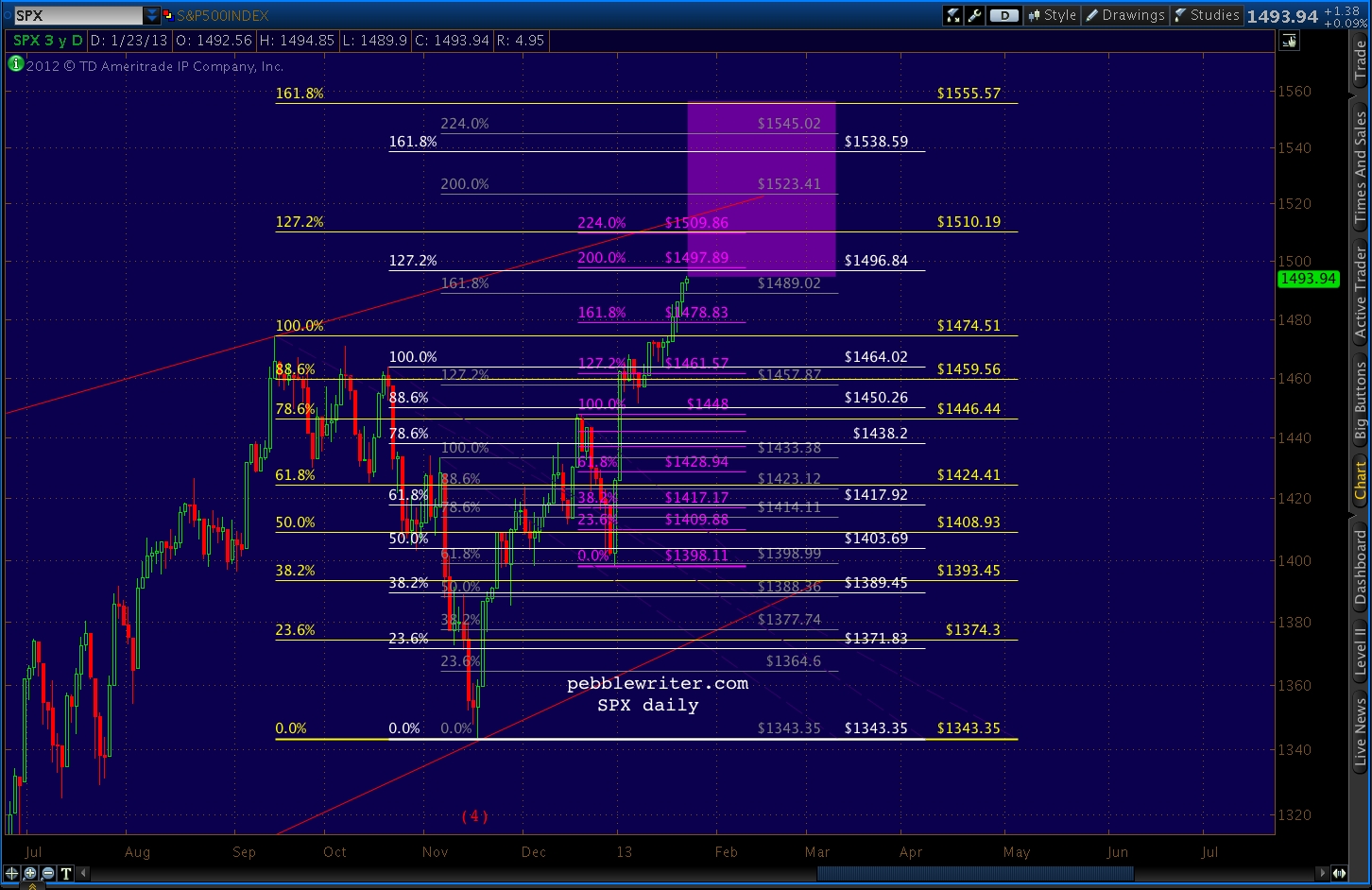
    Since we’ve exceeded the range at which this rally could be considered a double top, we’re probably going higher still. So, we’ll examine the 1.272 and 1.618 extensions.

    In terms of a trading strategy, I’d be comfortable going long here at 1491.  But, disappointing AAPL earnings could knock the stuffing out of the market.  So, those with weak hearts should probably stay on the sidelines until tomorrow morning.

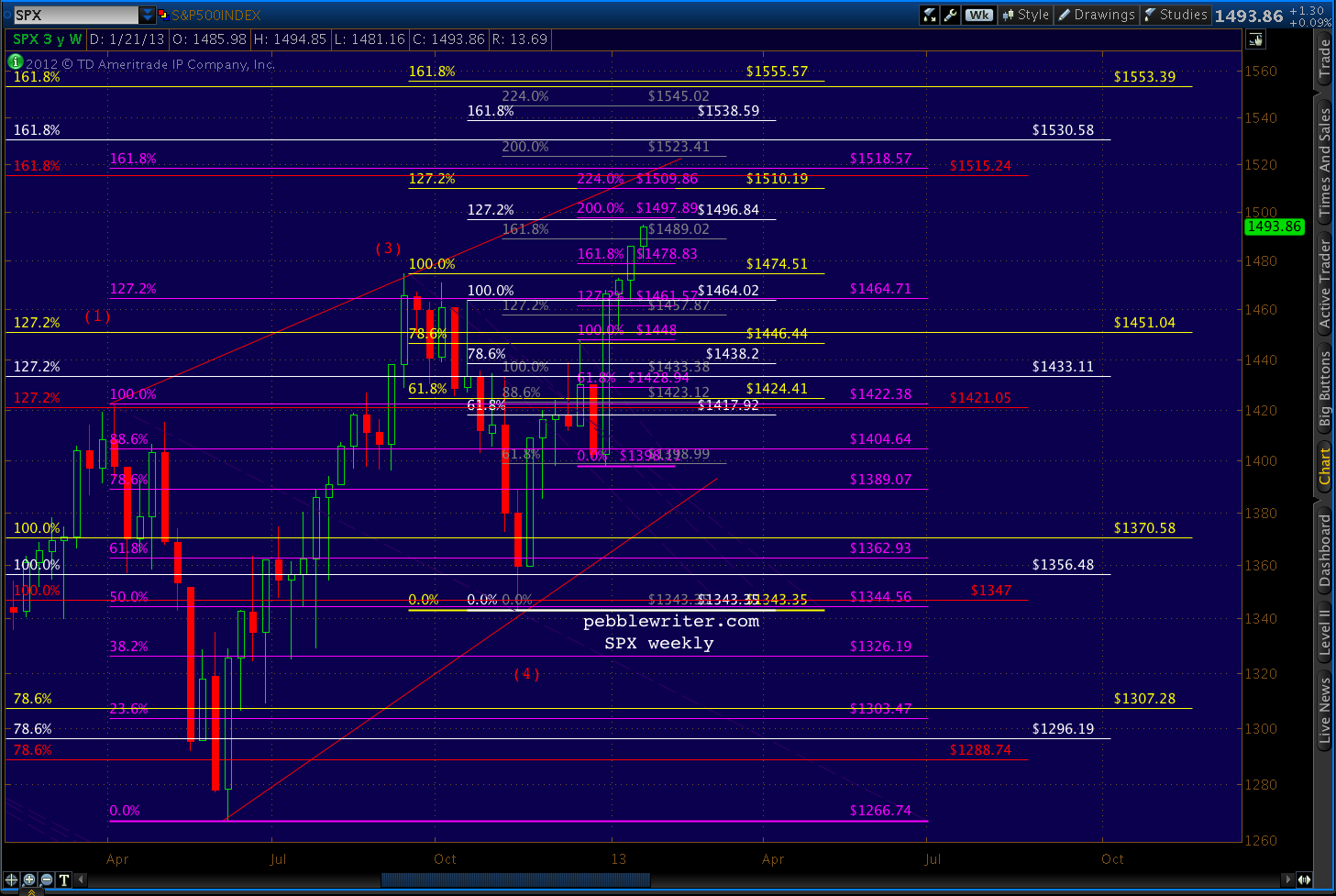
    The most recent patterns show a few possibilities, some of which are clumped together in fairly narrow ranges.  The largest of the patterns — the yellow grid — shows a 1.272 Butterfly Pattern extension at 1510.19 that intersects with the 2.24 extension of the decline (purple grid) from 1448 – 1343.

    A Butterfly Pattern is a good bet, as the Dec 18 reversal at 1448 pretty much nailed the .786 Fib level Point B (1446.44) which Butterfly Patterns require.

    1510.19 also falls within the confines of the thin red line — the TL connecting the Apr 2 and Sep 14 highs that would probably satisfy the EW requirements of an ending diagonal.  I know you’re out there, my Waver friends.  Please weigh in, as I know only enough EW theory to be dangerous.

    The white pattern is appealing enough, but I would have to consider it secondary in importance to the yellow since it began at a less momentous point X.  Ditto for the grey pattern.

    Although it should be noted that we faced a similar dilemma when choosing between the Point X’s for the Butterfly patterns beginning in 2011 [see: All the Pretty Butterflies.] In the end, it was a point similar to the white pattern 1.0 Fib at 1464.02 that determined the April 2 turn.  It featured a Point B closest to the .786 Fib.

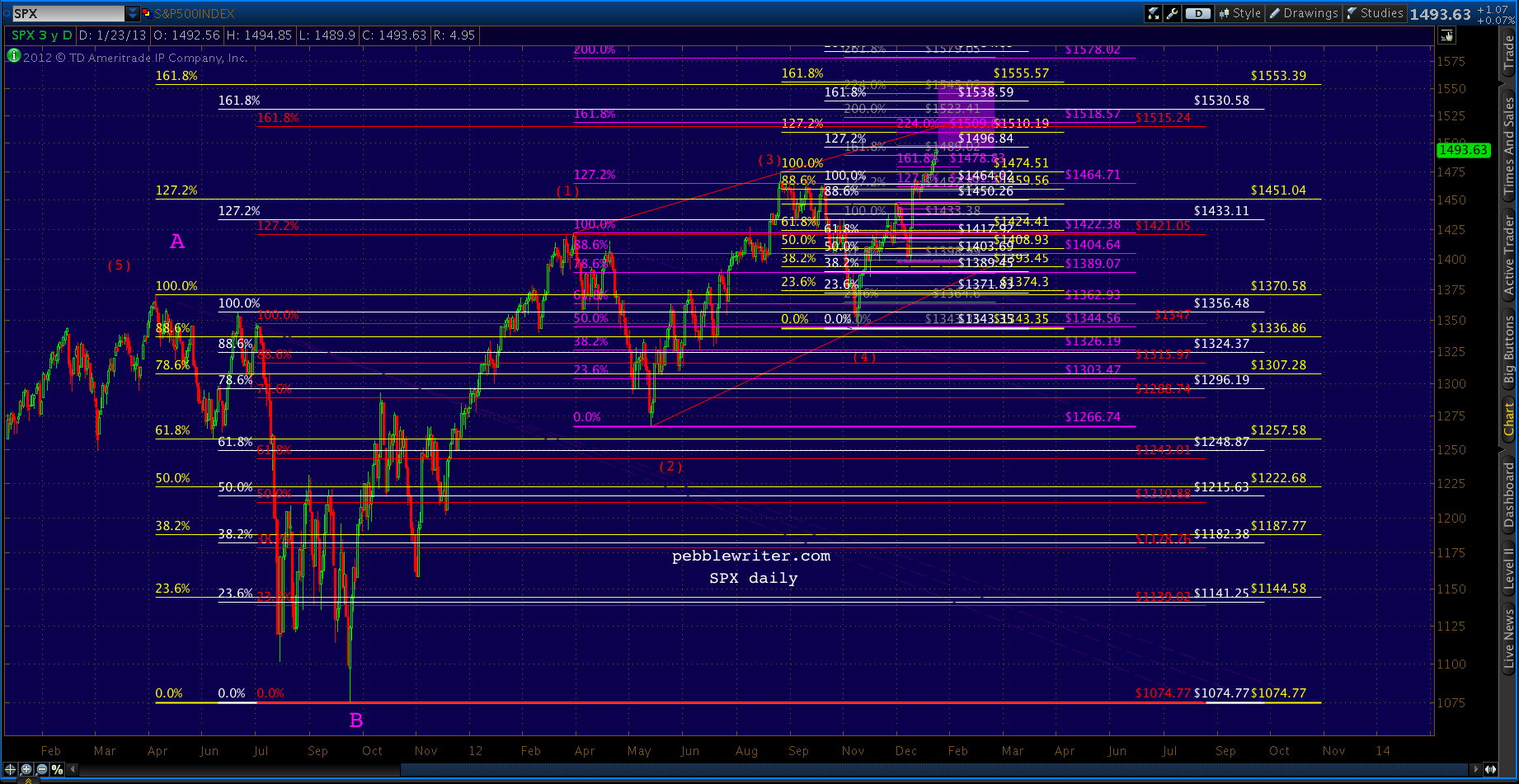
    Zooming out, we can see that the 2011 highs could very well still influence the outcome of the current top.  The chart that includes everything is a little busy…

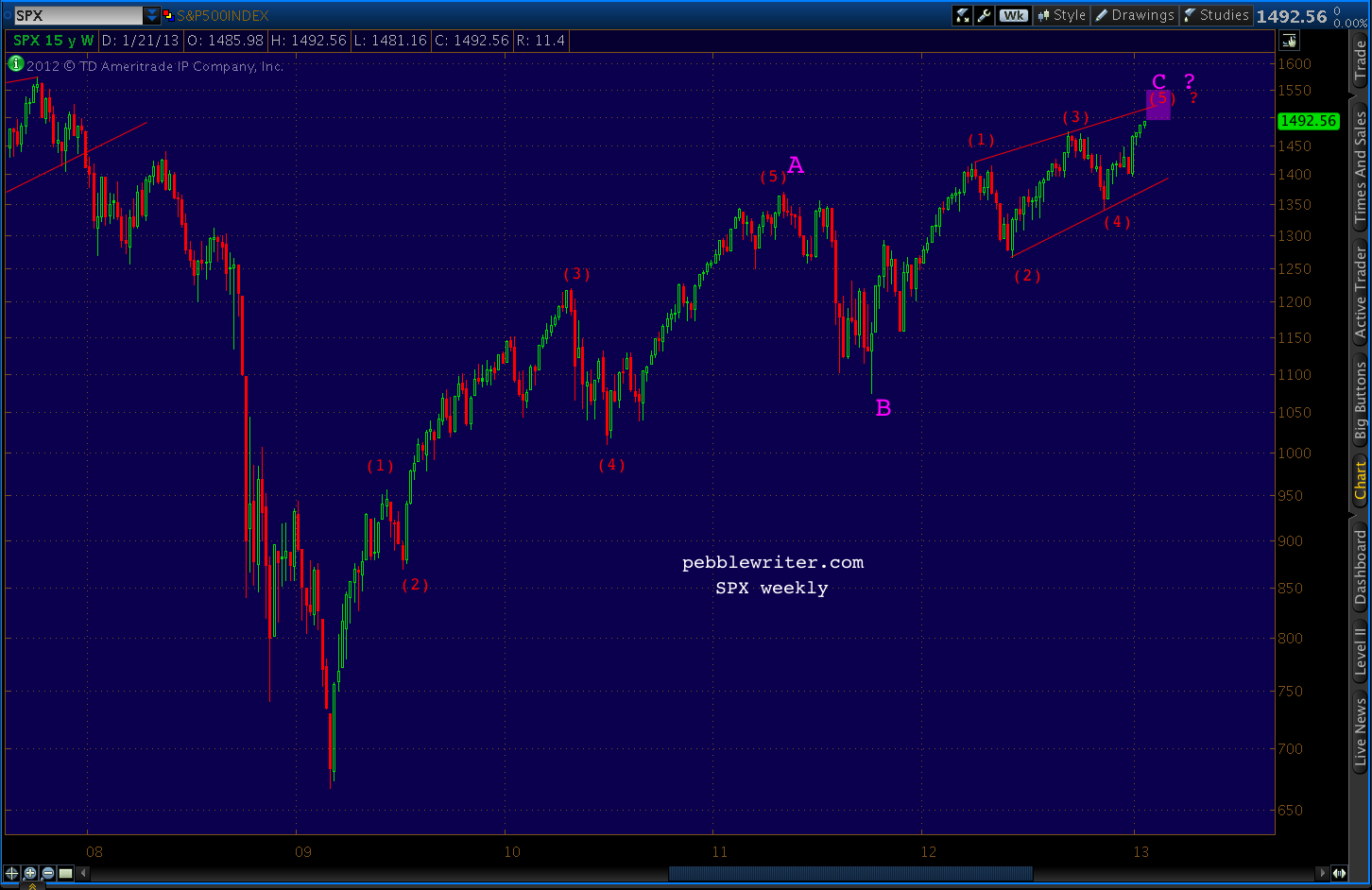
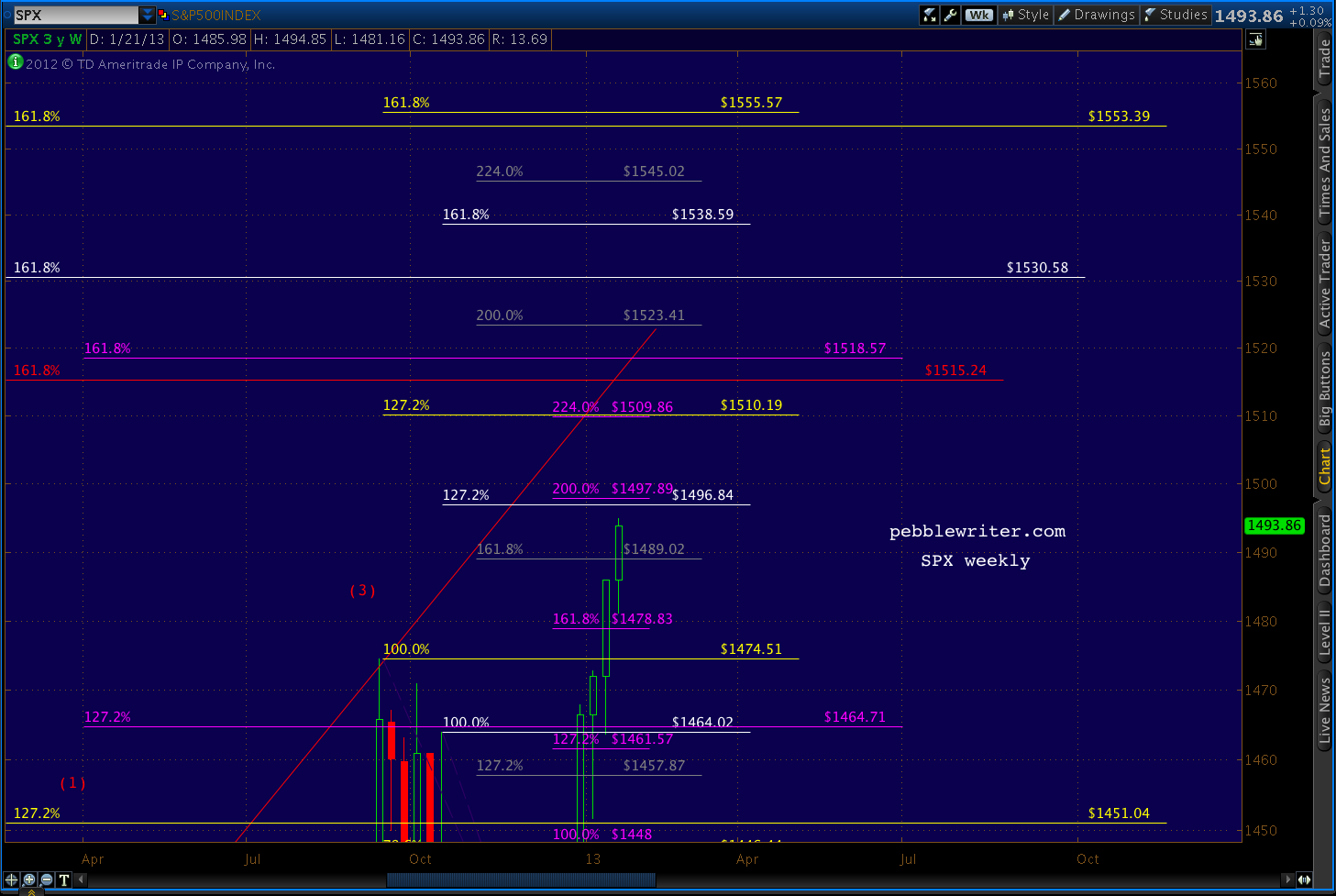
    …so I’ll clean it up by eliminating the interior retracement levels and switching to weekly.

    The target areas can be more easily seen in this close up.

    Note that the large red pattern, the one whose 1.272 extension helped me accurately forecast the April top, comes into play at its 1.618 extension of 1515 – only a few points away from the 1509-1510 level discussed above.

    This is promising, as patterns that influence markets once (that was an 11% correction, after all!) are more likely to do so again.  And, patterns that the market completely ignores — such as the yellow and white patterns from May and July 2011 — are less likely to suddenly leap into a position of authority.

    And, there’s also a purple 1.618 extension (set up by the 1422 – 1266 decline) at 1518.57.  Again, this is close enough to be considered significant.

    If 1520 is exceeded, then we’ll look at the next higher grouping: 1553-1555.  This “group” is basically the two yellow 1.618’s.  Again, the larger pattern’s 1.272 had no influence on the market.  The smaller pattern’s 1.272 is the one coming up at 1519.

    Summary

    My leading harmonic forecast is for 1509-1515.  I can’t imagine getting this close to 1500 and not snagging it for the trophy case.  And, I like the idea of dancing with the harmonic patterns that brung us.

    My secondary goal is slightly higher at 1553-1555, so there should be opportunities to jump back in and capture most of any upside above 1520 if/when appropriate.  Such a move would likely follow a reversal from 1509-1515 back down to 1474ish and would constitute a fifth wave rather than the ending diagonal suggested above.

    If AAPL’s earnings stink up the joint after the closing bell, going long won’t have looked very smart.  But, judging from the steadily appreciating share values, I’m guessing that a relatively positive result is already being leaked.

    Chart Patterns

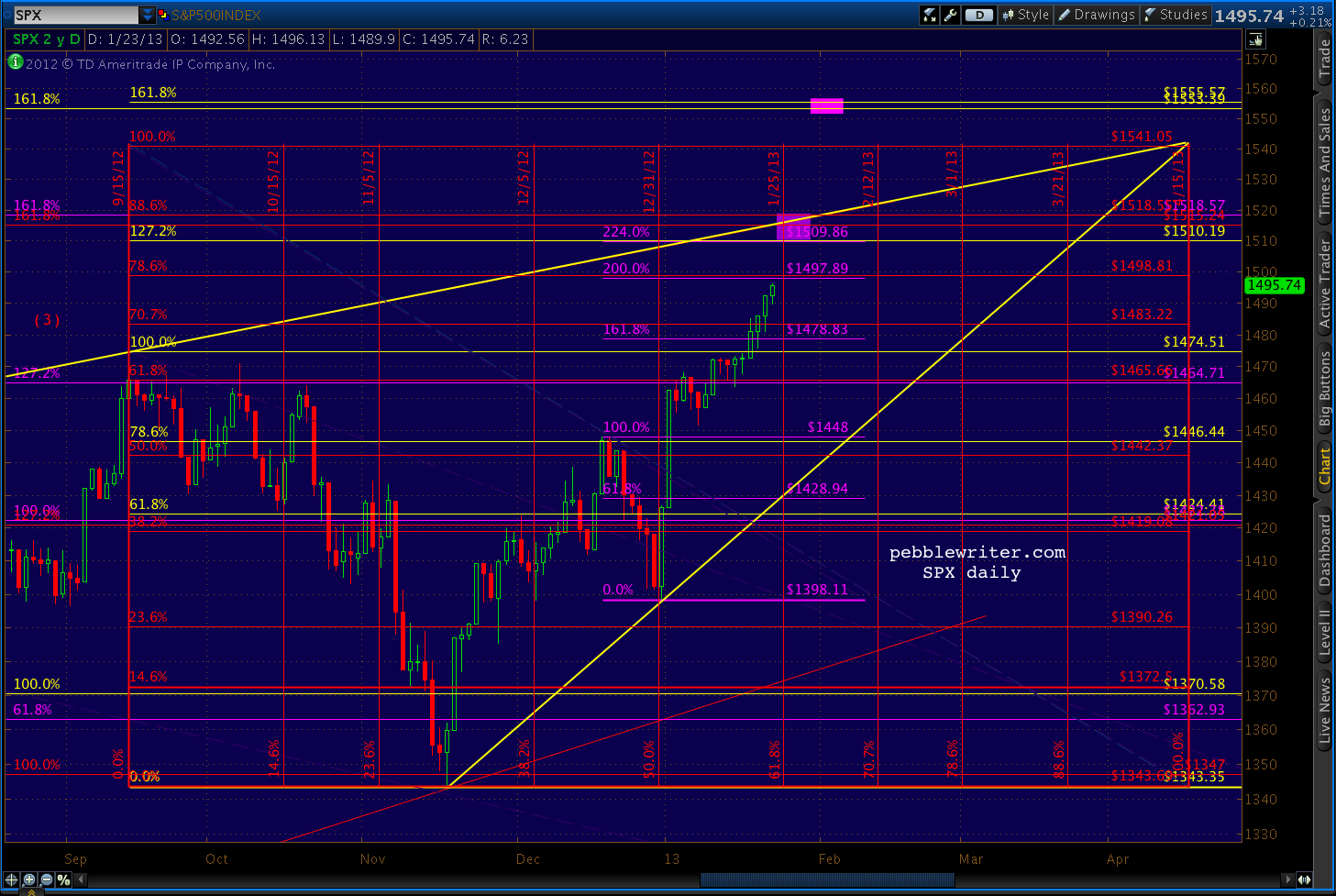
    I won’t rehash the stuff already posted in the past couple of weeks.  Just take a look at the rising wedge that would be confirmed by a reversal at 1510 as early as tomorrow.  The target would come at the .886 of the base to apex price range and .618 of the time range (almost too good to be true.)

    We’re currently very close to the .786 of 1498, which tells me there’s a decent chance of a run up to 1500ish into the close.

    UPDATE:  3:45 PM

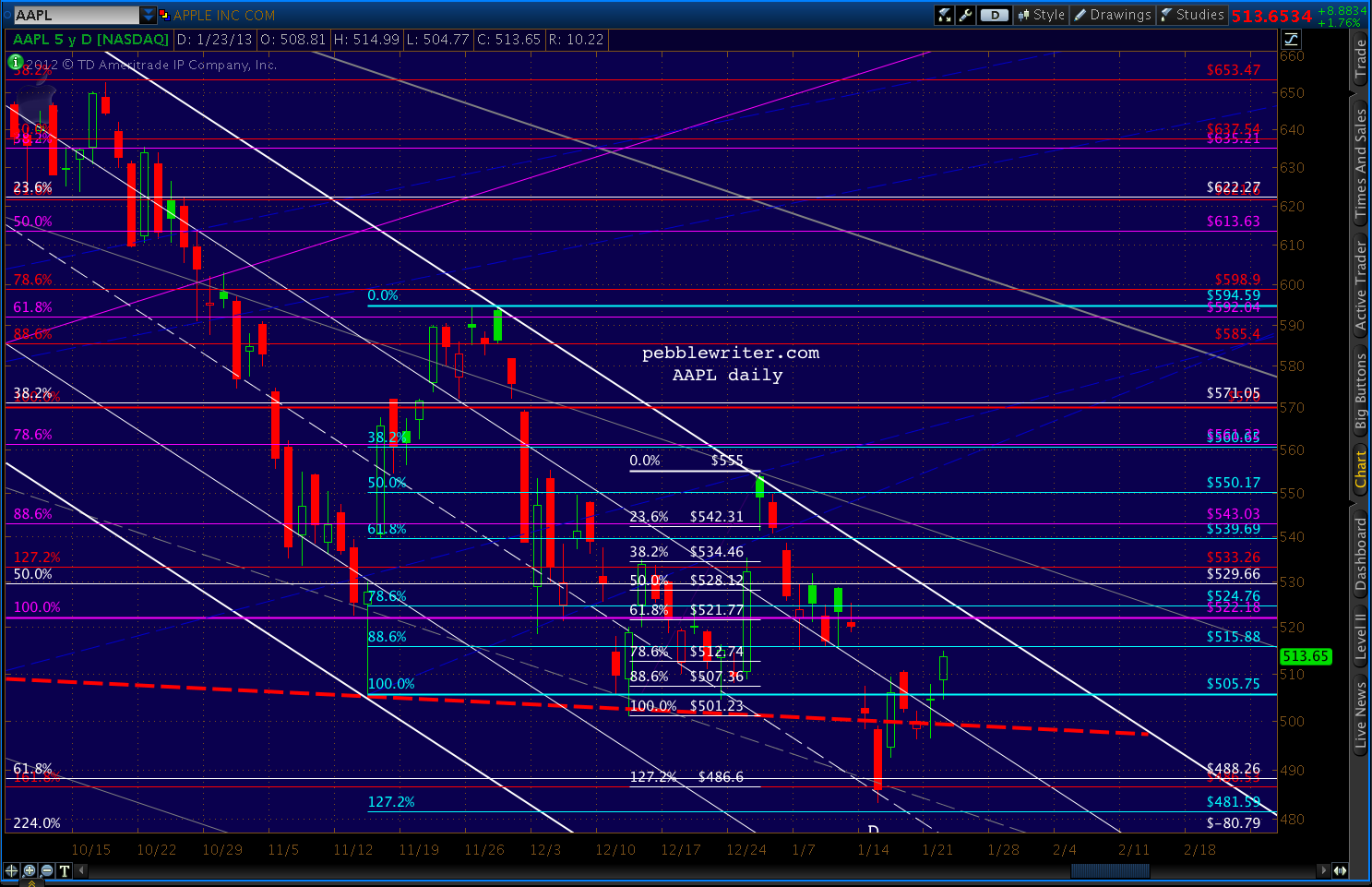
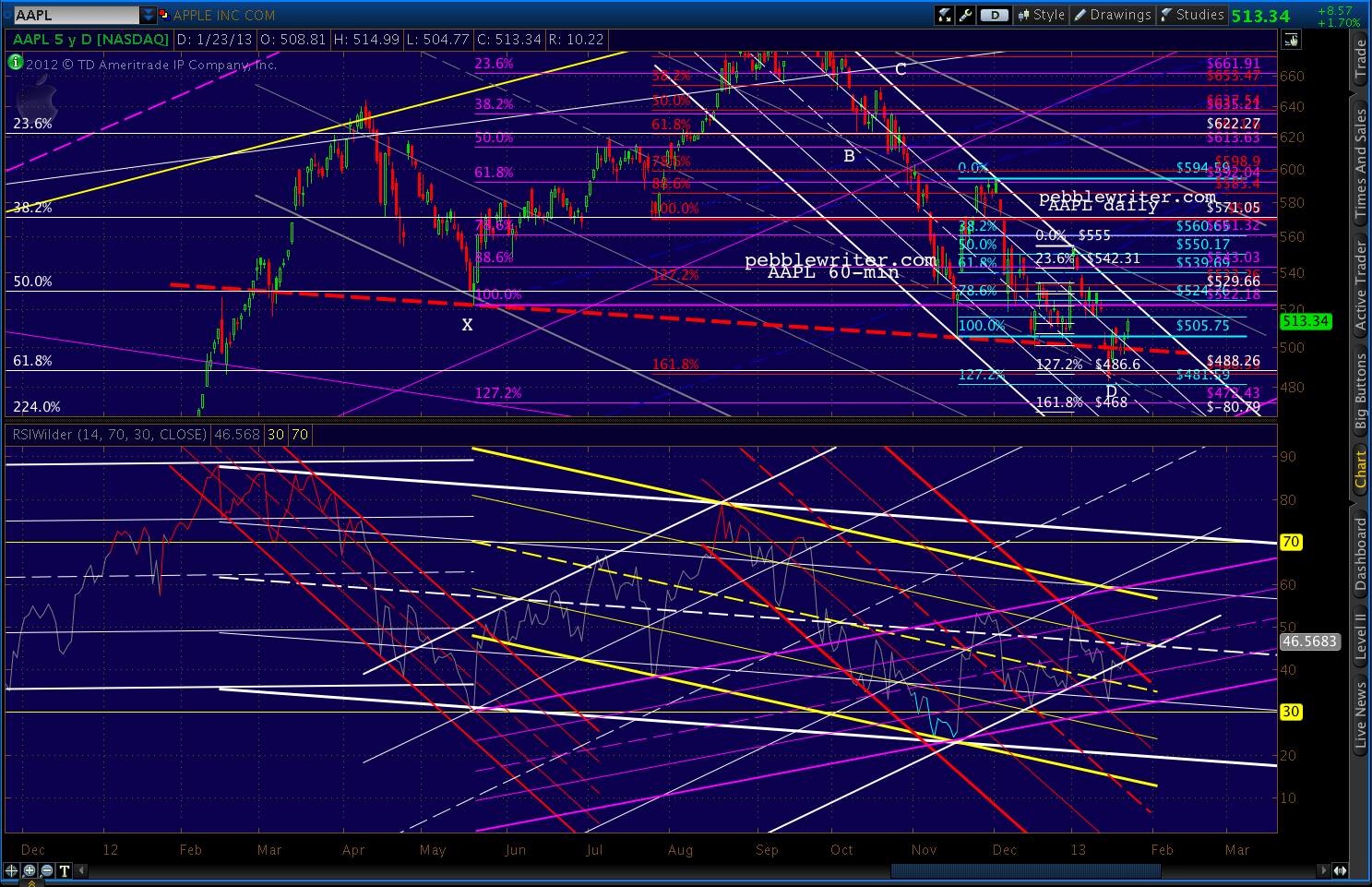
    AAPL is up almost 9 points at the moment.  A rally past 1426 would take it up out of the falling white channel it’s been in since last August.

    Anything over 515 would take RSI above the white and purple RSI channel midlines.   So, as expected, much is riding on the earnings report and how it’s perceived.

    We’ll watch these RSI channels, though. A return to the top of the yellow (and, especially the white) channel would surely spell a reversal.

    The Agenda

    I think it’s pretty straight-forward — bag an important new high, but without setting the bar so high that expectations can’t be managed.  At 1510, SPX clears 1500 but buys some time before the pressure of “will it exceed 1576?” comes to bear (no pun intended.)

    Then, get through the budget mess (or, more kicking of the can) and see where we are.  If we get a sequester, so be it.  The establishment will be well positioned ahead of time and the correction will be managed.

    After the shock of it wears off and prices have firmed in the 1200-1300’s, time to establish the next leg higher.

    Now, the big question is whether TPTB can engineer such a move without it getting out of hand — as it often does.

    Stay tuned.

  • Should We “Like” Facebook?

    The last time I posted about FB was October 24 [see: CIW Oct 24, 2012], when I happened to hear Donald Trump repeatedly mention the stock as he was being interviewed about something else all together.

    BTW, interesting chart on Facebook.  I knew something was up when I heard Donald Trump touting the stock on the radio.

    He…still managed to mention the large position he’d been buying about 5-6 times.  More likely he was going for the ol’ pump and dump.

    It’s hard to escape the power of channels.

    The channel in question had been stretched to the limit by the gap up from 19.5 to that day’s 24.5 high and looked like this:

    The channel de-friended FB, smacking it back down to below 19 within the next two weeks.  But, since then, the amazingly positive stock market to the moon has taken hold, trumping that falling channel.   The stock has retraced about half the losses since its 45 high (the white Fib levels below.)

    Unfortunately, it’s also traced out a Rising Wedge — not to mention a Bat Pattern from its June highs (the purple Fibs above.)  As such, it is likely to weaken considerably here — with a drop to at least the bottom of the rising wedge — currently at 27.75 or so.

    Judging from the charts, though, I’d say FB is a good candidate for a breakdown of its Rising Wedge.  Often, this results in a new channel that features a lower bound parallel to the upper bound of the wedge.

    The mid-line of the proposed channel is at 27 (a 10% drop from current prices), and the bottom is way down at 22.75.  The good news is that the channel is obviously rising, so these potential targets are also on the rise.

    The bad news, however, is that the charts indicate the trend may well have changed and the downturn could be more significant than just 10%.  4-hr MACD just crossed over yesterday (60-min is already negative.)

    And, the rising daily RSI channel is probably yielding to a falling channel — signalling a trend change to go with the obvious negative divergence.  Though, we won’t know for sure until RSI reaches the bottom of the white channel.

    Bottom line, the road ahead should be very bumpy.

    Stay tuned.

  • Channeling a Top

    We got the reversal we were looking for last Friday, but as detailed in the last forecast there is still some uncertainty as to the ultimate outcome of this latest rally.

    We remain short from 1462, but a stop in the 1466-1468 range would be prudent.  A rally through 1474 changes our forecast, as discussed yesterday.

    The euro bounced off the bottom of the rising wedge we’ve been tracking as expected.  There is negative divergence relative to the Dec 7 low; so, in all likelihood, the larger wedge should break.

    The daily RSI shows the two options quite well — a bounce off the yellow channel line or just a back test of the broken purple channel line.

    The dollar continues to move in tandem with equities.  It rose last week as SPX rallied, and is off today.  But, like EURUSD, there is marked divergence on the daily chart since it broke up through the top of the red price channel and retested the bottom of the white price channel.

    It reversed at the .786 of the B-C (purple) drop.  And, the 1.618 extension of this move is the same level as the .786 of X-A:  83.10ish.  This would set up a tag of the white channel mid-line somewhere around Jan 22-23 (the .886 intersects with the mid-line around Mar 6.)

    I posted quite a bit over the weekend about the SPX forecast, so I won’t rehash it here.  Suffice it to say we need to see some follow-through on the dip this morning in order to get anything going on the downside.

    The 15-min chart shows a potential H&S pattern that targets 1443.  But, SPX will need to reverse before 1468 for it to play out.

    I’ve updated the channels and harmonics for the most recent top.  In general, they confirm the current forecast.  But, there is plenty of wiggle room.

    continued for members

    (more…)

  • Down the Rabbit Hole

    “In another moment down went Alice after it, never once considering how in the world she was to get out again.”
    Lewis Carroll, Alice’s Adventures in Wonderland

    Not quite four months ago, the Fed guaranteed lower interest rates and higher stock prices forever.  At least that was the mainstream media’s take on QE3.  The market shot up about 40 points in a day, then did something rather curious.  It stopped.

    While the rest of the world took advantage of the pause to shift more money in AAPL, those who study harmonics loaded up on shorts in anticipation of the huge Bat Pattern that was completing [see: The World According to Ben.]

    After having reversed at the Fibonacci 61.8% of the 2007 to 2009 crash, SPX had reached the 88.6% level.  Would it be a huge reversal as occurred when the Gartley Pattern completed at the .786 (- 21.6%) or something more modest?

    The fact is, we don’t know yet.  After shedding 131 points (8.9%) from September to November, SPX has retraced 119 points — roughly 88.6% of them.

    This means that SPX has constructed another Bat Pattern over the past 4 months.

    It’s easier to see if we zoom in.

    Like the larger pattern that took place from 2007 to 2012, will this pattern deliver a big reversal or something more modest?  For help, we can examine how SPX reacted the last time it reached a major Fibonacci level — the Gartley Pattern at the .786 in May 2011.

    SPX lost 112 points to 1258.07 before regaining about 88.6% of them to complete a Bat Pattern (the light blue pattern.)  At that point, it did it all over again (the red pattern.)

    In retrospect, the move from 1370 to 1258 was the 1st wave.  The move back up to 1356 was the 2nd, corrective wave.  It was powerful and quick — taking only 14 sessions compared to the 1st wave’s 33.  This fooled a lot of investors into thinking it was a motive wave and was going to establish a new high.

    Note: For those of us following an analog that compared the 2011 top to the 2007 top, it was a fabulously opportune time to start loading up on shorts [see: Why Do Analogs Work?]  Our gains over the next couple of weeks were nothing short of spectacular.

    The same thing happened a second time (the red pattern.)  The wave from 1356 to 1295 took 7 sessions, while the wave back up to 1347 took only 3.  Again, this suggested higher prices, not the powerful reversal that slashed 246 points in only 13 sessions.

    Are there any parallels between the market’s reversal at 1370 and its reversal at 1474?  As regular readers know, I am tracking a new analog [see: A New Old Analog] that suggests there are.  But, there’s a line in the sand at current price levels.

    We can argue all day about whether the pathetic fiscal cliff deal, combined with the latest QE incarnation, should mean higher prices.   But, if the latest Bat Pattern doesn’t hold, and prices ramp up past 1474, I’ll consider the analog broken and start charting upside targets.

    But, it won’t be because the Transportation Index just made a new high.  It simply completed a Crab Pattern (on negative divergence I might add), imbedded in the tail end of a large Bat Pattern that it’s been trying to complete since February.

    And, it won’t be because the Russell 2000 just made a new high — which can also be viewed as a quadruple top (dashed purple TL) that coincides with: (1) a Butterfly Pattern completion (in purple); (2) a Crab Pattern completion (in red); (3) a back-test of a well-formed rising wedge; and, (4) the .786 time fib of the wedge.  All of this, of course, is on negative divergence.

    It would be in spite of a dollar index that just broke out of a channel that dates back to May (red), after testing the bottom of a channel (in white) that dates back to Feb 2011.

    It broke out of and back-tested the latest channel on the hourly chart, too.

    I’ve always wondered what would happen when The Powers That Be threw everything they had at the market and it yawned.  Might that be a rabbit hole from which there is no easy escape?

    Between QE3, ESM, Congressional Kumbaya singing…the market should be hitting new highs.  So, why is it mired at the same point (metaphorically, at least) that preceded the last big correction?

    The market is currently frozen in headlights, wondering whether to respect the latest Bat Pattern or not.  So, I’m going to take the opportunity to review our analog and general forecast.

    To be continued…