Author: pebblewriter

  • Membership Sale!

    Welcome to our new Membership Sale!

    This has become something of a tradition for pebblewriter.com.  We’ve done a few of them now, and they have proven very popular with both new and returning members.  It’ll run for the next few days.  The terms are pretty straightforward:

    • $1,099 annual rate – 33% off the regular annual rate, and 50% off a year of monthly payments
    • your Rate will Never Increase as long as you remain a member
    • a Free Report on a security of your choice (as long as it’s available on TOS)

    Ready to sign up?  Click HERE.

    What’s New

    This last feature is new.  Charter annual members will receive a free technical analysis report on the stock of their choice.  It will consist of 2-3 pages of charts and commentary, including 20-yr, 5-7 year and 1-year charts as well as a forecast for both bullish and bearish scenarios.  This same service will be rolled out to existing members in mid-October.

    Lots of folks have a sizable position in certain stocks — the company where they work or used to work — and can benefit from knowing what the charts indicate about the future.  As always, no guarantees.  But, I’ll give you a couple hours of my best thoughts on the matter.

    I’m also offering the same service as a stand-alone option to prospective members.  It will be coupled with a one-month trial membership — something folks inquire about almost every day.  The cost is $249, which is about $0.25/share on a 1,000 share position.

    Help Me Help You

    One other note: I do no advertising on pebblewriter.com.  There are no banner or pop-up ads.  I don’t sell or rent your email address or any other information to third parties.  I hate that kind of stuff, and assume you do, too.

    So, I rely on current members to bring in new members. That’s why I offer great incentives to refer friends and business associates to the site ($300 each during this promotion.)  In fact, if every member brought in a new one, we could probably discontinue these promotions!

    If you enjoy the site, please spread the word.  It will benefit you directly (the $300!) and probably even more indirectly.  The closer I get to my membership goal, the more bells and whistles I can offer all of you.

    What I hope you won’t do is screen-grab charts and commentary and share them, or your log-in information, with non-members.  It only dilutes the value of your membership, as I spend a good 30-minutes/day unlocking folks’ accounts when they share with non-members “just this once.”

    What’s Next

    Back to bells and whistles: my wish list includes an administrator, improved web design, live conference calls, videos, etc.  These are all things that cost time and money, but are easily attainable as our membership grows.

    I’m currently about 1/3 of the way towards my membership goal (a closely-guarded number that’s strongly correlated with my three daughters’ college and wedding plans.)  It doesn’t really compare to what I could make by returning to Wall St., but I like working for all of you instead of “the machine.”

    Most of you have probably noticed our rates are increasing monthly.  This is according to plan, which calls for an annual rate of $2,500 by Jan 1.  And, I’ll probably discontinue offering monthly, quarterly or semi-annual subscriptions unless I get an administrator on board.  So, if you or someone you know is thinking about a membership, this would be an excellent time to take action.

    Thanks!

    Last, thanks for all of your support.  These last few months have been ridiculously volatile and seemingly without direction.  Please believe me when I say it’s as bothersome for me as it is for you.  While the volatility has generated some really great results, it’s just plain tiring.  And, those of you who can’t stare at your computer all day long often miss out on some attractive opportunities.

    Ever since USDJPY (the primary engine for higher prices) topped out in December, stocks have been whipsawed incessantly.  It’s hard to say what, exactly, the BoJ is going to do.  But, it shouldn’t be too much longer.  At that point, I expect to be able to focus more on trending prices and less on intra-day swings.

    Sign Me Up!


  • Capitulation

    Yesterday, SPX ran all the way down to tag our lowest target, producing some great numbers (3%+) on the day.  But, the close presented a challenge that I finally addressed with the following:

    FWIW, USDJPY appears likely to tag the bottom of its triangle tomorrow or overnight.  Would not be at all surprised if it does so overnight in order to allow NKD to reach 17092, followed by a bounce before tomorrow’s opening that traps today’s overeager bears.

    It’s exactly what happened last night.  As we noted in the Update on the Nikkei 225 late last night, NKD tagged the next lower target that we’ve been tracking for the past several weeks.

    This was accomplished by USDJPY tagging the bottom of its triangle yet again.2015-09-29 USDJPY daily 0600And, now we’re facing a small gap up that has bears who held short overnight a little nervous.  Should they be?

    continued for members(more…)

  • Update on Nikkei: Sep 28, 2015

    NKD just tagged our two next lower targets and is closing in on the third.  As we discussed back on Sep 10 [see: Sep 10 Update on Nikkei], this latest leg lower is seen as necessary to prommpting a further expansion of QQE and/or debasement of USDJPY.

    It’s pretty clear that NKD’s price action has been as heavily manipulated influenced as any index.  But, in this case, another leg lower would make perfect charting sense.  It would also fit in nicely with the idea of compelling the BoJ to further expand QQE.

    We expanded the target range to include not only the ,886 retracement of the rise from 16525, but the .618 of 14400 to 20990 and the 1.618 of the bounce from 18450 as well (the Fib numbers have changed a bit with the roll to the next contract month.)

    2015-09-10 NKD daily 1301Now, with NKD finally reaching the target range, we have to figure out “where to” from here; and, will it be enough to get the BoJ off the dime?

    continued for members

    (more…)

  • Charts I’m Watching: Sep 28, 2015

    Note: for those wondering, ThinkorSwim did a major update over the weekend — which means that our color scheme options were changed.  I’m trying this one out today — but, the jury is still out.

    *  *  *  *  *

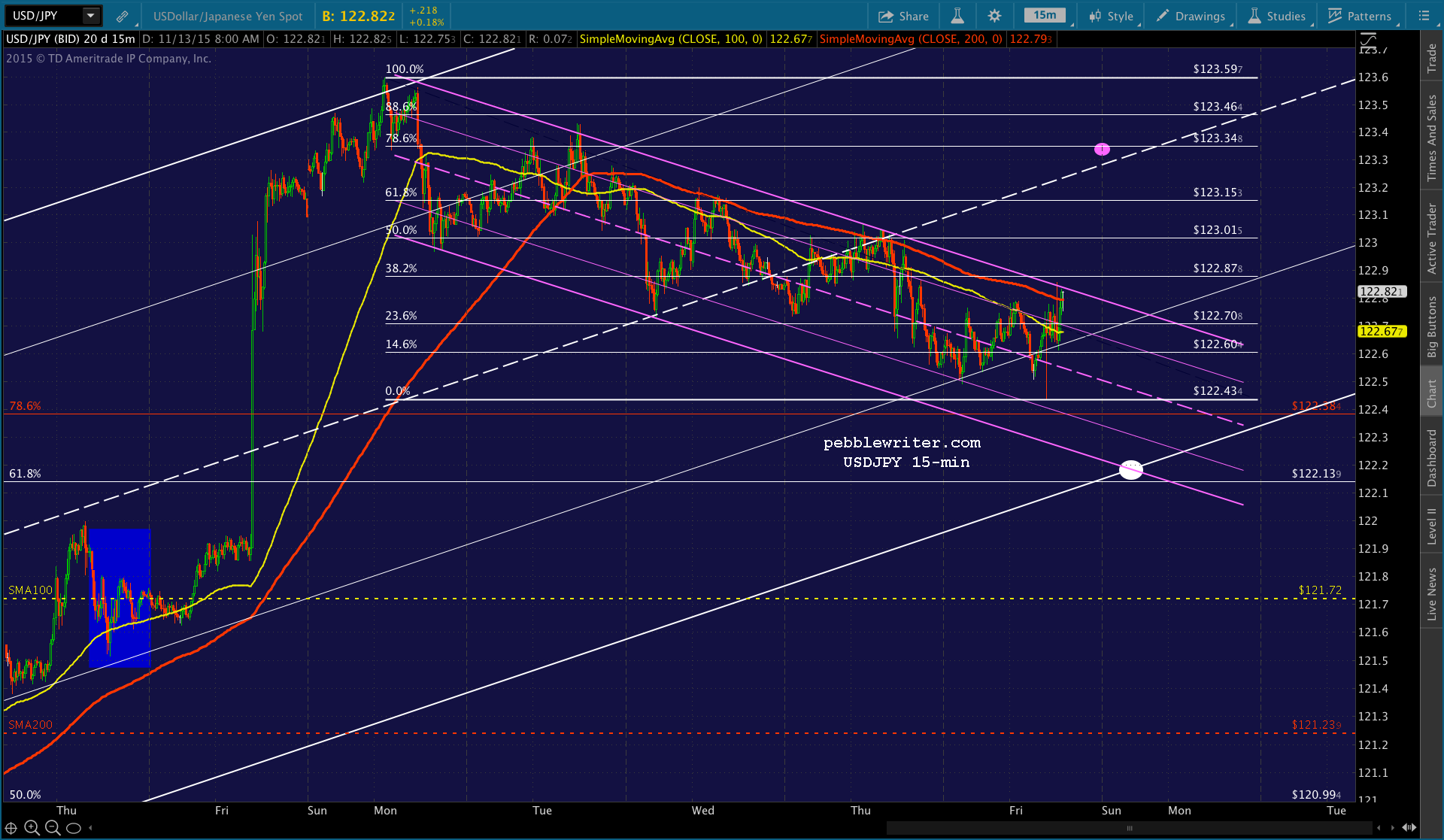
    USDJPY toyed around with breaking out of its triangle on Friday (purple lines below), but ultimately failed when it ran into the SMA200 — leading to a nice pop and drop opportunity we discussed early in the morning.

    Note that it’s still being constrained by the SMA200 — which means SPX might not go anywhere after this morning’s initial pop.

    SPX gained 20 points in the first half of the session, only to give back 30.  Now that USDJPY has retested the .618 at 120.11, we’re left to wonder how long it’ll take before it breaks out for real.

    continued for members(more…)

  • Update on Gold: Sep 26, 2015

    The last time I updated our gold charts [see: Update on Gold, Jul 24, 2015] I noted that it looked like a good buying opportunity.

    For those who are interested, however, it’s worth noting that GC just tagged that yellow .500 Fib level and the bottom of a fairly well-formed channel at 1072.3 that could mean a significant bounce. The initial target would be the neckline (1140) of the just-completed H&S Pattern (that targets 970.)  If things really got going, 1285 looks mighty interesting.

    As luck would have it, that was the bottom.  GC spiked to 1140 within a month, a nifty 6.4% gain. At that point, it had backtested the bearish H&S Pattern that targeted 970.  It could have fallen pretty dramatically at that point.2015-09-26-GC daily 1930But, it didn’t.  It rose to tag a trend line (dashed, purple line) off the January highs before dropping back below that neckline.  Surely, at that point it would have continued on down to establish new lows.

    But…it didn’t.  It made its way back up to tag that very same TL all over again this past Thursday — where it reversed yet again.  After five tags and five reversals, maybe that TL is telling us something.

    continued for members(more…)

  • USDJPY’s Triangle Breaks

    NKD finally tagged our next downside target yesterday, enjoying a huge 5.3% bounce afterwards.2015-09-25 NKD daily 0615It was made possible by USDJPY.  It’s been a month since USDJPY began forming the triangle that has whipsawed markets on a daily basis.  Yesterday, after the US close, it broke out. But, it’s not out of the woods just yet.

    Note that it’s still being constrained by the SMA200 — which means SPX might not go anywhere after this morning’s initial pop.

    continued for members(more…)

  • Update on XLF: Sep 24, 2015

    As the byproduct of mystical companies with make-believe accounting, the XLF is rarely worth charting.  But, it’s been a few months, and we’ve had some interesting things happen.  When we last posted on Jun 30 [see: Update on XLF], with XLF at 24.38, I forecast three key price levels: 23.88, 25.82 and 22.01.   2015-06-30 XLF daily CU 1300Noting that XLF had just broken down (again) through a key trend line, I wrote:

    Will it bounce right back as though nothing happened, or will this plunge leave a mark?

    As it turned out, XLF came within 0.24 of the 23.88 target, bounced right back through the previously-mentioned trend line to within .20 of the 25.82 target, and, finally, opened within .18 of the 22.01 target (on the day that it dropped over 21% in the opening hour — further evidence that XLF is a silly thing to chart.)

    2015-09-24 XLF daily 2042continued for members(more…)

  • Update on NDX: Sep 24, 2015

    I don’t chart NDX very often.  In my opinion, it’s one of the most manipulated indices. It constantly breaks patterns, almost always in a bullish fashion  So, I was surprised in late August when it plunged to a very reasonable and predictable level.  My cynicism was validated, however, by its subsequent recovery.

    continued for members(more…)

  • Thank You Sir, May I Have Another?

    kevinUSDJPY’s triangle continues to punish stocks, alternating between bruising sell-offs and warm embraces.  Futures are off about 16 at the moment — but, are just getting started.

    But, it’s NKD that continues to draw my focus.  It broke through the TL of support from previous lows and is closing in on our target from two weeks ago [see: Update on Nikkei, Sep 10, 2015.]

    I don’t know whether the BoJ is one of the cloaked paddlers or one of the ones grabbing their ankles.  But, either way, NKD is the target of this particular hazing.  At some point, TJPTB (The Japanese Powers That Be) is bound to cry oji!

    2015-09-24 NKD daily 0615continued for members(more…)

  • The Cost of Central Banks’ Protection

    wildfireWildfire is a common occurrence in  many parts of California.  But, unlike earthquakes, mudslides and bad plastic surgery, The Powers That Be seem to feel they can prevent it.

    If you live in fire country, you’re awfully glad that Cal Fire is quick to respond when things go south.  In financial terms, it’s like having a protective put.

    Long before Man arrived on the scene, however, Mother Nature had her own way of responding to periodic wildfires: let ’em burn until the available fuel was consumed and/or a timely downpour came along.  And, it wasn’t necessarily a bad thing.

    The negative effects of wildfires are often outweighed by ecological benefits such as the removal of non-native plants and insects and the release of nutrients from older vegetation into the soil to support new growth.

    And, there’s a bonus.  If much of the dry, combustible underbrush is consumed by periodic smaller fires, the next wildfire won’t be anywhere near as bad.

    The economy is much like nature in that downturns are both natural and cyclical.  As any econ student knows, business cycles entail periods of expansion and contraction, punctuated by peaks and troughs.

    business cycleThroughout modern history, financial wizards have tried various methods to prevent or at least smooth out the peaks and troughs (especially the troughs.)  But, the real economy rarely cooperates.

    For starters, excess optimism and pessimism are baked into human nature — both the cause of and the antidote for one another.  Behavioral yin and yang, if you will.

    And, there’s also what could be called the “wildfire principle.”  When a central banker acts to prevent the occasional financial wildfire, the cycle might be delayed or interrupted — but, not eliminated.  And, delaying or interrupting it is likely to only make the next one worse.  As we discovered (but, have apparently forgotten) in the last financial crisis, prices do eventually revert to the mean.

    Even along the way, the negative effects can greatly outweigh the benefits.  When the Fed forced “risk free” interest rates to historically low levels, for instance, they increased the present value of streams of cash flow (earnings, dividends, rents or whatever.)  This ratcheted up the price of things without increasing their utility (i.e. created asset bubbles.)

    And, by rendering bonds relatively useless from a cash flow standpoint, central bankers encouraged investors to pile into overpriced assets without regard to the historical risks.  They’ve even taken extraordinary steps to reassure investors that these assets are risk free.  It’s the equivalent of building wood-framed houses on fire-prone prairies and then offering interest-free loans and move-in specials.  What could go wrong?

    Yen Carry Trade PicturePerhaps the most egregious example of central banker interference has been the yen carry trade [see: Yen Carry Trade Explained.]  I believe most of equities’ gains since 2011 are attributable to this effective, but ill-advised scheme.

    Large investors can borrow in yen at near 0%, invest in equities certain to rise, and repay their  debt with yen guaranteed to have declined. It works because the BoJ has been willing to ignore the negative effects on the Japanese people in order to keep stocks rising.

    Like a forest that never burns, Nikkei 225 has gained about 140% since its Fukushima lows.  The chart below shows how QQE and stock purchase programs extinguished various flare ups along the way, while the falling yen (rising USDJPY) essentially acted as fertilizer.  [Note: the BoJ and GPIF purchase stocks directly and are currently the largest shareholders of Japanese stocks — amounting to $666 billion, about 14% of Japan’s GDP and the NKD’s market cap.]

    2015-09-22 NKD BoJ Intervention Notes

    After such rapid, uninterrupted gains, the Nikkei was an ideal target for arsonists.  But, the BoJ kept it growing by: (a) constantly debasing the yen; and, (b) buying every dip that came along.  So, it’s no surprise that, nearly a year after QQE and USDJPY flatlined, NKD has actually lost value.  If USDJPY ever actually suffered a meaningful decline, the gains of the past four years would no doubt go up in smoke.

    The FOMC’s recent non-rate increase was evocative of the BoJ’s behavior.  In a stunning impression of a forest that should have been thinned long ago, Yellen & Co. deemed a 1/4% increase in the Fed Funds rate too great a threat!

    Furthermore, the Fed — like the BoJ — has been fundamentally deceitful regarding its reasons for holding rates near zero for over seven years.  It has nothing to do with reaching a desirable rate of inflation (if it ever did.)  There’s plenty of inflation to be found if it were properly recognized and acknowledged.  The reason is much more straightforward.  We can’t afford it.

    The US spent seven long years landscaping its economy, budget and stock market with unnaturally low rates.  A return to normal rates now would bankrupt borrowers who built business plans around ZIRP and slash the value of investments whose prices are based on cash flow.

    It would also triple the US’s annual interest expense, boosting it from last place to third in the race to waste the most taxpayer money.Screen Shot 2015-09-22 at 8.53.58 PM

    As the Fed Governors so aptly demonstrated last week, it’s probably too late to attempt a controlled burn. Their only choice, now, is to remain hyper-vigilant, hoping against hope that the ultimate reversion to the mean won’t come during their tenure.

    The hapless ECB is content to sit in Franfurt with their fingers crossed, secure in the knowledge that while they don’t know how to fix the euro zone’s problems, no one else does either.  Their trillion euro experiment has produced negative interest rates, which allows overindebted countries to continue to appear solvent.  But, they’re not really fooling anyone.  Like Japan, only ECB-funded banks and the ECB itself are buying those bonds.

    The BoJ, after watching 2015’s gains go down in flames over the past three weeks, will no doubt throw more fuel on the fire in the form of expanded QQE and/or additional yen debasement.  In fact, since last March [see: A New Analog], my market forecasts have presumed that TPTB would tank stocks if necessary in order to “help” the BoJ make the right decision.  They’re in an equity trap of their own making.

    The late-August conflagration was a good start.  The flames currently racing towards us just might do the trick.

    Stay tuned.