Year: 2015

  • Charts I’m Watching: Mar 18, 2015

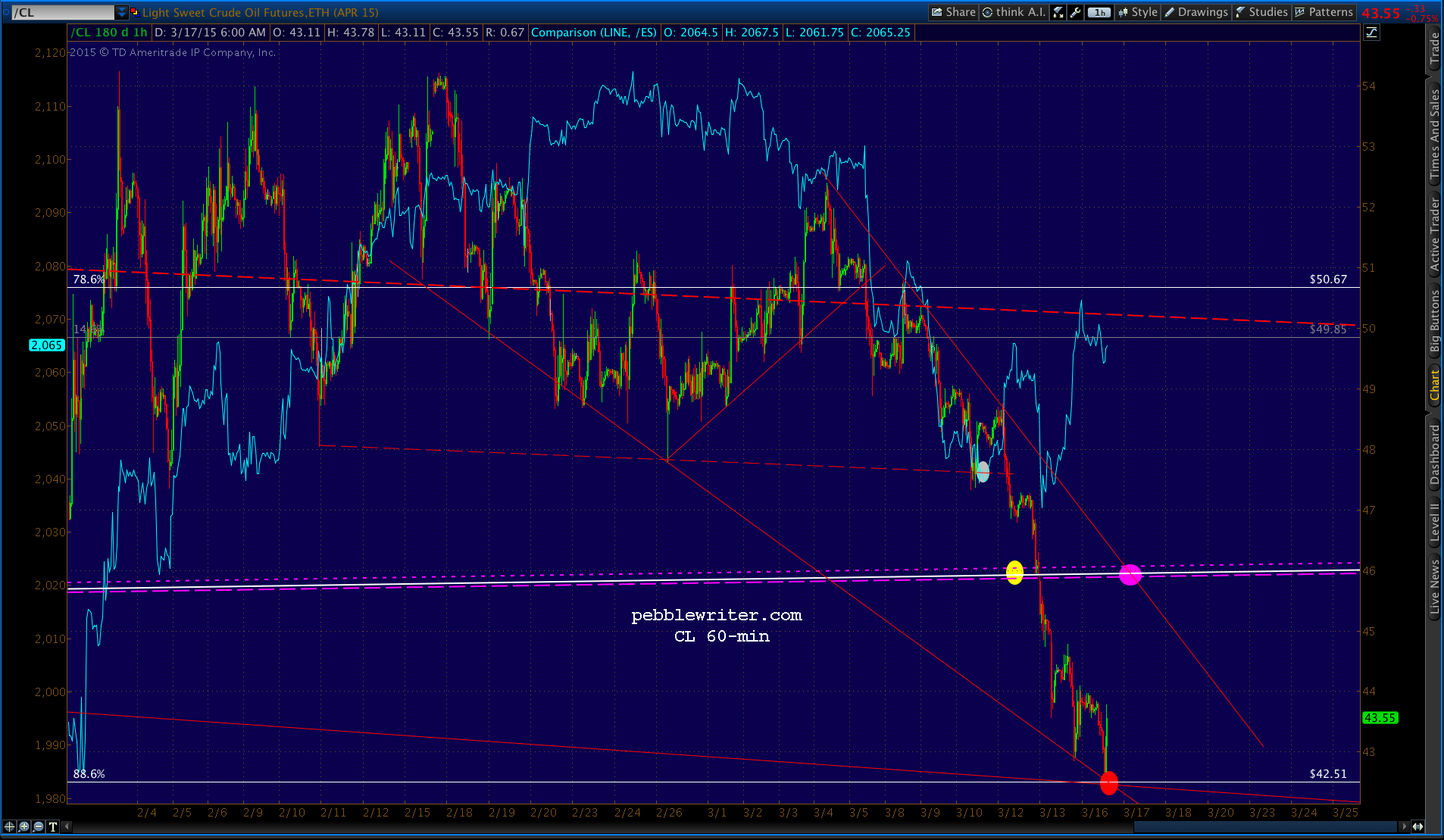
    About an hour before the cash markets opened yesterday, we observed that crude light was closing in on our long-held 42.51 target.  It bounced at 42.63 and was on its way higher when stocks opened trading, prompting us to write:

    The bounce has begun, even though CL came up a few cents shy of 42.51. Stops are advised, as a premature bounce sometimes means one last leg down.

    We also noted how much of CL’s decline had been conducted in the after-hours, so as not to disturb stocks’ continuing rally.  Guess what?

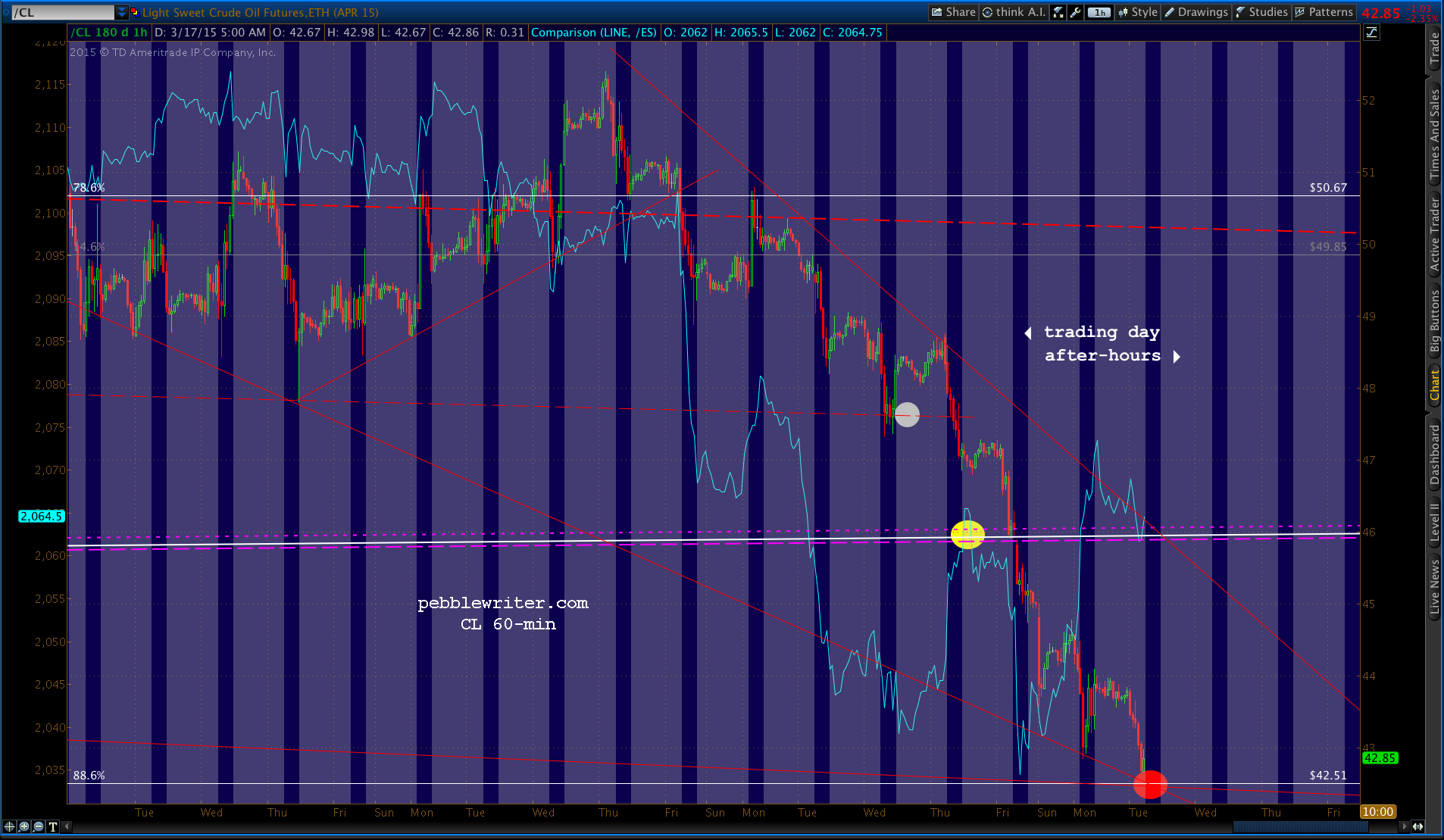
    2015-03-18-CL 5 0600CL did post another leg down.  And, it happened right after the close — passing through 42.51 in the very minute before the futures also closed.  The 60-min chart:

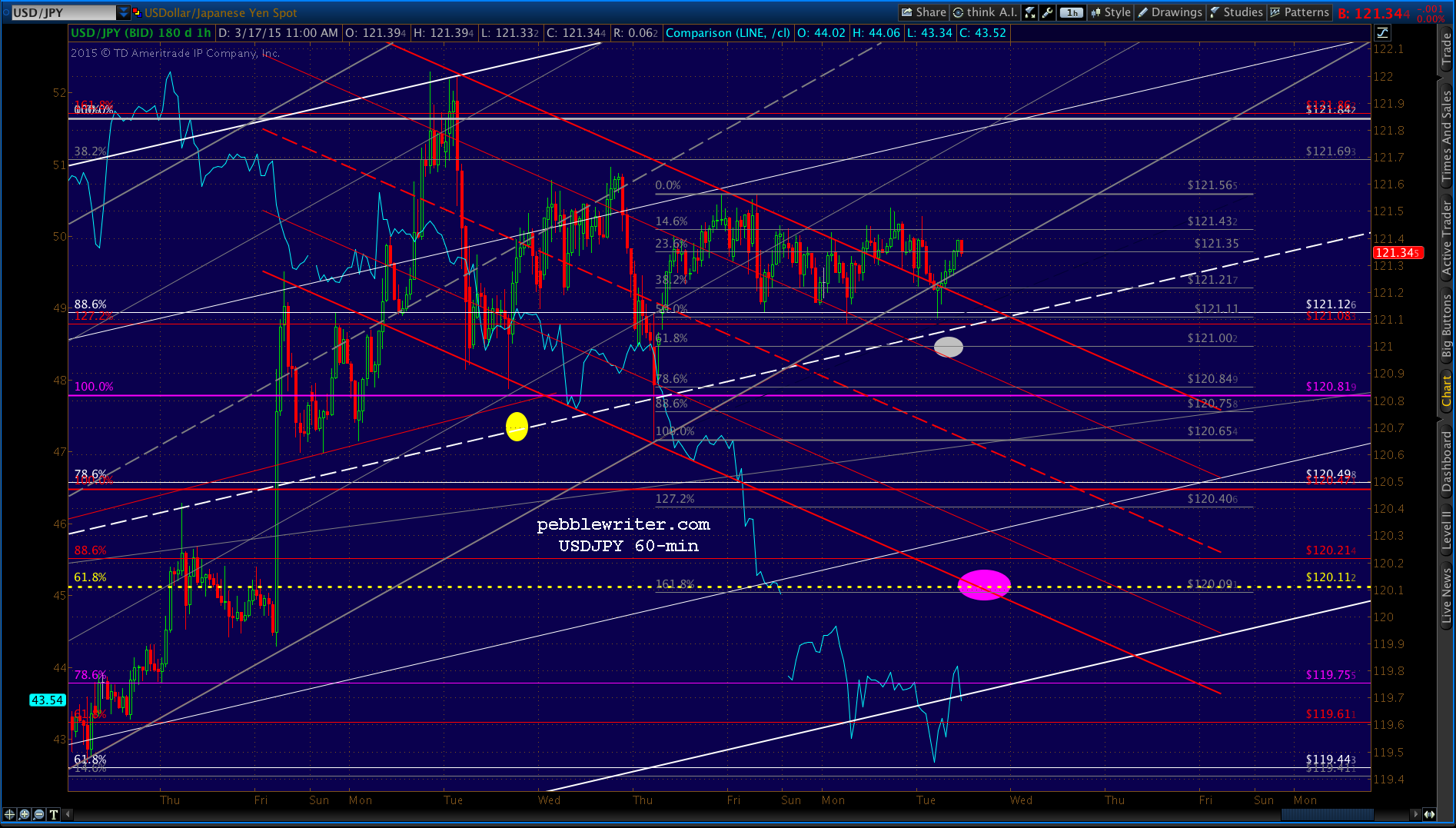
    2015-03-18-CL 60 0600We also noted as the market opened that USDJPY had dipped below the gray channel bottom for the first time since Feb 26.  The degree to which is was allowed to reset would depend on how stocks reacted to CL’s decline and subsequent bounce.

    A strong response would allow USDJPY to decline during market hours; a weak or lackluster response would require it to wait until tonight or, as we discussed yesterday, a reaction to the Fed’s statement tomorrow.

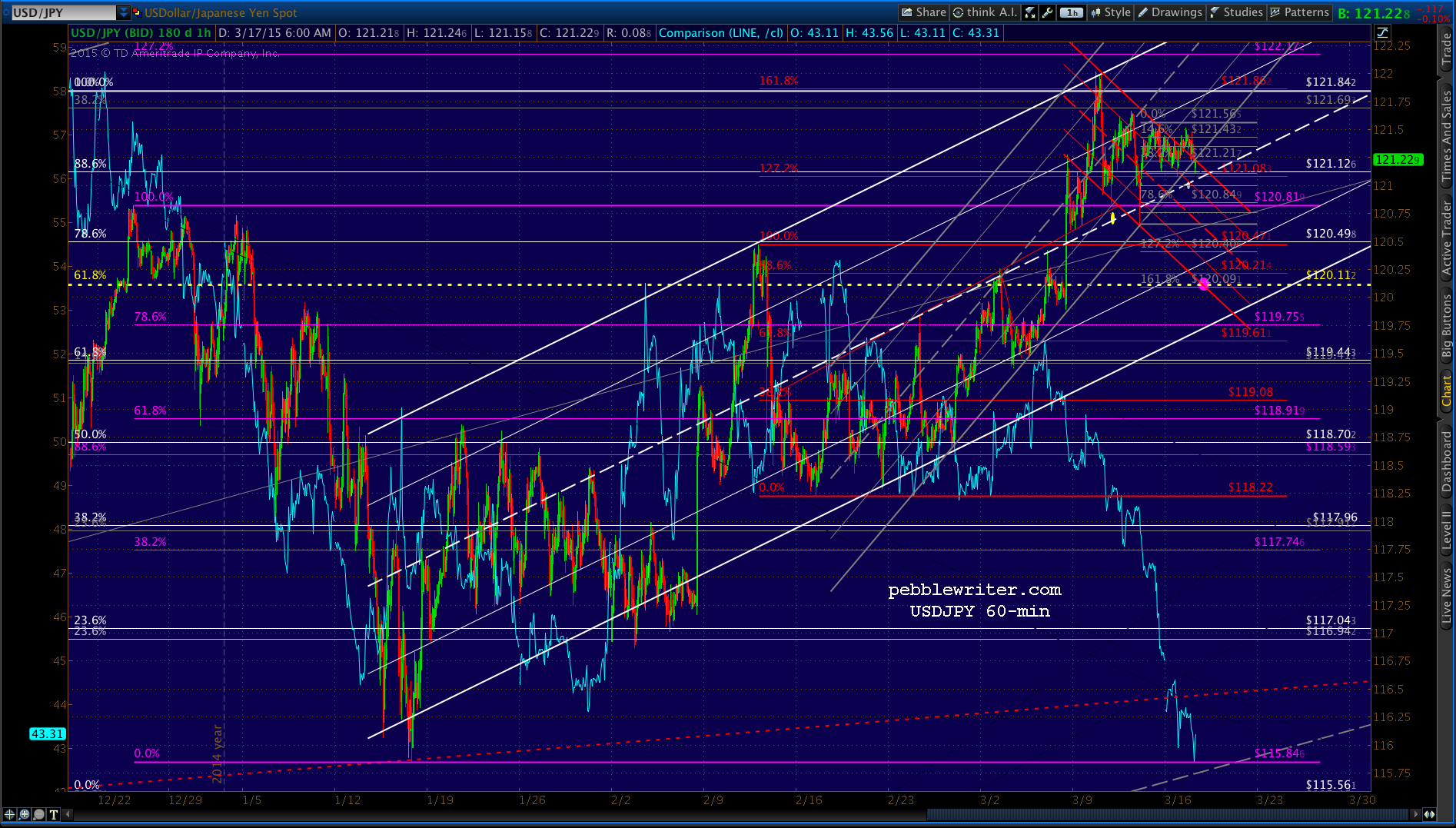
    2015-03-18-USDJPY 60 0600Stocks started to falter, so USDJPY was brought right back into the gray channel — and, the falling red channel was broken — for the remainder of the cash session.  USDJPY was not allowed to decline to the white channel midline until after stocks had closed for the day.

    If the above aren’t grounds for suspicion (if not proof) that these are the most heavily manipulated markets in memory, how about VIX’s actions this morning?

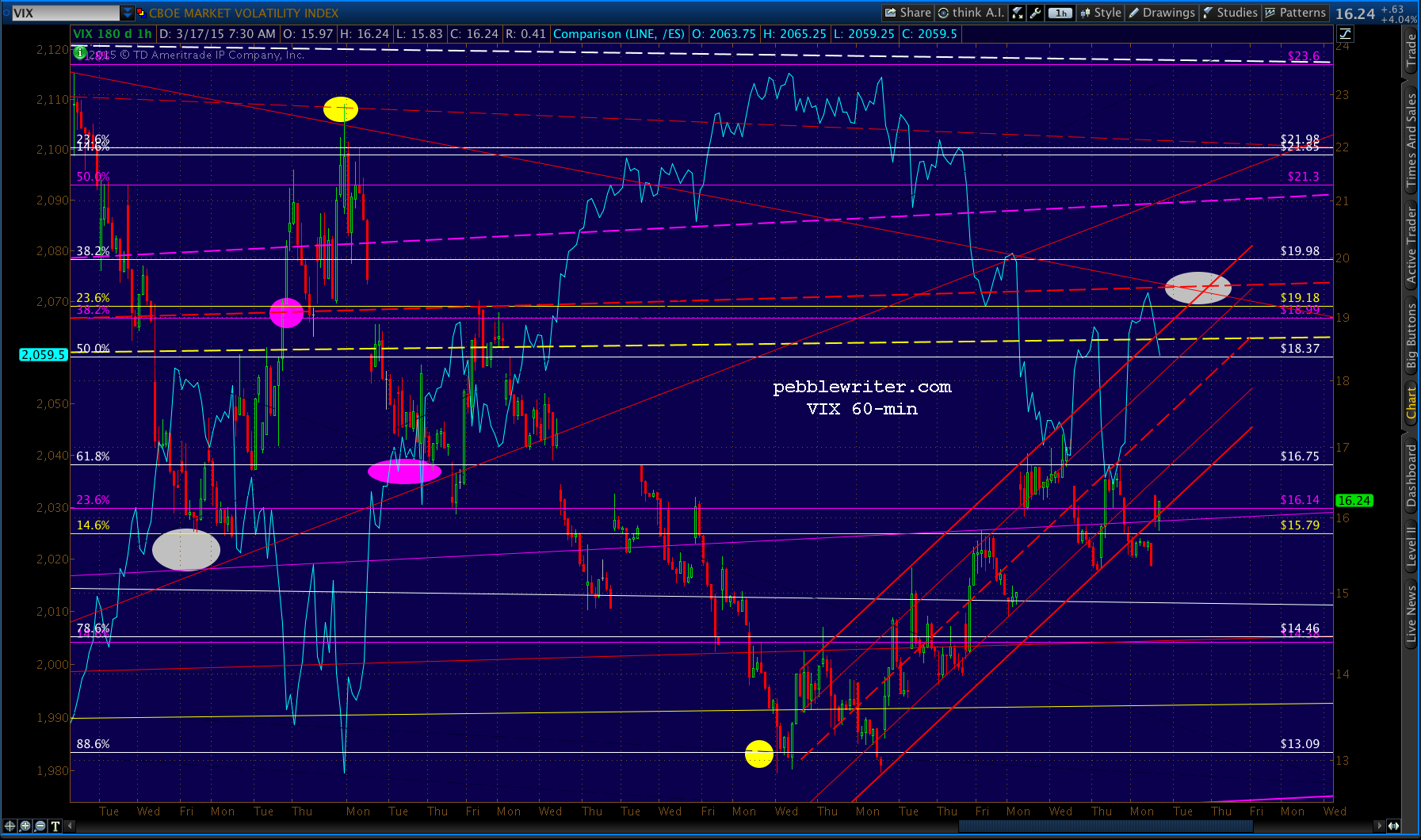
    A 4-point SPX decline in the opening minutes was enough to prompt the Fed’s traders to push the panic button, sending VIX plunging from yesterday’s 15.96 close to 13.69 in the first three minutes of “trading.”

    2015-03-18 VIX 1 0645It broke the perfect little rising red channel, sending a loud and clear message that significant declines would not be tolerated.  Not today, with the Fed release coming up at 2pm.

    2015-03-18 VIX 60 0630Oil’s decline has been a godsend for the Fed, which has been struggling to find a way to keep inflation and thus interest rates low in the face of improving headlines.  But, it isn’t without repercussions.

    The very banks whose bidding the Fed does on a daily basis are rather exposed to oil’s fortunes.  So, we rather expect that CL has reached a sweet spot and, like USDJPY, EURUSD, VIX, ZN, etc., will be utilized when needed to nudge the “market” in one direction or the other.

    For more, see yesterday’s Update on Oil.  And, for how it fits in with the bigger picture including currencies, interest rates and inflation, see Those Wacky Central Bankers.

    This being a FOMC announcement and press conference day, we don’t advise trading.  SPX typically follows a pattern of consolidation, putting in a triangle of some sort before a very brief and sharp correction, which is then followed by aggressive USDJPY ramping and VIX monkey-hammering that erases all losses and leaves it higher for the day.

    But, as we’ve already seen, there is a great deal of manipulation that occurs on these days.  That doesn’t mean, however, that we won’t offer some thoughts on likely moves.

    continued for members(more…)

  • Charts I’m Watching: Mar 17, 2015

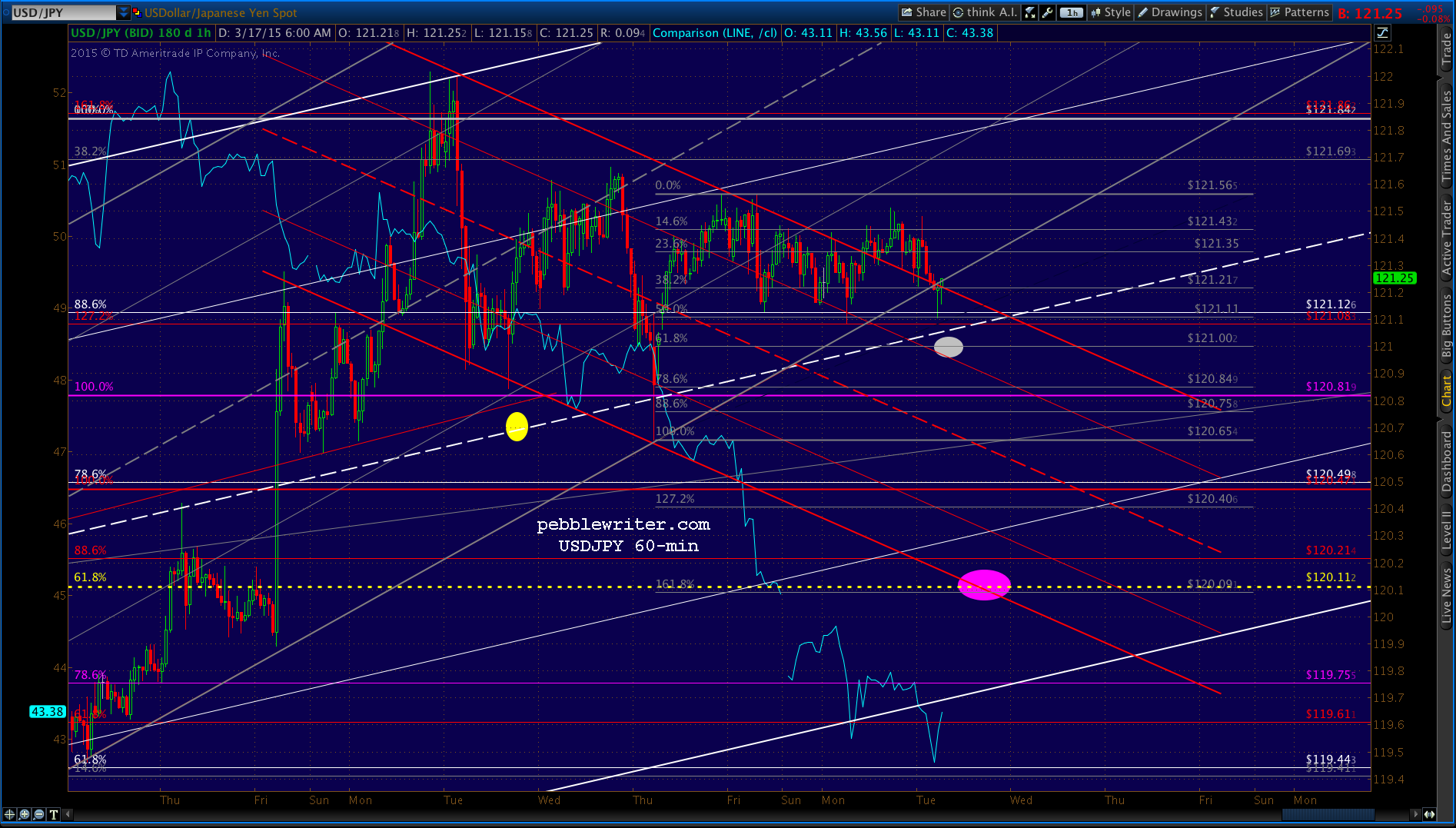
    With CL pennies from reaching our price objective [see: Update on Oil, Mar 17] this morning…2015-03-17-CL 60 523am…USDJPY should have a chance to reset.  It has already begun, with the first (tiny) slip beneath the gray channel bottom since Feb 26.

    2015-03-17-USDJPY 60 0623Whether it completes a backtest of the .618 Fib at 120.11 will be determined by how well equities respond to oil’s bounce or lack thereof.

    2015-03-17-USDJPY 60 0630A strong response would allow USDJPY to decline during market hours; a weak or lackluster response would require it to wait until tonight or, as we discussed yesterday, a reaction to the Fed’s statement tomorrow.

    UPDATE:  9:40 AM

    The bounce has begun, even though CL came up a few cents shy of 42.51. Stops are advised, as a premature bounce sometimes means one last leg down.

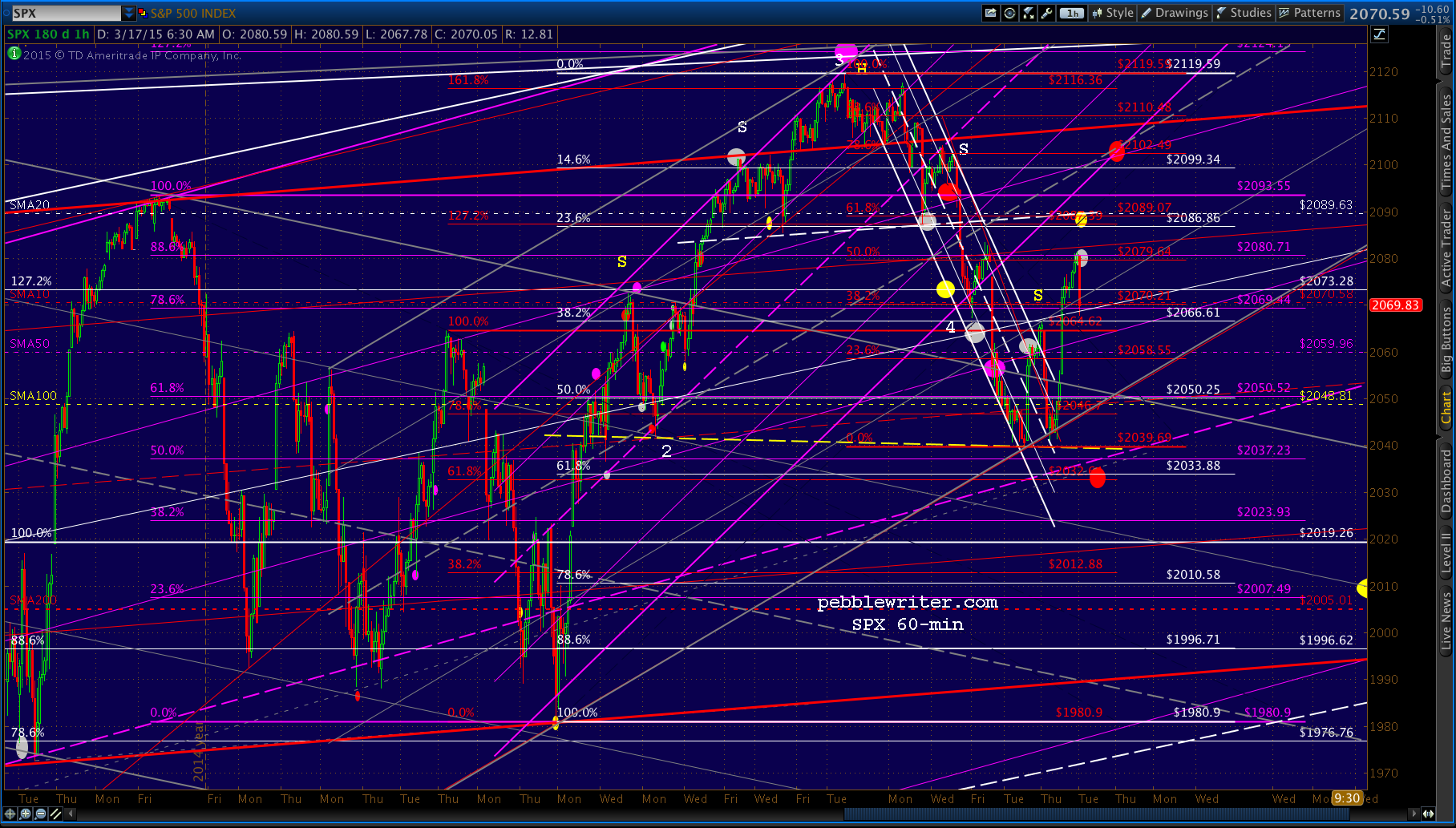
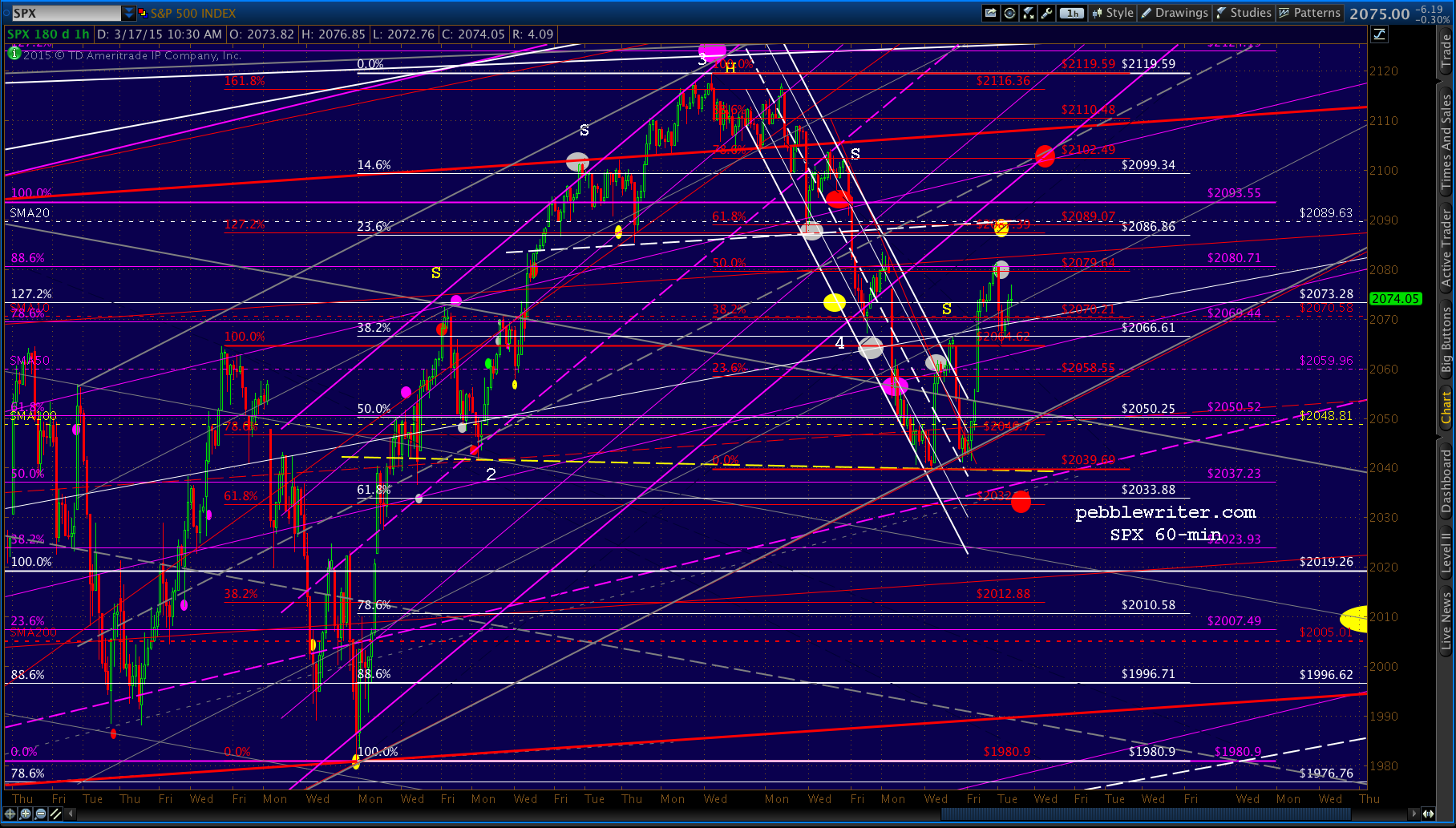
    The optimal timing for USDJPY to reach 120.11 and CL to reach 46 would be around midnight tonight (EDT.)  But, we’ll have to wait and see what TPTB have in mind, and how the “market” responds.2015-03-17-CL 609 0640Bulls should try to hold the line for SPX at the SMA10 of 2070.58.

    UPDATE:  10:15 AM

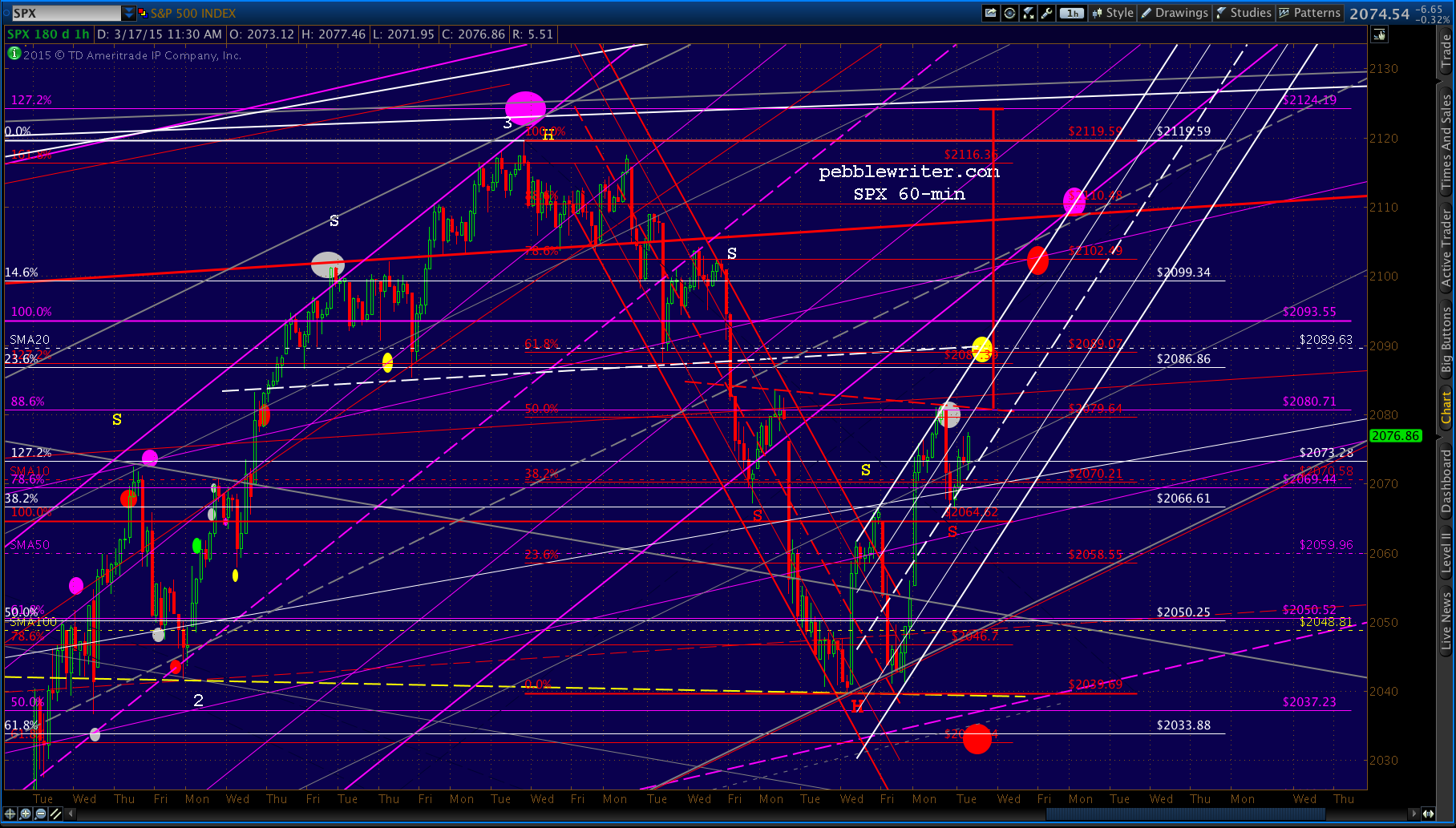
    The SMA10 is hanging on.  Note this is also the .786 channel line of the large rising white channel.  It was backtested on Mar 12, but broken in yesterday’s ramp job.

    2015-03-17-SPX 60 0715Forecast coming up.

    continued for members...

    Note the gray channel I’ve added in the mix.  I don’t expect this to hold, but we might find it a useful reference point in terms of the scenario that’s being suggested.  The bottom overlays the TL from mid-October, and I’ve placed the top such that the midline captures several past reversals.

    Assuming SPX can get past the SMA20, the midline also intersects with the broken purple channel bottom for a backtest Thursday morning at the red .786 (or next Tuesday the 24th at the .886 at 2110.48.)

    The downside case (yes, there still is one) remains the white .618 at 2033.  The move up from 2039 to 2080 did avoid completing the H&S Pattern.  But, it also might have constructed a 4th wave of a 5-wave 61.8% retracement from 2124.

    Remember how we commented about VIX being a good indicator of what they really have in mind?  And, how the small red channel’s breakdown yesterday might be a head fake?  Check it out this morning:

    2015-03-17-VIX 60 0804All of the above is pure conjecture, and will  of course depend on whether oil really did hit bottom this morning and what the FOMC tells us tomorrow.

    Personally, I don’t expect a rate increase or a promise of a rate increase — for reasons that we’ve discussed many times.  The US can’t afford one any more than it can afford a higher dollar.

    UPDATE:  2:25 PM

    All I can say is “wow!”   The TPTB are so terrified that the “market” won’t be able to hold its own that they had to once again ramp USDJPY up out of the obvious direction it was heading.

    2015-03-17-USDJPY 60 1122Or, perhaps the brief breakdown through the gray channel bottom was just a head-fake.  I don’t know.  All I know is they succeeded in pushing SPX back above the SMA10.

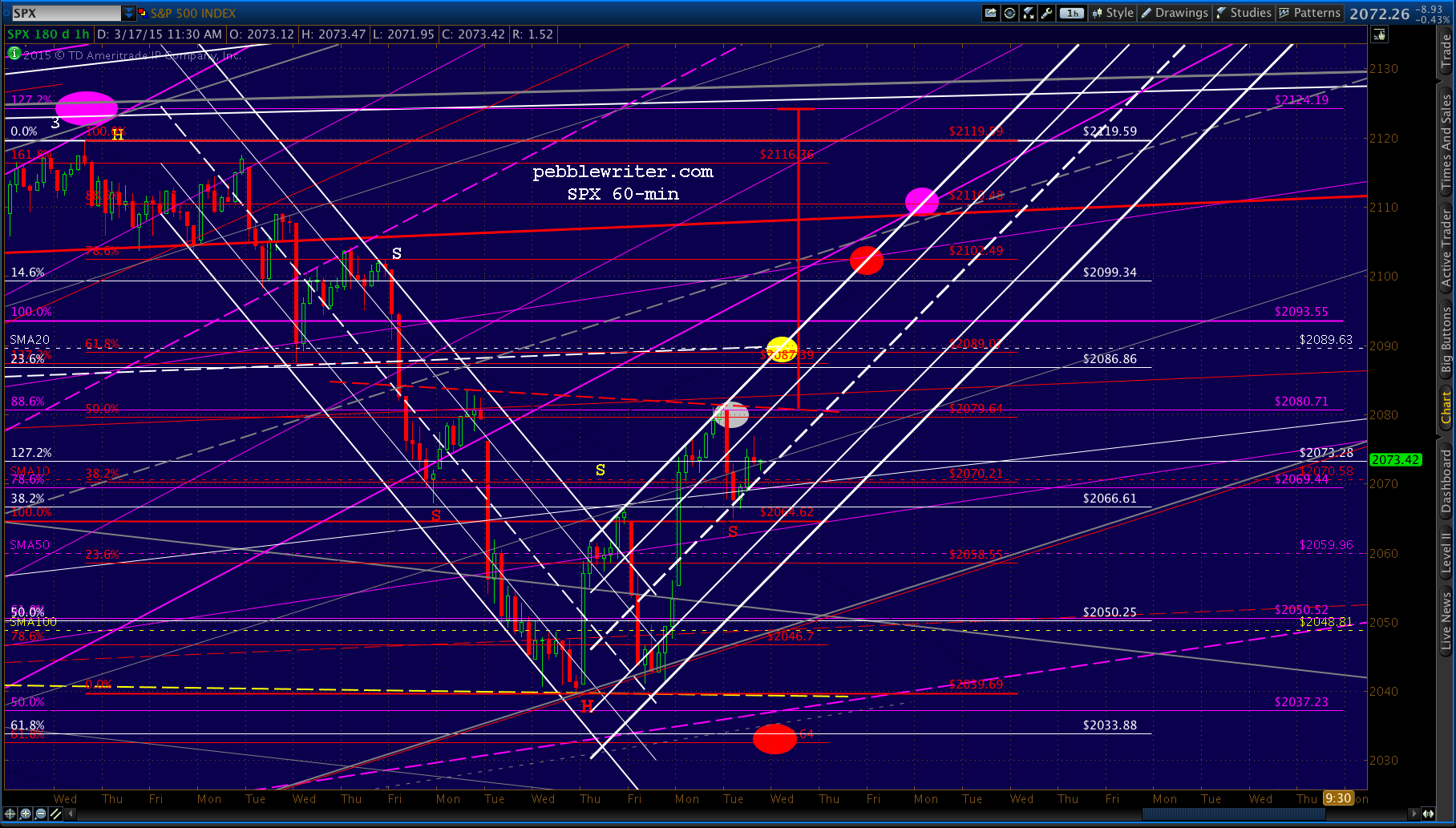
    2015-03-17-SPX 60 1122In light of this development, it’s worth noting that SPX is 7 points away from completing an IH&S (at 2080.80) that targets 2124.14.  If that’s the next stop, the rising white channel below would reach the yellow dot tomorrow morning and the red dot Friday morning.  The purple dot looks more like Monday morning.

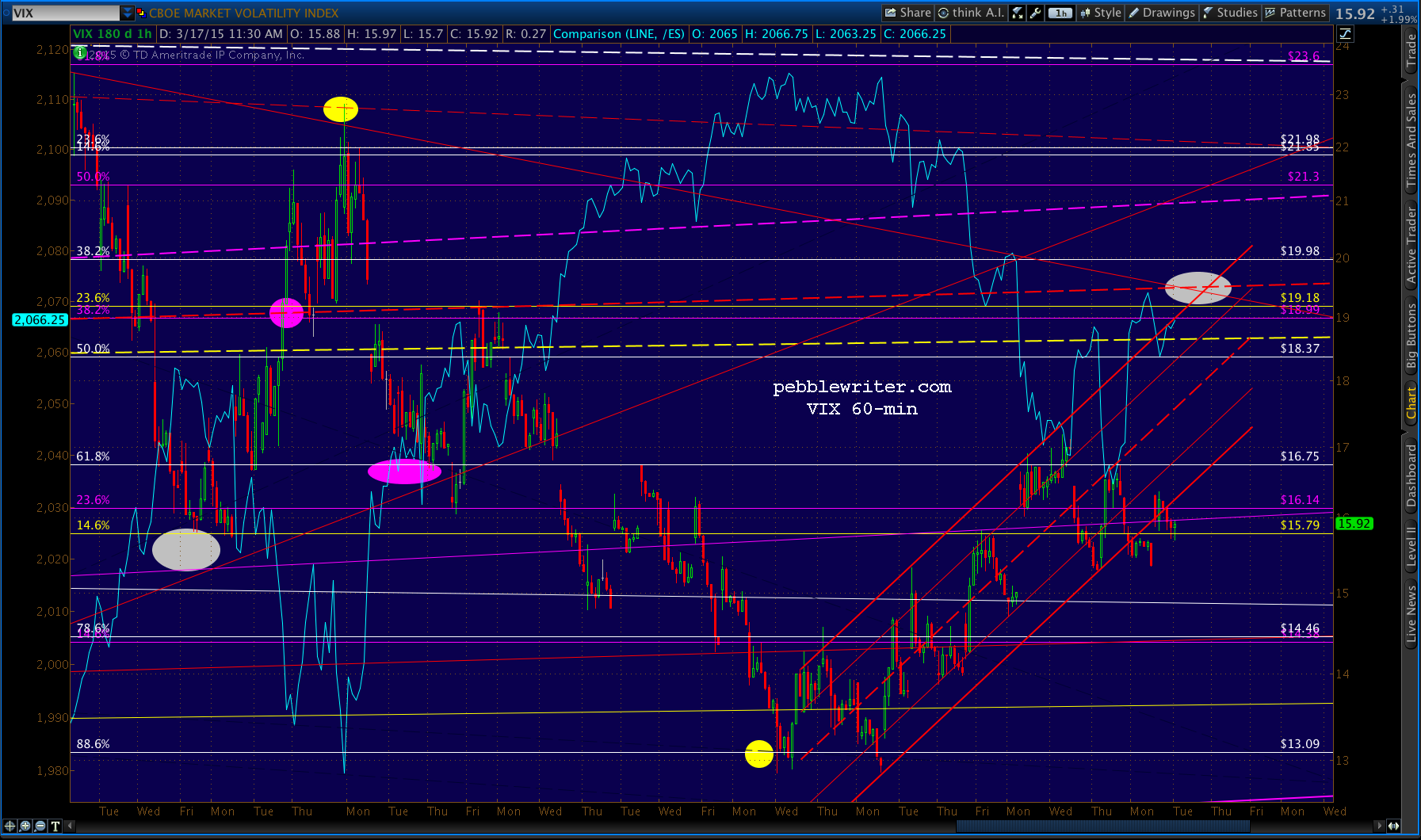
    2015-03-17-SPX 60 1154VIX’s earlier promising signal has petered out, falling back out of the rising red channel at this time…

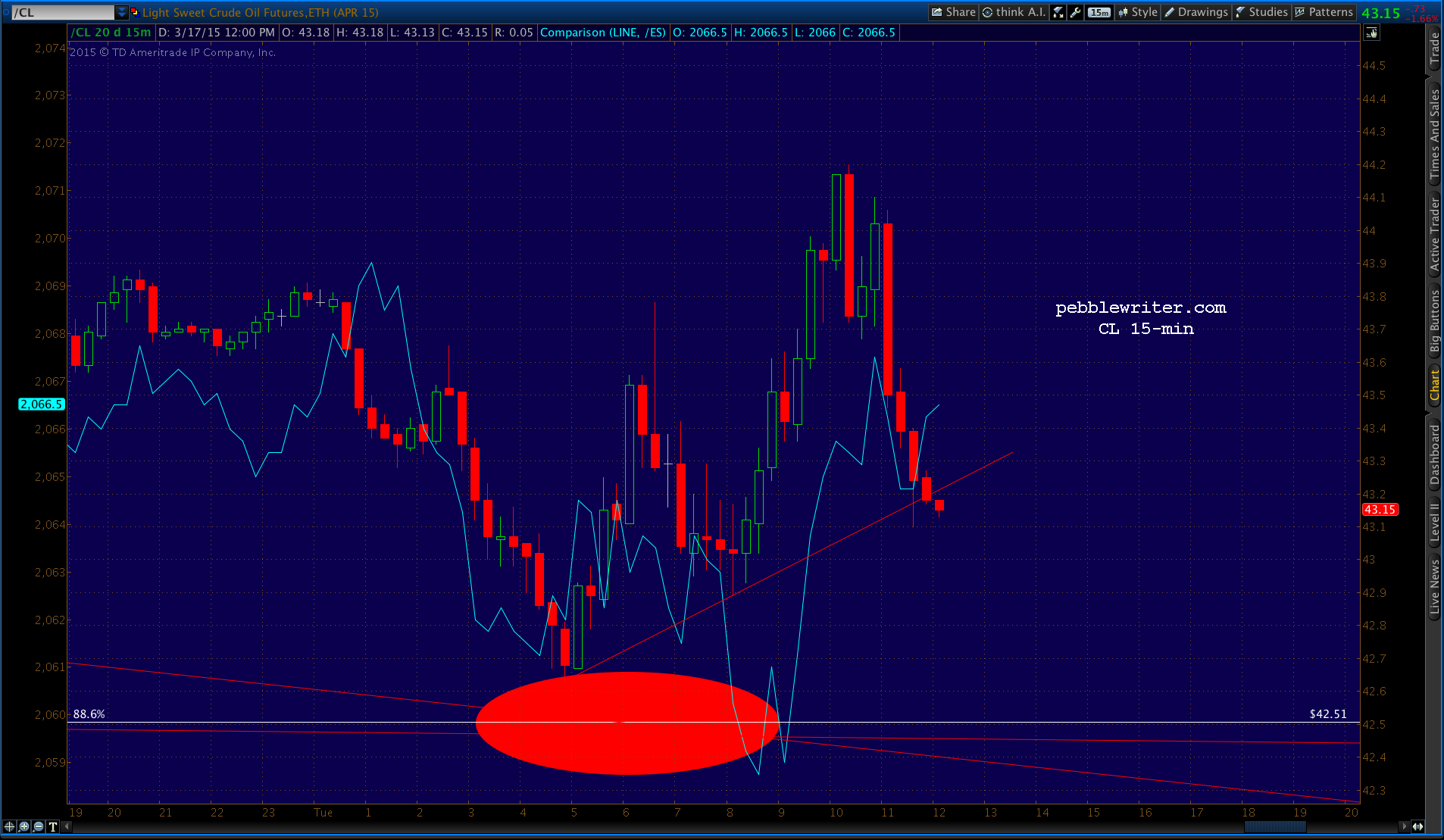
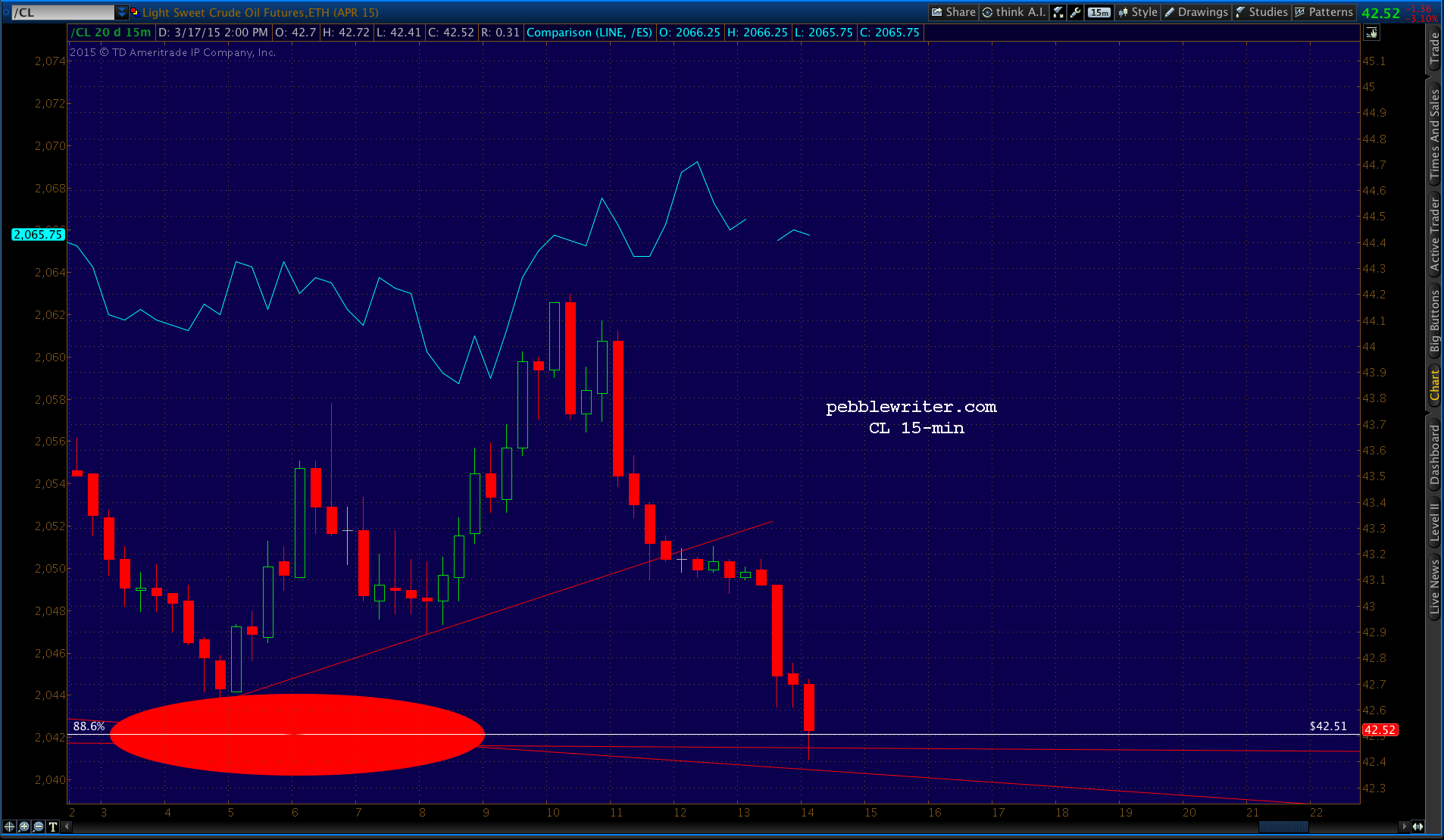
    2015-03-17-VIX 60 1154…as CL dips below the TL off this morning’s lows.  With an hour to go, will we have a repeat of yesterday’s ramp job transitioning into an after-hours reset?  Or, maybe a breakdown in the final hour to actually tag 42.51?  Stay tuned.

    2015-03-17-CL 15 1154UPDATE:  3:15 PM

    Here’s a better look at the SPX chart showing the 2124 IH&S target.  Note that it would just about tag the rising white channel top at the purple 1.272.  2015-03-17-SPX 60 1216

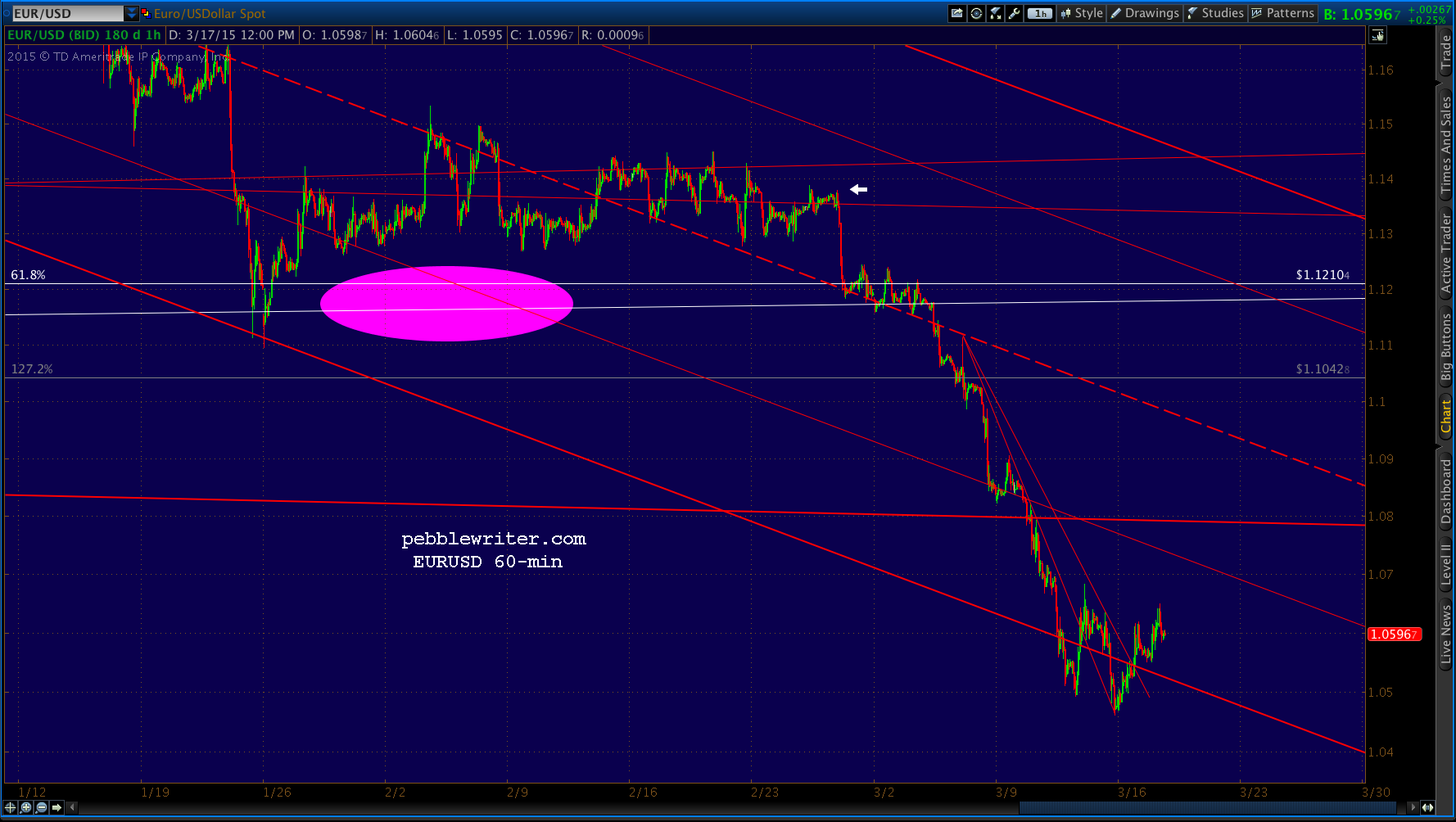
    This was the target back on Feb 25.  It looked awfully darn certain until the euro decided to collapse.  The white arrow below corresponds with SPX’s 2119.59 top.

    2015-03-17-EURUSD 60 1215UPDATE:  5:40 PM

    Lovely…

    2015-03-17-CL 15 1415

  • Update on Oil: Mar 17, 2015

    Crude light (CL) is about to tag our 42.51 target — completing a Bat Pattern at the 88.6% retracement of the rise from 33.20 in Jan 2009 to the peak of 114.83 in May 2011.  We’re looking for a significant bounce.

    2015-03-17-CL wkly 523amClose-up on the 60-min chart:

    2015-03-17-CL 60 450amIn our last dedicated update [see: Jan 6 Update] we noted the trend line connecting the Dec 12, 1998 and Jan 15, 2009 lows:

    We discussed the bleak channel and TL standpoint.  From a price Fibonacci standpoint, the next major support is another 13% lower — the white .886 at 41.49 [note: now 42.51 due to price adjustments for contract changes.]

    Since CL broke through the trend line a few days ago, we have been expecting this drop.  Also as expected, it occurred during the after-hours (lighter color in the chart below), so as not to upset equity markets which are much more easily propped up in light volume.

    2015-03-17-CL 60 523am As we discussed about a week ago [see: Those Wacky Central Bankers,] oil’s massive price decline is both a reflection of and perfectly suits the US’ needs:

    – strong dollar
    – low inflation
    – low interest rates
    – continuation of the yen carry trade
    – penalties for our “enemies”

    In fact, oil’s decline was quite possibly the only major economic event which could have satisfied all of those critical needs — leading me to believe it was a deliberate take-down.

    From a chart pattern standpoint, failure of a 17-year trend line is a big deal.  But, so is completion of a Bat Pattern.

    2015-03-17-CL wkly ES divergSo, it’s going to be very interesting to see whether oil will rebound here as it normally would for technical reasons or continue to fall (or, at least flatline) because that’s the corner into which central banks have painted us.

    My gut tells me we’ll get a decent bounce that boosts stocks and allows USDJPY to reset (or, at least backtests the .618 at 120.11.)  A typical bounce after completing a Bat Pattern would be to the .618 Fib which, in this case, is 64.38 — so, we’ll put a pin in it. Though, that high a bounce could undo many of the benefits from this latest plunge.

    Stay tuned.

  • Charts I’m Watching: Mar 16, 2015

    The big story in the markets overnight is crude’s near collapse below the trend line from 1998 to test its Feb lows.

    2015-03-16-CL 60 0600The long-term chart:

    2015-03-16-CL weekly 0710But, USDJPY came to the rescue yet again, popping up to test (5th time) the falling red TL upper bound with a threatened breakout…

    2015-03-16-USDJPY 60 0600…and sending ES scurrying higher overnight.  It’s currently showing a 12.75 gain and backtesting the .382.

    2015-03-16-ES 60 min 0600The stage is set for SPX to pop and drop. But, the ramp job should get it up over the SMA50 at 2059.27 in the opening minutes.  So, it’ll be interesting to see whether it takes the bait.

    Note that USDJPY has backed off the channel top, and is signalling a retest of the white channel midline or lower — but, not until it’s done providing cover for oil

    2015-03-16-USDJPY 60 0630It now appears more likely that the backtest of the yellow .618 at 120.11 might wait until Wednesday — perhaps as the initial kneejerk reaction to the Fed announcement.

    continued for members(more…)

  • Update on the Dollar: Mar 13, 2015

    In October 2013, after the dollar had reached our long-held 79.60 target, we naively opined:

    The dollar finally reached our 79.60 target [see: Sep 20 Update] overnight and should see a bit of a technical bounce here at a large scale .886 (white) and medium scale 1.618 (purple.)

    It wasn’t a completely ridiculous call — just naive.  DX had recently broken down through a long-term channel bottom (red below) and an even longer-term channel midline (in white.)

    https://pebblewriter.com/wp-content/uploads/2013/10/2013-10-18-DX-since-May-2011.png

    We observed that a declining dollar in the US — a net importer — usually leads to an increase in CPI.  This was troubling, as it seemed the dollar was due to fall further at a time when inflation had already bounced off long-term lows.

    I suppose someone in the central planning control room was thinking the same thing.  Because, they put a floor (dashed yellow line) under the dollar right then and there.

    2015-03-13 DX wkly 1500The yen plummeted from 100 to 122 to the dollar (its high earlier this week) and the euro plummeted from 1.39 to about 1.05 USD.

    As we discussed yesterday [see: Those Wacky Central Bankers] this was not a random occurrence.  Along with oil’s take down, it was a carefully orchestrated exercise that — among other goals — would shift inflation from the US (which wasn’t prepared for it) to Japan and the eurozone.

    By keeping inflation under control, interest rates could also be kept at a manageable level — an important issue when a return to historical norms would triple the country’s annual debt service.

    Equally important, a plunging yen would keep the yen carry trade alive and stock prices on an upward slope. For details on the BOJs role in inflating markets, see: Invasion of the Market Snatchers — a 3-part series which began today.

    Nothing lasts forever, as they say.  And, the dollar is approaching its next major hurdle.

    continued for members(more…)

  • Update on EURUSD: Mar 13, 2015

    When we last examined EURUSD [see: Jan 23 update] it had just reached our Dec 3 target at the .618 Fib level of 1.12.

    2015-01-23 EURUSD wkly 1000

    We were looking for a bounce, but its magnitude was a big question mark.

    The degree of any technical bounce is a bit tricky.  It would take a lot of short covering to effect a meaningful retracement.  After all, the ECB is officially trashing the euro to the tune of 1 trillion bucks.

    The widely held expectation is that the Fed will “soon” be raising US interest rates, and therefore strengthening the USD — a viewpoint we don’t share, by the way.  If we’re right, and US rates remain low or trend even lower, this will put pressure on the dollar and, in return, strengthen EURUSD.

    We speculated about whether our next downside target of .9898 might not arrive until later in the year, and left readers with the admonition:

    Keep an eye on this critical support here at 1.1210.

    That support has since been crushed underfoot by the thundering herd scrambling for the exits.  The bounce off the .618 never got above 1.1533 and lasted only 22 sessions.

    2015-03-13 EURUSD daily 1300What’s worse, it now’s now in danger of losing all support all-together.  continued for members... (more…)

  • Invasion of the Market Snatchers

    The Wall Street Journal recently reported that, over the past two years, the Bank of Japan has purchased stocks on 96% of the days when the market opened lower or closed lower after initially opening higher.  In this two-part series, we’ll pick up where the Journal left off and examine how this activity by the BOJ — now the single biggest owner of Japanese stocks — has led to a bigger stock market bubble than in 2000 or 2007.

    *  *  *  *  *

    pods
    “Looks harmless enough. I’ll just give it a little poke and… hey, what the–!?”

    What do you call it when it looks like a market, walks like a market, sometimes even quacks like a market… but it’s not like any market ever before seen on this earth?

    One of the more interesting articles I’ve seen in quite a while is this Wall Street Journal article published Wednesday that discusses how, for the past five years, the Bank of Japan has been — and, you should probably sit down for this — manipulating the markets!   I know, I know.  Shocking, right?

    This is hardly news to pebblewriter members.  We’ve lamented it ad nauseum for years.  But, the article caught my eye because it’s one of those rare few mainstream media articles that openly discusses a practice which many investors regard as conspiracy theorist delusions.

    The Prologue

    The BOJ first obtained approval to buy ETFs and REITs back in 2010.  Like the S&P 500, the Nikkei 225 had tumbled about 60% during the crash.  Unlike SPX, which didn’t bottom out until March 2009, NKD hit bottom (7425) in October 2008.  And, in a remarkable coincidence, again in March 2009 (yes, exactly 7425.)

    Also unlike SPX — which regained a Fibonacci 61.8% of its losses by April 2010 — NKD regained only 38.2% (also a Fib) of its losses.  On the way to there, it dipped to 9490 — not once, but twice.

    So, when it dipped a third time (yes, to exactly 9490) it set up what we chartists call a Head & Shoulder Pattern.  The chart below shows each of the two shoulders marked with a red “S” and head with an “H.”

    2015-03-13 NKD daily 2009-10The only thing necessary to complete the pattern was a substantial bounce and a subsequent drop below that dashed red line (the “neckline”) at 9490 — which was delivered on August 24, 2010.

    The completed pattern targeted 7095 — a huge 25% decline.  The Japanese needed a 25% correction like they needed a 9.0 earthquake.

    Enter the Bank of Japan, which had plenty of experience with quantitative easing (QE) of the government bond buying and currency manipulation variety.  Maybe, just maybe, they could help out on the stock market front as well.  From the WSJ:

    BOJ officials used to be cautious about purchasing ETFs, worried that it could distort market activities and put the central bank’s own financial health at risk.  But, under pressure from politicians following the global financial crisis, the bank changed its stance in late 2010.

    “We led the cows to water, but they didn’t drink it, even though we told them it tasted good,” Miyako Suda, who was a board member then, wrote in a a 2014 book discussing monetary easing at that time.  “So we thought we should drink it ourselves, showing them it was tasty.”

    The BOJ rushed through a plan to purchase ¥76 trillion (then, about $1 trillion USD) in “tasty” financial assets that included ETFs and REITs.  From the Principle Terms and Conditions:

    Screen Shot 2015-03-12 at 11.17.38 PMThe rumors that the BOJ would actually be buying stocks — trillions of yen in stocks — were, alone, enough to send the Nikkei scampering back above that neckline.  By the time the program was actually instituted, NKD put 9490 in its rear view mirror for good.

    2015-03-12 NKD daily 2009-2010Or, so everyone thought.

    next: the pods open…


  • Charts I’m Watching: Mar 13, 2015

    SPX broke out of the falling white channel yesterday… 2015-03-13 SPX 60 0615…largely on the back of USDJPY, which rallied sharply…

    2015-03-13 USDJPY 60 0615…to offset CL, which tumbled to our target — in the after-hours, of course.  When it comes to manipulating prices higher, it’s important to backfill at night, when the e-mini volume is light enough to prop it up cheaply.

    2015-03-13 CL 60 0615Now that the cash markets are open, let the spoofing begin!

    continued for members(more…)

  • Charts I’m Watching: Mar 12, 2015

    SPX reached the SMA100 yesterday, less than six points from our target of 2033.88 — but, couldn’t quite punch through.  The target remains unchanged from Mar 4.

    2015-03-12 SPX 60 0600We’re watching to see whether or not the overnight ramp job can hold, with futures currently up about 7.50.  2015-03-12 ES 60 0610USDJPY is being rather coy — bouncing off the easy initial red TL support after reaching our first downside target: the white channel midline.  Had it happened during trading hours, SPX would have bagged 2033 by now.  We’re still looking for 120.11.2015-03-12 USDJPY 60 0615 0600And, CL — which reached our 47.66 target yesterday — is back in the rising purple channel (for now.)  If it’s going to break down and tag our 45.86 target, today really is the day.

    2015-03-12 CL 60 0610The two most interesting charts are DX and EURUSD.  Both are showing a bit of a reversal, which — when it occurs for real — will be the biggest potential game changer around.

    continued for members(more…)

  • Those Wacky Central Bankers!

    The euromess continues to have everyone on edge. The genius of Mario Draghi is that he trashed the euro and took interest rates below zero without having to do much besides flapping his gums.

    2015-03-11-EURUSD daily 0620The idiocy of Mario Draghi is that the euro and eurozone interest rates have sunk so low, no one knows whether or how they’re going to stabilize now that QE has finally begun.

    The global markets have risen to stratospheric heights on the back of dollar strength and yen/euro weakness, plain and simple. We’ll take a fresh look at the current state of the carry trade in the next few days.  But, even the White House admits that dollar strength is becoming a fundamental problem.

    And, while some believe the yen will fall further (140 is tossed around quite a lot), there is increasing pushback by the Japanese consumer and businessman alike (see: HERE.)  If not for the plunge in the price of oil (which is trying to find support here, by the way) Japan would have way more inflation than it can manage.

    2015-03-11-CL 60 0711Contrary to Abe’s fairy tale figures, overall inflation reached 4.4% last May, and has since backed off to 2.8% thanks to energy.  But, fresh food prices are up 15% since November. And if, as I suspect, oil has bottomed out for now, Japan Inc. will be hard pressed to flog the yen any further without deepening the death spiral in which it already finds itself.

    20140902_citi3We’ve speculated as to whether the ECB can (let alone should) accomplish the same results as the BOJ.  The eurozone has a definite deflation problem.  So, to the (very questionable) extent that QE could solve that problem, buying up €1.1 trillion in bonds might seem like a good thing.  The “markets” would certainly appreciate the injection of cash.

    But, where to put €1.1 trillion?  As the research shows, there just aren’t enough attractive, eligible bonds laying around.  And many of them already feature negative yields.  Buying them at current prices already guarantees an investor will lose money.  Can the fractious eurozone support such an endeavor, especially when voters come to realize they won’t benefit one iota?

    Then, there’s the dollar.  If the euro and the yen continue getting cheaper, it would obviously continue to rise in value.  US consumers are happy as clams pumping cheaper gas into their cheaper Toyotas and Mercedes. But, the handful of exporters still kicking in the US are hurting.

    And, there’s that elephant in the room: how to take central bankers’ big, fat feet off the gas without reversing all those carry trades and crashing the global economy (along with stock markets everywhere?)

    The last time oil prices plunged like this, stocks reflected the concurrent economic weakness.  This time, they haven’t — at least, not yet.

    2015-03-11-CL v SPX wklyIs it because economic conditions aren’t all that bad, and the oil price decline is out of sync?  Or, perhaps the economy is in big trouble, as oil accurately reflects; and, stocks are being driven higher by unrelated factors.

    We think the actual answer involves a little of each.  Let’s summarize:

    JAPAN

    1. Japan’s economy is circling the drain.  It has gone all-in on QQE in order to stay alive.
    2. Japan’s plummeting yen has fueled the carry trade, driving stocks everywhere higher.
    3. Japan’s plummeting yen was crippling consumers and businesses — until oil plunged.
    4. The BOJ is officially monetizing the Japanese gov’t (and increasingly its stock “market.”)
    5. If inflation remains under control, the yen could be trashed even further.

    EUROZONE

    1. The EZ’s economy is circling the drain.  It just instituted QE in order to stay alive.
    2. The plunging euro has also helped fuel the carry trade.
    3. The plunging euro has not impacted consumers yet — again, thanks to low oil prices.
    4. The ECB is indirectly monetizing eurozone governments.
    5. Deflation is a huge and real concern.

    UNITED STATES

    1. The US economy has seemed fine on the surface; in reality, it’s faltering badly.
    2. The soaring dollar has helped fuel the carry trade.
    3. The soaring dollar has helped consumers due to lower oil and other import prices.
    4. The Fed has ended QE (for now), but has zero desire to see interest rates rise.
    5. Inflation is under control (for now), but could soar if the dollar plunged in value.


    How do all these factors explain the current state of affairs? Let’s put it all together.

    The driving force is the US, which desperately needs inflation and interest rates to remain under control. Otherwise, the nation’s debt service payments would get out of hand, the bond bubble would burst and equities would plummet. It also needs consumers to increase borrowing and spending.

    One key element is lower oil prices, which are largely a factor of a strong dollar and increased domestic production.

    While oil and gas capital expenditures total about 10% of US CAPEX, they represent only about 1% of US GDP. In other words, the US can weather the price decline without much damage to the average American or to GDP (employment is another matter.)

    Keeping oil prices low allows Japan to maintain its QQE and incentivizes the ECB to increase its QE — thus supporting the carry trade and continuing stock “market” expansion.  It also offers the side “benefit” of punishing Russia for its actions in the Ukraine.

    If oil prices were to rise and/or the yen fall much further, Japan’s will to support the carry trade might falter.  The eurozone, on the other hand, is ostensibly open to higher oil prices in order to increase inflation.  It’s an idiotic bold experiment that is likely to end in failure as it did in Japan.  But, that’s a crisis the next crop of kleptocrats can deal with.

    How about our Middle East “friends” and the good folks at Big Oil?  OPEC doesn’t seem too alarmed by falling oil prices.  It’s the (temporary) cost of stifling shale oil & gas production in the US, not to mention chipping away at ISIS oil revenues which have been estimated at $3 million/day.

    And, Big Oil — while taking a beating on last quarter’s earnings — is likely licking its chops at the cheap reserves that will come available as more highly leveraged and less stable companies go belly up.  We wouldn’t be surprised if the majors were not only well aware of the decline, but helped orchestrate it, too.

    So, yes (in case you were wondering), we suspect oil’s abrupt decline was scripted — engineered in order to meet the otherwise conflicting needs of the G7 for low interest rates, low inflation and rising stock prices in the face of a global economic slowdown.

    Will it work? Absolutely! *


    (* until it doesn’t)