
Tag: oil

  • Why the Market Didn’t Correct Today

    Hint: it’s the same reason the “market” hasn’t corrected much at all for the past six weeks.  And, no, there’s no free lunch involved.

    The day started with some tragic news out of Brussels.  ISIS terrorists attacked innocent civilians at the airport and a metro station, killing dozens and wounding hundreds.  Brussels is the de facto capitol of the EU, so the attack understandably sent investors scurrying for cover.  Only, it didn’t last — thanks to crude light (CL.)

    For those who weren’t watching, CL spiked almost 3% in about 90 minutes on absolutely no news whatsoever.  Why?  Because, stocks were selling off.  That’s it.  If you don’t believe me, read on.

    2016-03-22 CL 5 0807 SPX had dropped almost 10 points (0.5%) in the first 5 minutes of trading.  This took it directly to a trend line connecting the last two lows (3/16 and 3/22) seen below in red.  It dithered here for a few minutes, then broke through the TL and started lower — seemingly to backtest a rising channel line or the 200-day moving average.

    2016-03-22 SPX 5 0807But, at exactly the same time that SPX reached that trend line, CL swung into action.  It reversed higher, pushing up through its short-term moving averages and, ultimately, through two falling TLs of its own.  It didn’t stop until it had topped yesterday’s highs.

    This would normally be highly unusual, given that CL had just broken down through a TL (from Mar 15) and reversed at a key Fibonacci level (the white .618 at 41.42.)

    2016-03-22 CL 15 0837But, it is most decidedly not unusual for CL, which has taken over from USDJPY as the single most influential driver of equity algorithms.  Needless to say, SPX reversed back above its broken TL and went on to register new highs for the fifth session in a row.

    How it Works

    Want SPX to stop dropping, or even reverse higher?  How about popping up through important overhead resistance?  All it takes is a sudden spike higher by CL.  The chart below illustrates how commonplace it’s been in the last few sessions.2016-03-22 SPX 1 0837The first instance on the chart above was when CL gapped higher in order to get SPX up past its SMA200.  There were many other instances when CL either reversed or at least propped up SPX (the yellow arrows.)

    Occasionally, an intraday SPX backtest of a Fib is prompted by a CL drop.  But, for the most part, CL’s drops are limited to after-hours — when S&P 500 futures are easily propped up in the light volume.

    When the “market” reopens in the morning, CL has already been reset and is ready to spike higher all over again in order to support SPX for the next 6 1/2 hours.  It’s been going on for months.  But, it’s never been more obvious than since our bottom call on Feb 11 [see: USDJPY Finally Relents.]

    The Unbroken Broken Channel

    CL traced out a rapidly rising (white) channel from Feb 11 to Mar 14, at which point the channel broke down (the red arrow.)  Normally, this would portend a reversal of some significance.

    2016-03-22 CL v ES 5 0931This breakdown occurred as SPX had finally climbed back to its 200-day moving average — a 10.5% rally off its Feb 11 lows.  Again, normally we’d see a significant reversal upon reaching major overhead resistance such as this.  Combined with the CL channel breakdown, it looked like a sure thing.

    Instead, it was limited to a minuscule 13 points.  And, few traders would have had the nerve to participate.  It came on a gap lower following a 3-day, 54-pt rally that saw SPX slice through the SMA100 without blinking and close above the SMA200 two days in a row.2016-03-22 SPX 60 1500Why such a puny reaction?  First, CL not only cut short its decline, it pushed back above its SMA20, SMA100, a TL from June 2015 and the midline of a channel from Oct 2012.  Second, just for good measure, it even gapped right back into the channel from which it had broken down (the yellow arrow above.)

    After already spiking 49.6% (in the face of obviously deteriorating fundamentals) between Feb 11 and Mar 11, this latest CL spike amounted to another 18.2% off the Mar 15 lows.  In those five sessions, it lifted SPX a total of 51 points (2.54%), with each day seeing a new higher high.

    What Happened Today

    Though it’s not particularly unusual, today’s action clearly illustrates the manipulation going on.  Note that CL broke down again from its rising white channel this past Friday.  It seemed destined for a backtest of its 10-day moving average (at least) when it was pressed into duty to prop up SPX.

    2016-03-22 CL 5 1500It bounced around a bit while SPX found its feet, then zigzagged higher until SPX backtested a little H&S neckline (purple.)  When SPX faltered there, CL suddenly popped up through a TL that had connected its overnight highs.  With SPX threatening to reverse lower, CL suddenly broke out through a TL (white) that connected the highs made since last Friday.  This drove SPX up over the neckline.

    With SPX back on track, CL was free to fall back below the white TL.  And, it was time for USDJPY to take over. 2016-03-22 USDJPY 5 1500

    USDJPY had sprung to life just as SPX had reached the neckline, zooming back to the top of the channel whose bottom it had briefly broken as the terrorist attack hit the newswires.  It was a strong 1% move in about 10 hours, and involved USDJPY breaking out through a TL (red, dashed) it had established overnight, and again through a TL (white) connecting Monday’s highs.

    But, after reaching the top of the rising red channel, USDJPY had nowhere to go.  With oil prices having increased so much over the past month, the Japanese need a strong yen to compensate — hence USDJPY’s flatlining since Feb 11 (there’s that date again.)2016-03-22 USDJPY v SPX 5 1500SPX saw USDJPY’s predicament, and started back down — only to be rescued again by CL, which not so coincidentally maintained an uptrend until the close.  At that point, it was free to reset — which it did.  It’s not free to do it all over again tomorrow if TPTB deem it desirable. 2016-03-22 CL v SPX 5 1500

    What Now?

    Speaking of TPTB, who’s behind this daily manipulation?  Some blame the big banks, which have much at stake in the energy sector.  I favor the central banks themselves, especially the BoJ.  It has a huge equities portfolio.  By my calculations, it costs about 5-10 cents on the dollar to prop up SPX with CL — a bargain if there ever was one.

    I firmly believe that central banks colluded to crash oil in order to keep the yen carry trade alive.  But, it got out of hand.  Oil companies started suffering.  More importantly (to the central banks, anyway) the banking industry started to suffer.  There came a point (probably about Feb 10) that they decided it was time for prices to recover.

    This was tricky, because with a terribly devalued yen (sky-high USDJPY) higher oil prices were a burden Japan couldn’t bear.  This explains why USDJPY has repeatedly returned to the Feb 11 lows (a more valuable yen) while CL and, hence, SPX have soared.2016-03-22 USDJPY v ES 60 1500How long can this go on?  It pretty much depends on us.  The stock “market” has rallied nicely, which benefits those with substantial equity portfolios.  But, the 64% spike in CL since Feb 11 amounts to a tax on everyone else.  The average price of regular unleaded gas has risen over 18% since Feb, making a mockery of central banks’ relentless “we need more inflation!” mantra.

    When rising gas prices are again deemed a problem, or start to show up in official inflation data, CL’s run will be over — not a moment sooner.  At that point, look for the yen carry trade to return in all its glory.  Or, maybe by then, the ECB will have established the euro carry trade.  Or, maybe the whole steaming pile of crap will implode under its own weight.

    As always, there will be winners (the “haves”) and losers (the “have-nots.”)  Guess which constituency TPTB will bend over backwards to protect?


  • Drumroll Please…

    In our October 6 update on oil [see: Update on CL] I expressed skepticism regarding oil’s ability to continue rallying.  It had just popped 30% off the Aug 24 lows, and had broken out of a triangle formed while digesting those gains.  Still, I saw it declining rather than making new highs.

    …lower prices make sense.  And, they’re necessary — particularly in light of the critical yen carry trade.  Japan can’t very well devalue the yen against the dollar unless oil — which is denominated in USD — declines to offset the currency effect.

    Yes, it means that marginal players — like the entire shale industry — will be decimated.  But, that’s a sacrifice that central banks are willing to make.  The health of the oil industry versus the wealth effect of trillions in rising equities?  No contest.

    I was wrong about CL declining right away.  It didn’t start until October 9.  2015-12-29 CL 60 0600continued for members

    (more…)

  • Update on Oil: Jan 6, 2015

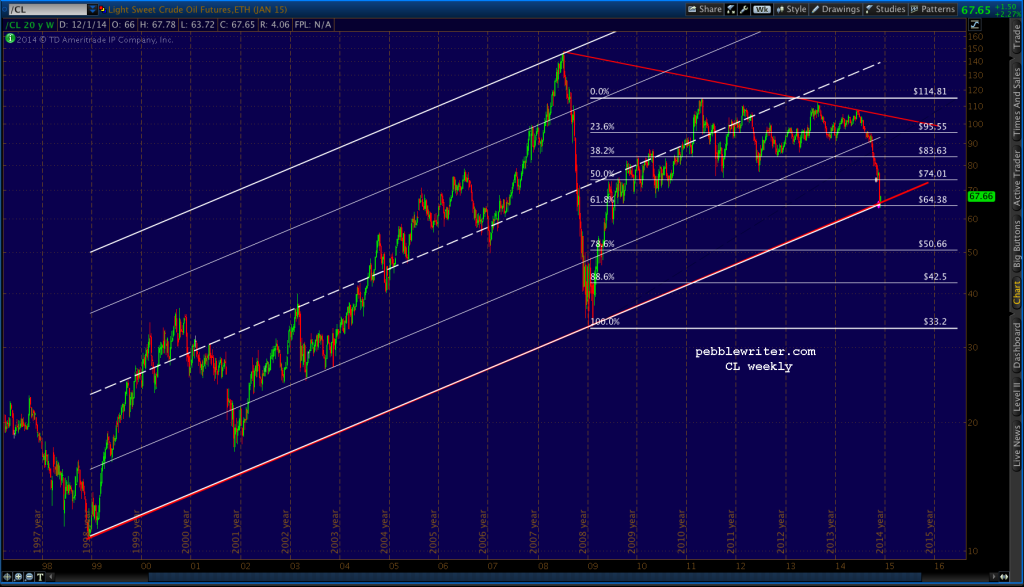
    A little over a month ago, we wrote that crude light (CL) had reached a two month-old target and what appeared to be a potential buying opportunity: the intersection of a key Fibonacci level and a long-term channel bottom.

    2014-12-01-CL weekly 0800

    We were pleased with that call…until the rebound ran out of gas only a day later.

    Some say the continued decline is Saudi Arabia’s way of bringing US shale growth to a screeching halt.  Others suspect that it’s the US government at work, tanking Russia’s oil-dependent economy.  It’s also possible that that chart, for all its symmetrical beauty, was drawn in the wrong scale.  I’ll explain.

    I chart just about everything in logarithmic scale — particularly those charts that span a long period of time and contain large swings in price.  But, once in a while — for no particular reason — an arithmetic chart just makes more sense.

    Here’s the updated chart in logarithmic scale in all its channel-busting ugliness.

    2015-01-06-CL wkly log 1400Switching to arithmetic scale, it’s obvious that the white channel doesn’t even belong.  Before clicking back to that cat video, though, check out the alignment of the 1998, 2001 and 2009 lows — connected here by the yellow dotted trend line.

    2015-01-06-CL wkly arith 1400A trend line that goes back that far is certainly subject to placement error (to use the tails or not?)  But, simply connecting the Dec 12, 1998 and Jan 15, 2009 lows puts that TL at about 45-46 — a couple of points below today’s low — and, not too far from the white .786 Fib.

    Does it matter?  We’ll find out in the next few days.  If nothing else, it’s a good reminder to check out the alternative view from time to time.  A casual perusal of the blogosphere reveals plenty of folks who chart arithmetically.  Maybe this is one of those times when log scale wasn’t the best choice.

    Suppose CL drops below 46.  What then?

    We discussed the bleak channel and TL standpoint.  From a price Fibonacci standpoint, the next major support is another 13% lower — the white .886 at 41.49.  A time Fibonacci chart shows that the June 2014 highs (the red 1.618) were right in line with the major low in 1998 and high in 2008.  In other words…also bearish.

    2015-01-06-CL wkly arith 1430

    And, it’s probably not too crazy to start talking about the purple Fib lines.  If the 2009 low of 32.34 is broken, the purple .886 at 26.13 is pretty much the last line of defense until the 10.65 lows from the (drumroll, please) Last Century.

    Regardless of whether one looks at log or arith charts, the strong positive correlation between oil and stocks (SPX, in purple below) over the past 20 years is obvious.  It broke down this past year when stocks decoupled from, well… just about everything.

    But, given the level of financial institution involvement with the oil industry ($550 billion in bonds and loans since 2010), it’s probably safe to say that a continued slide in oil can’t help but leave a mark.

    2015-01-06-CL wkly arith 1440Stay tuned.

  • Ay, There’s the Rube

    Oil is often viewed as a proxy for economic health.  In a growing economy, energy consumption increases.  This increased demand generally pressures prices higher.  Likewise, a decline in oil prices often accompanies declining demand.

    That’s a greatly oversimplified view, of course.  It ignores such important issues such as Middle East tensions, weather and refinery anomalies, etc.

    But, the most important of these external factors is the US dollar — the currency by which oil is traded globally (for now.)

    A weakening dollar is great for the many US companies that export overseas.  In general, it makes dollar denominated assets — such as stocks, real estate, etc — more attractive to overseas investors which helps the US attract and retain capital.

    But, it makes foreign-sourced oil much more expensive.  This isn’t an issue if you travel everywhere via America’s world-class public transportation system.  But, it really sucks for the guy with a 3-ton SUV — or anyone who consumes anything made overseas, for that matter.  Imports are about 18% of GDP.

    So, what’s a central banker to do?  Boost stocks and investment in US assets, and there’s a pretty good chance you blow the budget of every American consumer.  (Of course, it only really affects those who eat and drive — hey, buy a Chevy Volt already!)

    Boost the dollar to make gas and food more affordable for the 50 million Americans living in poverty (1 in 5 children, 2 in 5 African American children), and you risk a true disaster — a stock market decline.

    Never fear… Bernanke and his fellow Guardians of the American Dream know whose bread to butter.

    The chart below shows how crude light, the US dollar and the S&P 500 correlated over the past seven years.  In 2006 and 2007, oil and the stock market soared pretty much in sync while the dollar took it on the chin.  When SPX topped in late 2007, oil kept right on soaring — because the dollar was still plunging.  Nationwide, gas hit $4.12/gallon in the summer of 2008.

    We’re all conditioned to think of dollar strength as a function of risk off.  But, as the financial crisis worsened, the dollar couldn’t catch a bid.  Money fled to the euro, the swiss franc, the sterling — anywhere but the dollar. There were several best-sellers on bookstore (remember those? shelves that advised putting every last cent into the euro.

    From October 2007, when SPX peaked, until July 2008, stocks and the dollar moved pretty much in tandem.  But, as euro zone problems became more apparent, the dollar finally bottomed.  In August, as stocks began sliding again, the dollar finally took off.  Now deemed a safe haven, DX soared 27% by March of 2009, while stocks shed another 54% in value (58% in all.)

    Of course, this did a number on oil — already reeling from declining global demand.  CL plunged an astounding 78% in only six months — from 147 to 33.  Fortunately for the stock market — and especially the oil industry — Ben Bernanke came to the rescue.  The first round of QE was a resounding success and both promptly reversed.

    In the first three months alone, CL more than doubled to 73.  SPX added on a respectable 44%.  And the dollar took one for the team, shedding an initial 13% on its way to an 18% loss.

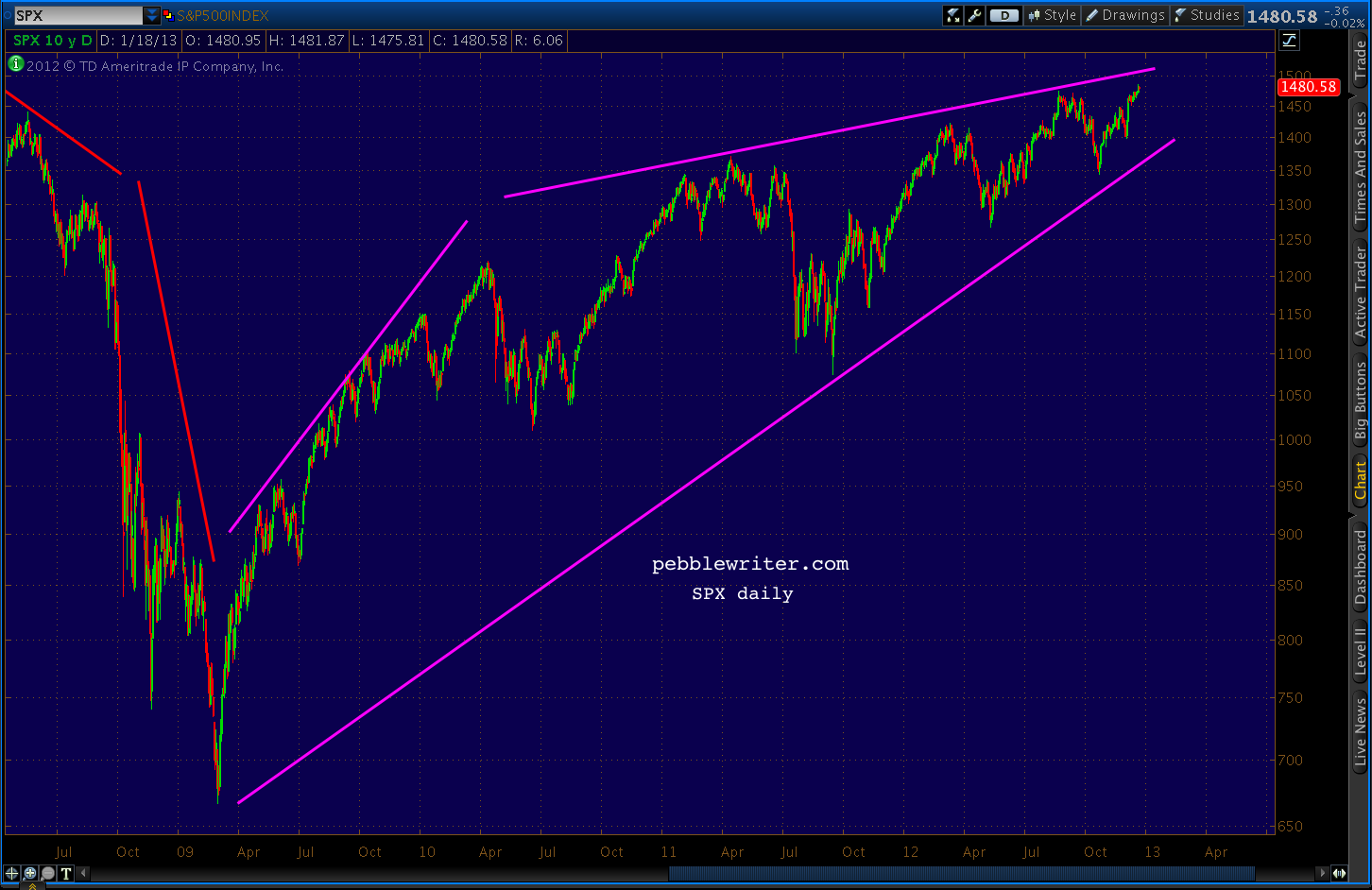
    So, why the history lesson?  By now most of you have noticed a slight discrepancy over the past 3 1/2 years.  Oil and the dollar have formed triangles.  They’ve had their ups and downs, but in general the highs have been getting lower and the lows getting higher.  I use the term “coiling” because eventually prices won’t be able to compress anymore.

    This pent-up energy will eventually be released in the form of sharply higher or lower prices, though it won’t necessarily happen tomorrow.   Both have drawn close to one side of the pattern, but there’s still plenty of room for a reversal.

    Oil, if it doesn’t suddenly shoot higher, will probably bounce back down.  Likewise, the dollar is poised to bounce higher.

    Stocks, on the other hand, have made a series of higher highs and higher lows in what’s known as a rising wedge.  These patterns also can’t last forever, and they almost always resolve to the downside.

    Prices are much closer to the upper bound than the lower, which also suggests the next major move will be lower.  In fact, when rising wedges break down, they typically target their origin. Needless to say, a return to 2009 or even 2010 prices would be a huge blow to the rosy scenario TPTB are crafting.

    Does oil offer any hints as to which way prices are likely to go?   I’m drawn to a few periods in particular.  From June 2009 to May 2010, oil gained 19% compared to SPX’s 27%.  Yet, they both shed roughly 20% in the May – June 2010 correction.

    We had another round of QE, which collapsed the dollar and sent stocks up 36% and oil up 70% through May 2011.  This time, SPX corrected 22% and oil 35% (through Oct 2011.)

    At that point, CL sold off strongly — dropping 23% through the end of June.  SPX, however, lagged.  It lost 8%, then promptly regained 90% of it in the next three weeks (compared to CL’s 40% retracement.)  When the slide continued, however, SPX caught up — in spades.

    It lost 80% of its gains from June 2010, while CL only lost about half that.  SPX then went on to make three new highs in a row, adding 38% through today’s close.

    CL managed an 88% retracement of its May-October losses for a 47% gain through Feb 2012, and has made two lower highs (each a 61.8% retracement of the previous high) since then.  Total gain from Oct 2011: 27%.  And, it’s been a fairly neutral currency market.

    I can’t help wondering what the oil and currency markets know that the stock market doesn’t.  A look at the CL charts indicates more downside.  Will SPX again play catch-up?

    Even ignoring what I suspect about the dollar and equity markets, CL presents a bearish picture.

    Whether it breaks down or out, CL is obviously at a turning point.  We’ll keep an eye on it…


  • Update on Oil: Sep 20, 2012

    Oil has tumbled the past few days, begging the question “what about QE3?”  It was supposed to prop up commodity prices.  There are many competing theories as to the influence of elections, Saudi assistance, etc.  But, the bottom line is CL had tagged some important channel lines and simply corrected.

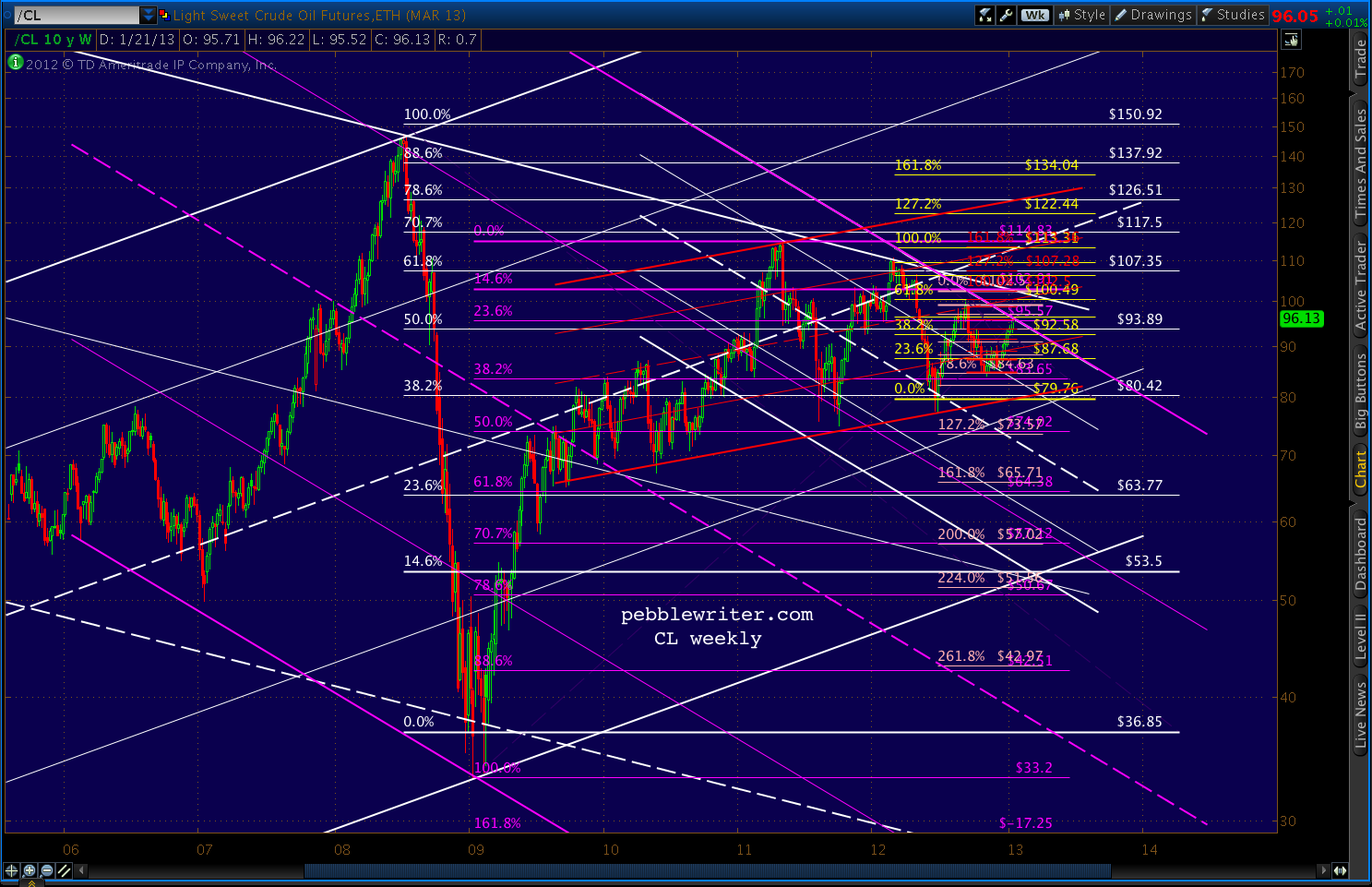
    There are some pretty obvious long-term channels, as well as two huge rising wedges. The first one broke down only 50% of the way to its apex in price, and 61.8 of the way in time, yet — as is often the case with early breaks — prices came back to tag the apex in time (as well as a major channel line.

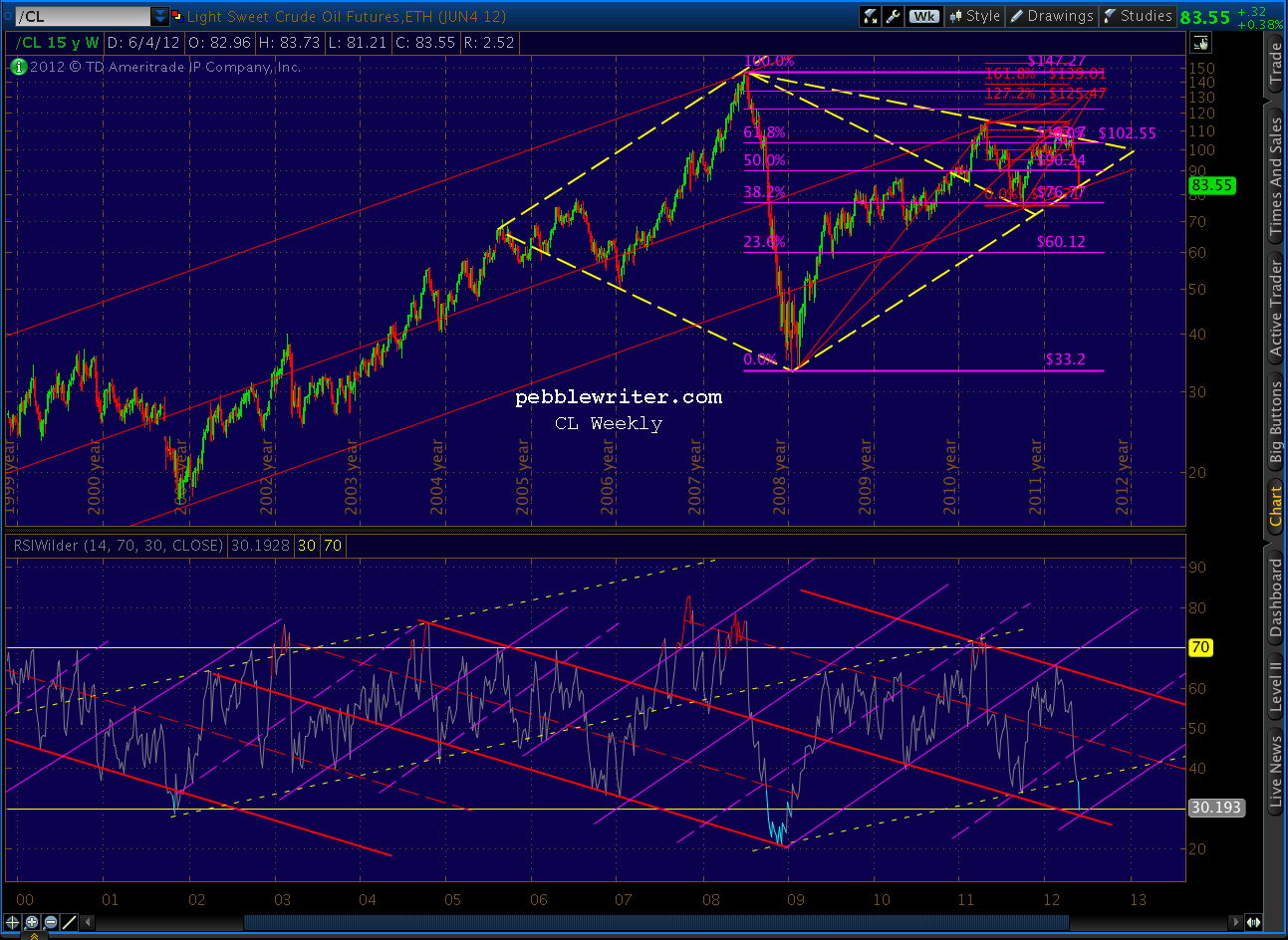
    The latest RW broke much later — .707 in time and .786 in price — and is already beyond the apex in terms of time.  The apex is around 144 — close enough to the all-time high of 147 to be considered a double-top were it to come into play.

    To do so, however, CL would have to break through a fan line from that 147 high.  As the following chart shows, the fan lines have been pretty effective at signaling major moves.

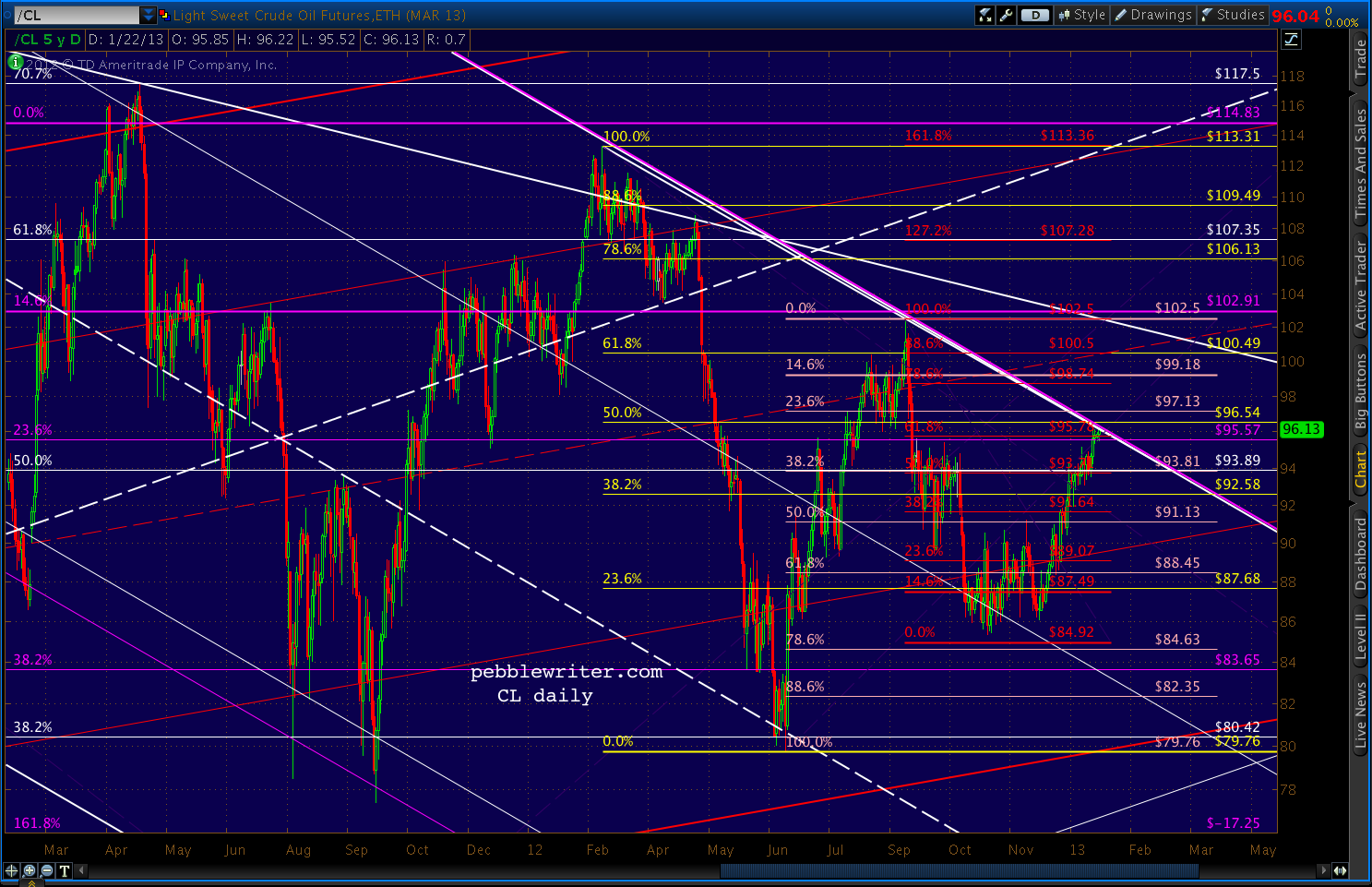
    The next such potential support is just below at around 88.  But, this line has been broken twice before on strong plunges, and CL seems determined to make another tag on the long-term support represented by the solid yellow channel line below at 78.

    But, to do so, it’ll have to break through triple harmonic support.  CL is also nearing the largest pattern’s .500 Fib at 90.24, which corresponds with the .382 on two smaller patterns at about the same price.

    It’s easier to see on the close-up.


  • Oil’s Balancing Act

    Many readers have been asking about oil.  It’s not that I haven’t been interested, it’s just been a real bear to analyze.  Here, after a dozen hours of racking my brain, is where I see it.

    Like many stock indices and currencies, Crude Light (CL) is at a critical stage.  It reached 114.83 after breaking out of a diamond pattern in April 2011, only to back test the diamond six months later at 74.95.  It then retraced .886 of that plunge, setting a lower high of 110.55 in February before plummeting once again as low as this morning’s 81.21 (the .886 is just below at 79.01.)

    CL now balances on a precipice, where a move in either direction is likely to be huge.  We’ll examine why, and which course is more likely.

    continued…

    (more…)