
Despite Trump’s assurances that the US air campaign would result in a swift collapse to Iran’s government and military, the war has dragged in multiple regional players, resulting in a dramatic surge in oil prices.
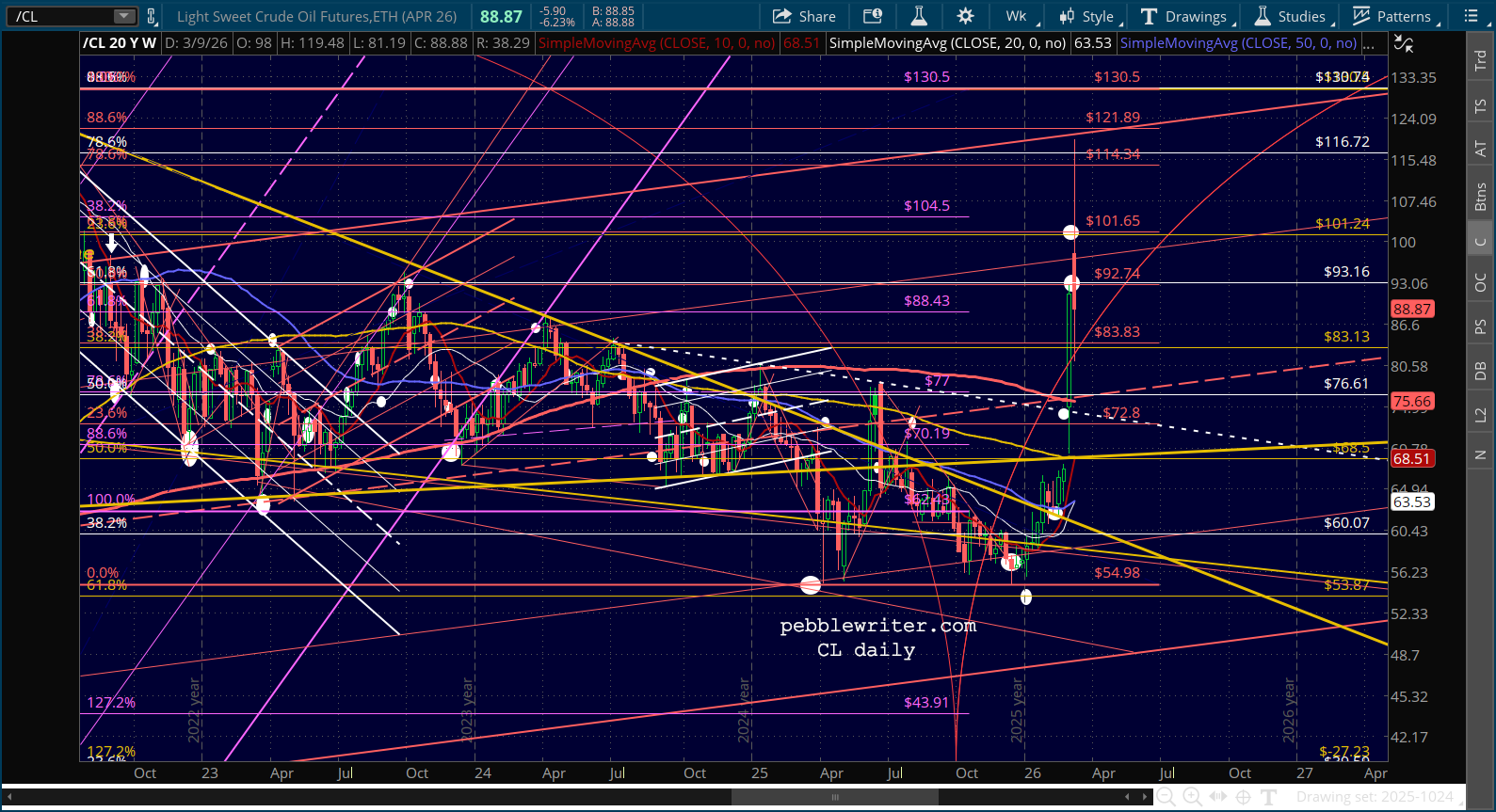
CL easily reached our 93.16 and 101.65 price targets…
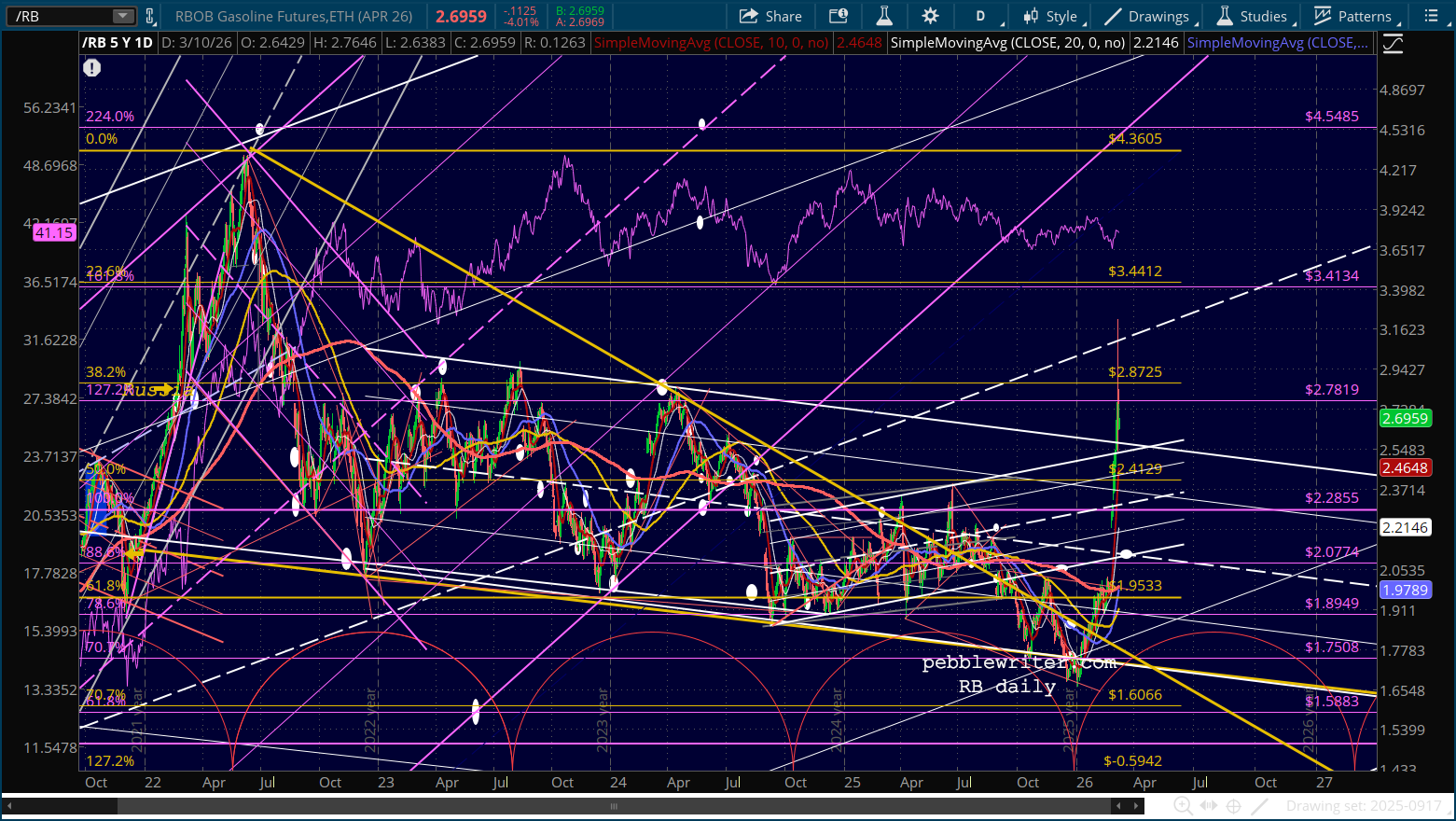
…and RB easily reached the 2.57 breakout threshold.
The Straits of Hormuz are effectively closed. Any attempts to bring tankers through – with or without US protection or insurance – will make things worse. All it would take is one sunken ship to constitute a long-lasting blockade. With tankers and storage facilities full, oil producers are shutting down production and capping wells – meaning that even after the war is over, prices will remain elevated.
As we outlined last week [see: More of the Same], ES tagged its SMA200 – though in the after hours, to prevent those pesky retail options traders from cashing in. TPTB wasn’t able to stem the losses until facing a lower low.
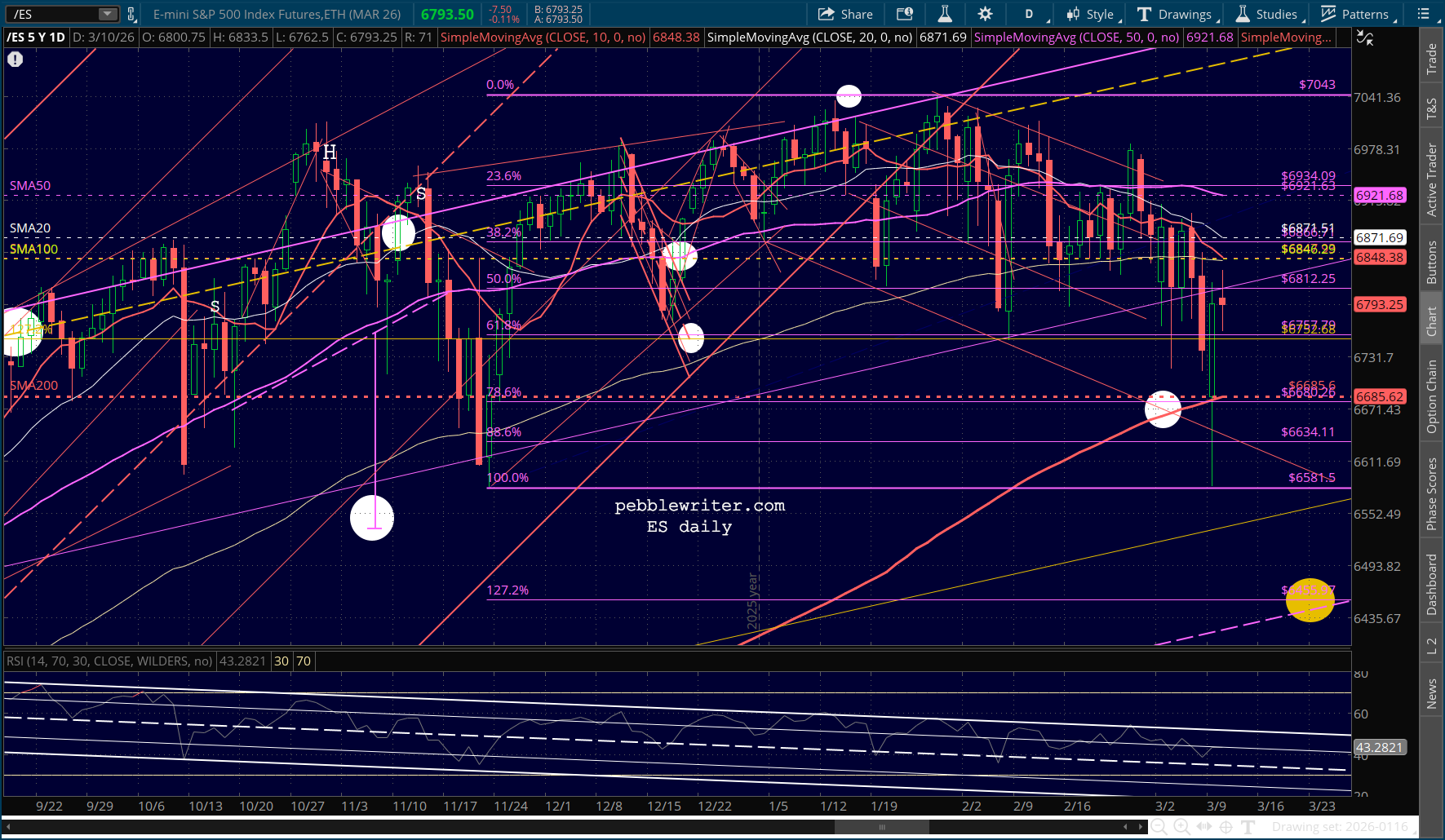
The rescue effort was clumsy, though, as SPX never reached its SMA200, now at 6586 – quite close to the .886 Fib at 6576.68.
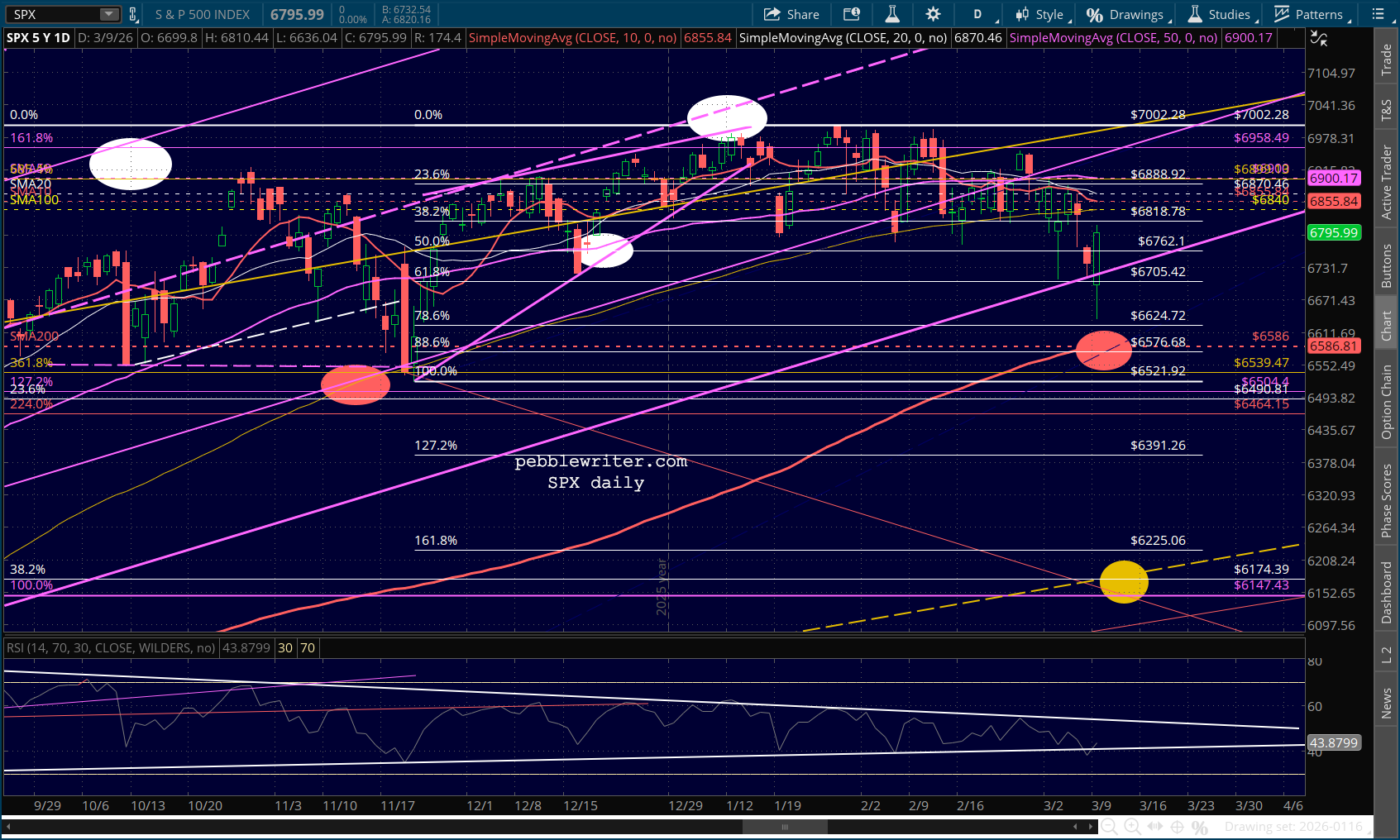
This likely means another leg down today, before any potential end-of-quarter bounce. After that, however, the charts still point to lower lows.
In today’s NY Times Dealbook, Andrew Ross Sorkin asks: “Does the S&P 500 now dictate U.S. foreign policy?” Of course it does (though Trump prefers the DJIA – bigger numbers.) Making the Dow Higher is #1 on Trump’s to do list. It’s his own internal scorecard. And, like his golf score card, it is a record of his attempts to “win” by cheating.
He’s not the only president to have ever cared about stock prices. But, he’s the most obsessed and the most obvious about it. Needless to say, higher stock prices are good for the economy, to a point. They support healthy capital formation and, all else being equal, contribute to a wealth effect that buoys consumer confidence and helps folks retire.
But, stock prices that depart from the fundamentals raise the risk of severe downdrafts – the sort that we discussed in our 2026 Forecast. We saw this in the dot com bubble of 2000-2003, the Great Financial Crisis of 2007-2009, and the COVID crash in 2020-2021. I don’t know what they’ll call this one. But, like the others, it represents an avoidable unforced error.
Trump was so determined to drive the Dow to new highs that he harangued the Fed, abandoned our allies, made unwise deals with Russia, Israel and OPEC, and attacked Iran. He reasoned that if interest rates were lower, the Dow would keep rising – usually a safe bet. But, with stocks already at nosebleed levels, the market balked. So did the Fed, which regards inflation which has remained stubbornly above target as incompatible with rate cuts.
Trump, who has likely never passed a marshmallow test, was not content to wait for Powell and Cook to be ousted. He also refued to let the economic reporting apparatus of the US government announce that we were in a slowdown that justified a rate cut. The only lever he had available, then, was to try and force inflation lower by lowering the price of oil.
When OPEC drew the line at $55/bbl, he forced the issue by attacking Venezuela, kidnapping its president, and turning it into a “major oil supplier.” Analysts called bullshit, as Venezuela’s oil is heavy, dirty and costly to refine. And, it is only about 1% of the world’s total oil production. The price of WTI didn’t drop. It didn’t even budge. Trump needed a bigger boat – or so he reasoned.
The challenge was finding a big oil producer who could be convinced to produce more. He had pissed off Canada (6%.) The rest were Saudi Arabia (11%), Russia (11%), China (5%), Iraq (4%), Brazil (4%), UAE (4%), Iran (4%) and Kuwait 3%.) Like Venezuela, Russia and Iran were under sanctions. Lifting the sanctions on those regimes was problematic, as they had earned their stripes. Though, Trump waived certain oil-related sanctions on Russia yesterday – the same day we found out that Russia has been providing intelligence to Iran on the location of US forces.
But, if he could quickly and cheaply assume control of the Iranian spigot, he could pump up the volume, flood the market, lower prices, get inflation down to 2%, get Fed Funds down to 2%, and get the Dow up to 60,000!
If only it were that easy…