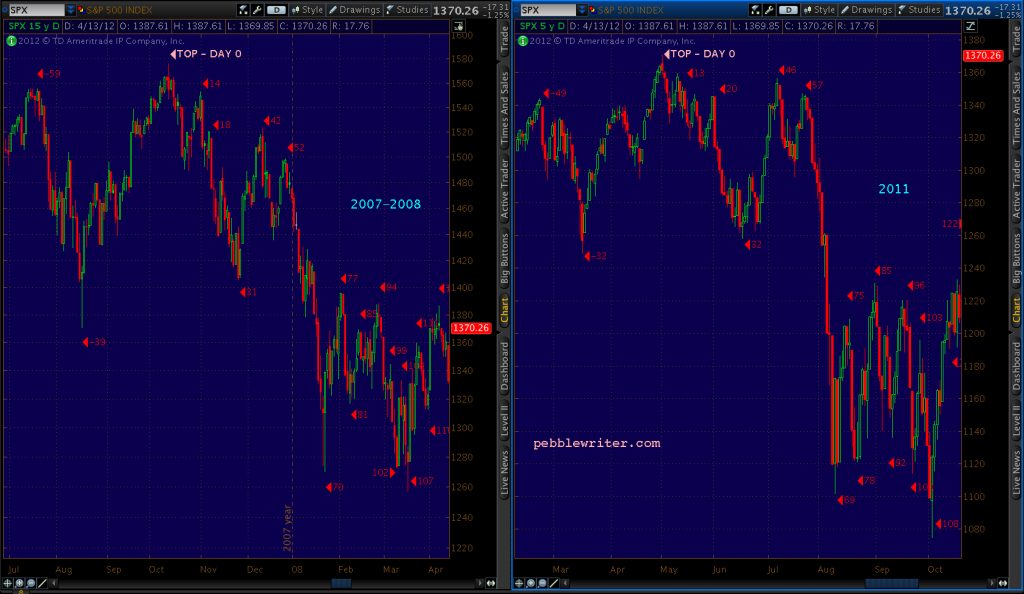

SPX reached our 1543.43 target yesterday, exceeding it by 4 cents before reversing to close below 1540. This was a 1.272 extension of the decline from 1530.94 to 1485.01 that began on Feb 20.
But, 1.272 completions result from Butterfly Patterns. And, Butterfly Patterns require a key reversal (Point B) at the .786 Fib level. The move up from 1485 barely reacted at the .786 Fib level, but saw a significant reversal at the .886 Fib. So, harmonics suggest a move to the 1.618 extension for a Crab Pattern (though not always so, see the 1:30 update below.)

The futures are all pointing skyward this morning, with the eminis indicating a willingness to ignore several key Fib levels – albeit on negative divergence – and the dollar and euro at key inflection points.


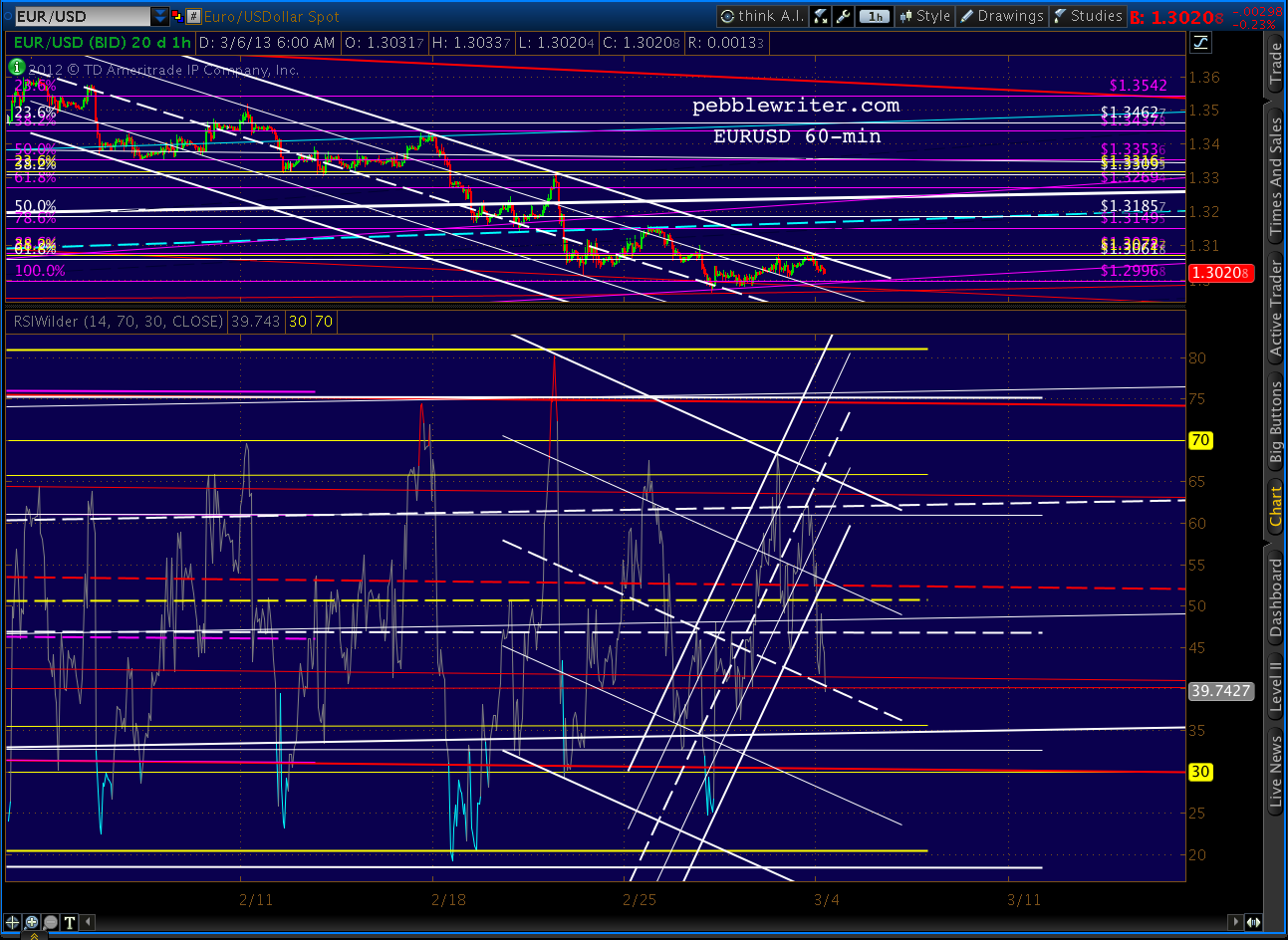 Keep an eye on the EURUSD 15-min chart, which shows the precarious position of the pair.
 Good time to review stops…stay nimble today.
UPDATE: 10:05 AM
The EURUSD just broke down from the little channel we were watching earlier and is back below 1.30 again.

The next significant Fib support is 1.2875-1.2885, but the .786 or .886 on the 15-min chart above should be watched. If one produces a reversal, the pair could try to redefine its falling channel from the current steeply sloped white channel below to a kinder, gentler version such as the purple.
 Any break out of the white channel should be viewed as such a move and would likely result in a retest of the light blue channel midline currently at 1.3167.
Stocks spurted higher this morning on a better than expected ADP employment report which, for all the hoopla, shows a month over month decline.
 Offsetting the “good news” is slightly more credible word from the Census Department that durable goods fell off a cliff last month. Total new orders for all manufactured goods were reported down 2% in January. The real, non-seasonally adjusted decline, however, was 6.96%.
New orders for manufactured durable goods were reported down a whopping 4.9%, which is bad enough. Remove the varnish of seasonal adjustment, and the real decline was from $239 billion to $204 billion, a 14.4% plunge.
The optimists will say this decline was due to worries over the sequester. And, there’s probably some truth to that. They also say we should ignore transportation and defense spending — an argument which has never made the slightest bit of sense to me. It’s also an argument you will never hear when transportation and defense orders surge as they did last month.
According to the Aerospace Industries Association, that industry alone accounts for about 633,000 jobs (about 6% of all mfg jobs) and $224 billion in revenues (17.9% of all durable goods revenues) including $95 billion in exports — 6.2% of all durable goods exports and one of the few success stories in America’s perennially crummy balance of trade picture.

A decline in orders, such as might be expected when, say, the US is trying to reign in spending in the midst of winding down a couple of wars, could put a real dent in those figures. And, these are relatively high-paying jobs with benefits, not part-time Wal-Mart greeters.

Defense spending accounts for about 2/3 of all government spending (federal, state and local) which, in turn, accounts for nearly 20% of total GDP.
Please don’t get me wrong. I’m not arguing that defense spending should be increased, or even maintained. Other than increasing the shamefully paltry benefits provided to wounded veterans, I’d love to see the budget slashed dramatically. It doesn’t take a lobbyist to see we probably spend a bit more on defense than is necessary.

But, when someone suggests we should ignore transportation and defense spending when assessing the country’s economic future, it’s because those components are in decline. Excluding them makes the economy look stronger, just like excluding the long-term unemployed makes employment statistics look stronger.
It’s all about perception.
UPDATE: 12:40 PM
SPX is off its high (1545.25) for the day and trending lower. It’s early still, and it’s likely to be expanded, but the operative channel is probably something like this:
 Note that SPX is flirting with the white channel midline, while the yellow TL off the 7/23/11 and 9/14/12 highs is still well below at about 1532 — near the 1.618 of the latest spurt higher.
continued for members…
Keep an eye on the shorter-term charts for signs of a breakout or breakdown. The 15-min chart, for instance, shows a potential H&S pattern brewing. It would target 1530.50 — in the middle of the 1525-1534 range where we expect the backtest (if that’s all it is) to land.
 Remember, 1525 is the former IH&S neckline, 1534 is the white channel midline. 1530.94 is the former (Feb 20) high.
UPDATE: 1:30 PM
Way up at the top of today’s post, I remarked how the latest harmonic pattern, because it featured a reversal at the .886 Fib instead of the .786, was probably a Crab Pattern instead of a Butterfly Pattern.
There is one fairly recent and quite significant case of this occurring — in circumstances not all that different from today’s.
In October 2002, SPX bottomed out at 768 after shedding 50% of its value from 1552 in March 2000. By Mar 04 it had rebounded by 50% off its lows — which meant it had retraced 50% of the 1552-768 decline. At that point it corrected by 8.8% and settled into a more modestly rising channel. It reacted to about the same extent at the .618 and .707 Fib levels.

None of the corrections were all that dramatic, but the leading candidates for a harmonic pattern completion would have been a Gartley Pattern at the .786 or a Bat Pattern at the .886. At the .786, SPX barely reacted. This prompted an acceleration up to the .886 where SPX reacted by only 7% before moving higher.

Clearly, bulls could smell the finish line up at 1552. The index gained 11.7% in only two months, reaching the 1.618 extension of a well-formed Butterfly Pattern. I say Butterfly, because there had been a significant reversal at the .786. It could have terminated at the 1.272 (D1) or the 1.618 (D2).
But, of course, that 1552 high was still within striking distance. I can picture the crawl on the CNBC broadcast: “SPX only 2% from all-time high!”
SPX lingered, loitered, stuttered and stammered for almost two months, finally getting up the courage to capture the flag on July 13 with the new high of 1555.10, and closing above the all-time high on Jul 19.

On July 20, SPX corrected down to a channel line and the .886 at which it had previously reversed. That previous reversal had established a Point B at the .886, promising a Crab Pattern completion at the 1.618 of 1572.41. And, it just so happened that the top of the white channel would intersect with 1572.41 in a matter of days.
Of course, it didn’t happen. SPX fell 11.7% in less than a month, giving up almost all of its gains from the last leg up.
 My point isn’t that the same thing will (necessarily) happen again. Back then, the financial crisis was just beginning to be understood, and we didn’t have a rich uncle cramming $85 billion into the markets every month.
It’s simply that, as amazing as harmonic patterns are in providing reliable turning points…they’re not foolproof. I wasn’t charting back then, so I can’t tell you exactly what “tell” might have protected us from that 160-pt failure to complete the Crab Pattern at 1572 — or prepared us for the rally over the next two months that reached 1576 (maybe this one.)

But, it’s worth studying these patterns from all those years ago, especially when facing a similar set of circumstances today. You never know.
UPDATE: 2:43 PM
SPX continues to linger, loiter, stutter and stammer in the same price range it’s been in all day. At this point, it’s pretty simple. A break of the neckline at 1538.50 would complete the little H&S Pattern. A break of 1545.25 negates it, at which point I would likely switch sides again for a move higher.
 I have to run out for a meeting shortly. Watch those levels I mention above. If the H&S completes and breaks the neckline I’d be looking for at least 1533-1535. But, keep an eye on the channels. They should provide excellent guidance in the event of a selloff.
 GLTA.
GLTA.
continuing…
Comments
4 responses to “Charts I’m Watching: Mar 6, 2013”
I did not see those. It does help and thank you.
Asriel777, At the end of yesterday’s post (Break On Through) PW posted 2 charts and
brief commentary on the $RUT. Not sure if today changes anything for the $RUT.Hope
this helps.
I would be interested in your take on the $RUT
Hello PW, yesterday you had a discussion of USD/EUR analog. What is the connection of that to the current “Dow Record High”? Thanks!