
We called the top on the 10Y on October 10, 2018 [see: Plan B] with rates at 3.24% and ZN at 117’230.
…I’ve always been inclined to believe more in the yellow channel — which says that 10Y yields have now topped and ZN has bottomed.

Since then, I’ve taken a “show me” attitude toward rates, setting a target or two at a time and updating as they were met — with the 15.54 target officially in play once TNX dropped through 21.72 a few months ago. But, the price chart has been crystal clear ever since December [see: December 26 Update on Bonds] with a critical target of 130’20 – 130’23.
From last December…
 …and, this morning.
 It’s always fun to nail a target so precisely many months in advance. But, the excitement quickly fades once the pressing question sets in: what now?
* * *
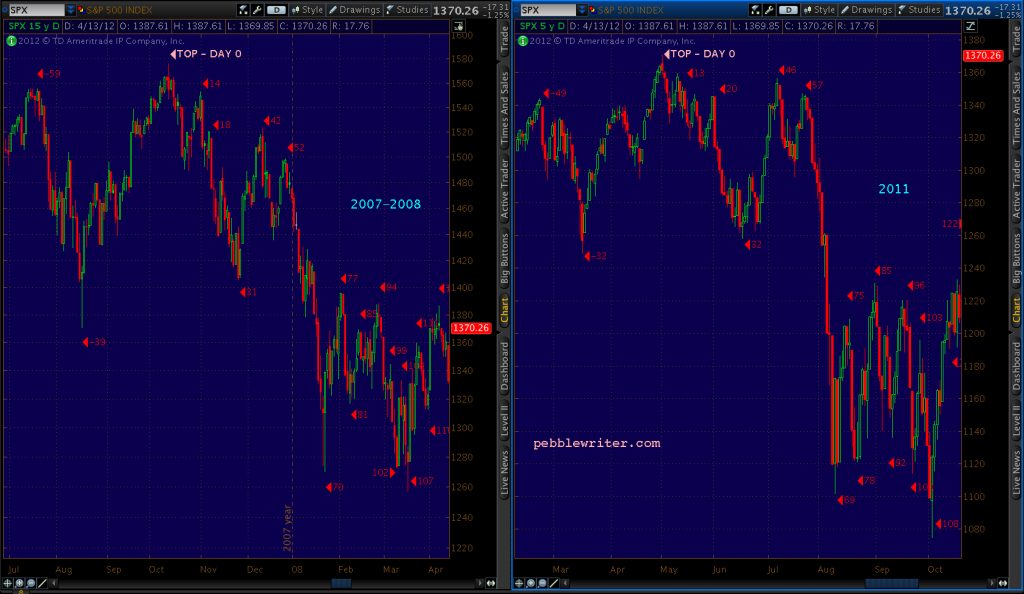
Meanwhile, the equity funhouse is about to reopen. Our analog is still very much on track, supported by yesterday’s head fake and this morning’s plunge. Many of the stocks we follow have tagged their next downside targets. It’ll be interesting to see how long they can hold up in the face of lower lows.


 Isn’t it funny how, with all the market turmoil, no one’s talking about DB’s latest breakdown?
continued for members…
Note that TNX still hasn’t reached our 15.54 target, but is getting very, very close. If our analog is correct and stocks are due to bottom and bounce on Aug 14, that would be a good target date for TNX to bottom and bounce as well. But, for now, I’d look for a reversal in ZN.
If we expand and extend the gray channel (now purple) we can see it works pretty well, capturing most of the major turning points. This gives us an upside target in the event that ZN breaks out past 130’200. If we are, as our analog suggests, facing a rebound around Aug 27 followed by a sharp plunge around Sep 11, I can easily see ZN’s rising red channel capturing those moves with a push up to the .886 at 132’100 coinciding with SPX’s Sep 11 decline. If it exceeds 132’100, then we’re looking at the channel top at around 133’085.
 Assuming stocks’ rebound following 9/11 is quite sharp, the pullback in ZN would probably backtest today’s highs or, if it reached the channel top, the .886 at 132’100. Then, the October decline would test and ultimately push past the 2016 highs. Putting it together, it would look something like this:
 I haven’t done the math, but a breakout in ZN would obviously lead to a breakdown of TNX’s yellow midline and white channel bottom. The next downside targets are the former low of 13.36 and the purple 1.618 of 12.84.
The 2016 low was only slightly lower than in 2012. So, this low would be only slightly lower than the 2016 low.
Fortunately, our analog calls for equities to rebound nicely following the October lows. I seriously doubt it’ll be a 700-pt rise into January as currently modeled. But, even a portion of that could help TNX rebound for several months, backtesting the white channel or yellow midline until January before the next leg down arrives.
If, at the end of the day, 1% breaks down, the next legitimate support doesn’t arrive until the 1.272 at 8.16 or 1.618 at 1.54 — as in 0.154%. If the falling purple channel held together all that time, we’d also have the yellow channel .236 line around 5.25 in May 2020 — about the same time SPX is arriving at 2138. The last target is on election day, 2020 at -0.2%.  Do I think we’ll get there? Sadly, yes. If you look at the big picture, you can see that five of TNX’s six lows have occurred on a regular cycle of roughly every 4 1/2 years — the one exception being in 2007 when the Fed was trying desperately to stave off the GFC.
The next cycle low lines up nicely with -0.2% in November 2020. Again, let me reiterate: all analogs eventually break down. The 2011 as 2007 analog would have taken SPX to 450 or so had the BoJ not intervened and trashed the yen. It is also very early in the process. The further out you forecast, the less accuracy you can expect.
Anything could happen. But, as we’ve been discussing forever, there doesn’t seem to be any escape from the race to the bottom for interest rates — particularly as deficits and debt continue to explode higher.
Markets were never allowed to clear in 2008-2011. Instead, central banks pumped trillions of dollars into markets — money that has to go somewhere. If stocks melt down, that means accepting negative rates in treasuries where there is a presumption that you’ll get at least (most of) your money back.
Sigh…