Tag: DX

  • Satisfaction

    Will the sixth try be the charm?  SPX has futzed around in our target area for six sessions in a row.  Today, we should finally get some satisfaction.

    The dollar has broken out of and is back-testing the yellow triangle. Lots of juicy Fib levels ahead, starting with the cluster at 80.758-80.883.

    RSI appears poised to break out of the red channel and explore the upper half of the white.

    While the EURUSD looks like it’s ready to tumble.  The test I’ll be watching closest is the intersection of channels around 1.3253.  But, merely popping back down below those falling white channel lines would be a great start.

    If I’m right, the falling white and/or yellow channels will take it from here.  Note the negative divergence represented by the last two spikes up to the top of the yellow channel.  The flatish red channel dates back to the fall of 2008, and every sustained push below its midline — currently around 50.51 — has been accompanied by a nice sell-off in EURUSD.

    Japanese finance minister Taro Aso is frantically searching for the “off switch” on the yen-cinerator.  In a chat with a legislative budget committee, he admitted: “it seems that the government’s policies have fueled expectations and the yen weakened more than we intended in the move to around 90 from 78.”

    The 7 sessions in (and slightly above) our target area are looking tenuous.  A dip to the bottom of the white channel could take the pair back to 90.82.

    And a fall from the white channel could easily see a back-test of the midline from the purple channel dating back to 2000.

    continued for members(more…)

  • Charts I’m Watching: Feb 5, 2013

    The dollar is taking a breather after a strong reversal off the latest .886 and channel bottom, but appears ready to break out.

    The EURUSD back-tested the broken channel line and rising wedge lower bound, and is likely about done.

    SPX fell 19-pts after we shorted last Friday.  We positioned for an intra-day bounce, but SPX added only 4 points before falling back to complete a little H&S pattern at the close.

    continued for members(more…)

  • Charts I’m Watching: Feb 4, 2013

    The US dollar bounced off the .886 of its Sep – Nov 2012 run…again.  This is the fourth time it has found support in the 78.725 – 79 range, though each subsequent bounce has been lower than the previous one.

    The result is a descending triangle that arrives at the bottom of an uptrend (the white channel below) and a 2nd back-test of the latest channel (red) that was originally broken out of on Jan 2.

    The primary driver has been euro zone weakness, with the EURUSD back-testing the midline of the white channel after a bull run that equaled that of this past Aug-Sep.

    Though, the yen is also pitching in — reaching our secondary price target well in advance of the forecasted date range.

    SPX was off over 10 points this morning, making our decision to short Friday at 1514 appear to have been the right move.  SPX is heading toward the next lower purple channel line, where it will likely get at least a bounce in the 1500-1501 range or the .886 Fib at 1498.77.

    The question is whether the market is just taking a breather or beginning something more significant.  I’ll spend the next hour or so examining the road ahead.

    continued for members(more…)

  • But, When It Was Bad…

    In my younger days I played Rubgy, a drinking party with a little sport thrown in to make it legit.  I don’t know if it’s still so, but back in those days, when the parties (always with the opposing side, much more civilized than American football) reached a certain level of inebriation, someone would start up with some limericks.   Who knows why…

    They were always off color, often hilarious, and sometimes even made sense in spite of the fact that the guy delivering it was, by then, completely arseholed.  There were no less than a dozen variations on the Longfellow poem There Was a Little Girl.

    There was a little girl,
        Who had a little curl,
    Right in the middle of her forehead.
        When she was good,
        She was very good indeed,
    But when she was bad she was horrid.

    One of the cleaner variations finished with “and when she was bad she was incredible.”

    As I watched the news roll in over the past 12 hours, I couldn’t get that poem out of my head.  Got an economic boo-boo?  Not to worry, the Fed will kiss it and make it all better.   We’re all so conditioned to that idea that no one bats an eye when it’s reported like as did CNBC:

    Frankly, I’m surprised they even threw in the word “possibly.” It’s probably only because, as Cramer assures us, this enormous GDP contraction from the previous quarter was a “one-off” event.

    More details on the report — the first negative quarter since 2009 — shortly.  But, the chart from Briefing.com clearly illustrates a lower low to go with the Q3 lower high.  Sorry, folks, but that’s a trend that points downward — especially when you layer in a sequestration and tax increase coming up next quarter.

    Of course, this horrid economic news pales in comparison to the importance of the Blackberry 10 launch.  Which, of course, will hopefully distract our attention from the craptastic AMZN earnings report — which, almost got the stock back to where it was two days ago…imagine if they’d had two positive footnotes in there! — and Boeing, the future of which is sitting on tarmacs in the form of fifty 110,000 kg paperweights (with another 800 on order.)

    The market’s reaction to all this?  Off a whopping 3 points on SPX and 20 on the Dow.  Oh, well, I suppose it could be up 10.  I’m taking on odds on how many minutes it takes for the BB-10 launch to replace the GDP headlines on CNBC.com…

    continued for members(more…)

  • Charts I’m Watching: Jan 29, 2013

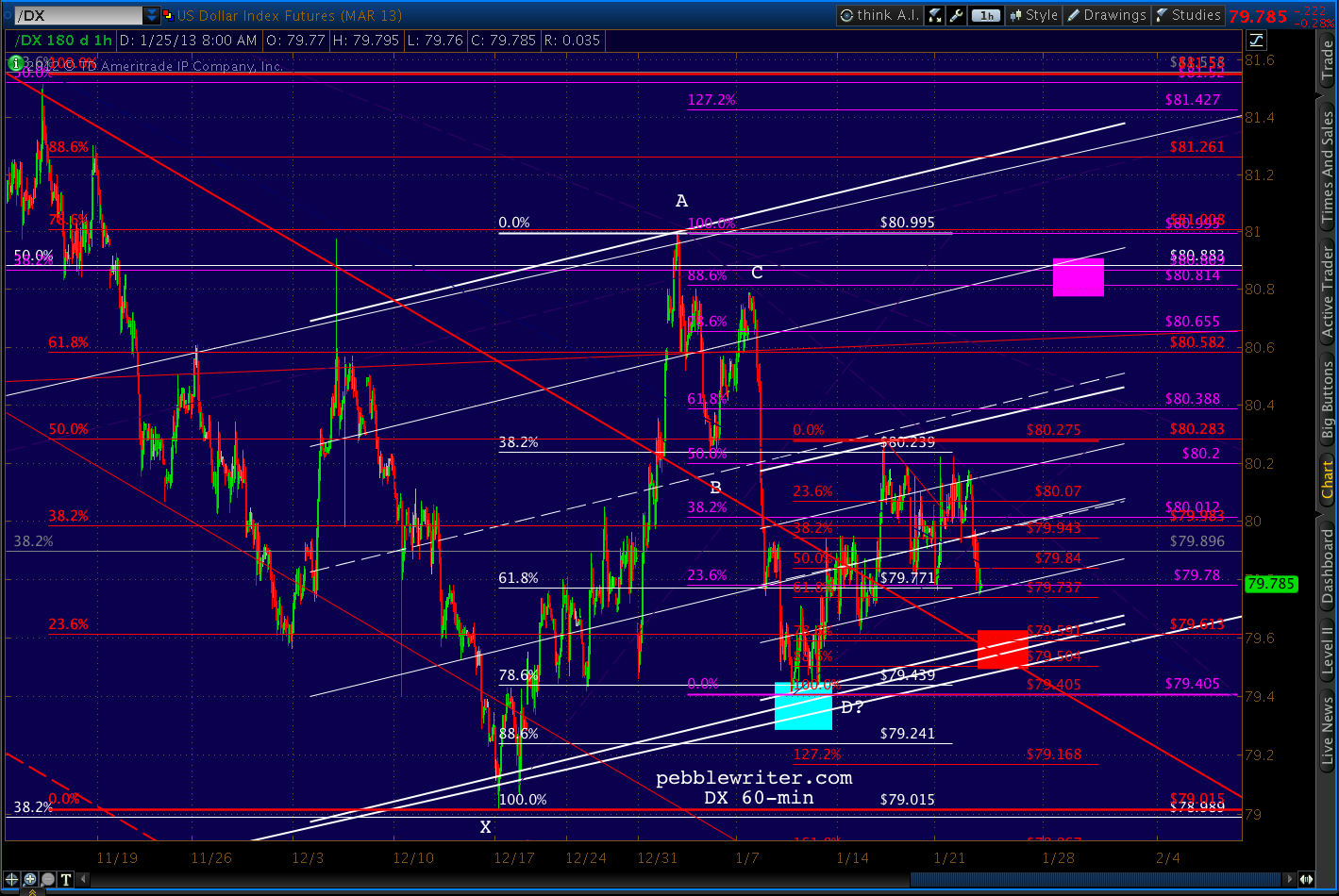
    Currencies are relatively quiet this morning in the midst of a slew of earnings and economic data. The dollar looks like it could hit our downside target of 79.50 – 79.59 from Jan 25 [see: Update on DX] this morning if the yellow channel holds, but note that its midline intersects with the bottom of the white channel (support) just below current levels.

    EURUSD looks like a lock to tag the 1.618 at 1.3490 we’ve been tracking the past few days.

    This e-mini chart caught my eye this morning…

    With the overnight slide of 8 points, the e-minis give the impression of a broken channel and back test.   Now, it might be one of those dips from which we quickly recover as occurred on the 16th.  But, for those playing the intra-day moves, this bears watching.

    This ES channel equates to the small purple channel within the larger white one on SPX.  So, as yesterday, watch the channel midline for signs of something more significant.  It’s currently around 1498.30.

    The 15-min RSI should see a bounce at the red trend line if the trend is to remain on track.

    As we discussed yesterday, there is a great deal of economic data due out this week.  But, all pale in comparison to the FOMC announcements following their two-day meeting getting underway right about now.

    Last we heard, dissension was growing over how and when to throttle back on QE.  The language that alarmed the Dow 20,000 crowd:

    While almost all members thought that the asset purchase program begun in September had been effective and supportive of growth, they also generally saw that the benefits of ongoing purchases were uncertain and that the potential costs could rise as the size of the balance sheet increased. Various members stressed the importance of a continuing assessment of labor market developments and reviews of the program’s efficacy and costs at upcoming FOMC meetings. In considering the outlook for the labor market and the broader economy, a few members expressed the view that ongoing asset purchases would likely be warranted until about the end of 2013, while a few others emphasized the need for considerable policy accommodation but did not state a specific time frame or total for purchases. Several others thought that it would probably be appropriate to slow or to stop purchases well before the end of 2013, citing concerns about financial stability or the size of the balance sheet. One member viewed any additional purchases as unwarranted.

    Needless to say, an increase in hawkish rhetoric could really do a number on this rally.

    Odds are we’ll see another day like yesterday, with market makers shuckin’ and jivin’ to try and convince us a larger move is underway — the better to shake loose some of our hard-earned money.  But, I unless we see a huge miss on economic data or earnings, I don’t expect any fireworks until Bernanke steps up to the microphone (though much of the juicy stuff will have to wait for the minutes to be released.)

    UPDATE:  10:00 AM

    The Conference Board’s Consumer Confidence Index came in well below expectations: 58.6 vs expectations of 65 and Dec 2012’s 66.7.  Most of the rise in pessimism was the result of worsening job market conditions.  Those expecting more jobs in the months ahead dropped from 17.9% to 14.3%. Twenty-seven percent expect fewer jobs — unchanged from last month.  A full 22.9% (up from 19.1%) expect their incomes to decline.

    Briefing.com tracks the data and puts it in a nifty little chart (reflects data through December.)  There are a lot of potential interpretations here, but to me it comes down to “expectations coming back in line with reality.”

    And, though I don’t have the time to construct a chart, I’m pretty sure that expectations — the yellow line — have tagged the top of a descending broadening wedge (megaphone) while present conditions have formed a garden variety falling channel.  Both appear to be at or near their upper bounds, meaning a breakout or a fall is imminent.

    Global Economic Intersection posted an interesting article last month that showed the relationship between consumer confidence and past recessions.  Definitely worth a read for those who pay attention to such things.


    So far, the market is pretty much shaking it off, with a dip to the white channel midline the extent of the reaction.  If the midline holds yet again, there’s a good chance we’ll hit our upside target later today or tomorrow.

    continued for members(more…)

  • Charts I’m Watching: Jan 28, 2013

    A positive durable goods report, mixed CAT earnings and the usual meaningless NAR drivel (this time negative, but being spun as a lack of inventory) have combined to drive SPX down 5 points.As we discussed Friday, the bottom of the purple channel (1498) and/or midline of the white (1496.50) are good trigger points for those who play intra-day moves.  Look for a bounce there.

    The bottom of the white channel is currently 1485, the level at which a move lower would seriously undermine our current position.  Otherwise, our core position remains long.

    The dollar, which broke back down below a channel line on Friday, had a 2nd nice bounce off the next lower channel line, but as yet hasn’t broken out.  The short-term harmonic picture continues to be ambivalent.

    Keep an eye on the RSI channels, which still point lower in the short run amidst a general move higher.

    The EURUSD continues to linger in double-top territory — also the completion of a Crab Pattern (small, purple.)

    Note that this is also a .500 and .382 Fib of much larger patterns, so we should get a sizable reaction here.

    I’m adding two pages to the website this morning.  The first is a general discussion of harmonics trading techniques — something I’ve been wanting to do for months.  Part 1 has already been posted under the harmonics section of the “learn” tab.

    The second, which will be posted shortly, is a brief summary of my current core position and will be available under the “markets” tab.  Many of you have asked for such a page, but I’ve hesitated because of the risk of misinterpretation.

    Someone taking a quick look might see a long position, for example, without noting the commensurate high risk of a sharp downturn that was discussed in the daily post the day before.  There’s also the risk that a short-term trade is misinterpreted as long-term, or vice versa.  At tops and bottoms, when we’re waiting for the market’s stripes to emerge, core and short-term trades aren’t always easily distinguishable from one another.

    Last, such a page will out of necessity be a snapshot — a peek at where things stood at the time of its posting.  The outlook might have changed two minutes ago but not have been posted yet.  Someone who reads the full daily post would realize a change is in the works, but this page wouldn’t yet reflect it.

    But, with those caveats out of the way, I’ll post it later today for members only.

    UPDATE:  11:30 AM

    SPX bounced at the white channel midline as suggested earlier (1496.33 v 1496.50 target) and is back above 1500.

    I believe our short-term forecast is right on track.

    continued for members(more…)

  • Update on DX: Jan 25, 2013

    Currency markets have been quiet the past few days, with the dollar showing some indecision as investors try to wrap their minds around a potential new high for equities.

    Since we hit our downside target at the white .786 on the 13th, DX has been non-committal.  My best guess is a repeat of the .786/.886 retrace down to the red zone before DX takes off higher, but this is neither assured nor necessary for our equity forecast to play out as expected.

    continued for members(more…)

  • Now What?

    First, a quick overview…

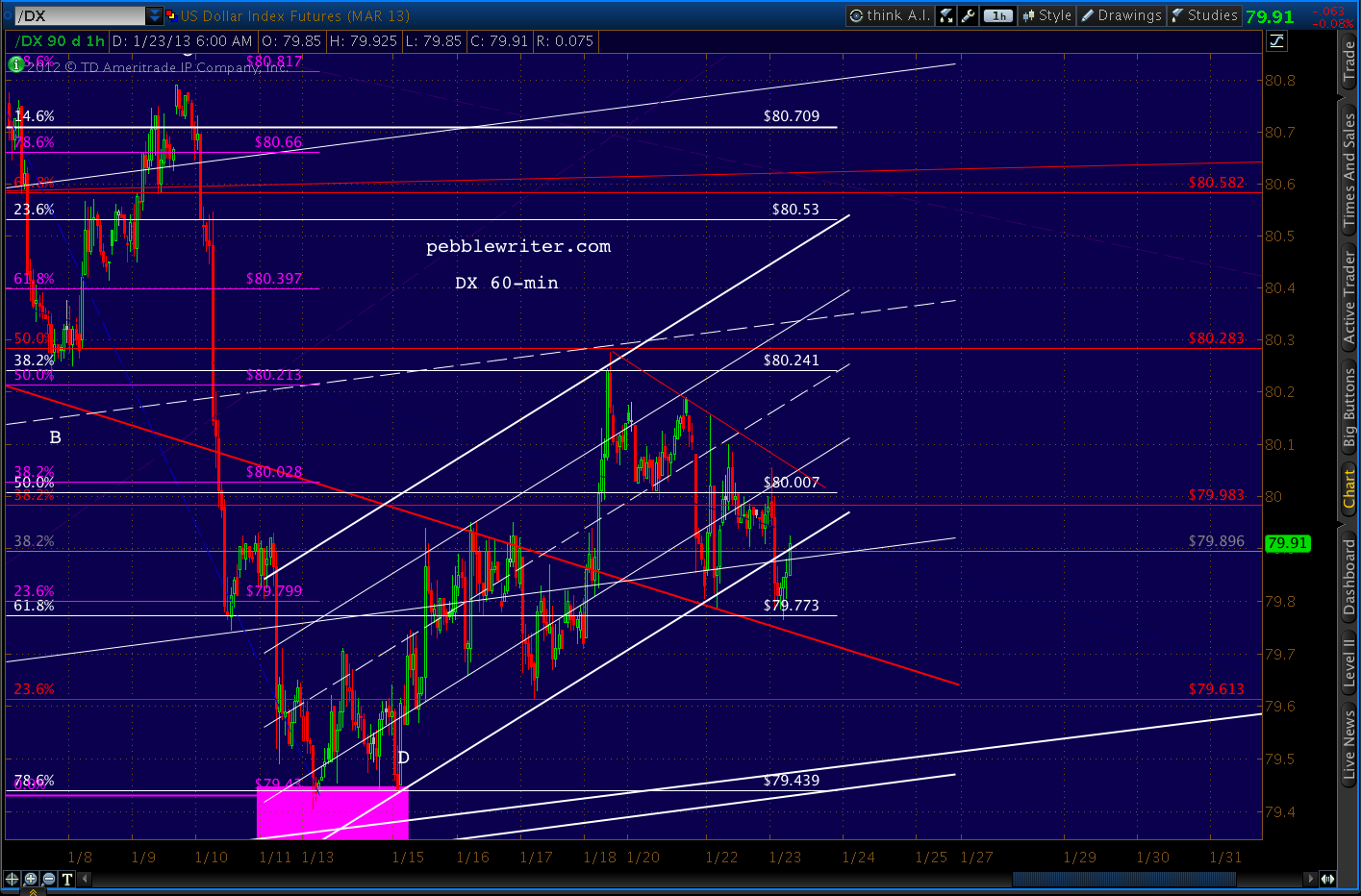
    The dollar got clobbered overnight, knocking it temporarily out of the white channel that’s guided it since Jan 11.
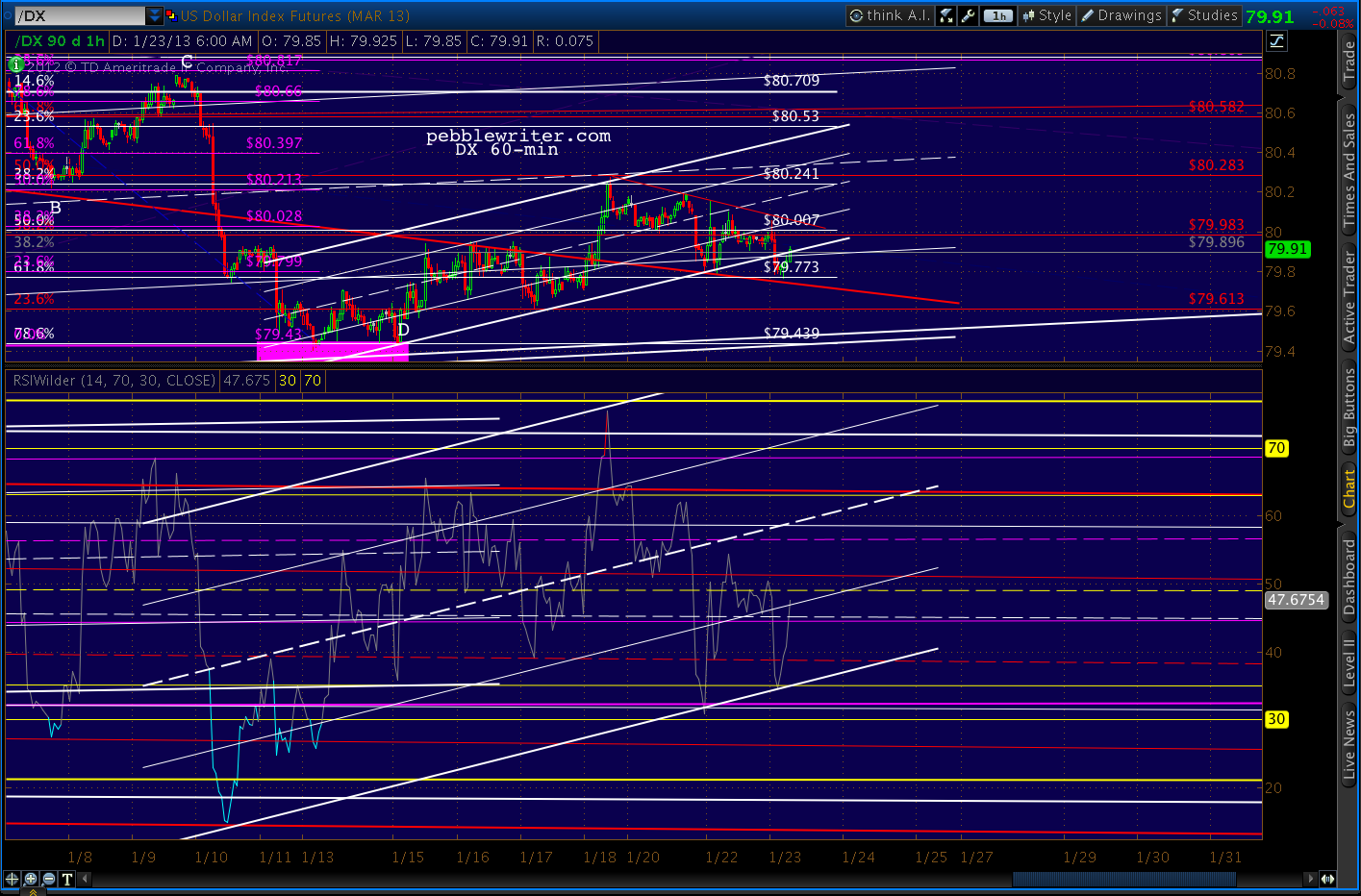
    But, interestingly, its RSI channel is doing just fine, thank you.
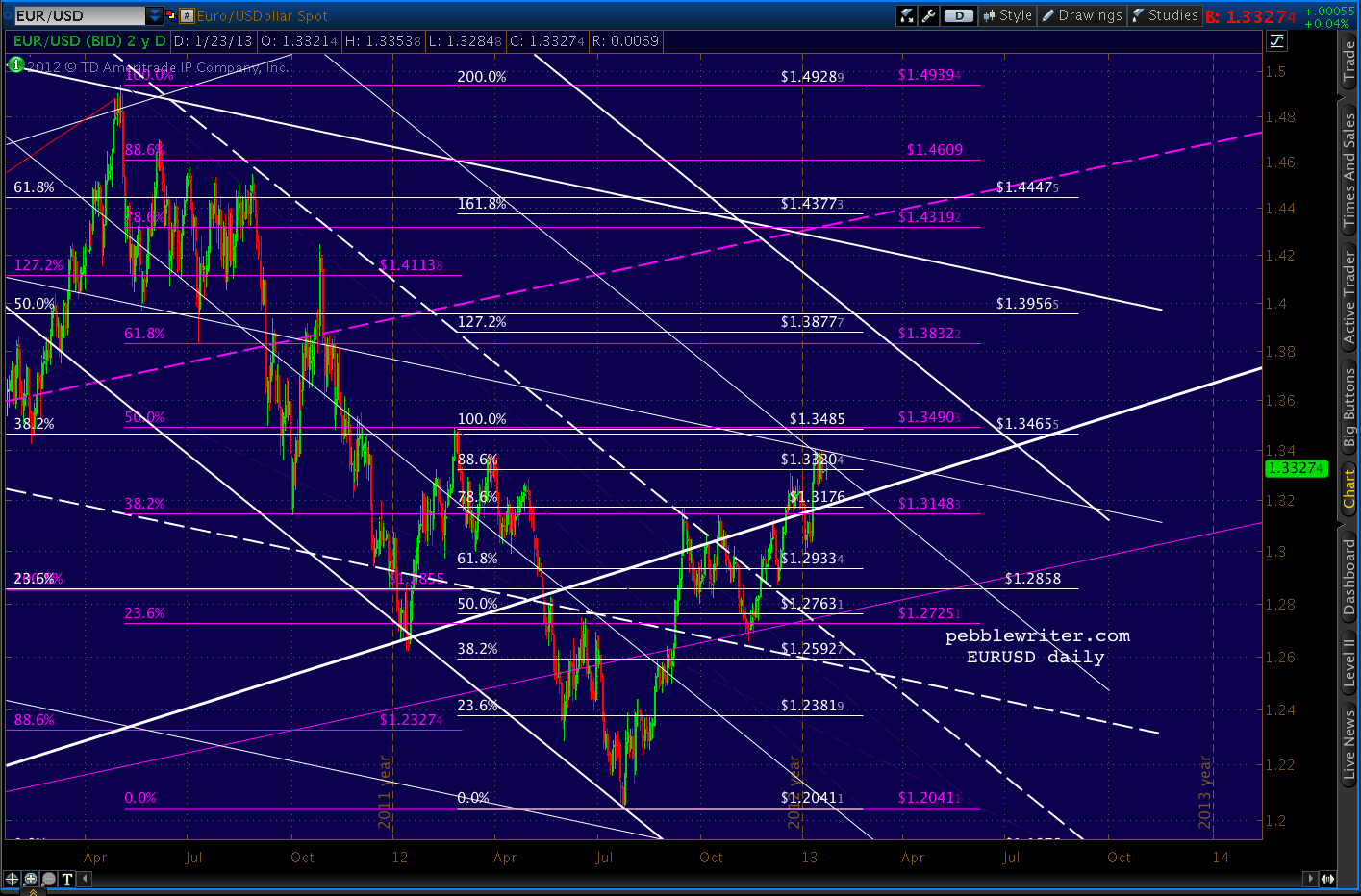
    The EURUSD continues to levitate, but still hasn’t broken the last important interim top put in on Feb 24.  It is also bumping up against two 25% channel lines, so could very well stall out here at the .886.
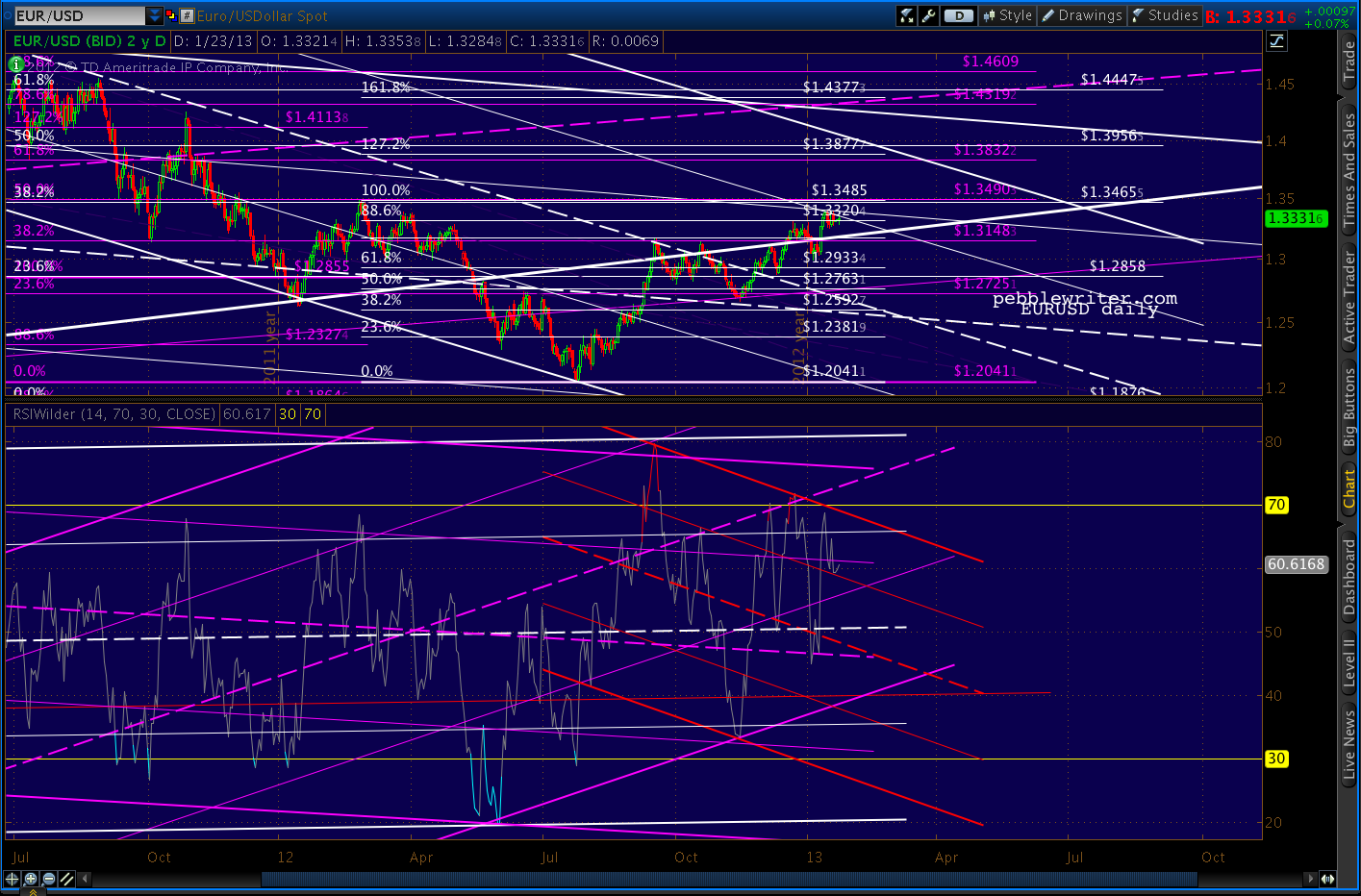
    There is still ample negative divergence regardless of which channel ultimately wins out.
     

    With the market exceeding the recent 1474 highs, the analog that did so well for us since last April is officially dead.  This begs the question: “now what?”  I see three big issues hanging over the market right now:

      1. earnings season —  AAPL in particular
      2. the US budget/debt ceiling imbroglio
      3. new highs justified?

    Earnings

    GOOG and IBM both gapped up this morning, but the earnings that can really move the market — AAPL — comes after the close.  We’ll take a fresh look at the AAPL chart later today.

    Budget/Debt-Ceiling

    In a few hours, the House will probably pass a measure to postpone the debt ceiling debate until May.  Reid and Obama have both said they’re on board, so this appears to be a done deal.  If House Republicans don’t fall in line, as occurred with “Plan B,” the market will sell off precipitously.

    New Highs

    The market’s strength has caught many off guard, including yours truly.  Many are calling for new all-time highs for SPX. The 2007 high of 1576 is now only 84 points away, so a few good sessions could do it.

    We’ll take a fresh look, focusing on the harmonic and chart pattern picture as well as the establishment agenda.  “What’s that?” you say.  Say all you want about random walks, CAPM, dividend discount models and Dow Theory.  Like any government-managed enterprise, the market is subject to the policy goals and needs of those who attempt to control it.

    Even to my cynical ears, this sounds a bit like rants from the tin-foil hat crowd.  But, consider the news on Egan-Jones yesterday.  This is one of the biggest stories of the month, yet predictably earned only this from WSJ/Marketwatch:
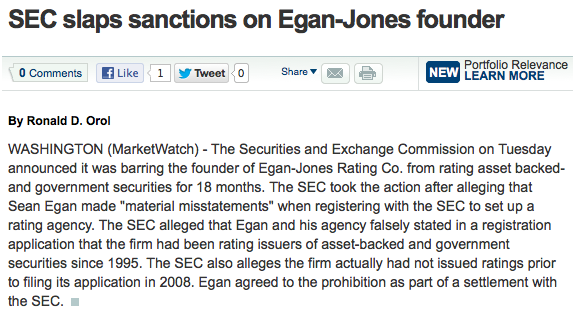
    CNBC was slightly more generous, yet still presented only the SEC’s side of the story.  It’s a story that deserves to be told because it speaks volumes about the degree to which the market is presently being controlled.  And, I’m not just talking about quantitative easing, though I suppose we’d have to consider QE exhibit #1.

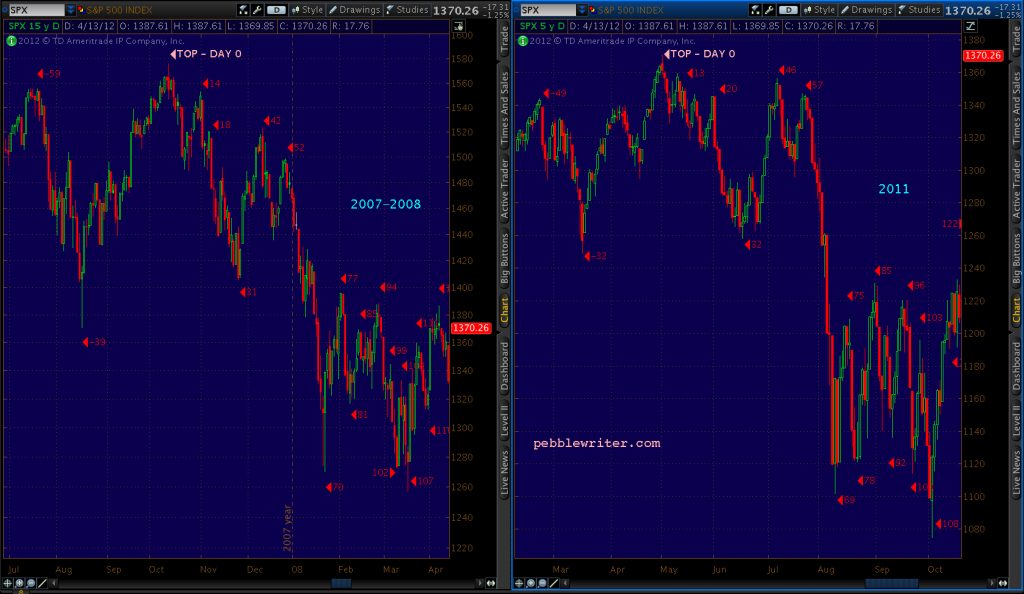
    Last summer the market crashed 22%.  It was an analog (replay) of the 2007 top, so we saw it coming in plenty of time to profit quite handsomely.  But, it was a huge wake-up call for The Powers That Be (TPTB) or Plunge Protection Team, Wall Street Cabal — whatever you want to call it.

    With virtually unlimited power and unlimited resources, why couldn’t they prevent something like that from happening?  More importantly, if the top was a replay of the 2007 top, might the rest of 2011 play out like 2008-2009?

    It didn’t, because they learned from the crash of July-August.  First, they tweaked the markets just enough to bust important chart patterns that were playing out.  Second, they tweaked the rules to provide for more time to contain any damage which might otherwise occur (circuit breakers, etc.)  Third, they attacked those who had “caused” the crash.

    S&P CEO Deven Sharma was one of the first victims.  In the wake of the 2007 financial crisis, S&P was rightly pilloried for having pulled its punches — particularly on mortgage and banking related debt.  This was no surprise to anyone who’s ever worked on Wall Street — which pays for these supposedly unbiased views.

    An infamous exchange between two S&P analysts in April 2007 aptly illustrates:

    “BTW, that deal is ridiculous.”

    “I know, right . . . model def(initely) does not capture half the risk.”

    “We should not be rating it.”

    “We rate every deal. It could be structured by cows and we would rate it.”

    Imagine if Hollywood studios funded the reviews of their movies.  Would you care if they received thumbs up or down?  So, in August 2011 S&P found religion and bravely downgraded US debt.  Seventeen days later, Sharma was fired and replaced with the COO of Citibank, the bank whose existence relies on the absence of any future downgrades.

    Egan-Jones beat S&P to the punch, downgrading US debt on July 16.   Two days later, the SEC’s Office of Compliance Inspections and Examinations called looking for information on the downgrade.

    On October 12, Egan Jones was formally notified of a Wells Notice — they were being investigated.  On April 24, the SEC filed a cease and desist order against Egan-Jones — the only rating firm not on the take — stating the action was “necessary for the protection of investors and in the public interest.”

    The financial establishment’s interests, sure.  But, to frame this obvious smack down as “in the public interest” is laughable alarming.  Egan-Jones was the one rating firm with the balls to point out the country’s crumbling financial condition and stick to their guns.  Now they’ve been branded as deceitful, dangerous.  George Orwell spoke the truth in 1984:

    “In a time of universal deceit, telling the truth is a revolutionary act.”

    That other deep thinker, Jim Morrison, provided a similarly profound observation:

    “Whoever controls the media controls the mind.”

    The extent to which the market has been manipulated is deserving of its own post.  But, this Zerohedge article, forwarded by a member, is a great preview.

    Okay, so I know what you’re thinking: if the market is so heavily manipulated (and, presumably, insulated from downturns) why bother trying to beat it?  Simple.

    1. Chaos theory tells us they won’t have enough fingers to plug every hole in the dike (TPTB have similar “never again” strategy sessions after every crash.)
    2. Even when things do run as programmed, we can still effectively capture enough significant swings in the markets enough of the time to boost returns and, more importantly, try to avoid huge downdrafts.

    Over the very long-term, stocks return 8-10% — depending on the time frame examined.  But, sadly, most of us are limited to 40-60 years of investing.  And, a 60% crash right before starting a business, buying a home or beginning retirement could be devastating.

    So, we’ll keep plugging away, letting the markets tell us where they want to go…while trying to get there first.

    So, the question is “Now What?”  We’ll start by looking at the harmonic picture.  As detailed in our last review of all the previous tops, harmonic patterns are very likely to come into play.  So, we’ll start with the charts, then move on to the agenda question and, last take a look at AAPL.
    Since we’ve exceeded the range at which this rally could be considered a double top, we’re probably going higher still. So, we’ll examine the 1.272 and 1.618 extensions.

    In terms of a trading strategy, I’d be comfortable going long here at 1491.  But, disappointing AAPL earnings could knock the stuffing out of the market.  So, those with weak hearts should probably stay on the sidelines until tomorrow morning.

    The most recent patterns show a few possibilities, some of which are clumped together in fairly narrow ranges.  The largest of the patterns — the yellow grid — shows a 1.272 Butterfly Pattern extension at 1510.19 that intersects with the 2.24 extension of the decline (purple grid) from 1448 – 1343.

    A Butterfly Pattern is a good bet, as the Dec 18 reversal at 1448 pretty much nailed the .786 Fib level Point B (1446.44) which Butterfly Patterns require.
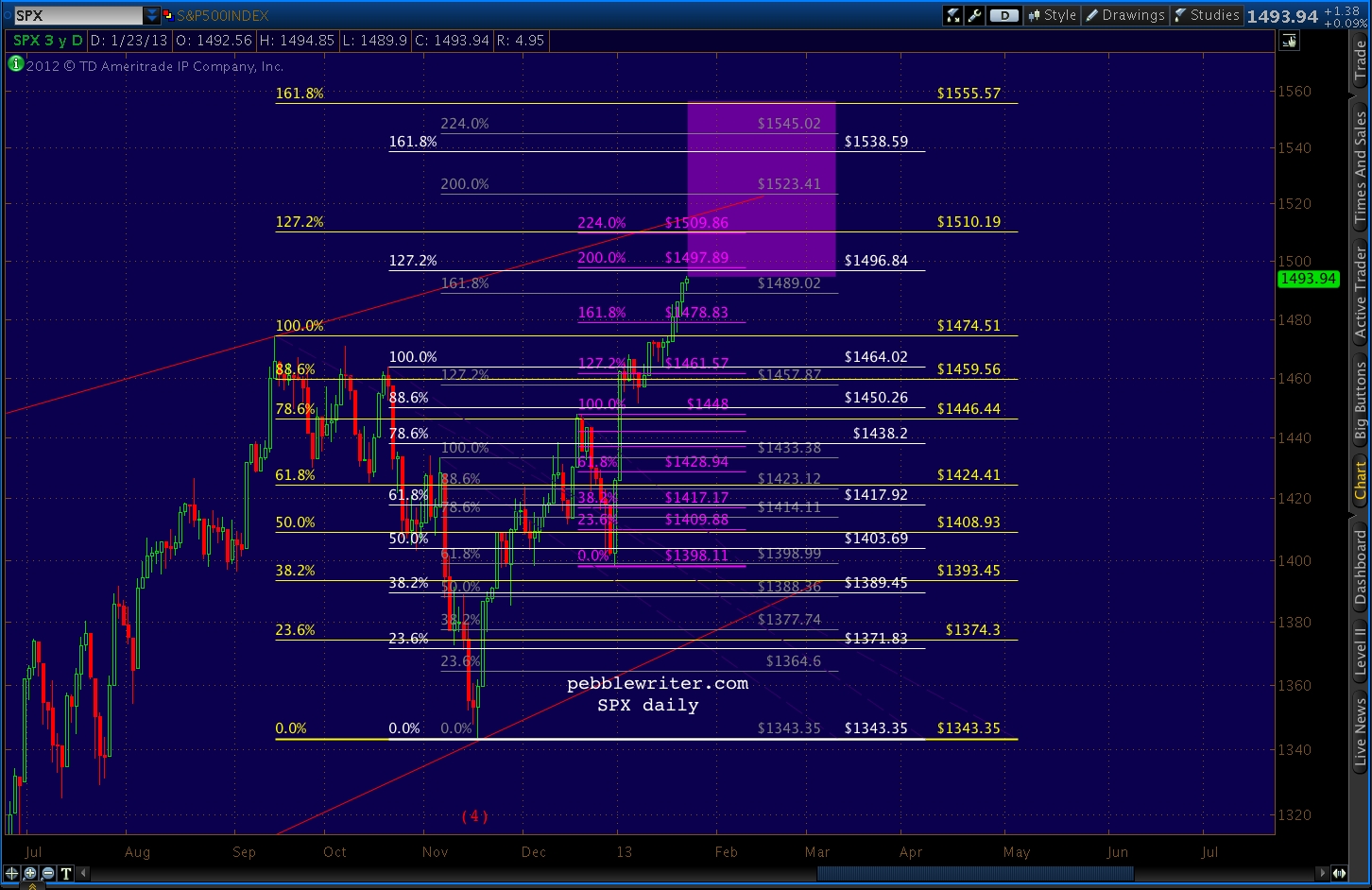
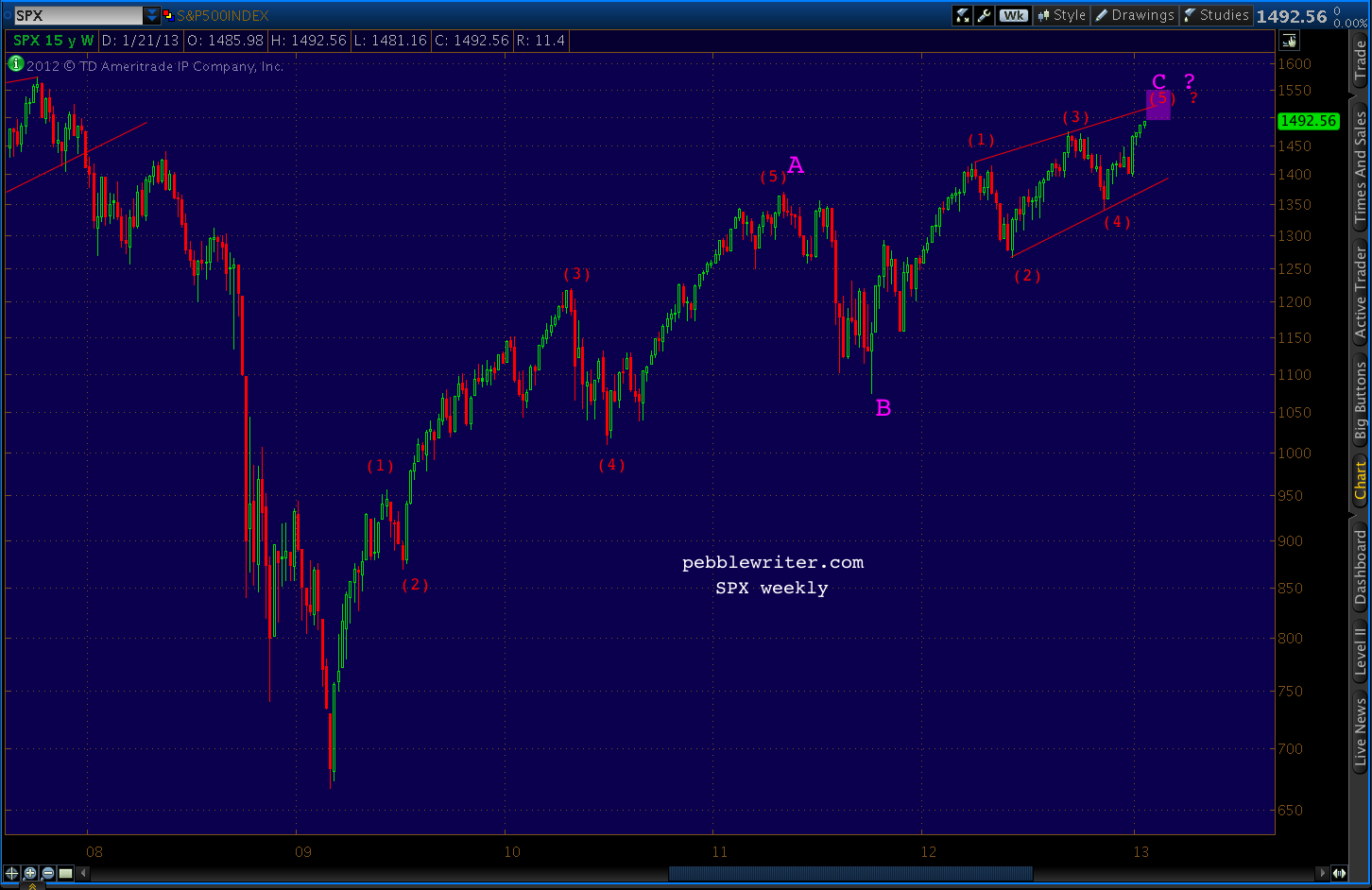
    1510.19 also falls within the confines of the thin red line — the TL connecting the Apr 2 and Sep 14 highs that would probably satisfy the EW requirements of an ending diagonal.  I know you’re out there, my Waver friends.  Please weigh in, as I know only enough EW theory to be dangerous.
    The white pattern is appealing enough, but I would have to consider it secondary in importance to the yellow since it began at a less momentous point X.  Ditto for the grey pattern.

    Although it should be noted that we faced a similar dilemma when choosing between the Point X’s for the Butterfly patterns beginning in 2011 [see: All the Pretty Butterflies.] In the end, it was a point similar to the white pattern 1.0 Fib at 1464.02 that determined the April 2 turn.  It featured a Point B closest to the .786 Fib.

    Zooming out, we can see that the 2011 highs could very well still influence the outcome of the current top.  The chart that includes everything is a little busy…
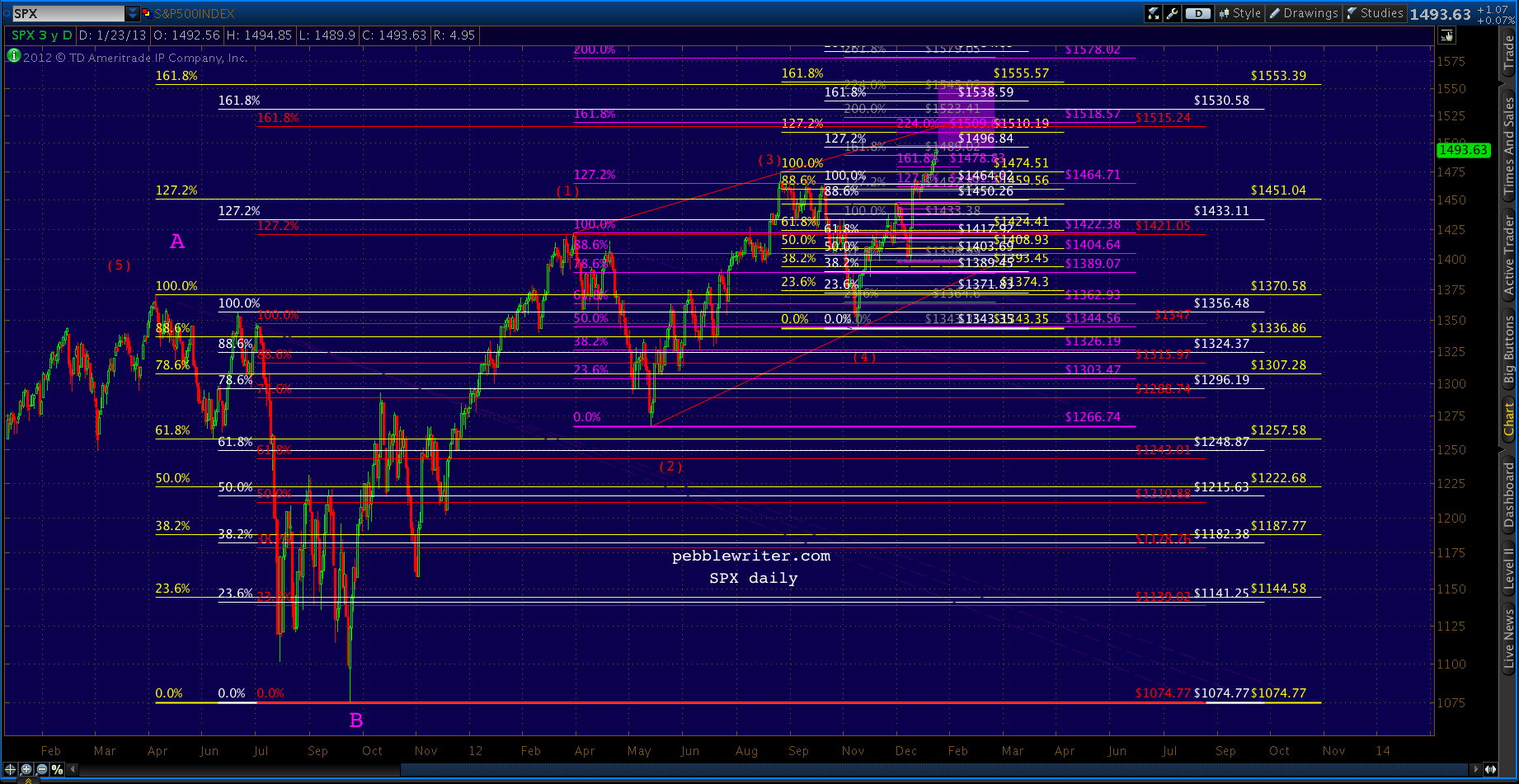
    …so I’ll clean it up by eliminating the interior retracement levels and switching to weekly.
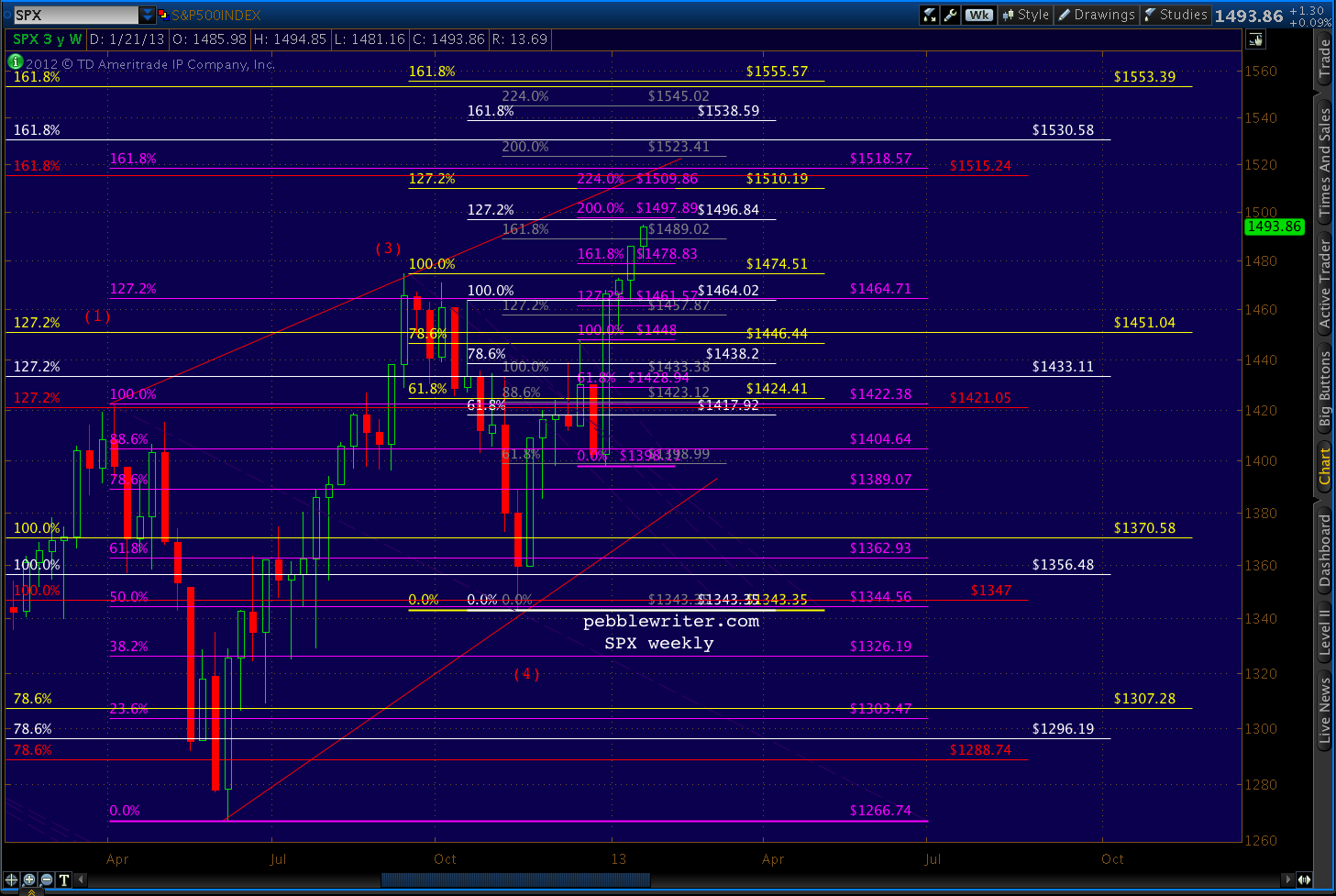
    The target areas can be more easily seen in this close up.
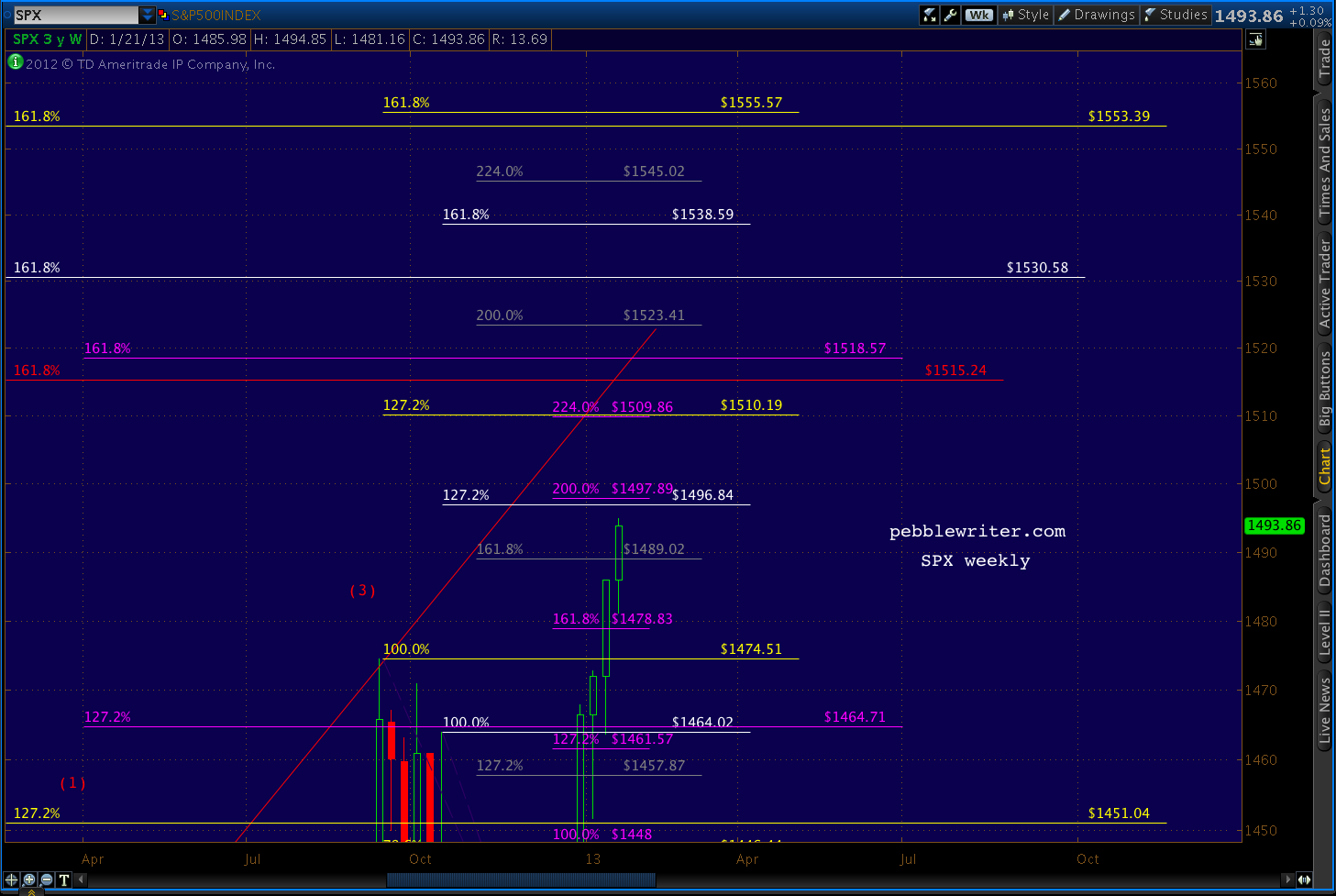
    Note that the large red pattern, the one whose 1.272 extension helped me accurately forecast the April top, comes into play at its 1.618 extension of 1515 – only a few points away from the 1509-1510 level discussed above.

    This is promising, as patterns that influence markets once (that was an 11% correction, after all!) are more likely to do so again.  And, patterns that the market completely ignores — such as the yellow and white patterns from May and July 2011 — are less likely to suddenly leap into a position of authority.

    And, there’s also a purple 1.618 extension (set up by the 1422 – 1266 decline) at 1518.57.  Again, this is close enough to be considered significant.

    If 1520 is exceeded, then we’ll look at the next higher grouping: 1553-1555.  This “group” is basically the two yellow 1.618’s.  Again, the larger pattern’s 1.272 had no influence on the market.  The smaller pattern’s 1.272 is the one coming up at 1519.

    Summary

    My leading harmonic forecast is for 1509-1515.  I can’t imagine getting this close to 1500 and not snagging it for the trophy case.  And, I like the idea of dancing with the harmonic patterns that brung us.

    My secondary goal is slightly higher at 1553-1555, so there should be opportunities to jump back in and capture most of any upside above 1520 if/when appropriate.  Such a move would likely follow a reversal from 1509-1515 back down to 1474ish and would constitute a fifth wave rather than the ending diagonal suggested above.

    If AAPL’s earnings stink up the joint after the closing bell, going long won’t have looked very smart.  But, judging from the steadily appreciating share values, I’m guessing that a relatively positive result is already being leaked.

    Chart Patterns

    I won’t rehash the stuff already posted in the past couple of weeks.  Just take a look at the rising wedge that would be confirmed by a reversal at 1510 as early as tomorrow.  The target would come at the .886 of the base to apex price range and .618 of the time range (almost too good to be true.)
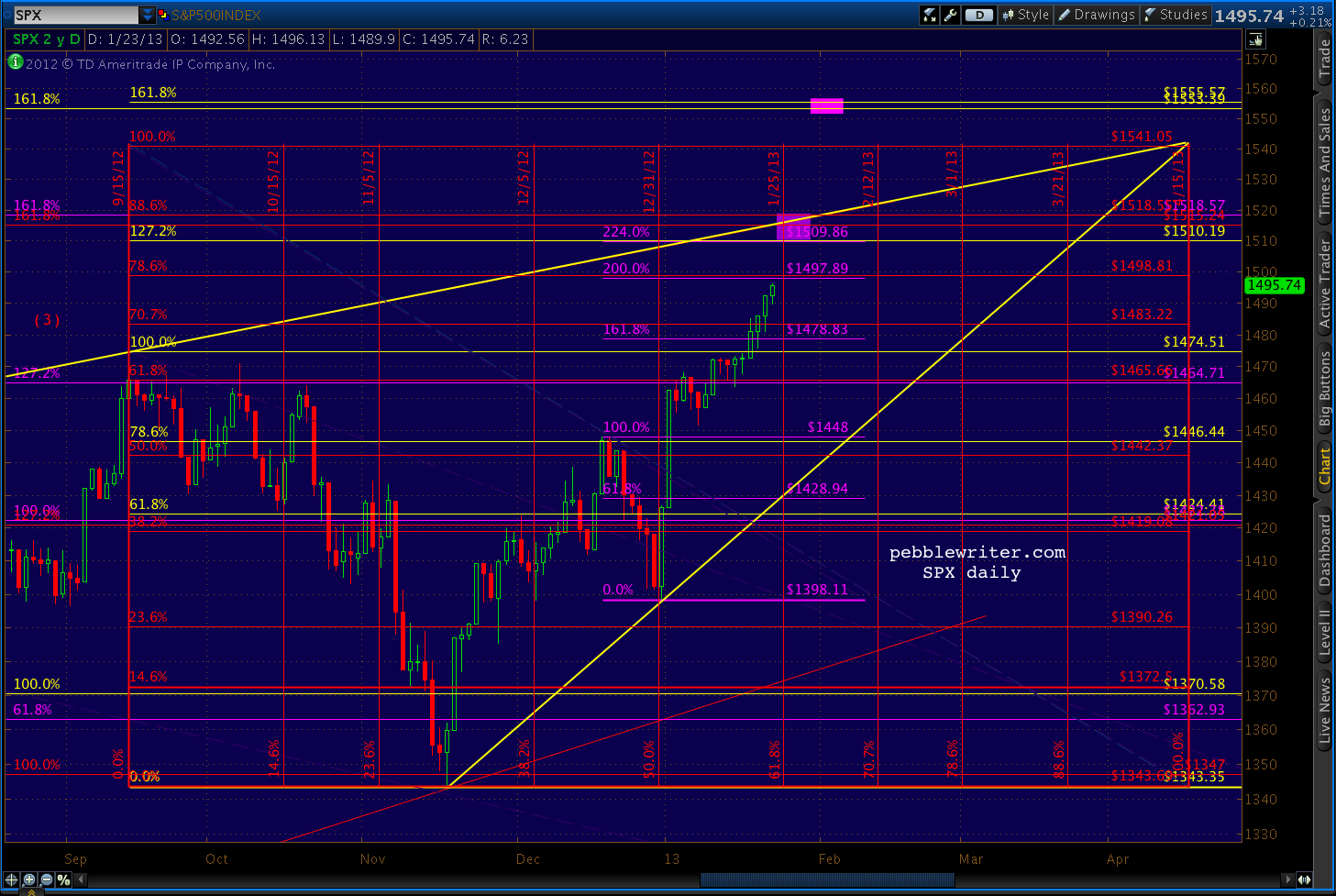
    We’re currently very close to the .786 of 1498, which tells me there’s a decent chance of a run up to 1500ish into the close.

    UPDATE:  3:45 PM

    AAPL is up almost 9 points at the moment.  A rally past 1426 would take it up out of the falling white channel it’s been in since last August.
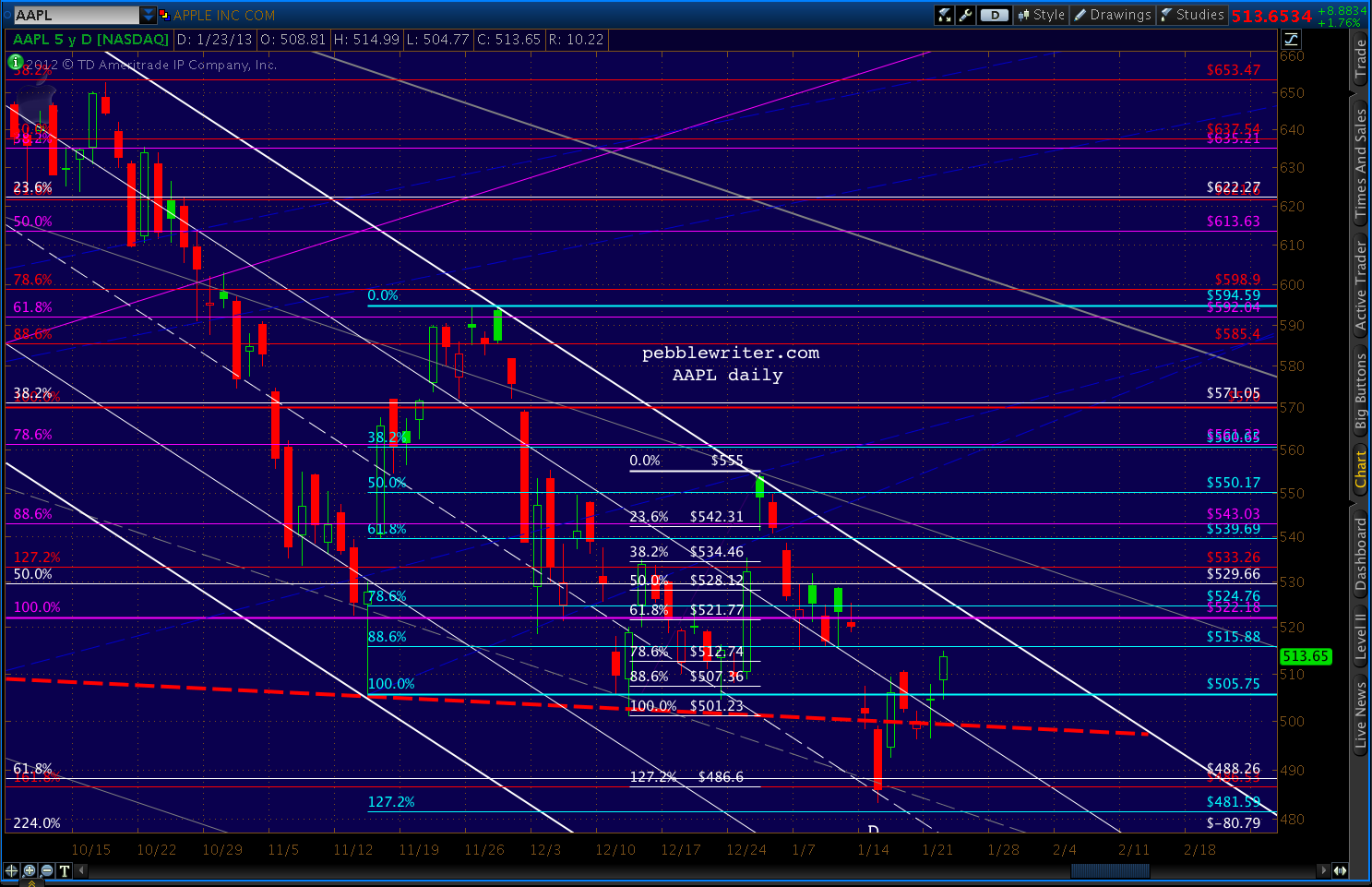
    Anything over 515 would take RSI above the white and purple RSI channel midlines.   So, as expected, much is riding on the earnings report and how it’s perceived.
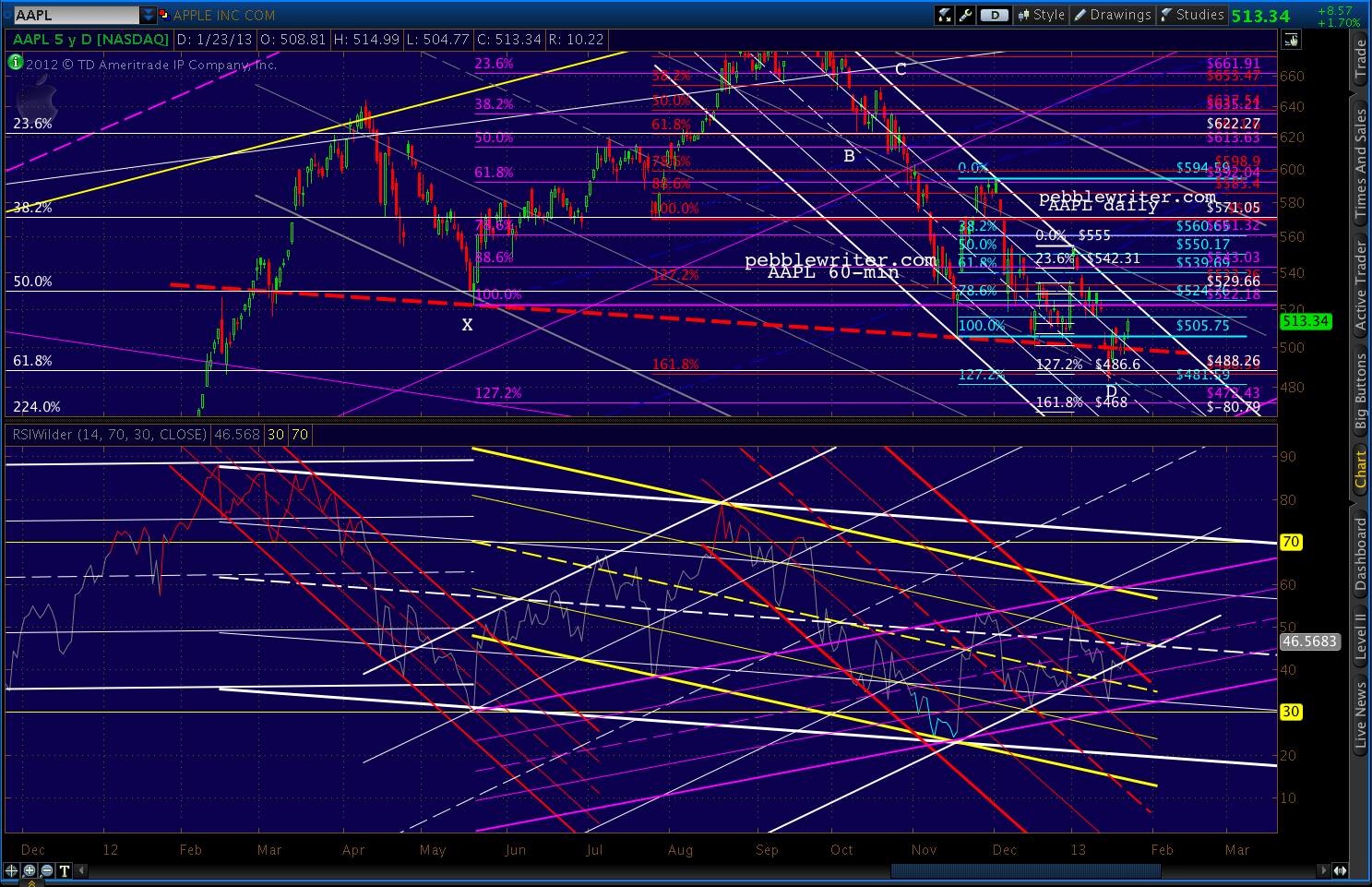
    We’ll watch these RSI channels, though. A return to the top of the yellow (and, especially the white) channel would surely spell a reversal.

    The Agenda

    I think it’s pretty straight-forward — bag an important new high, but without setting the bar so high that expectations can’t be managed.  At 1510, SPX clears 1500 but buys some time before the pressure of “will it exceed 1576?” comes to bear (no pun intended.)

    Then, get through the budget mess (or, more kicking of the can) and see where we are.  If we get a sequester, so be it.  The establishment will be well positioned ahead of time and the correction will be managed.

    After the shock of it wears off and prices have firmed in the 1200-1300’s, time to establish the next leg higher.

    Now, the big question is whether TPTB can engineer such a move without it getting out of hand — as it often does.

    Stay tuned.
  • Ay, There’s the Rube

    Oil is often viewed as a proxy for economic health.  In a growing economy, energy consumption increases.  This increased demand generally pressures prices higher.  Likewise, a decline in oil prices often accompanies declining demand.

    That’s a greatly oversimplified view, of course.  It ignores such important issues such as Middle East tensions, weather and refinery anomalies, etc.

    But, the most important of these external factors is the US dollar — the currency by which oil is traded globally (for now.)

    A weakening dollar is great for the many US companies that export overseas.  In general, it makes dollar denominated assets — such as stocks, real estate, etc — more attractive to overseas investors which helps the US attract and retain capital.

    But, it makes foreign-sourced oil much more expensive.  This isn’t an issue if you travel everywhere via America’s world-class public transportation system.  But, it really sucks for the guy with a 3-ton SUV — or anyone who consumes anything made overseas, for that matter.  Imports are about 18% of GDP.

    So, what’s a central banker to do?  Boost stocks and investment in US assets, and there’s a pretty good chance you blow the budget of every American consumer.  (Of course, it only really affects those who eat and drive — hey, buy a Chevy Volt already!)

    Boost the dollar to make gas and food more affordable for the 50 million Americans living in poverty (1 in 5 children, 2 in 5 African American children), and you risk a true disaster — a stock market decline.

    Never fear… Bernanke and his fellow Guardians of the American Dream know whose bread to butter.

    The chart below shows how crude light, the US dollar and the S&P 500 correlated over the past seven years.  In 2006 and 2007, oil and the stock market soared pretty much in sync while the dollar took it on the chin.  When SPX topped in late 2007, oil kept right on soaring — because the dollar was still plunging.  Nationwide, gas hit $4.12/gallon in the summer of 2008.

    We’re all conditioned to think of dollar strength as a function of risk off.  But, as the financial crisis worsened, the dollar couldn’t catch a bid.  Money fled to the euro, the swiss franc, the sterling — anywhere but the dollar. There were several best-sellers on bookstore (remember those? shelves that advised putting every last cent into the euro.

    From October 2007, when SPX peaked, until July 2008, stocks and the dollar moved pretty much in tandem.  But, as euro zone problems became more apparent, the dollar finally bottomed.  In August, as stocks began sliding again, the dollar finally took off.  Now deemed a safe haven, DX soared 27% by March of 2009, while stocks shed another 54% in value (58% in all.)

    Of course, this did a number on oil — already reeling from declining global demand.  CL plunged an astounding 78% in only six months — from 147 to 33.  Fortunately for the stock market — and especially the oil industry — Ben Bernanke came to the rescue.  The first round of QE was a resounding success and both promptly reversed.

    In the first three months alone, CL more than doubled to 73.  SPX added on a respectable 44%.  And the dollar took one for the team, shedding an initial 13% on its way to an 18% loss.

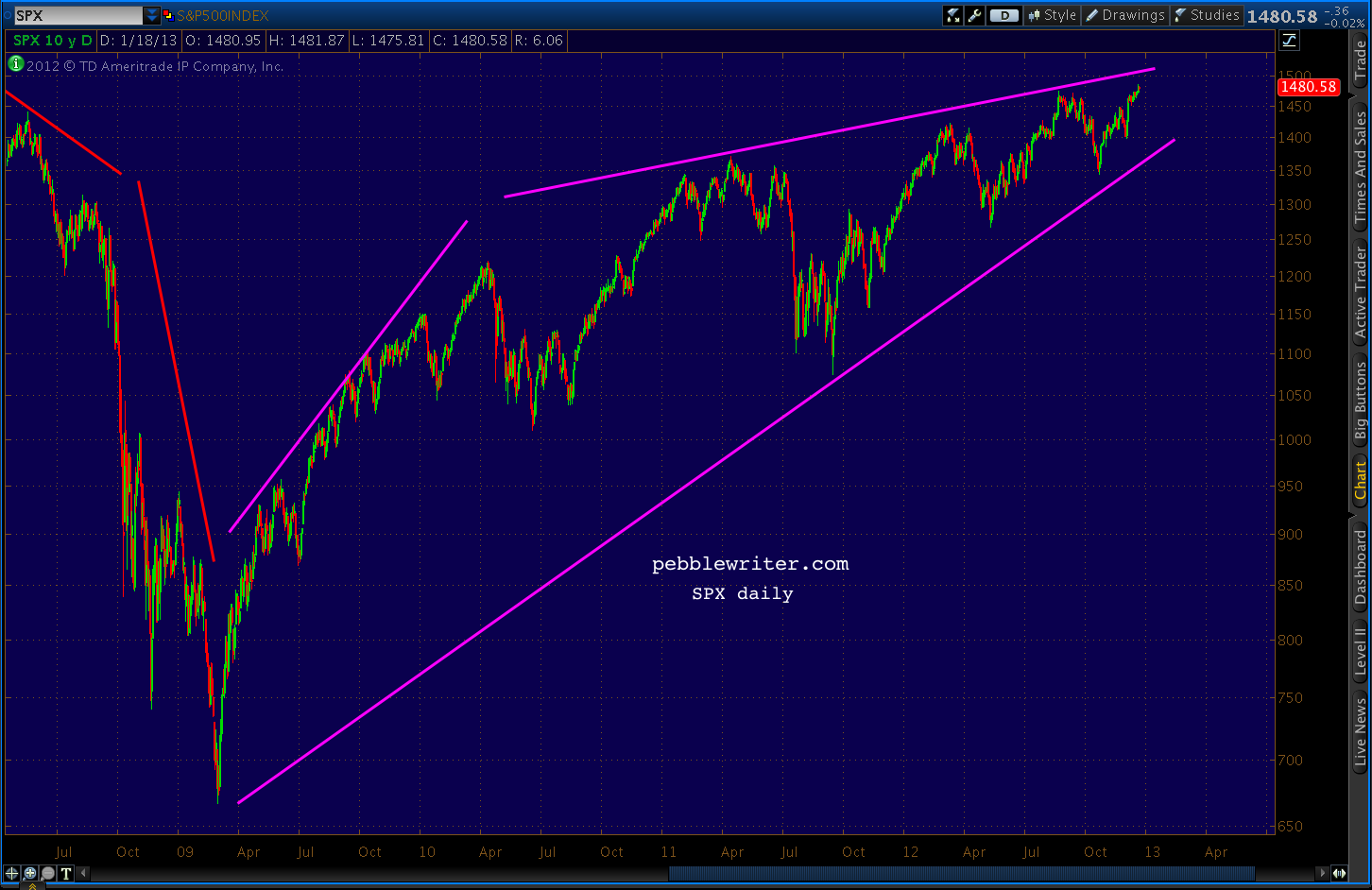
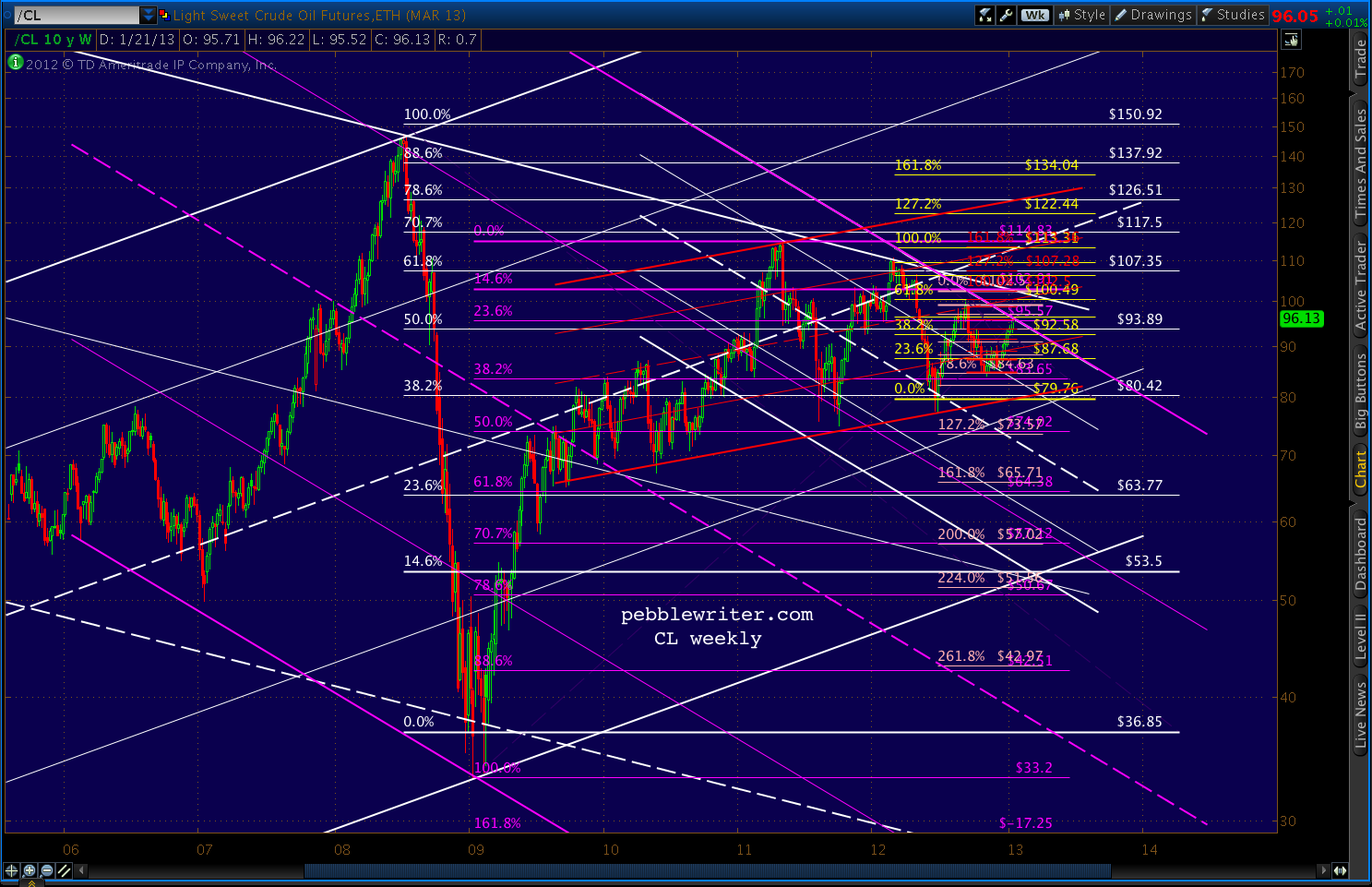
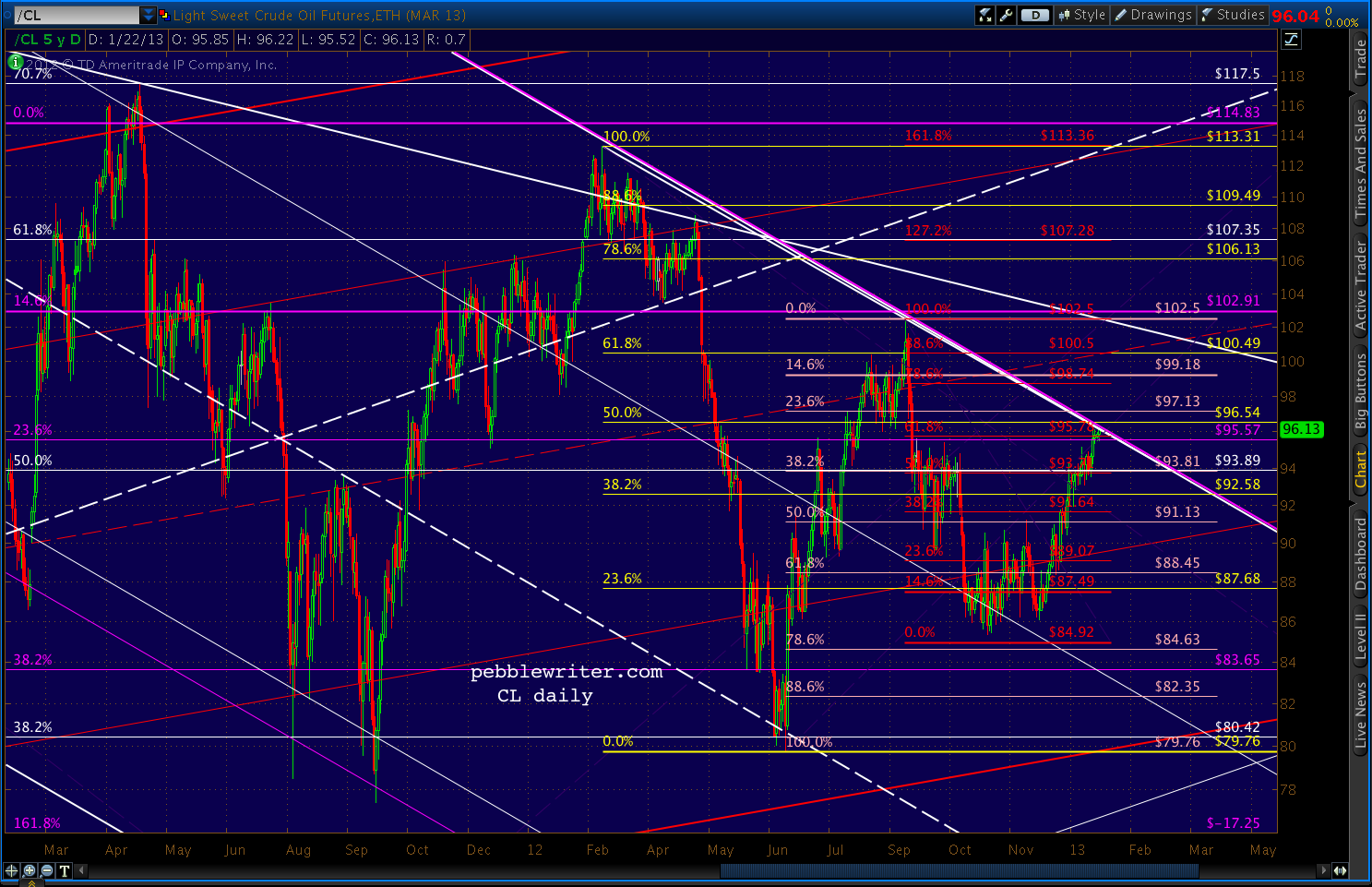
    So, why the history lesson?  By now most of you have noticed a slight discrepancy over the past 3 1/2 years.  Oil and the dollar have formed triangles.  They’ve had their ups and downs, but in general the highs have been getting lower and the lows getting higher.  I use the term “coiling” because eventually prices won’t be able to compress anymore.

    This pent-up energy will eventually be released in the form of sharply higher or lower prices, though it won’t necessarily happen tomorrow.   Both have drawn close to one side of the pattern, but there’s still plenty of room for a reversal.

    Oil, if it doesn’t suddenly shoot higher, will probably bounce back down.  Likewise, the dollar is poised to bounce higher.

    Stocks, on the other hand, have made a series of higher highs and higher lows in what’s known as a rising wedge.  These patterns also can’t last forever, and they almost always resolve to the downside.

    Prices are much closer to the upper bound than the lower, which also suggests the next major move will be lower.  In fact, when rising wedges break down, they typically target their origin. Needless to say, a return to 2009 or even 2010 prices would be a huge blow to the rosy scenario TPTB are crafting.

    Does oil offer any hints as to which way prices are likely to go?   I’m drawn to a few periods in particular.  From June 2009 to May 2010, oil gained 19% compared to SPX’s 27%.  Yet, they both shed roughly 20% in the May – June 2010 correction.

    We had another round of QE, which collapsed the dollar and sent stocks up 36% and oil up 70% through May 2011.  This time, SPX corrected 22% and oil 35% (through Oct 2011.)

    At that point, CL sold off strongly — dropping 23% through the end of June.  SPX, however, lagged.  It lost 8%, then promptly regained 90% of it in the next three weeks (compared to CL’s 40% retracement.)  When the slide continued, however, SPX caught up — in spades.

    It lost 80% of its gains from June 2010, while CL only lost about half that.  SPX then went on to make three new highs in a row, adding 38% through today’s close.

    CL managed an 88% retracement of its May-October losses for a 47% gain through Feb 2012, and has made two lower highs (each a 61.8% retracement of the previous high) since then.  Total gain from Oct 2011: 27%.  And, it’s been a fairly neutral currency market.

    I can’t help wondering what the oil and currency markets know that the stock market doesn’t.  A look at the CL charts indicates more downside.  Will SPX again play catch-up?

    Even ignoring what I suspect about the dollar and equity markets, CL presents a bearish picture.

    Whether it breaks down or out, CL is obviously at a turning point.  We’ll keep an eye on it…


  • Charts I’m Watching: Jan 14, 2013

    ORIGINAL POST:

    The dollar is making a stand at the upper end of the target range I charted Friday, but hasn’t yet broken out of the steep falling channel.  While there was a turn at the .618 Fib that would justify a .786 completion (a Gartley), the more obvious Point B was at the .382.

    In a perfect world, this would signal DX has further downside potential to the .886 for a Bat Pattern completion — though, obviously, not every corrective wave has to be a harmonic pattern.

    The EURUSD similarly reached a common turning point at the 1.272 extension of the latest move down from Dec 19 (or Jan 2, take your pick.)

    But, as can be seen, the rally from last week features no potential Point B whatsoever.   It’s hard to call this a Butterfly Pattern in the absence of an actual pattern.

    Furthermore, the tails on the daily candles offer an even more aggressive upper bound for the rising wedge we’ve been charting for the past several weeks.

    Equities are pointing to a soft opening, but nowhere near what one would normally expect with horrid AAPL news on the tape — much less the approaching budget showdown.

    Regular readers are well aware of the importance of the 500 price level for AAPL.  As we’ve discussed many times, the completion of the H&S pattern could have dire consequences for AAPL and the entire market.

    continued for members(more…)