Author: pebblewriter

  • Charts I’m Watching: Jan 28, 2014

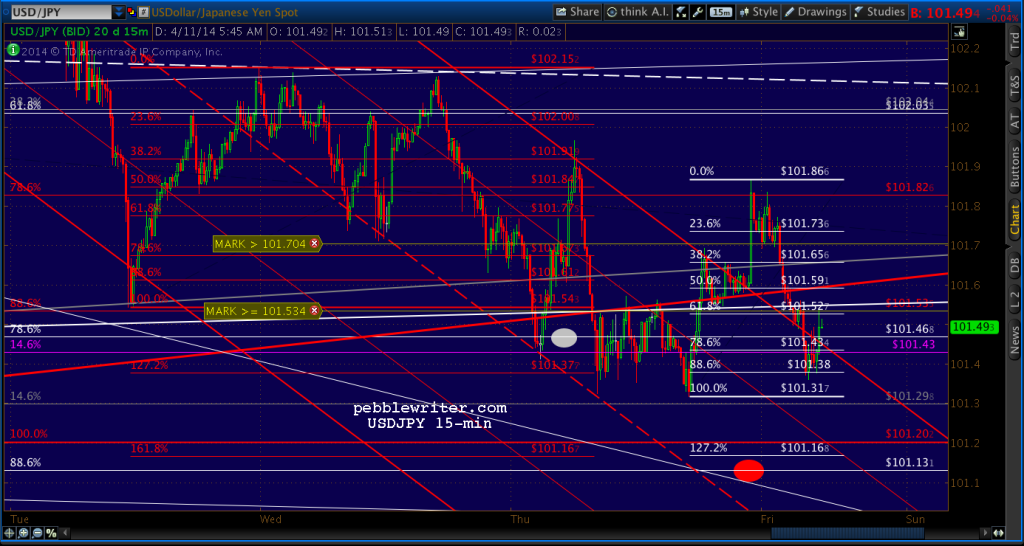
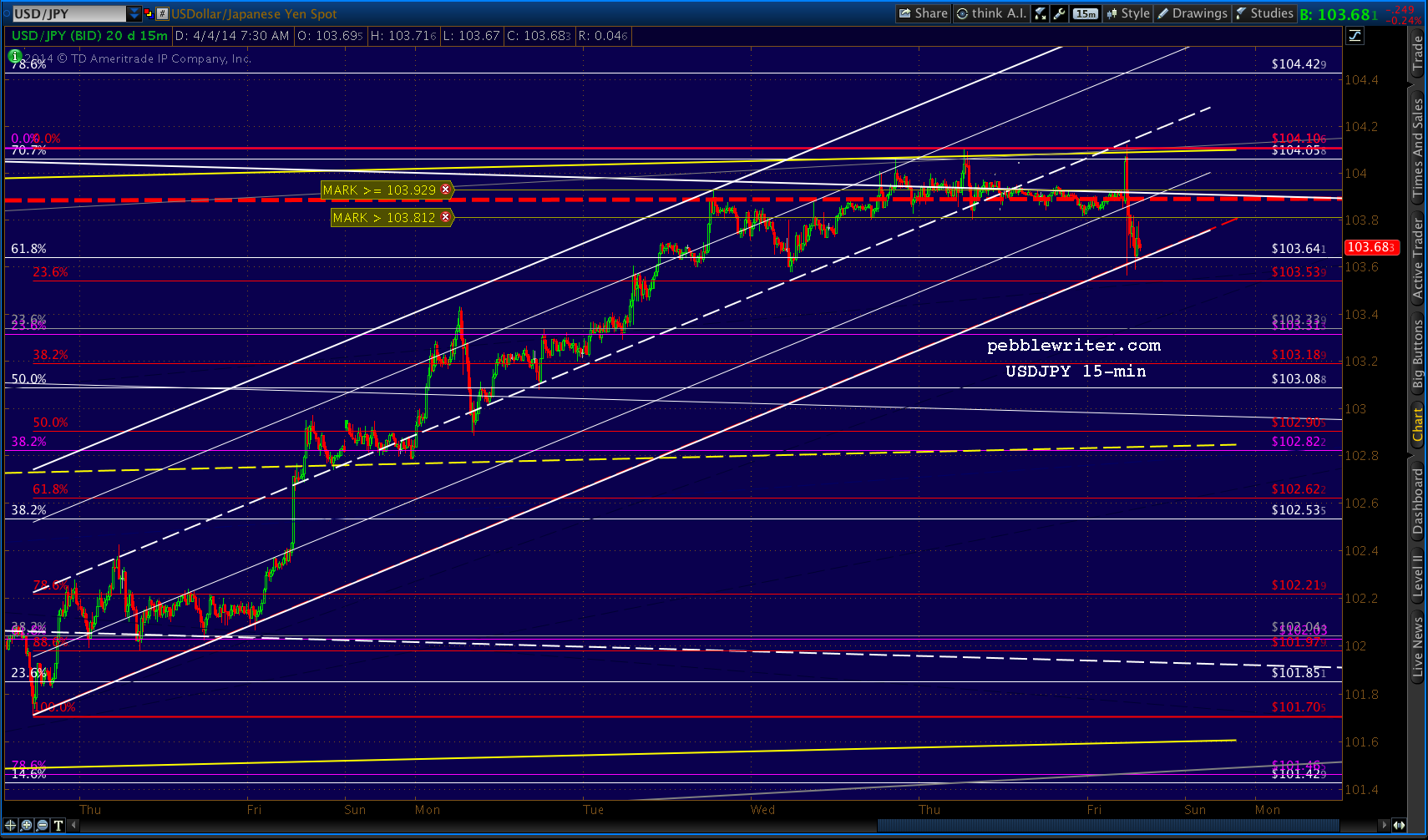
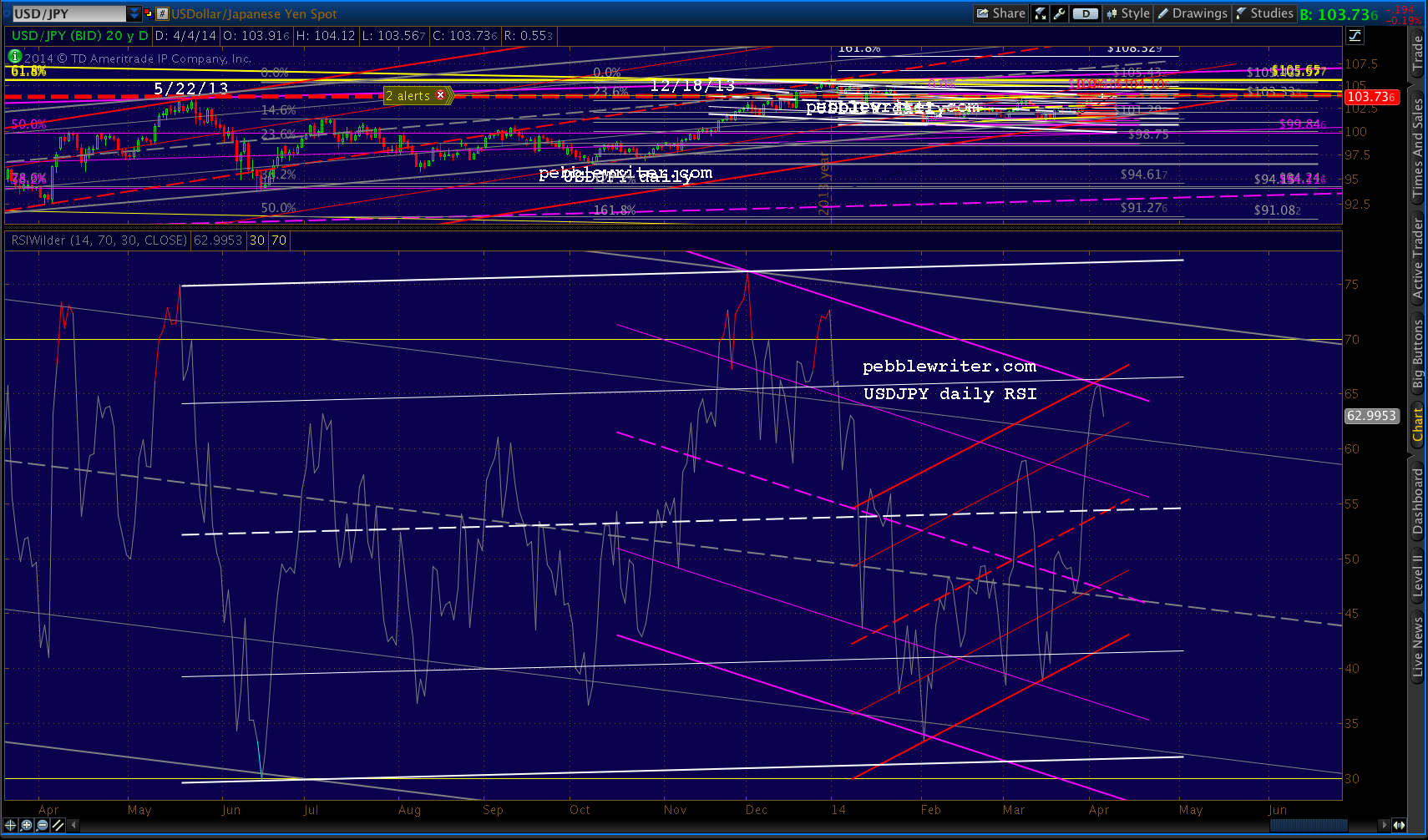
    The USDJPY is hanging in there still — surprising, given the abysmal durable goods print.  I wouldn’t expect the rising wedge to hold.

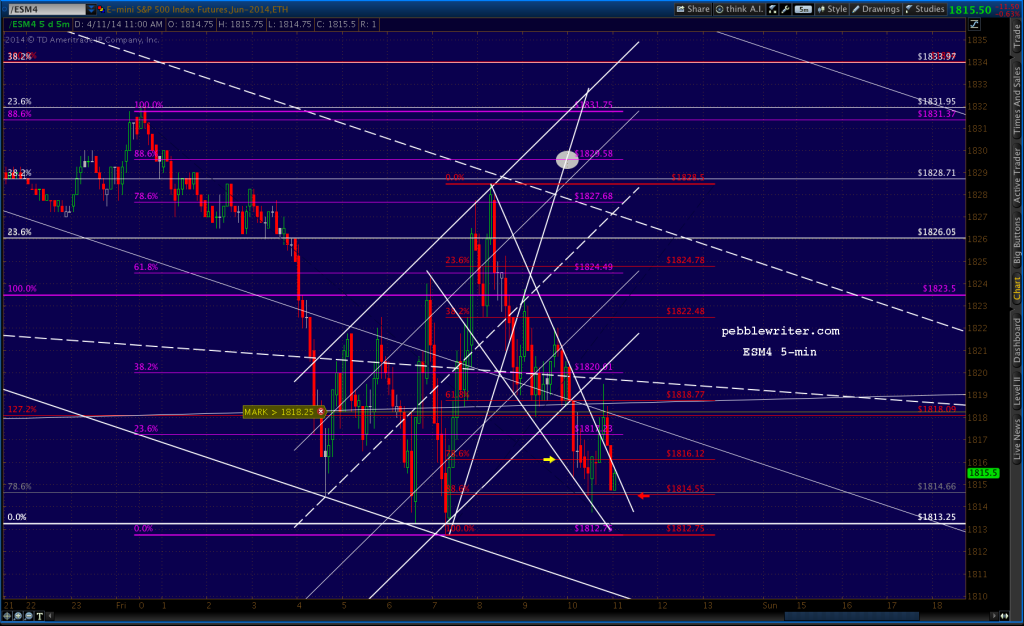
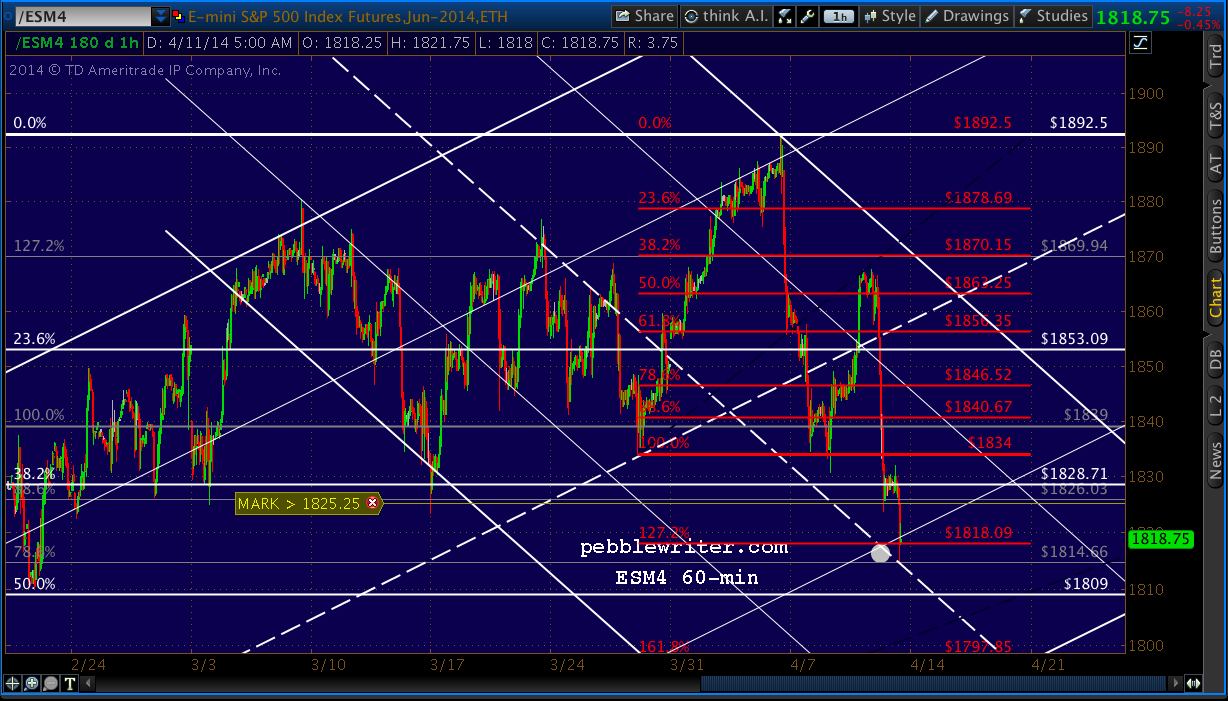
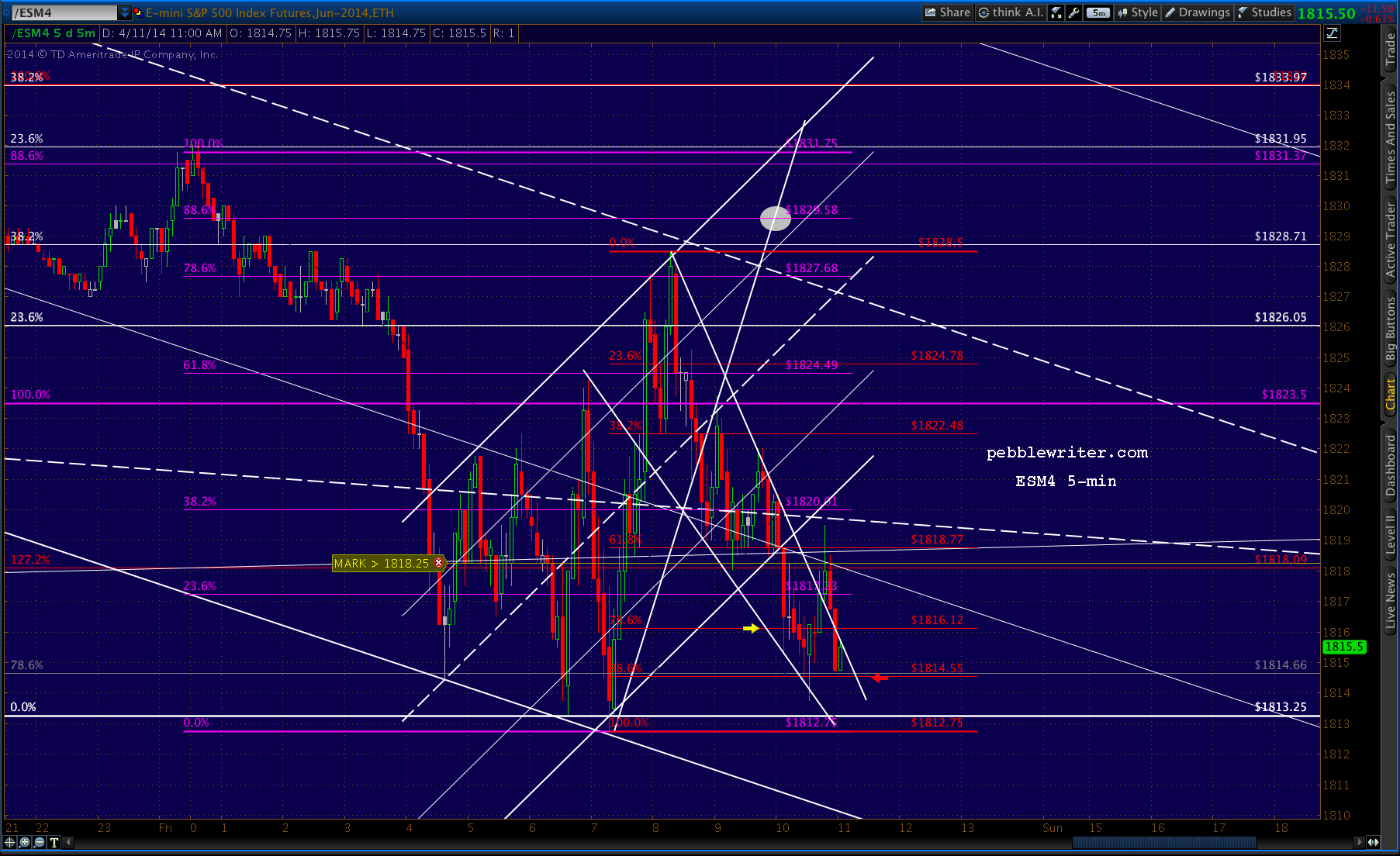
    The e-minis shed a portion of the overnight ramp, but only to the purple .618 so far.

    continued for members(more…)

  • Charts I’m Watching: Jan 27, 2014

    USDJPY, having lost the rising white channel as expected, found the purple .236 channel line.  Recall that the rebound of the yen was one of the central tenets behind our last major market call [see: USDJPY update.]

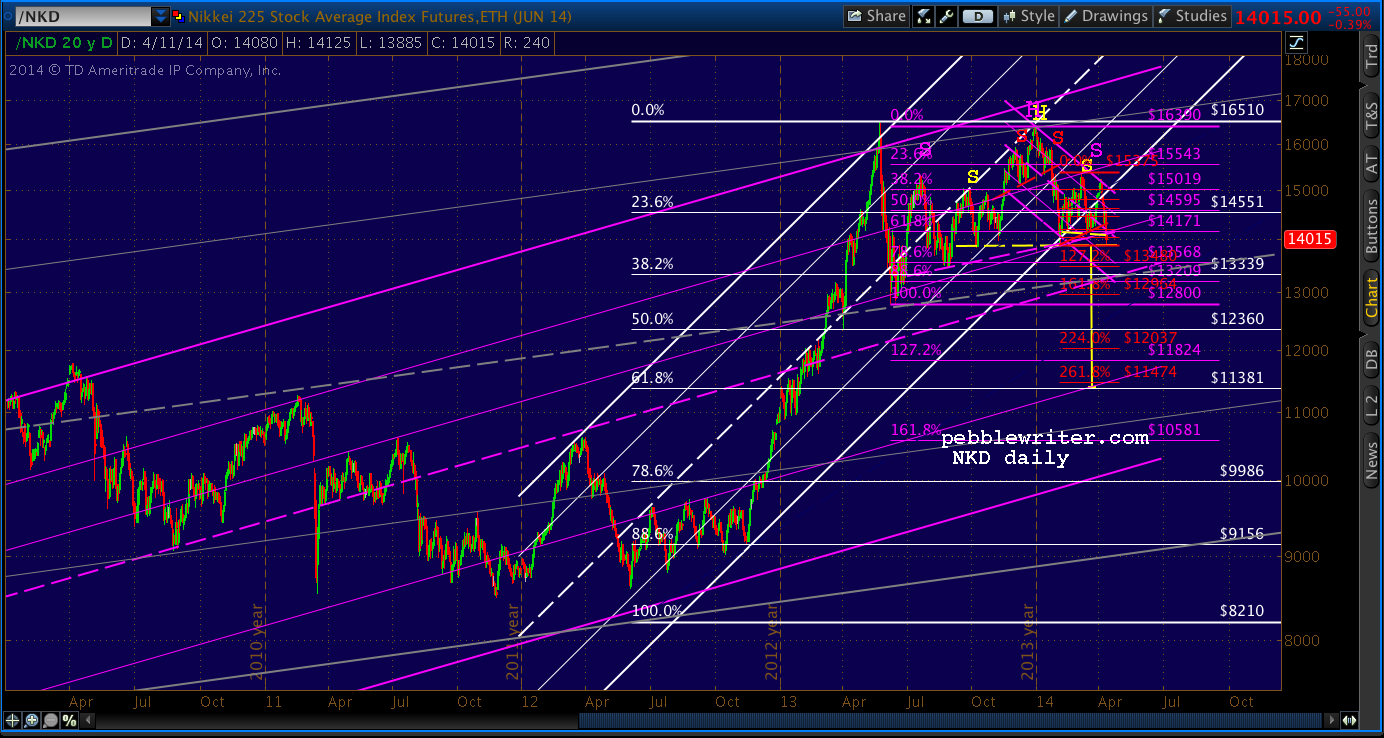
    At the time, the pair had reached a TL dating back to 1998.  The previous 3 tags had resulted in drops in the S&P 500 of 22, 35 and 57%.  In addition, Japanese stocks had reached what I believed to be a turning point:

    The TOPIX off almost 6% since then, and has found trend line support here at 1229.

    In general, the market is due for a retrace, but I necessarily wouldn’t hang my hat on the USDJPY channel line as a catalyst. In fact, this channel has been pretty sloppy. I’m particularly interested in whether the pair can push back above the falling white midline and, hence, the Jan 13 lows.

    There is pretty obviously (to me at least) plenty of additional downside, but things could change quickly if the FOMC/IMF/ECB comes to the rescue due to the EM unrest.

    This week is a minefield of economic and earnings news, and I’d be very cautious on any position long or short.  As discussed Friday, this week we’ll get:

    …new home sales, durable goods, the FOMC announcement, initial claims, advance GPD, consumer confidence, Michigan sentiment and Chicago PMI.  The unemployment report (Wednesday) should be a big boost, as the 1.4 million folks whose benefits Congress just declined to extend will no longer be counted.  The unemployment rate should plunge.

    All in all, I think it’s a week best suited for scalping, as I’m not willing to risk my gains from last week’s shorts on the accuracy of my FOMC crystal ball.

    continued for members(more…)

  • Charts I’m Watching: Jan 24, 2014

    ORIGINAL POST:  5:15 AM EST

    USDJPY just confirmed the H&S we were watching.  Target = 100.68.  There’s good horizontal support for it there, as well as the purple channel .236 line.

    The daily chart shows the much lower potential.

    UPDATE:  6:15 AM

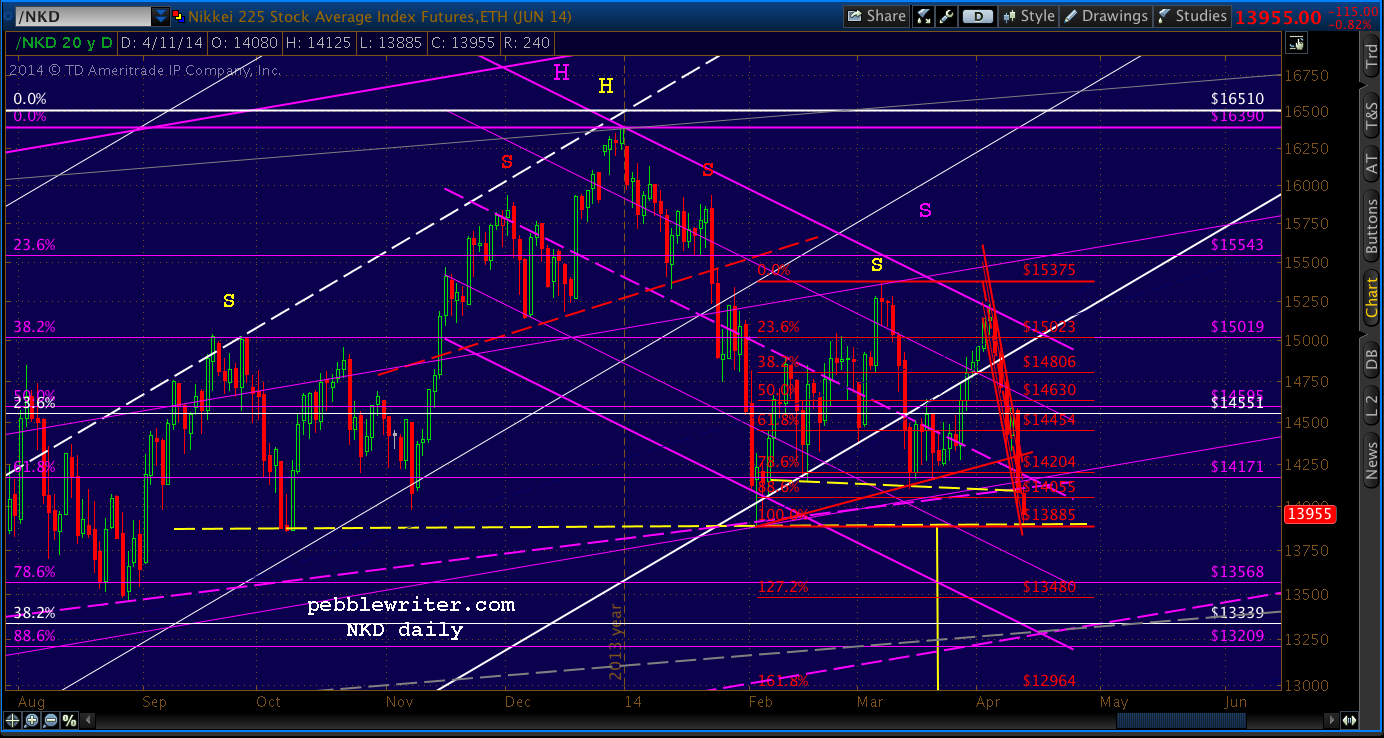
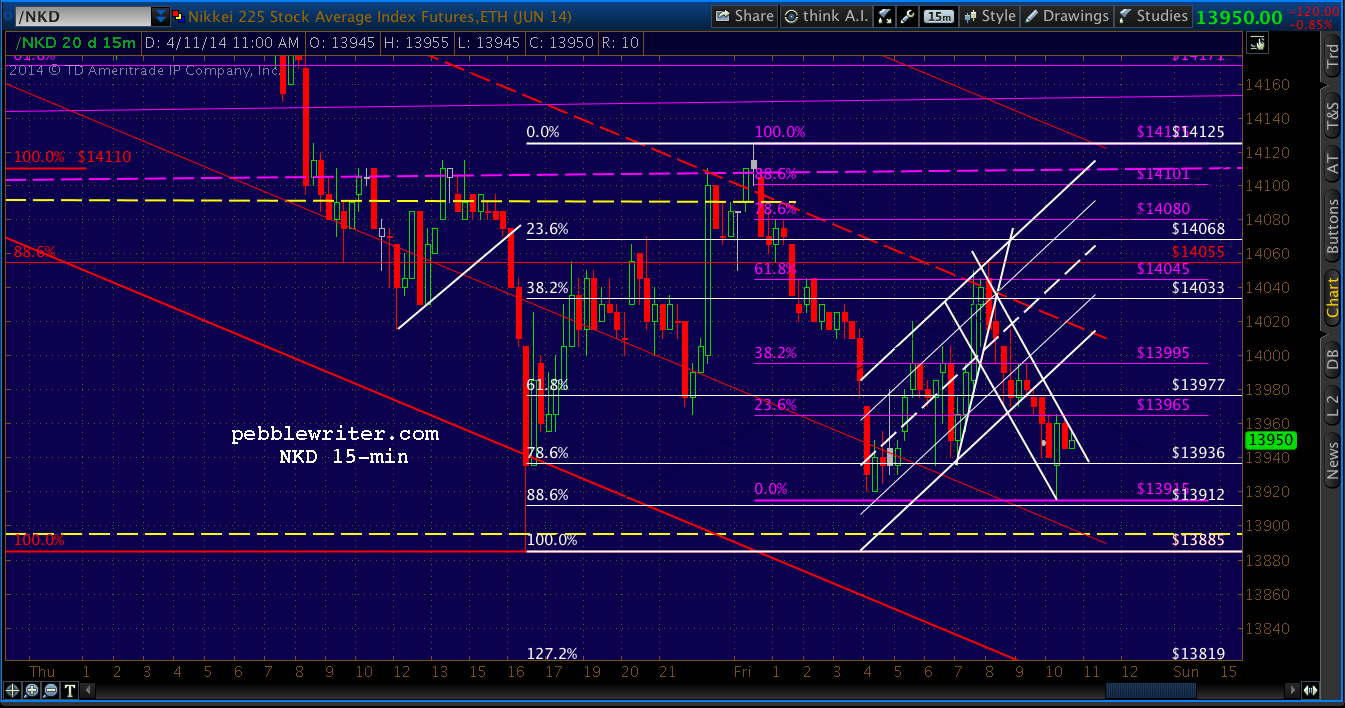
    The Nikkei futures H&S pattern targets 14300 near the purple channel bottom.

    BTW, for those who were looking at the transports’ divergence as a silver lining — I hate to break it to you.  DTX just completed a large Crab Pattern that should smack them back significantly.

    Dip buyers beware.  This will get worse before it gets any better. Art Cashin just said [watch on CNBC] exactly what we’ve been saying since Dec 27:  the yen’s strength (and USDJPY decline) represents a flight to safety — as are lower yields.

    Right now, everyone’s talking about Argentina and the Ukraine, but watch for the focus to switch to Asia any minute.

    Next week is huge from an economic news standpoint.  We have the new home sales, durable goods, the FOMC announcement, initial claims, advance GPD, consumer confidence, Michigan sentiment and Chicago PMI.  The unemployment report (Wednesday) should be a big boost, as the 1.4 million folks whose benefits Congress just declined to extend will no longer be counted.  The unemployment rate should plunge.

    Coming up, downside targets.

    continued for members(more…)

  • Charts I’m Watching: Jan 23, 2013

    Lots of action this morning. We’re finally getting some real downside courtesy of the yen, which is following our evil plan to the letter.  As we discussed back on Dec 27 [see: USDJPY update] when we posted this chart, the USDJPY’s reversal at the top of the channel would mean trouble for stocks.

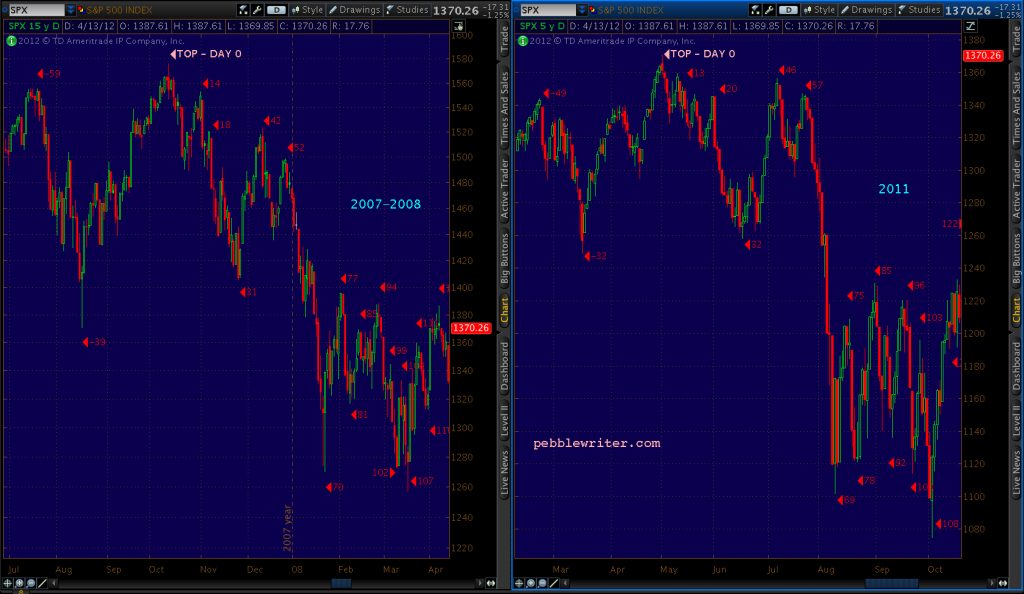
    The 1st time back in 1998 knocked SPX (above in purple) down by 22%.  The 2nd, in 2000, chopped 35% off SPX.  And the 3rd, in 2007, walloped stocks for a 57% loss.

    For my fellow Fibonacci freaks, each of those declines was roughly 1.618X the previous one.  And, 57% X 1.618 is 92%. Still trying to wrap my mind around that one

    Of the catalysts we suggested for a strengthening yen, each seems to be playing out so far:

    The BOJ will have to taper.  IMF Managing Director Shinohara questioned the continuation of QE at a seminar in Tokyo last night.  “As long as progress is being made, there is no need for the Bank of Japan to expand its quantitative easing programme.”

    Furthermore, the annual limit of QE has already been reached only 9 months into the program.  And, inflation — especially in food and energy — is becoming more noticeable.  As Zerohedge reported yesterday, it’s beginning to dawn on analysts that the program will be wound down.

    Flight to Safety.  Troubles continue to mount in Thailand, where violence is spilling out into the streets.  A state of emergency was declared on Tuesday.  The markets are getting increasingly nervous.

    Global funds have pulled $2.8 billion out of Thai stocks and $1.4 billion out of Thai bonds since Oct 31.  The baht is tumbling, and stocks are down 12.5% since October.

    China Troubles.  The news on China is increasingly negative, with liquidity issues, a large bankruptcy, and declining PMI headlines in the last few days alone.

    Japanese Stock Market.   Japanese stocks have topped and are due for a correction.  The Nikkei maxed out on Dec 31, the same as many other indices.  Though it’s still early, the 7% drop (half of which came today) in NKD since then has even the bulls wondering (but, not technical types who know a H&S Pattern when they see one.)

    In sum, the yen is taking off as expected.  And, it’s doing a number on the USDJPY, which this morning lost the acceleration channel it’s been in since last October.

    Maybe this time will be different, and the reversal off 105.43 won’t do much damage to stocks.  But, I’m much more comfortable being short.  It’s a long way to the bottom of the ridiculously-steep-nothing-bad-will-ever-happen-as-long-as-the-fed-has-our-backs channel, let alone the Fibonacci targets I’m eyeing.

    GLTA.


  • Charts I’m Watching: Jan 22, 2014

    USDJPY is treading water this morning…

    …while EURUSD is clinging to the yellow TL/neckline, with plenty of immediate downside.


  • Harmonic Overview: Jan 21, 2014

    I’ve been pounding the table for weeks on the EURUSD and USDJPY charts…

    And, presented what I believe to be a  compelling chart on Japanese equities last week:

    But, the fact is that almost all of the major indices I watch have reached a natural reversal point from a harmonic standpoint.  Many have also completed chart patterns that indicate a reversal is at hand.  To wit…

    RUT completed a large Crab Pattern today.

    DJIA has still failed to break out after completing a Butterfly Pattern in late December.

    NYSE topped out on Dec 31 after completing a double-top.

    COMP has almost (98.6% of the way) reached 78.6% of its drop from 5132 in Mar 2000.

    XLF recently retraced half of its 85% drop from 2007 to 2009.

    The Transports are just shy of completing a Crab Pattern at the 1.618 extension.

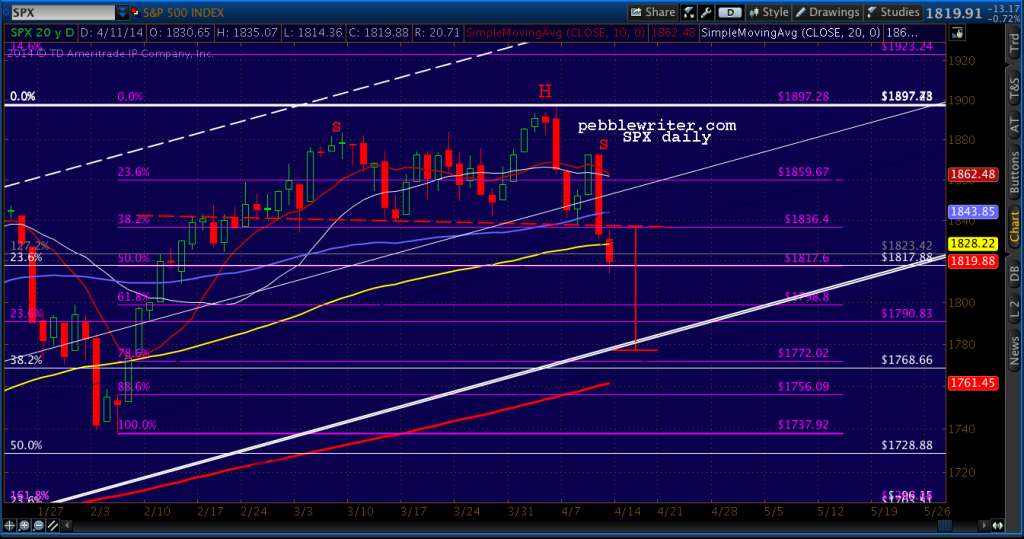
    SPX pushed slightly beyond its Butterfly top of 1823 in order to accommodate a Butterfly completion in ES — but has yet to break out despite numerous ramp jobs in the after market.

  • Charts I’m Watching: Jan 21, 2014

    Battling computer issues this morning…  Fortunately, the markets are cooperating (after the usual holiday weekend ramp job.)  EURUSD continues to weaken as expected…

    …as does USDJPY.

    Once the white acceleration channel fails, things will start happening pretty quickly. 

    continued for members(more…)

  • Currencies: Jan 16, 2014

    USDJPY reached our target range and is reversing.  This is the key, today.

    The rising white channel is clearly bigger than the falling purple channel, and as such could be expected to hold.  But, remember, it’s positively puny in comparison to the larger channels now in control of the big picture.

    If they can’t arrest the slide at the potential H&S neckline, the next downside targets are the white 1.618 at 100.68 and purple .786 at 98.46.

    We’ve been watching the USDJPY as it has been very highly correlated with US equities.   In the not too distant past, the key was the EURUSD.  For the past 9 months or so, the correlation has been pretty strong.

    If we examine the 10-yr EURUSD chart, we can see that it’s been locked in a falling channel since the 2008 highs.  Interestingly, it has returned to the top of that channel — where past reversals have not been kind to US equities.

    The last two channel-top tags were accompanied by significant SPX drops of 53% (from Apr 2008) and 22% (May 2011.)

    The future of the euro is anything but certain, but my interpretation of the charts is that the rising red channel is the most dominant.  I’ve highlighted the .618 channel line, which EURUSD is currently backtesting.

    The backtest was touched off by a third bounce off the neckline of a completed H&S Pattern (in yellow.) Had the bounce not occurred, I suspect the pair would have tested the white .618 Fib at the bottom of the falling white channel in Aug 2012, backtested the neckline, and proceeded to the bottom of the red channel at the .786 Fib (still a good possibility.)

    The H&S Pattern didn’t pay off (yet) because the pair strengthened when the Fed maintained and even discussed increasing the pace of QE in mid-2012.  The pair bounced, even managed to gain a toe hold on the recently lost yellow channel bottom — which it has since again lost.

    To summarize: EURUSD has reversed off the top of the falling white channel, fallen below and is backtesting the red .618 channel line, fallen below and is backtesting the yellow channel bottom, and has reached the white .618 Fib line.

    Another, simpler way of looking at it is in the context of the neckline — which makes for a terrific channel midline as seen below:

    Note that yellow channel also does an excellent job of capturing SPX’s moves over the years.  The area to the lower right — SPX below 1000 and EURUSD below 1.20 — is interesting to me.  It represents, I suppose, the downside case.

    That is, if the market should fall apart in the next few years and retreat to the falling purple trend line at, for sake of argument, 550 in mid-2016, would it surprise anyone if EURUSD also fell below 1.00.  Surely, such a market meltdown would be accompanied by tough times on the continent, and the USD would likely revert to safe-haven status.

    If the EURUSD and USDJPY are both poised to drop — and, it’s by no means a foregone conclusion — it implies that the dollar is strengthening against the euro, but the yen is strengthening against the dollar.

    This implies to me that the catalyst might come from Asia.  There’s little question that QE has done a marvelous job of inflating bubbles across Southest Asia:  Singapore, Thailand, Indonesia, Malaysia, Philippines.  Their stock markets are up 3-5X, and their currencies have all soared versus the yen — especially since Abenomics kicked in.

    The Singapore dollar is up over 40% since its lows.

    Ditto the Thai baht.

    Collectively, Singapore, Thailand, Indonesia, Malaysia and the Philippines represent about $755 billion in currency reserves — about 60% of Japan’s $1.3 trillion.  Throw in Hong Kong’s $309 billion and Korea’s $345 billion, and the total exceeds the yen’s $1.3 trillion.

    Money supply tells a similar story.  The five “smaller” countries total about $1.8 trillion; adding HK and Korea brings the total to $5.3 trillion — about half of Japan’s total.  And, the growth has been completely lopsided, with a significant concentration in the smaller, faster-growing countries and little growth in Japan.

    The reality is that much of the money invested in the fast movers comes from Japan.  Naturally, when markets roil, money would return there — boosting the yen and throwing the others in a 1997-like plunge.

    So, what happens when both the EURUSD and the USDJPY decline in unison?  Since they began moving roughly in tandem in 2006, it hasn’t worked out well for US stocks.  SPX declines have ranged from 11 to 49%.

    Stay tuned.

  • Charts I’m Watching: Jan 15, 2014

    We’re nearing another Bat Pattern completion (on the red grid) that also retraces .786 of the drop from Dec 31.  A rally to the white .886 (1842.28) would mean repeating the Jan 10 high.

    For those wondering whether it can turn without the cooperation of the USDJPY, not to worry.  The pair is running into its own “issues” with 104.80 (if not sooner) looking like serious resistance.

    And, remember this chart from on Dec 31 [see: “The Top?”]  That nice white channel above recently took USDJPY to 105.43 and the trend line at which — if the past is any guide — we can expect a correction ranging from 22% to 57%.

    The big question is whether all that technical logic can overpower the biggest POMO of the month ($4-5 billion), the latest feel good Empire State Survey from the Fed (it’s a survey, does it really need seasonal adjustment?), and an earnings report from BofA that proves they know how to release just enough reserves to top the Street’s expectations — but haven’t quite figured out how to make money in banking.

    SPX seems to be mulling it over.

    UPDATE:  12:00 PM

    SPX just topped its previous high, while ES came within 0.75 and reversed (so far.)

    If it seems we’ve seen this movie before, think back to a few weeks ago.  On Nov 29 ES hit 1805.75 and dropped 34.5 points over the next 4 sessions.  When it rebounded, it ran up to complete a Bat Pattern on Sunday afternoon, Dec 8th.  It seemed like a good short opportunity.

    But, on Monday, ES edged higher, stopping out many who shorted the Bat Pattern completion the day before.  Surprisingly, it only reached 1805 — never topping the original Point X at 1805.75.   So…short opportunity #2 at 1805, right?  Not so fast.

    At 3AM, ES reached 1805.25, stopping out those positioned for another leg down.  Naturally, the market gapped down and ES plunged 50 points over the remainder of the week (reversing 32 points between 10pm on a Sunday night and 6am Monday morning, of course.)

    This sequence of late night reversals, blatant stop running, etc. is emblematic of the market of late.  But, what was the point — besides the usual market makers fleecing investors theme?  It was all about timing.

    When SPX reversed on Nov 29, it began to trace out a nice little Butterfly Pattern that, along with an Inverted H&S Pattern and two channels pointed right at the 1823 high — the Big Butterfly that had been predicted by the drop from 1576 in 2007 to 666 in 2009.

    The only problem was, the pattern would complete when the market opened on Monday morning, and it was only December 9.  If the market turned down before the end of the year, then 2013 gains would be lower.  Headlines would be less impressive.  Bonuses would be lower.

    To make matters worse, the Fed was talking about tapering QE — the engine in the Little Market That Could.  There was an announcement coming up on Dec 18.  Talking about pouring kerosine on the fire…

    The Butterfly Completion had to be postponed.  On the morning of Dec 11, before the market opened, the futures started selling off on no news.  Congress had agreed on a budget deal late the night before, so the market should have been through the roof.  That’s not me talking, but permabull Cramer, who was incredulous:

    By the end of the day, the narrative had spun around to the notion that the budget deal had removed an important impediment to the Fed tapering — the old “good news is bad news” bit.  From CNBC’s daily wrap-up:

    The narrative had traction.  For the next week, the market continued selling off in anticipation of the Fed’s taper — which was broadly expected to be the bull market’s undoing. Naturally, when the Fed finally announced the taper on Dec 18, the market plunged — for all of 2 minutes.

    Apparently, in that two minutes, investors did some serious soul searching and embraced the idea that if the Fed felt good enough about the economy to scale back on QE, then gosh-darn it, they should too!  They bought the dip, then bought it some more.  They bent the dip over the nearest chair and bought it over and over again ’till it begged for mercy.

    By the time all was said and done, the market was up 43 points, closing at the highs of the day.  Off the lows, it was the single largest daily gain in all of 2013 and nearly made the top 25 daily gains of all time.  That’s some serious soul searching.

    Needless to say, the bears were demoralized.  Even those of us who fully expected the dip to be bought were demoralized.  Noting it was a POMO day, I wrote earlier that morning:

    There’s little argument that today’s decision will impact the markets.  My expectation?  Whether they taper or not, TPTB are standing by with buckets of cash to buy any dips that appear.

    If they hadn’t bought the dip?   SPX 1700ish — a modest 4-5% decline to 1680-1710, for starters.  Given the normally reliable completed H&S Pattern, well-formed harmonic patterns and channel lines, it would have made perfect sense.

    After that, who knows?  TPTB didn’t even trust the market to bounce back from a 5% decline.

    So, we’ll have to wait to find out what happens when it does — if ever.

    Yes,the market will always go up…until it doesn’t.  It should go without saying that the higher it rises on the basis of QE, share buybacks, fuzzy accounting and outright manipulation, the further it will fall when it finally comes undone.

    I don’t know what the catalyst will be.  For now, it seems everything is stacked in favor of the bulls.  Sentiment is as bullish as ever — and, why not, with only 4 sessions with 1.25% or greater declines in the past six months.

    Rating agencies know that any future downgrades will be punished severely.  Banks trade the markets (they certainly don’t lend anymore) with free trillions courtesy of the Fed, while $1.5 quadrillion in largely unregulated derivatives hangs over their heads while regulators look the other way.

    China seems intent on joining the ranks of the US, Portugal, Spain and Greece with more debt than it can ever reasonably hope to service.  The Baltic Dry Index is acting like it’s 2008.  And, the world’s biggest currencies are engaged in a race to the bottom.

    The unemployed are being defined out of existence, while the newly homeless compete with one another to rent their former houses from landlords whose affiliates foreclosed on them.  Disposable income per capita is sagging, savings is plummeting, and interest rates are on the rise — but, still the market climbs, driven by equally huge stores of liquidity and hubris.

    I can live with the embarrassment of jumping at shadows, missing a few percentage points of upside here and there in order to protect myself and my partners from the decline that’s coming.  Better embarrassed than broke.  What I can’t live with is lying blissfully in the long-only sun, trusting in the Fed, the banks, and the politicians to warm and protect me.  They’re the same ones who were in charge in 1987, 1998, 2000, 2007 and 2011.