Author: pebblewriter

  • An Algo for Every Occasion

    With this morning’s ADP employment report bolstering the odds of a rate increase next week, one would expect the USD to get a little bump (is there anyone left out there who doesn’t expect an increase?)

    It would be a shame, though, if investors saw rising rates as a negative — which explains why USDJPY stepped up to the plate.  The peculiar thing is that the now-familiar spike occurred over 5 hours before the ADP news hit.  

    In fact, it was about the same time that oil broke down from its week-old rising channel, dragging stocks below an important channel line.

    Futures are up 9.5 points from their overnight lows, and everything is peachy again in the “markets.”

    continued for members(more…)

  • Charts I’m Watching: Mar 7, 2017

    SPX nailed our downside target yesterday, then turned around and came within pennies of our bounce target.  Today promises to be not quite as easy, as CL has joined VIX in propping up the futures overnight — but, at pivot points where they could break out or break down.

    Odds are the 5-pt loss is designed to hold SPX to a backtest in the opening minutes of trading — putting in a floor of sorts.

    continued for members(more…)

  • VIX: Back in Action

    VIX spent the past month edging higher, finally breaking out of the falling white channel that has marked tops since Dec 30.  There were numerous intraday plunges, as needed, in order to keep stocks from slumping.

    But, with SPX threatening to put in a dreaded 1% drop last week, VIX was pressed back into action, descending back into the falling white channel, breaking down the rising purple channel and — drum roll please — making its 8th voyage below the long-term yellow channel bottom.

    It was enough to merely postpone Friday’s drop to our next downside target — which should be tagged this morning.

    continued for members(more…)

  • What is the Fed Trying to Tell Us?

    The Fed’s Evans, Lacker, Powell, Fischer and Yellen are all appearing in public today, and will no doubt be pressed for confirmation regarding the recent hawkish comments by Dudley, Brainard and Kaplan. I can’t remember a time when there was so much unanimity regarding a rate hike.

    SPX was off a whopping 14 points yesterday which, given its recent melt up, felt like much more.  Somewhere, some investors are clearly wondering about rising rates.  After 8 long years of the most accommodative monetary policy in history, can the Fed and the bulls sell investors on the idea that higher rates are a good thing?

    continued for members(more…)

  • Oil: Better Late than Never

    I suggested last October 10 [see: Welcome to Peak Oil] that oil, then at 51.60, would need to fall significantly to avoid nasty YoY CPI comparisons in Feb 2017.  Recall that CL reached 26.05 on Feb 11, 2016 — so Feb 10, 2017’s close at 53.85 was roughly a doubling over the course of that year.

    As it turned out, CL did drop sharply — dropping 18% to 42.2 by Nov 14.  But, TPTB were quickly reminded of what I had been posting about for months: CL had taken over primary responsibility for driving equity algos.  Having driven SPX almost 20% higher since Feb 2016, CL’s decline was now dragging equities lower.It was SPX’s second such dip below the midline of a large rising channel (yellow arrow below, the first being Brexit) and the Central Planners wanted nothing to do with the bottom half of that channel.  The day after the US election, CL joined with USDJPY and VIX in trying to convince investors that the election results were a good thing [see: Why the Trump Rally is a Fraud.]

    Everyone knows the rest of the story.  Oil ignored huge inventory builds and rallied through the end of the year to new highs — enabling SPX to do the same.  Even after the channel that carried it sharply higher for two months broke down on Jan 9, CL managed to limit its losses to 8%.  Even after January’s CPI numbers came out at 2.5% on Feb 15 — due largely to oil and gas — it still bounced back, almost to its previous highs.

    That was then…and, this is now.  We’ve been expecting a divergence between RBOB and CL, and the past few days has not disappointed.  It seems TPTB have reached a compromise that will enable gasoline prices to drop back to an acceptable level without CL participating in as much downside.

    RBOB rallied sharply along with CL and, well, everything else in November — suggesting a new, faster rising white channel and avoiding our original white target at 1.4855.  Yesterday, RBOB closed below its SMA200.  This morning, the white channel broke down.  RBOB might just find its way back to the red channel after all.

    Much of it, of course, has to do with what SPX has accomplished over the past couple of weeks.

    continuing(more…)

  • Why the “Trump Rally” is a Fraud

    I very seriously doubt that Trump, nor anyone for that matter, can sharply expand spending while slashing taxes without generating higher inflation and, thereby, higher interest rates.

    Yet the “market” continues to melt up, supposedly because the new administration will be so beneficial to the economy.  What gives?

    Without question, trend followers have jumped on board after seeing stocks make new highs.  But, it should be obvious by now that prices are way ahead of any improvements in fundamentals – both current and promised.

    The past two days are a great example of what’s really driving stock higher the past several months: well-timed spurts in USDJPY and CL and downdrafts in VIX.

    A rising USDJPY is, of course, the primary sign that the yen carry trade is at work.  And, VIX, formerly an indicator of risk, is now regularly used to goose algorithms which spur stock buying every time VIX ticks lower and/or breaks below support.  CL is a general, all-purpose price booster with a very outsized impact.

    THE PAST SEVERAL MONTHS

    Since the election, SPX has traced out a rising channel, shown below in purple.  In late January, it took on a steeper trajectory, shown as the red channel below.  This red channel sliced through a Fib level that might ordinarily serve as overhead resistance — the white 1.618 at 2335.34 — without so much as a backtest.

    So, it made sense that, after a reasonable amount of time and a couple percent, SPX would return to backtest it.  Beginning on Feb 21, SPX started to trace out a falling channel, also shown in red.  It was well-formed, meaning it offered several lows and a couple of highs that lay along parallel lines.  And, it aimed for the 1.618 around March 6.

    THE PAST TWO DAYS

    There’s nothing very unusual about the past two days.  We’ve seen the very same factors play out that drive prices higher on a day-to-day, even moment-to-moment, basis.  It’s instructive, though, to see what’s working lately.

    When SPX opened the morning of Feb 24, it gapped lower to tag the bottom of the falling red channel where it intersected with the bottom of the rising red channel (the first yellow arrow.)  It was an obvious spot for a bounce — which we noted at the time.

    VIX, which had made a special point of climbing from its close at 11.7 the day before to 12.59 just before the open (a 7.6% spike), dropped like a rock moments later, gapping back down to 11.66 by 10am.

    VIX’s plunge ensured a sharp bounce.  But, what then?  How to keep the rally going?  First, VIX quickly reset back to 12.49 where it began a slow, steady decline that only algos could love.  It helped SPX slowly churn its way back to the top of the channel.

    In the final 30 minutes, as SPX approached the top of the falling red channel and VIX had reached the bottom of its rising yellow channel, VIX plunged through channel support (the white arrow) and dropped to a new low at 11.34 — a 9.9% plunge from its overnight highs. The algos went nuts, and SPX closed above the falling red channel top — a breakout.

    It didn’t matter that VIX jumped right back in the rising yellow channel the next morning.  SPX had broken out, and all that stood between it and new all-time highs was a backtest.

    VIX pulled the same stunt the next day, ramping in the pre-market hours Monday morning so it could plunge when the “market” opened and drive prices even higher.  Fortunately, CL broke out overnight (the yellow arrow), keeping futures prices on the rise.

    But, Monday morning was problematic.  Durable goods and pending home sales both missed.  Futures were off 9 points from their overnight highs.  There was real buying pressure in VIX, and it started ticking higher after its initial plunge.  Traders didn’t believe stocks’ new highs.

    By noon, SPX was struggling and CL had reached resistance.  VIX was still climbing.  The only tool left was USDJPY.   It had been following a falling red channel since the previous Wednesday, but suddenly (the red arrow) felt the need to spike higher and break out of the channel (the white arrow), a rally that continued until stocks closed for the day.

    While USDJPY broke out of the falling red channel, there were other, bigger channels that spelled more downside.  And, it hadn’t quite tagged its SMA100 — an obvious attraction slightly lower. But, USDJPY’s spike was just powerful enough to offset VIX’s continuing rise and, more importantly, enough to push SPX to a slight gain and new, all-time highs.

    After the close, USDJPY reset back to the SMA100, CL’s rising purple channel broke down, and VIX continued to gain momentum.  To make matters worse, GDP and trade deficit numbers disappointed the following morning.  S&P futures were off 7 points as stocks prepared to open.

    SPX gapped down 5 points before VIX started dipping.  But, it wasn’t enough.  By 11:25, CL had shed 2.6% from its highs the previous day, and RBOB was off 4.8%.  Stocks, used to being supported by CL, were feeling very let down.

    At 12:26, SPX completed a backtest of the falling red channel at 2358.96 — potential support.  Does it surprise anyone that VIX reached the top of the rising yellow channel (the yellow arrow) and reversed at exactly that same moment?  Or, that CL chose that exact same moment to bounce at a slightly higher low (also, a yellow arrow) of 53.19?  Or, that USDJPY started spiking higher at exactly that same moment?

    SPX had completed a small Head & Shoulders Pattern that targeted 2356.87.  But, given the sharp rallies in both CL and USDJPY, it spent the rest of the day trying to rise above the neckline (red, dashed line.)  It appeared the 2356 tag, if it was going to happen, would have to wait until the next morning – this morning.

    It looked possible, given that the red channel had broken down earlier that day.  The only hitch was Trump’s speech later that night.  Could he suspend the laws of mathematics and present a cogent plan to sharply increase spending while lowering taxes and staving off inflation and higher interest rates?

    In the end, it didn’t matter.  Aside from not further alienating half the country, Trump’s speech was long on rhetoric and short on details.  It didn’t accomplish much.

    USDJPY, on the other hand, was very busy.  It extended its rally — now up 2.1% since yesterday morning.  CL did the same — gaining 2.4% until this morning’s EIA inventory report reminded everyone that oil prices should be much lower.

    VIX, which had reached 12.96 just before yesterday’s close, started dropping immediately afterwards, reaching 11.86 (a 8.4% plunge) as of this morning’s 8:30 data dump.  It dropped again after this morning’s EIA report gave CL permission to decline (only to support at the SMA10, of course), bouncing at the bottom of the yellow channel for the 7th time in the past week.

    The result: SPX and ES are currently up about 30 points.

    LOOKING FORWARD

    Does it matter why SPX keeps hitting new highs, or should we ignore the details and keep on buying the dips?  Surely, there are limits to the manipulation or what it can accomplish?

    It’s hard to say.  Since election night last November, USDJPY rallied 17%, crude rallied 30%, and VIX collapsed 56%.   There’s your Trump rally.

    The challenge in forecasting stocks each day is that these drivers take turns.  If oil suddenly starts dumping, it’s a safe bet that USDJPY will suddenly start spiking or VIX start plunging.  It’s like a hydra, with a new factor sprouting whenever another is cut off.

    I’ve mentioned to many clients that it’s become easier to trade USDJPY, CL and VIX themselves rather than equities.  As tools, their individual actions are much easier to forecast than their combined effects.

    Having said that, here’s where things shake out.

    Oil prices are problematic.  We’ve touched on this many times, noting that CPI broke out of a long-term trend with its Jan print — which should be even higher in Feb (due out Mar 15, the morning of the FOMC’s next rate decision and Yellen press conference.)  

    We’ve also discussed, however, that gasoline prices have dropped further and faster than oil.  If the last CPI print at 2.5% was acceptable, then a modest CL drop could hold the Feb CPI number to 2.7 or 2.8% and give the Fed cover to raise rates a bit.  Who knows, the PCE might even approach 2% (though, I doubt it.)

    Once the Feb 2016 lows are digested, YoY comparisons won’t be so alarming.  All the Fed will have to worry about (or not) is John Q’s ability to pay his bills with his declining real income.  But, for now, CL is at least 10% higher than it should be.

    USDJPY is an interesting case.  It’s a currency pair, meaning the dollar will have to increase from its already overvalued levels in order to, along with a falling yen, goose the yen carry trade.

    It has proven hugely effective in years past, driving the bulk of the 2011-2015 gains in stocks.  But, as the BoJ discovered in 2014, a very cheap yen creates very real inflation — especially if fuel prices remain at elevated levels.  Four percent inflation is an inconvenient truth when trying to justify the most accommodative monetary policy of all time in an effort to reach 2%.

    IMO, this reality was the impetus for oil’s crash — which, not so coincidentally, began on the same day that the USDJPY broke out.  A little mutually beneficial back-scratching, perhaps?

    And, you can bet the Fed and politicians alike are keeping a close eye on the trade deficit — which will continue to grow with the USD’s every tick higher.


    VIX is the reigning champion of market manipulation.  It knows no bounds (other than zero) and has no obligations to reality — economic or otherwise.  It’s a rare day when VIX doesn’t suddenly start dropping — goosing stocks in process — on no news whatsoever, other than that stocks are slipping below an acceptable level or need a nudge to get past resistance.

    TPTB discovered the extent of VIX’s power following the Brexit sell-off.  So, after years of respecting a long-term channel (in yellow below) VIX has been hammered below it countless times since election night’s “miraculous” recovery in equity futures (VIX plunged even while equities were plummeting.)

    As a chartist, it’s difficult to know when these moments will arise.  Often, for instance, VIX will construct a series of intraday lows — simply to have a trend line below which to plunge later in the day!  And, as occurred last night, there is rarely any correlation between its close one day and open the following morning — meaning frequent head fakes and sleepless nights for those who don’t go to cash every night.

    CONCLUSIONS

    Like most of our readers, I went to a great business school, studied under brilliant and highly-respected professors, read all the top books, magazines and newspapers (like the internet, but on paper.)  I worked with some of the brightest analysts for some of the top firms on Wall Street.  I have undergraduate degrees in math and economics, and still put in 60-80 hour weeks reading, studying, learning.

    And, I can tell you, I have never seen the “markets” as heavily manipulated as they currently are.  It was one thing when QE came along and there was a rising tide lifting all boats.  But, this is different.  It has become much more closely managed — to the point where hardly anything happens that isn’t either preplanned or carefully controlled.

    I spoke to a group of financial engineering grad students from my alma mater the other day — very bright young men and women.  One of the things they teach these days is using big data to discover and define the factors that drive the prices of investment assets — everything from financial reports to web traffic, patent filings and satellite imagery.

    I even took it upon myself to learn Python so I could play around with some ideas that pop into my head from time to time.  Quantitative analysis has become increasingly prominent, as evidenced by the growing number of quantitatively-driven hedge funds in the top 10.

    Two observations stand out.  First, most analysts, trained in random walk theory, efficient frontiers and various fundamentally-driven pricing models, remain completely unaware of the degree to which algorithms impact prices on a daily basis and, even, moment to moment.

    The other observation is the scary one.  There are only so many data points in the universe.  If we’re all studying the same data, then we will all likely come to similar conclusions regarding pricing and, thus, seek to buy and sell at similar times.  In other words, those following the important indicators constitute a crowd which could have great difficulties squeezing through the doors when (not “if”) the theater catches fire.

    We saw this play out on Black Monday in 1987.  We saw it again in 1998 when LTCM melted down.  We saw it after the internet bubble popped in 2000-2003, and again in 2007-2009 when mortgages blew up.

    Shiller CAPE Ratio

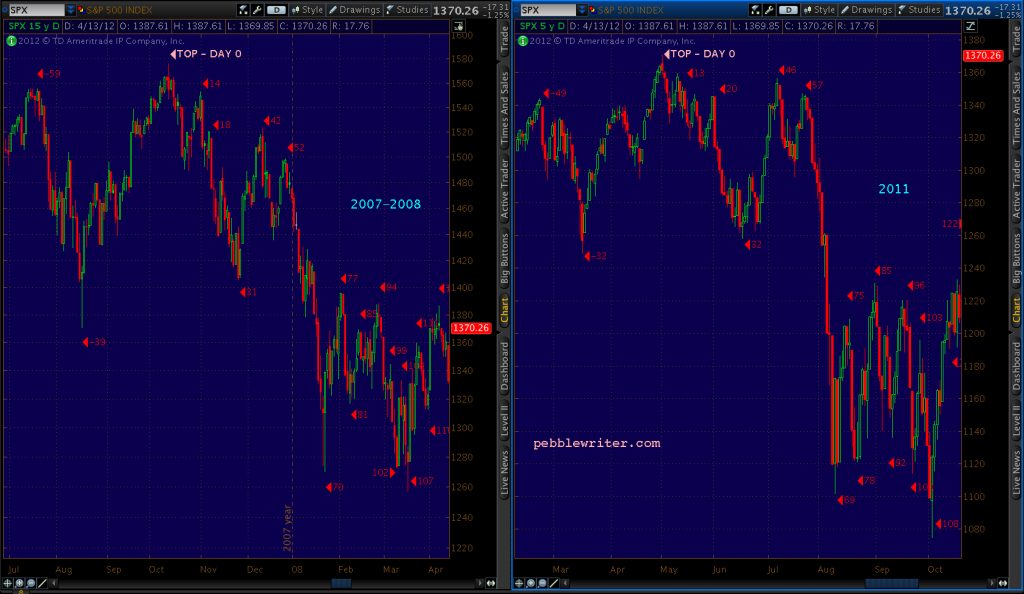
    More recently, we saw it happen in 2011, when our analog played out (despite very heavy central bank influence.)  It almost occurred with Brexit and the US elections, but was successfully beaten back.  What about the next time?

    We can’t know exactly when or what the next catalyst will be.  But, it’s safe to say there will be one.  With CAPE edging back above all but its 2000 highs, it could be a doozy.  In fact, if everyone is crowded into the same trade, betting on the same outcome, it increases the odds of it being truly devastating.

    WHAT’S NEXT?

    continued for members(more…)

  • It Doesn’t Add Up

    Over the past few years, the “market” has developed a knack for rising in spite of disappointing economic news.  Before CPI reached 2.5%, we usually characterized it as “bad news is good news.”  In other words, a moribund economy increased the odds of maintaining or even expanding the most accommodative monetary policy of all time.

    But, inflation changes things by laying bare the negative implications of easy money and easy credit.  It might be acceptable if hard economic data were keeping pace.  But, it’s not.

    Trump will speak to the nation tonight and, given that he’s smarter than the rest of us (except, perhaps, when it comes to healthcare), will explain how the laws of mathematics can be suspended for the next four years.  The “market” might even respond favorably — which would simply mean that USDJPY, CL or VIX-driven algos have kicked into high gear.  But, at the end of the day, it simply doesn’t add up.

    If he gets his way, we’re heading into deeper deficit spending — but, this time, with $20 trillion in debt and rising interest rates.  What could go wrong?

    continued for members(more…)

  • Crossroads Ahead

    The interplay between USDJPY and oil has been fascinating to watch.  The yen carry trade used to be the primary driver of algos and, thus, equity prices.  But, CL officially took over on Feb 11, 2016 and, despite the inflation complications it has engendered — not to mention a bearish channel breakdown and some of the worst fundamentals on record — it’s having a hard time letting go.

    With CPI reaching 2.5% in January, and the year-over-year numbers set to look worse for February, what can we expect from oil and, thus, equities?

    Can USDJPY find its feet, and can VIX be hammered strongly and frequently enough to offset the impact?

    continued for members(more…)

  • Charts I’m Watching: Feb 24, 2017

    With CL and USDJPY both off this morning, and VIX showing the first signs of life in weeks, we’re finally seeing futures exhibit a little weakness.  

    Can VIX hold its breakout this time?

    continued for members…. (more…)

  • The Big Picture: Feb 22, 2017

    We’ll start out today with a quick chart that says much about how these small pre-opening dips keep turning into nice gains on the day.  Note that VIX [see: VIX – Just Another Tool] is ramped higher most every night following the close.

    This tends to produce small losses in equity futures (the thin purple line) which are easily propped up in the low-volume after-hours.  The losses are easily converted into gains the following day when VIX is inevitably hammered — even when it’s only to a higher low than the session before.For the past two months, VIX has made a series of lower highs and lower lows — forming a falling channel, the top of which is currently around 12.07.  The biggest drops each occurred when stocks faced overhead resistance or, as was the case on Feb 1 when VIX was hammered by 17% in a matter of minutes, to offset bearish news such as the FOMC rate announcement. Now, on to the big picture.  Aside from VIX, stocks are also being driven by CL and USDJPY.  Where are they going?  And, where will it ultimately drive equities?  Is downside risk a thing of the past?

    We talk about oil almost every day, as it has been instrumental in goosing momentum-following algorithms on a daily basis.  As we discussed yesterday, CL’s biggest influence was a little over a year ago.

    Oil had broken down below long-term support (the yellow arrow) and stocks — having rebounded sharply the previous October after Bullard’s QE4 bounce was a good possibility — were following it lower.

    On Feb 11, 2016, with SPX at critical long-term support dating back to 2011, we reasoned that CL and USDJPY were bottoming out [see: USDJPY Finally Relents.]

    USDJPY, along with CL and SPX, should bounce here.  If you’re a bull, they must bounce here.

    Although it wouldn’t be obvious until a week or two later, this actually represented a passing of the baton from USDJPY to CL.  The yen carry trade needed a rest [see: The Yen Carry Trade Explained.]

    Between 1998 and 2011, the USDJPY fell from 147 to 75.  From time to time, it rallied to help goose stocks.  Perhaps most notably, it broke out past resistance (the red TL) in 2007 to help propel SPX beyond its 2000 highs.

    But, it wasn’t until the summer of 2011 that the yen carry trade really proved itself.  In May 2011, in the wake of the Fukushima disaster, SPX had reached the .786 Fib retracement of its drop from 1576 to 666 between Oct 2007 and Mar 2009.  SPX looked toppy to me, so I wrote my first post on May 2 [see: Charts for May 2] which, serendipitously, proved to be a significant top.

    Over the following month, I realized SPX was following the same path it had taken during the 2007 top.  This analog [see: Analogs] called for a very significant selloff, potentially below the 2009 lows, which would begin in earnest on July 26 [see: Happy New Year!]

    As it was, the correction was limited to 22% — a great short, but not as much as I had expected.  When SPX climbed back above resistance and the analog broke down, I started looking for reasons.  A number of events took place around year-end 2011 which influenced the outcome. But, none was as impactful as the resurrection of the yen carry trade.  It started out with USDJPY simply breaking out of a long, painful meltdown and spiking higher.But, this pattern would repeat itself at several critical points over the following four years.  In addition to busting the analog (purple arrow) that might have sent stocks much lower, it helped SPX break out past its .886 Fib at 1472 (red arrow), break out past its 1.272 Fib extension at 1823 (yellow arrow), and backtest that same 1823 level (white arrow.)The breakouts are shown in the USDJPY chart below with matching colored arrows.  The two labeled with question marks in late 2014 were special cases.  The first simply took USDJPY up past its .382 Fib and enabled it to break out of the falling gray channel from the 1998 high (see the weekly chart above.)  It enabled SPX to continue its breakout past the 1823, a Fib level at which it should have reversed.

    The second was a little trickier.  Once an important reversal point is exceeded, a backtest is an effective means of announcing that it now constitutes support.  So, USDJPY leveled off in mid-September, dropping steadily until Oct 15, at which point it began screaming higher — gaining nearly 16% over the next six weeks.

    Was it important for SPX to hold 1823?  The USDJPY chart says it was.  Of course, we could always ask Fed President Jim Bullard, who went on TV the following day to suggest that the taper should be paused and QE potentially expanded.  The video [click here] is worth a look.

    Aside from the comments regarding QE, Bullard offered a wonderful non-answer answer when asked about inflation and the price of oil.  The discussion leading up to his comment had centered around declining inflation expectations, and what the Fed might do to offset the weakness emanating from Europe.

    BB: A lot of people also point to oil prices.  You can’t really influence the direction of oil prices.

    Bullard:  (pause) Uh…the inflation goal for the Fed is a headline inflation goal.  It means that we want to hit, on average, over a period of years, the headline inflation rate.  Uh, these are prices that people actually pay.  And, uh, so they’re important prices and people substitute out of goods that are more expensive and into goods that are cheaper. And, uh, that’s part of the way economics works…

    In hindsight, I find this exchange particularly fascinating because:

    (1) US inflation had recently ticked higher, not lower
    (2) low inflation was the rationale for continuing accommodative monetary policies
    (3) rising oil prices were a major cause of higher inflation
    (4) Japan, with its plunging yen, was particularly hard hit by rising oil prices
    (5) someone with a very big margin account did, in fact, influence oil prices

    Note that US CPI had recently broken a TL from Sep 2011 (blue, dotted below) and had topped 2% — central bankers’ off-cited, Goldilocks-endorsed inflation bogey.

    Rising oil prices, of course, were highly supportive of stocks dating back to SPX’s 2009 bottom.  In fact, oil’s failure to complete an obvious Head & Shoulder Pattern was a major factor in arresting SPX’s decline in October 2011.But, rising oil prices also contributed to inflation, which was rather inconvenient for central bankers around the world who justified ultra-accommodative monetary policy by complaining that inflation was too low.

    As inconvenient as higher inflation was for the FOMC, it alarmed the BoJ.  By early 2014, when USDJPY reached the top of the falling gray channel and its .382 retracement, the yen had lost 40% of its value.  Oil was ratcheting higher in dollar terms, but was climbing rapidly in yen: up 192% from its 2009 lows.

    The effect was exacerbated by the closure of Japan’s nuclear power plants in the wake of the Fukushima disaster.  Either the yen needed to stop depreciating, or oil prices needed to fall.  Central bankers knew what would happen if the trillions of dollars tied to the yen carry trade unraveled.  Oil had to fall.

    The only way to offset the damage to stocks was for USDJPY to do something equally beneficial, such as break out of the falling channel it had been in since 1998.  And, that’s exactly what happened.  On Jul 29, CL broke down through the small, purple TL — the same day USDJPY broke out above the falling red TL.

    On Aug 18, CL broke down through the white neckline/TL and began a 73% nosedive.  The following day, USDJPY broke out through the red TL and began a 20% spike higher.

    The impact was almost immediate.  Oil’s breakdown, on the back of the FOMC officially ending QE, sent SPX 87 points lower — a modest 4.3% decline.  It might have gone ahead and backtested 1823 at that point.  But, USDJPY backtested its red TL and spiked higher.  Only after USDJPY took its early October breather was SPX’s backtest permitted to occur.

    Bullard’s QE comments put an exclamation point on SPX’s backtest, and the BoJ’s surprise Halloween QQE expansion two weeks later sent USDJPY and SPX soaring to new highs.  The only problems:  USDJPY’s .618 Fib at 120.11 and SPX’s Fib 1.618 extension at 2138.

    Since SPX didn’t so much as pause as it sped through the 1.272 at 1823, the 1.618 attracted a lot of attention.  It had been our next upside target after 1823 for several years.  And, USDJPY’s .618 at 120.11 was not only a key Fib level, but was a level at which Japan’s inflation seemed destined to be stuck at over 2%.

    USDJPY reached 120.11 on Dec 4, 2014, and spent the next 14 months flitting back and forth, above the below that price.  When USDJPY fell back below it in Aug 2015, as forecast by another analog based on the yen [see: Our Analog Plays Out,] it marked the beginning of a very volatile six months.  It was a glorious time for short sellers.

    Looking back, it’s clear that the BoJ was simply trying to buy time until oil reached an acceptable/defensible bottom.  But, as we discussed above, oil’s losses accelerated after the Aug 2014 breakdown, plunging from around 100 to only 44 in mid-January 2015.  It got a nice 35% bounce by May, where it sat, rangebound between 57-62 for two months — just long enough for SPX to reach 2134, before continuing its plunge.

    I suspect this next leg down was a bit more than many expected.  But, as usual, there was a method to the madness.  SPX’s Aug 2015 plunge only reached 1867 — no man’s land from a harmonic standpoint.

    When CL’s long-term channel broke down, SPX had permission to dip all the way to 1823 again.  If there’s one thing stronger than a backtest of a critical Fib level, it’s two backtests.  Or, maybe it’s the other way around.  Oil’s losses were accelerating, and TPTB realized they had to provide a floor or SPX would drop back through critical support  at 1823.

    I’m not sure it really matters.  It was Feb 11, and SPX had dipped to 1810, and the bull market would be over if something wasn’t done to get it back above 1823.  As we surmised at the time [see: USDJPY Finally Relents], this marked a bottom for USDJPY and oil.

    Oil doubled over the next 4 months, while USDJPY got a nice bounce before continuing lower — not really needed as, by that time, SPX was back within 14 points of its all-time highs.

    Of course, the rally was almost undone by both Brexit and the US election.  But, massive spikes in USDJPY (both times) and a nonsensical rally in CL (the election) saw to it that the dips were quickly reversed.  The election reversal was the game changer, as USDJPY, CL and VIX all conspired to rescue stocks from the overnight selloff.  The reaction was so strong as to launch SPX to new all-time highs.

    As we discussed above, there’s a cost associated with a cheaper yen and higher oil prices — especially for Japan.  The fact that USDJPY broke out of its falling red channel on Oct 4 led me to believe the yen carry trade would take over the ramping responsibilities while CL backed off its highs.

    It especially made sense, given that oil had doubled since its Oct 11, 2016 lows.  The YoY comparison in fuel costs, even after the BLS massaged away much of the actual impact, would drive CPI to unacceptable levels.  Sure enough, the January CPI released on Feb 15 showed a 0.6% MoM increase and a 2.5% YoY increase.  February’s release should be even worse.

    Was this what Janet Yellen was talking about when she suggested the economy would benefit from running a little hot for some time last October?  Or, should we believe her comments from last month when she said it would be unwise to allow the economy to run hot?

    Either way, CPI is now well over 2% — the holy grail, the magical target that central bankers held dear all these years as the key to economic prosperity and the signal to take their very heavy feet off the gas.

    The US dollar is 2% below its 14-year highs.  10-year treasuries have broached 2.5%.  And, stocks are partying like it’s 1999.  The talking heads call it the Trump Rally.  The fear that so many felt on election night was elected magically transformed into enthusiasm over the tax cuts and fiscal expansion that would soon be rolled out.

    The clock is ticking for details on Trump’s “phenomenal” tax plan and his strategy for talking conservative Republicans into increasing the deficit.  Meanwhile, stocks keep ticking higher.  And, those of us who watch markets all day know that the real determinants of higher equity prices have been USDJPY, CL and VIX and the algos they drive.