
Year: 2013

  • Moment of Truth: Mar 14, 2013

    SPX is fast approaching the moment where it must either break down or break out.  As we detailed on Tuesday, there are a limited number of patterns providing resistance at these levels.

    The all-time high is just above at 1576.09, but SPX is already bumping up above three Crab Patterns that should smack it back down.

    As we discussed in yesterday’s last update, a push above the 1556.77 high was reason enough to play along on the upside, but I can’t see SPX topping 1564 without doing serious damage to the bear case.

    I’m going full short again here at 1561, and will wait and see…again.

    But, keep in mind that the 161.8 of the latest small pattern and the 261.8 of the red pattern, not to mention the IH&S target of 1565 are all just above, and are easily attainable within the rising wedge.

    And, lately, SPX seems intent on bagging every last target within sight.

    UPDATE:  10:35 AM

    Yesterday I posted a strange concoction of mine that plots time and price Fib levels against a rising wedge.  In my experience, most rising wedges break down somewhere between .618 and .886 of the time and price from inception to apex.

    As the wedge is currently drawn, the .886 price Fib is around 1562 and the time Fib is around tomorrow morning.  But, keep in mind the rising wedge itself is subject to wiggle room (primarily, whether to include shadows/tails or not.)

    So, the placement of the apex, which is just the intersection of two (hopefully) precisely drawn trend lines, determines just how accurate the grid is.

    Wedges that go beyond the .886 Fib in price or time are likely to break out instead of down.  This is not highly unusual.  But, in this case, a break out would mean the trend line from 1994 we discussed the other day has been broken.

    It’s broken now intra-day, which doesn’t concern me too much. But, a close, backtest and move higher would likely mean the 1576 high would be taken out.  I’ve switched it to a dashed yellow line to better distinguish it from the RW.

    I’ve highlighted the most likely target range if prices are going to reverse.  Included in that circle are:

    • the RW time Fib .886
    • the RW price Fib .886
    • the smallest scale (white) 1.618
    • the red 261.8
    • top of the rising wedge
    • three channel lines
    •  the inverted H&S target.

    Aside from those, it is of little consequence (sarc.)

    In summary, we’re watching to whether or not SPX closes above the TL from 1994 and the two large Crab Pattern 1.618 Fibs.  It’s okay to poke around in the vicinity, and Crab Patterns don’t always reverse immediately at their 1.618s, but a leg higher would be bullish.


    UPDATE:  3:50 PM

    After a full day of charting, I have some exciting things to share later this afternoon.

    Here’s the updated 15-min chart,  w/ the time and price Fibs and the key chart patterns.  If we get a push through the RW (1565ish, also the IH&S target) by the end of the day, I intend to go long.

    Otherwise, I’ll sit short overnight.  Much more to come later, including a revised forecast.

    Lots of charts in the morning…


  • Charts I’m Watching: Mar 13, 2013

    We had a precise tag on the .618 Fib level late yesterday, which often suggests a Gartley Pattern completion at the .786 (1554. 94) or a Bat Pattern at the .886 (1555.80.)

    As with all potential first waves down, a deep second wave retracement is always a possibility.  So, we won’t know for sure whether 1556.77 was the top until SPX breaks above it or breaks down beneath the rising wedge (the yellow TL) and the former low 1548.24.)

    UPDATE:  9:45 AM

    A breakdown here would be perfectly in keeping with the Crab Pattern completions on Monday (1553 and 1555.)  It also fits with the most common rising wedge scenario where breakdowns occur around the .786 Fib retracement (or .886) of the price and time from inception to apex.

    By placing this RW in both time and price grids, we can see that the .786 Fib time ratio and the .786 price ratio have both been met.

    But, if SPX can rally up past 1556.77, the .886 is still up there at 1559.7. which just so happens to intersect with the 1.618 extension of the price movement from 1530.95 to 1485.01 (and the 1.272 extension of yesterday’s drop from 1556.77 to 1548.24.)

    On the other hand, any move down through 1548.24 damages the odds of a higher high.  So, anyone playing the bounce off 1548 should stay nimble and manage stops accordingly.

    Remember that there are a couple of small H&S Patterns currently in play.  A close below 1548.24 confirms them.

    UPDATE:  10:10 AM

    SPX came within one cent of yesterday’s lows, which reminds me of yesterday’s rally to one cent above the presumed right shoulder of the little H&S we were watching.  This tells me that certain someones are working very hard to keep the bull story (technically) alive.

    We’ve had several busted patterns in the past couple of weeks – patterns like the H&S that are normally quite reliable.  If SPX could break out of the RW itself, that would be a nice trick for the bulls.

    Just like the rising wedge, the 60-min RSI channel that convinced me to take an intra-day long position just before the close yesterday is in danger of breaking down.  Looking at the 30-min chart, its easier to see the market’s indecision.

    While we’re waiting for the short-term indecision to be resolved, let’s continue with the look at the big picture we started yesterday.  It’s been hampered somewhat by technical issues with the latest version of TOS’s charting software.

    When I draw channels, they don’t stay put.  They expand to a width of their own choosing and can’t be put back.  It can take 5-10 minutes just to trick the software into placing one channel properly — which makes charting a real joy!

    They assure me that tonight’s release will fix this and other, lesser issues.  So, hopefully I’ll be back to full speed.  It’s normally very good software, but the frequent releases are sometimes a pain.

    continued for members(more…)

  • Charts I’m Watching: Mar 12, 2013

    We tagged the two largest Crab Pattern targets on the charts yesterday: the 1.618 extensions of the 1370-1074 decline in 2011 and the 1474-1343 decline in 2012.

    At this point, we’re waiting to see if SPX has the juice to also snag the white 1.618 at 1559.32 and/or the IH&S pattern target of 1565.  Both are perfectly legit, though they are of a much smaller scale and thus not as important in the scheme of things.

    I’ll spend most of the morning laying out the downside scenario.  For now, support should be expected around the key channel lines such as the bottom of the white channel (currently at 1545), the purple channel midline (currently around 1540), and the small channel that’s guided prices since the breakout on Mar 5 (around 1549) that we’re just now reaching.

    Note that the first two price levels are in the vicinity of significant Fib levels: the white 1.272 and the red 1.618.  A reversal down to a previously topped Fib level can be viewed as a backtest on the way higher, so the bounces are often significant.

    The bounce off the bottom of the small white channel should provide a backtest of that channel’s broken .25 or midline but should fail by 1553.40.  When the little white channel fails, the yellow one should go quickly.

    UPDATE:  1:55 PM

    As expected, SPX bounced at the little white channel bottom and backtested its midline.  SPX is now testing the little white channel bottom.   The yellow channel bottom is just below at 1548ish and the purple midline is around 1541.50.  Each can be expected to provide a playable bounce, but we’ll decide when we get there.

    Okay, back to the big picture…

    First, let’s take a look at the Fibonacci Fans for SPX.  Over the years, they’ve done a reasonably good job of providing price warnings.  That is, prices tend to bounce along between neighboring lines until some catalyst — often a competing Fan Line — forces prices higher or lower.

    At that point, prices tend to backtest the just-broken fan line and continue bouncing between the next higher or lower pair.

    When the Fib Fan lines from 1994 were broken, for instance, prices typically fell to the next lower line — unless they fell two lines.  In either case, a break of one of those lines should have been taken seriously.

    And, note how SPX has repeatedly bumped up against resistance from the very same line that finally provided support for bottoms in Oct 02 and Mar 03.  I presented it yesterday afternoon as a factor in our decision to go full short at 1555.15.

    Looking at a close-up of the chart, we can see how the next couple of weeks might play out.

    continued for members(more…)

  • Results: Feb 28, 2013

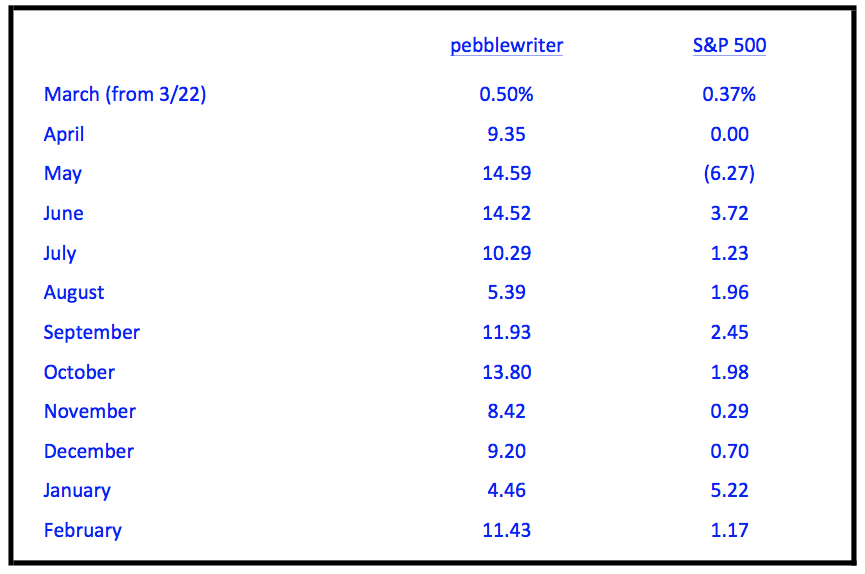
    The S&P 500 gained about 6% between the last update (Dec 20, 2012) and the Feb 19 highs of 1530.94.   The index gave back half of the gains over the subsequent week, then retraced 88.6% of those losses over the next two sessions for a total move through Feb 28 of about 11%.  Our calls accomplished approximately 19% over the same period.

    December, 2012

    December 2012 wrapped at +9.20%, leaving us with a total return for 2012 (since inception on Mar 22) of 97.99%. The S&P 500 was up 2.36% over the same period (excluding dividends) and the average hedge fund earned 7.32%.2

    I had anticipated a significant reversal in mid-December at SPX 1346, and the market accommodated with a 3.3% decline into the year’s end based on an analog that served us very well since April, 2012.

    January 2013

    Even though Congress failed (as expected) to really resolve the fiscal cliff dilemma, the market saw the resolution as “good enough” and pushed higher during the low-volume New Year’s holiday week.

    The next two weeks were spent in harmonic pattern limbo, deliberating whether a double-top or a new high was in the works.  Finally the question was settled by a push past the Sep 2012 highs — right into the next harmonic target range. With only 9 sessions left in the month, there was little time left in which to accomplish much.

    At +4.46%, January was the first month in which our numbers lagged the S&P 500.  I realize that 4.46% is nothing to sneeze at; but, in retrospect, I should have exercised more caution around big news days, used tighter stops and perhaps traded a bit more frequently.

    February 2013

    At +11.43%, February was a much more rewarding month — but, not without its challenges.  Prices fluctuated by 10 or more points in a full two-thirds of the trading sessions.  But, volatility creates trading opportunities, so I took full advantage.

    It seemed at the time that I traded too frequently (33 times, including 14 intra-day trades that added 5.50%.)3  Looking back, however, SPX gained only one point between the Feb 1 close and the Feb 28 close.  In other words, it was the kind of month where day traders are rewarded, and buy-and-hold types should have gone skiing.

    If nothing else, February convinced me that a managed fund could deliver added value for pebblewriter subscribers who have neither the time nor the inclination to sit by their computers waiting for the next trade signal.

    Even for those who do, there is the problem of time lag.  Under the best of circumstances, it can take several minutes to transmit a newly hatched idea — more if charting or explanation are involved.

    By the time a member receives, reads and acts on the information, prices can move appreciably — potentially reducing returns and/or increasing risk.  A fund should, at the very least, eliminate the lag.  I am currently working with advisors and will announce details as soon as possible.

    Summary

    As of Feb 28, we’re up 113.08% since inception for an average monthly return of about 10.05% — on track with our Dec 20 report.  I’ll continue to work on finding the right balance between trade frequency and risk-adjusted returns.

    The road ahead looks no less bumpy.  Will QEn sustain uninterrupted new highs, or will this market — like every one before it — soon reveal its Achilles heel?  Interest rates are on the rise, while a whole host of economic indicators and corporate earnings are flagging.

    Personal income is slumping, employment isn’t much better, the euro zone is officially back in a recession, China is faltering and central banks the world over are racing to devalue their currencies as debt continues to skyrocket.  Where’s the upside in that scenario?

    The day will come when money printing and accounting gimmicks alone won’t be enough to levitate the stock market.  At the end of the day, real profits require that someone, somewhere, buys something.  A bull market that rallies to new highs while ignoring that basic premise is, in my opinion, not long for this world.

    Stay tuned…


    Notes:

    1 According to this Barron’s article, only one of the hedge funds tracked by HSBC earned over 40% in 2012; another 7 earned 30% or more. The average fund earned 7.32% and about one third lost money.

    2 Remember, our “performance” is based on a theoretical unleveraged portfolio utilizing only long and short positions in SPX based on the tops and bottoms identified on pebblewriter.com.  Trading expenses are not included.  Your mileage will vary.

    3 Late last year, I began experimenting with leaving a core long or short position in place while placing short-term or intra-day trades.  The jury is still out on the effectiveness of this strategy.

  • Crab Dip

    I spent most of the weekend on fund business, charting and updating performance (posting shortly), so there are still a few of you waiting for answers on whether your annual memberships are charter or not.  My apologies for not getting to that, but I’m postponing any fee increases until I have time to research that — hopefully in the next day or two.

    A reminder to everyone else, purchasing a charter annual membership now locks in your subscription price for the life of the site and entitles you to fee rebates and discounts (available only to annual members) on a fund that’s in the works.  To sign up now, click on the link below.

    Sign me up!

    *  *  *  *  *  *  *  *

    ORIGINAL POST:

    Back on Jan 23, after the Sep 14, 2012 high of 1474.51 was exceeded, a post [HERE] asked “now what?”  We turned to harmonics for the answer, eyeing two prominent potential Crab Patterns:

    My leading harmonic forecast is for 1509-1515.  I can’t imagine getting this close to 1500 and not snagging it for the trophy case.  And, I like the idea of dancing with the harmonic patterns what brung us.

    My secondary goal is slightly higher at 1553-1555, so there should be opportunities to jump back in and capture most of any upside above 1520 if/when appropriate.  Such a move would likely follow a reversal from 1509-1515 back down to 1474ish and would constitute a fifth wave rather than the ending diagonal suggested above.

    The Fibonacci levels mentioned above can be seen on a chart posted a few days earlier [CIW: Feb 19] discussing the likelihood of a measured move to 1551.12.

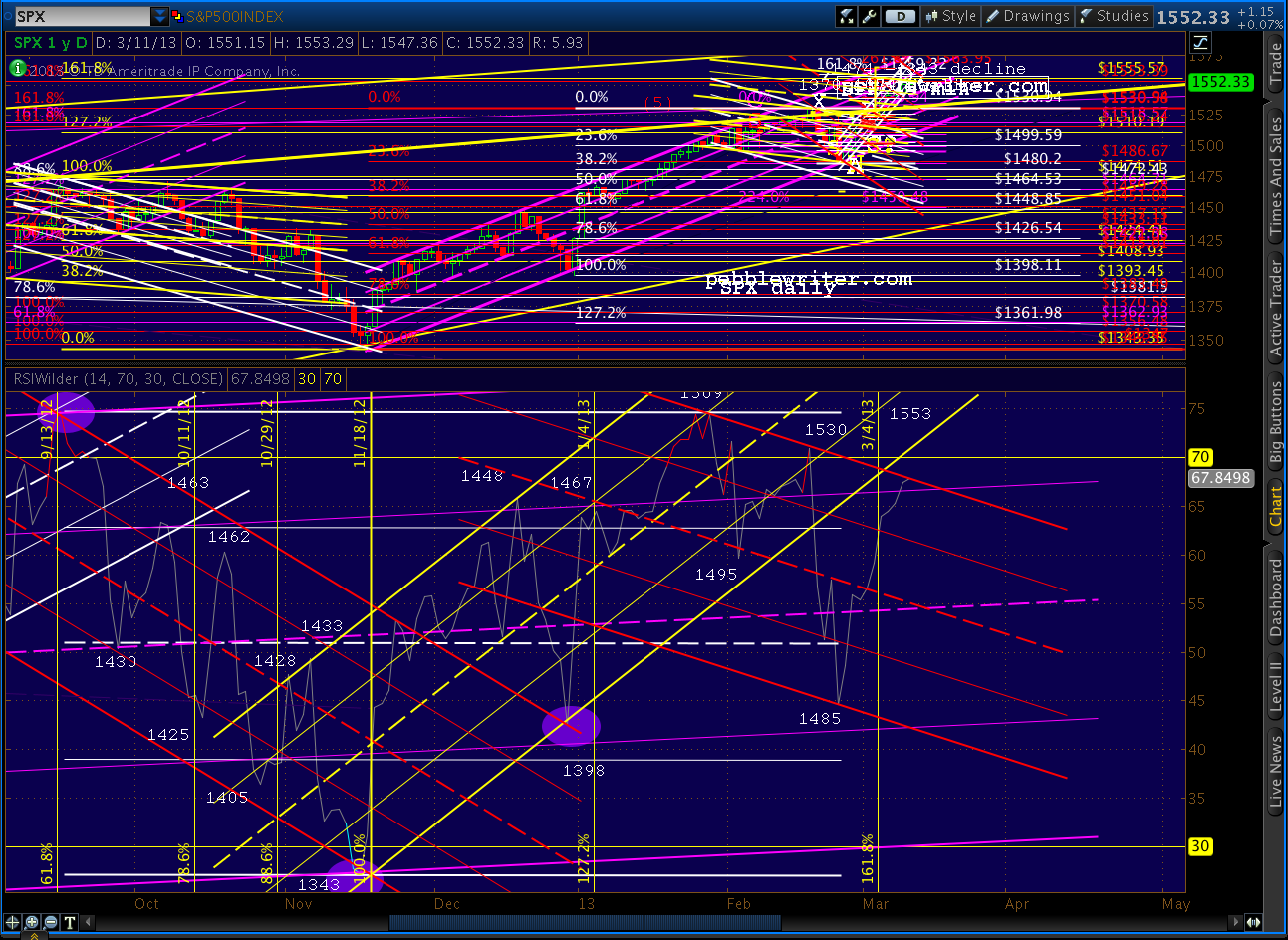
    On the chart above, the distance from (2) to (3) is 207.77.  Adding 207.77 to the 1343.35 low (4) yields 1551.12 – right there with those 1.618 Crab Pattern completion points. If SPX can break through 1530.58, there are no other Fib levels between there and 1553.

    Remember, 1472 constituted a Fibonacci 88.6% retracement of the 1576 – 666 drop and completed a 5-year, 800-point Bat Pattern, prompting a decision to short the S&P 500 at 1474 [See: World According to Ben.]  The ensuing 9% drop translated into a 25% return.  And, we’d racked up another 14% on the rebound from 1343.

    Above 1474, though, was the especially tricky part of harmonics: the price range between the .886 retracement and the 1.000  (a double-top.) It was tough being bullish in the face of the sequester (and all the other usual threats to the future of the human race.)

    So, we hedged our bets (often quite literally) by making the market prove to us it had additional upside for each new leg up.  I often hazarded long positions only intra-day, sometimes while holding a core short position.  It made for a lot of trading, but I didn’t trust the market’s seeming invincibility.

    But, the market proved itself, busting two normally very reliable H&S patterns, threatening a well-formed rising wedge, constructing a very unusual channel and ignoring a whole slew of economic troubles along the way.

    And, here we are.  Friday’s close at 1551.18, a whole 6 cents above the measured move target of 1551.12, leaves SPX only a few points shy of the last major harmonic targets at 1553.39 and 1555.57.  It’s close enough for the patterns to be considered completed.

    I’ll take one last stab at 1553/1555 if the .25 purple channel line here at 1548 can hold, but let’s be very cautious (tight trailing stops) with this move.  As Friday’s post title suggests, being long at this point is tantamount to the proverbial “picking up pennies in front of a bulldozer.”

    The above chart is quite messy, but note the two 161.8 Crab Completions at 1553.39 (red) and 1555.57 (yellow), the IH&S target at 1565 (yellow) and the small white Crab Pattern 1.618 at 1559.32.  Any of these would do as far as the upside goes, with preference being for the 1553/1555 level given the patterns’ prominence.


    UPDATE: 12:18 PM

    We’ve almost completed the larger Crab Pattern at 1553.39, the 1.618 extension of the May – Oct 2011 decline from 1370.58 to 1074.44.  It’s possible we’ll sneak a little higher to tag the other 1.618 at 1555.57 — the pattern derived from the 1474 – 1343 sell off last fall.

    But, I’m happy booking the 5 points from this morning’s longs and re-shorting here at 1553.29 … and, waiting to see whether the market can push higher.

    I’d leave stops a little loose to account for the possibility of the higher Crab Pattern completion — perhaps 1561 or so.  I might also risk an intra-day long if SPX pushes beyond 1554.

    It’s backed off a bit in the past 10 minutes, but daily RSI just reached 70 and, more importantly, tagged a trend line off the two previous highs.  I don’t believe the channel drawn below will hold, but the upper bound/TL drawn is compelling — especially on negative divergence.

    Also, though we haven’t looked at VIX (below 12!) much lately, it’s worth noting that its daily RSI just tagged the bottom of a well-defined channel.

    Not many investors watch or even care about harmonic patterns or RSI channels.  So, it’s not unusual to feel quite isolated, even vulnerable, when trading at the turning points they suggest.  All I can suggest is: (1) turn off CNBC; (2) don’t tally your profits just yet; and, (3) let a few very close friends and relatives know what you’re doing.

    Sure, the pattern could always bust (about 30% do…make sure you tell your friend that, too) and you’ll be the laughing stock.  But, trust me, it’s better than running into a friend who just lost thousands in the market and wonders why you didn’t say anything…

    The 15-min RSI channel we were watching on SPX Friday is shaping up nicely, but does show the potential for a few points higher.

    One last push back up to the white price channel mid line could reach 1559.32 if it started right away.

    Coming up, a review of the downside case and likely targets.  Continued for members(more…)

  • Picking up Pennies

    Just about every other index has reached an important harmonic and/or chart pattern target. Given the NFP print, this could be the day SPX finally reaches 1553-1555.  Best to be long on the opening, and ready to re-short fairly quickly.

    The dollar isn’t waiting, surging nearly 1% on the day and resolving the question as to which channel to watch.

    DX is very near a tag of the red .786 (83.064) and the purple 1.618 (83.179).  But, more importantly, it is coming up to the intersection of the midlines of two important channels.

    Look for heavy resistance at these levels — until the equity sell-off begins in earnest.

    Likewise, the EURUSD is off over 1% and approaching the white .786/yellow .500 — also the scene of an important channel line.

    Will the currencies react first to the equity strength, or are they positioning ahead of what they know will be an equity pop and drop?  As the grown-ups in the room, I believe currencies are doing the latter.

    Our premise called for a back test of the channel line or TL off the July 2011 & Sep 2012 highs, but the market is eager to go ahead and get there.  Who am I to stand in the way?

    UPDATE:  9:35 AM

    Got to 1551.65, only 1.74 away from the white 1.618 – which is close enough for me.   I have nothing against staying in until the actual tag; just watch your stops in the event it turns quickly.

    I’ll pick it back up if we get a second push through 1551, as it would not be unusual to see a bit of an overshoot — somewhere between 1553 and 1560.  Likewise, a drop through the yellow TL down around 1535.50 probably signals “game over.”

    Remember, this completes a Crab Pattern from the 2011 crash from 1370 to 1074.  Are we guaranteed a big sell-off here?  Of course not.  But, odds are it will be substantial.

    UPDATE:  10:08 AM

    If SPX is going to bounce higher, it should do so by 1543 — the 1.272 Fib on the small white harmonic grid and the bottom of the tiny channel SPX hung out in for the past several days.  For anyone who missed the last six points because of the gap open, this is your second chance.

    UPDATE:  10:27 AM

    SPX getting the bounce here at 1543… will take another crack at 1553-1560.

    In the meantime, let’s take a look at how we got here.  If you had asked me at the end of 2011 which upside scenario looked most likely, I would have suggested the Crab Pattern that started at 1370 in May 2011 and put in a bottom at 1074 in October (in white, below.)

    There were three potential Point X’s in a row: 1370.58 on May 2 (in white above), 1347 on July 21 (in red) and 1356.48 on Jul 7 (not shown.)  And, 1370.58, the high following the 1576 to 666 sell off from 2007 to 2009, was the most prominent.

    My reservation was that it reversed at the .707 Fib level rather than the more common .618, .786 or .886.  The .707 is the red-headed stepchild of the Fibonacci ratios.  It’s the square root of .500, which itself doesn’t get much respect as a Fib ratio.  Geeks and wannabe’s CLICK HERE for details…

    When SPX finally pushed above 1370 in March 2012 and started approaching the 1.272 Fib levels between 1422 and 1451, we had to choose from among the three possibilities for a Butterfly Pattern completion [see: All the Pretty Butterflies.]

    I went with the red pattern because of its more precise tag on the .786 and was rewarded with 20%+ gains from a perfectly-timed short.  And, I assumed the red pattern would continue to drive future harmonic swings.

    As we approached the red 1.618 at 1515.24, I noted that it intersected with the purple 1.618 (1518.57) and the yellow 1.272 (1510.19) — not to mention the yellow trend line running very precisely through the July 2011, April 2012 and Sept 2012 highs.  To me, this was a very solid conclusion based on very reliable patterns.

    We got the sell-off.  In fact, we got three sell-offs, one from each of those Fib levels.  On the final tag at 1518.57, we got a little overshoot to 1530 (a smaller harmonic pattern completion) before beginning a correction all the way to…1485.  Yep, not even a lousy 3%.

    In harmonics, it’s not usually the tops that bother me, it’s the 2nd waves.  The rebound from 1485 went to 1525 (a healthy .886 retracement) and even sold off nicely — before zipping back up to complete an IH&S, take out the 1530 high and…well, here we are.

    Harmonics are great.  They offer concrete turning points at which the market usually reverses.  If it doesn’t, you’ve either picked the wrong Point X (1347 instead of 1370) or the wrong pattern.  In other words, there’s a solid decision matrix; you know when it’s time to go to Plan B.

    Fundamental analysis isn’t anywhere near as precise — especially in the short to medium term.  And, as we’ve seen this past year, there’s plenty of money to be made by going long at bottoms and short at tops.  You just have to be prepared to switch gears when your assumption — no matter how well thought out — turns out to be wrong.

    If SPX exceeds the Fibs at 1553/1555 and/or the IH&S target at 1465, there’s not much more in the way of targets other than the previous high of 1576 (October 2007.)  Many other indices have made new highs, so maybe TPTB will feel it necessary for SPX to do so as well.

    more later…

    UPDATE:  1:55 PM

    The bounce off 1543 still going strong.  15-min RSI just broke out of a falling channel from this morning’s rally.  A move back to the white RSI channel midline might permit 1553/1555 or slightly higher.

    continued for members(more…)

  • Update on Bonds: Mar 07, 2013

    If rates really are heading back up in the near future, we’d expect to see bonds take a hit (and stocks, too, but that’s a different post.)  Back on Jan 21, we focused on the 10-year treasury (ZN.)

    We observed that ZN had just completed a large Crab Pattern and broken down from a rising wedge, and appeared to be due for a “significant retreat.”

    The chart below shows a big Crab (grey), followed by another Crab (red), a Bat (white) and another Crab (purple.)  Each previous Crab Pattern completion has been followed by a significant retreat, so we might suspect one here with the purple pattern completion.

    Since then, both the purple and white channel lines have broken down, suggesting more downside ahead. The intersection of the white channel bottom and purple channel midline is coming up in early April, and prices have fallen from 132’160 on Jan 21.  But, where’s the “significant retreat?”

    Shifting focus to the 20-year as represented by TLT (just for grins), the charts show continued weakness over the next couple of months — provided TLT can push through some important support.

    The harmonic picture is negative enough – given the potential Gartley or Bat Pattern in play. But, the white and red channels have both recently surrendered a support line.  Backtests are complete, and the next support is down around the .786 at 114.5 — though I suspect the .886 at 112.26 will get the nod.

    Note that it intersects with the falling white channel midline, the falling red channel bottom and the large white rising channel midline — all around late May-June.

    A slight overshoot would tag the .500 at 110.18 on a larger harmonic grid (purple) and establish a Point B for a pattern that might lead prices back down below the white midline.

    The fly in the ointment?  Check out the dashed red trend line cutting across the middle of the chart. It has influenced a few turns, and is just below current prices at around 115.60.

    Stay tuned…

  • Interest Rates: Breaking Out?

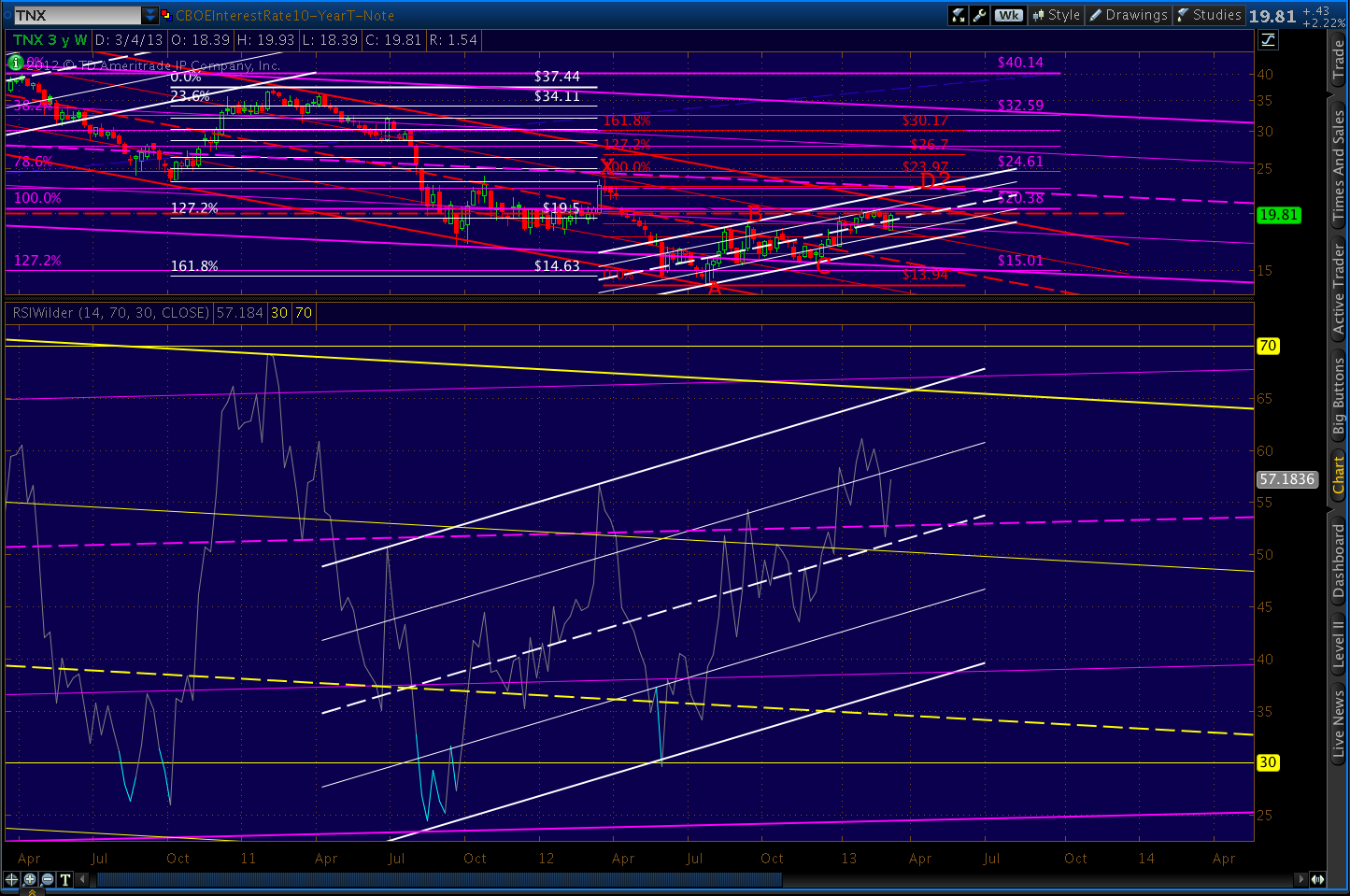
    With the usual caveat that I’m not a bond guy (seriously, what’s the point?) I took a fresh look at interest rates on the 10-year note.

    The obvious downtrend over the past 15 years is well-captured by the purple channel below.  It has been marked, however, by a series of rising white channels, some of which I have charted.

    When rates fell below the channel bottom last May, it might have ushered in a new, steeper decline suggested by the falling red channel.

    However, since bottoming in July, TNX regained the purple channel bottom, backtested it, and has put in a series of higher highs and higher lows that precisely echoes the slope of the previous channels.

    Its latest feat is pushing up through and backtesting both the red channel .75 line and the purple channel .25 line.  In the process, it has climbed back above the white channel midline and faces the psychologically important 2% mark yet again (the red, dashed TL.)

    From a harmonic standpoint, TNX looks well-positioned to test 2.28% in the next month.  Note that the July lows completed a Butterfly Pattern at the 1.272 on the purple grid and a Crab Pattern on the 1.618 on the white grid.

    Note the precise turn at the .500 Fib level, hinting at a Bat Pattern completion at the .886 of 22.83.  The .886 intersects with the purple channel line late next week — though the precise placement of such a long-term channel is always subject to some interpretation.

    To get there, however, TNX will have to push back through 20, the .618 Fib line at 20.14, and the top of the red channel – currently around 21.34.

    The RSI picture is promising.  The weekly chart shows the positive trend, regardless of whether you subscribe to the pessimistic (yellow channel) or optimistic (purple channel) view.

    A close-up of the above chart shows steadily improving relative strength since April 2011 and an important reversal at the midline.  The intersection of the white and yellow channel tops looms out there around April 3.

    The daily RSI, in addition to showing a steadfast refusal to become overbought, shows the recent break above the yellow channel’s 25% line.  Provided RSI can push through the dashed red trend line (corresponding with the .618 and 2% price levels discussed above), there is plenty of room to run.

    The intersection of the yellow midline and the purple channel top is around March 20.

    Like many markets, TNX is at a critical juncture.  It’s put up or shut up time.  A push through 2% would likely usher in 2.28% in short order, followed by a backtest of the red channel and subsequent push higher.

    If we expand the white channel (yellow, above) we get a glimpse of what the upside case looks like.  A turn at the red .886 would intersect with the .382 Fib of a harmonic grid drawn from the Feb 2011 highs.  The .618 of that pattern — not all that distant from the red 1.618 — would intersect with the midline of the yellow channel at 28.46 around the middle of August.

    A return to the top of the purple channel, currently around 3.4%, could come as early as July, but a more moderate case would be between Oct 2013 and Jan 2014.

    GLTA.

  • RUT: End of the Line?

    RUT has reached the upper bound of a well-defined channel that dates back to 1998.

    It could leak slightly higher in reaching for the top of the large rising wedge and some key Fib levels, but I suspect RUT has reached a turning point.

    continued for members(more…)

  • Charts I’m Watching: Mar 6, 2013

    SPX reached our 1543.43 target yesterday, exceeding it by 4 cents before reversing to close below 1540.  This was a 1.272 extension of the decline from 1530.94 to 1485.01 that began on Feb 20.

    But, 1.272 completions result from Butterfly Patterns.  And, Butterfly Patterns require a key reversal (Point B) at the .786 Fib level.  The move up from 1485 barely reacted at the .786 Fib level, but saw a significant reversal at the .886 Fib.  So, harmonics suggest a move to the 1.618 extension for a Crab Pattern (though not always so, see the 1:30 update below.)

    updated: 1:00PM EST

    The futures are all pointing skyward this morning, with the eminis indicating a willingness to ignore several key Fib levels – albeit on negative divergence – and the dollar and euro at key inflection points.


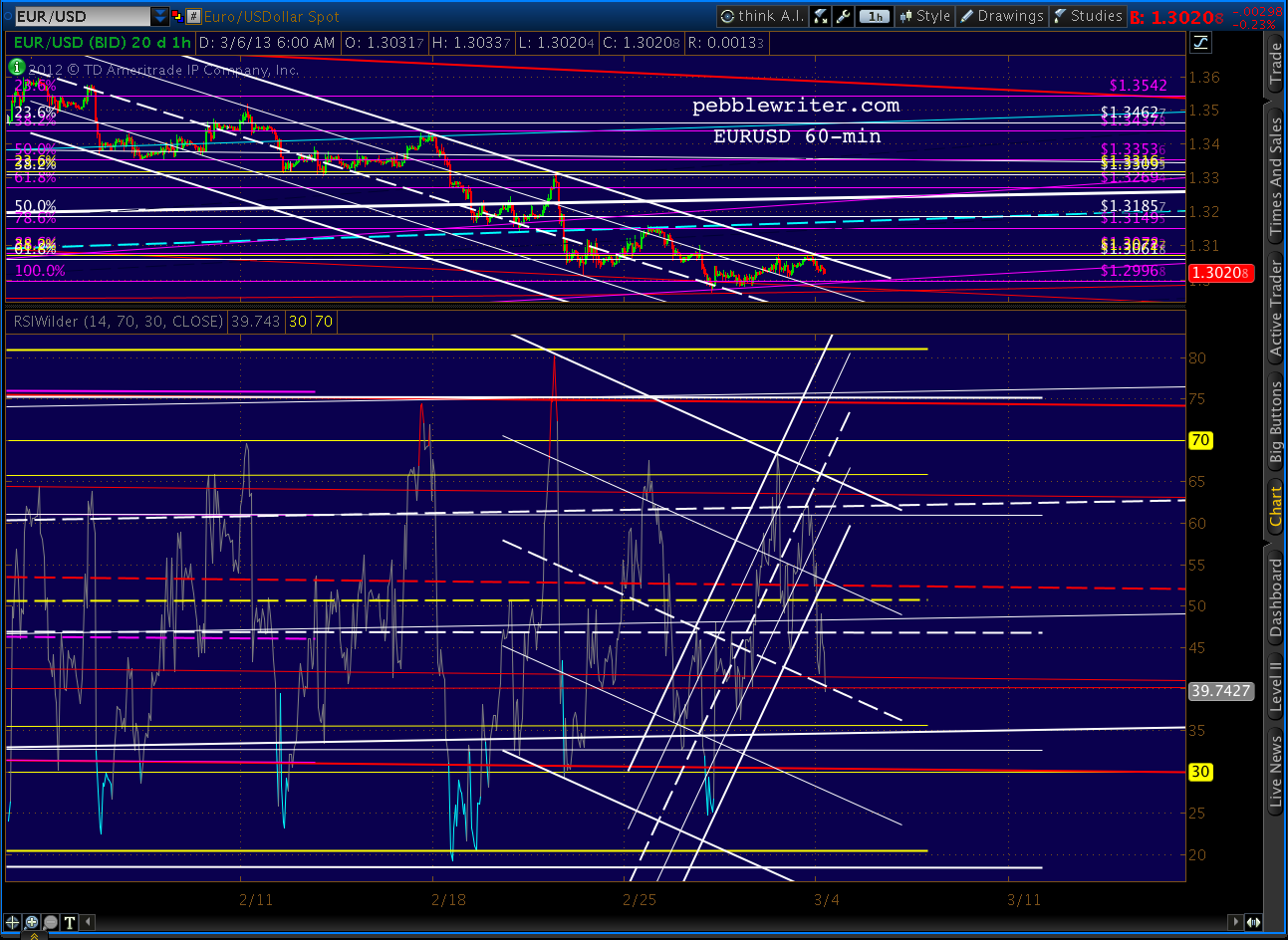
    Keep an eye on the EURUSD 15-min chart, which shows the precarious position of the pair.

    Good time to review stops…stay nimble today.

    UPDATE:  10:05 AM

    The EURUSD just broke down from the little channel we were watching earlier and is back below 1.30 again.

    The next significant Fib support is 1.2875-1.2885, but the .786 or .886 on the 15-min chart above should be watched.  If one produces a reversal, the pair could try to redefine its falling channel from the current steeply sloped white channel below to a kinder, gentler version such as the purple.

    Any break out of the white channel should be viewed as such a move and would likely result in a retest of the light blue channel midline currently at 1.3167.

    Stocks spurted higher this morning on a better than expected ADP employment report which, for all the hoopla, shows a month over month decline.

    Offsetting the “good news” is slightly more credible word from the Census Department that durable goods fell off a cliff last month.  Total new orders for all manufactured goods were reported down 2% in January.  The real, non-seasonally adjusted decline, however, was 6.96%.

    New orders for manufactured durable goods were reported down a whopping 4.9%, which is bad enough.  Remove the varnish of seasonal adjustment, and the real decline was from $239 billion to $204 billion, a 14.4% plunge.

    The optimists will say this decline was due to worries over the sequester.  And, there’s probably some truth to that.  They also say we should ignore transportation and defense spending — an argument which has never made the slightest bit of sense to me.  It’s also an argument you will never hear when transportation and defense orders surge as they did last month.

    According to the Aerospace Industries Association, that industry alone accounts for about 633,000 jobs (about 6% of all mfg jobs) and $224 billion in revenues (17.9% of all durable  goods revenues) including $95 billion in exports — 6.2% of all durable goods exports and one of the few success stories in America’s perennially crummy balance of trade picture.

    A decline in orders, such as might be expected when, say, the US is trying to reign in spending in the midst of winding down a couple of wars, could put a real dent in those figures.  And, these are relatively high-paying jobs with benefits, not part-time Wal-Mart greeters.

    Defense spending accounts for about 2/3 of all government spending (federal, state and local) which, in turn, accounts for nearly 20% of total GDP.

    Please don’t get me wrong.  I’m not arguing that defense spending should be increased, or even maintained.  Other than increasing the shamefully paltry benefits provided to wounded veterans, I’d love to see the budget slashed dramatically.  It doesn’t take a lobbyist to see we probably spend a bit more on defense than is necessary.

    But, when someone suggests we should ignore transportation and defense spending when assessing the country’s economic future, it’s because those components are in decline.  Excluding them makes the economy look stronger, just like excluding the long-term unemployed makes employment statistics look stronger.

    It’s all about perception.

    UPDATE:  12:40 PM

    SPX is off its high (1545.25) for the day and trending lower.  It’s early still, and it’s likely to be expanded, but the operative channel is probably something like this:

    Note that SPX is flirting with the white channel midline, while the yellow TL off the 7/23/11 and 9/14/12 highs is still well below at about 1532 — near the 1.618 of the latest spurt higher.

    continued for members(more…)