
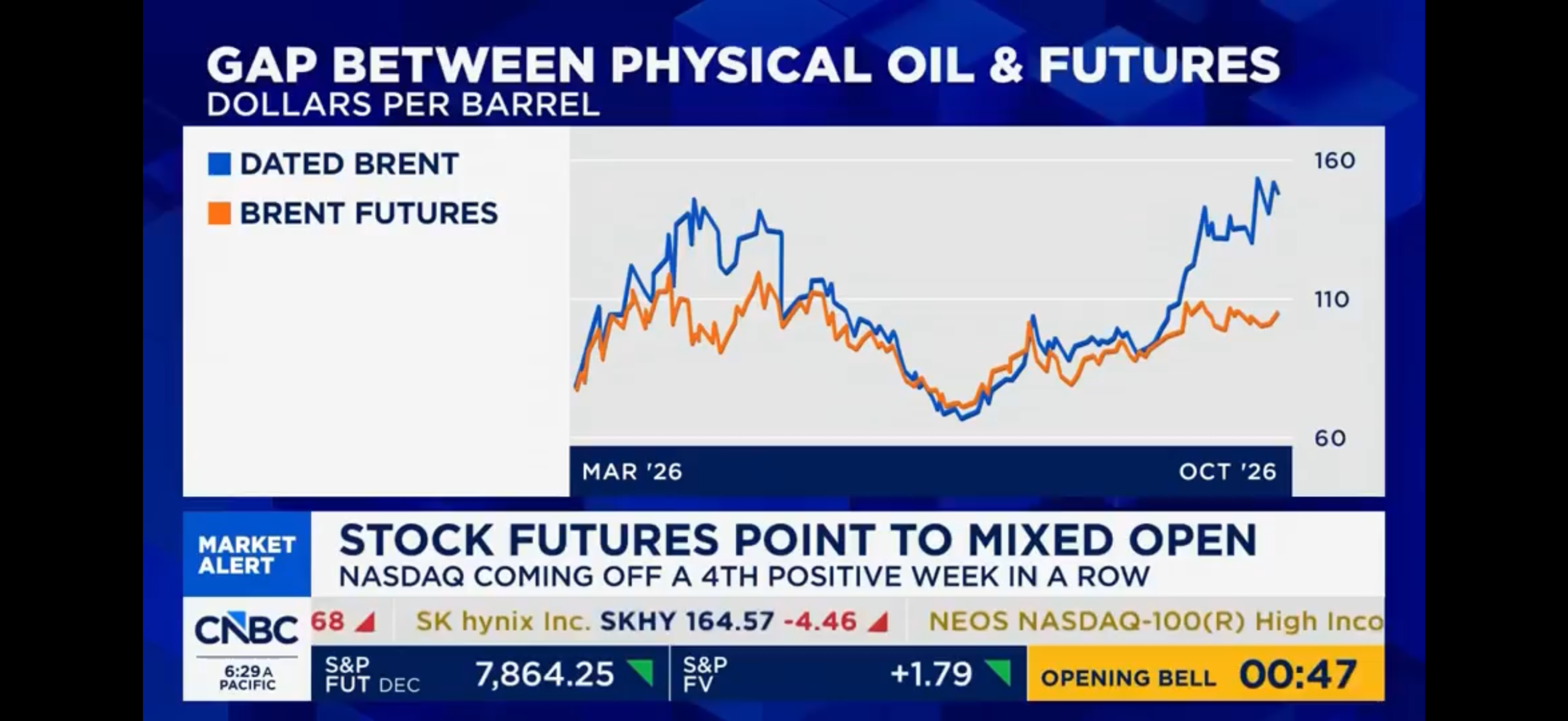
The oil price you see on your computer, about $103 for Brent, is a futures contract for oil delivered roughly two months from now. It reflects traders’ bets that the Iran war’s disruption to Persian Gulf supply will ease by then.
The “actual” price experts refer to is the cost of physical barrels available immediately, and since the Strait of Hormuz was essentially shut down in late February, that price has been much higher. Dated Brent, the benchmark for North Sea cargoes you can take delivery of right now (prompt cargoes), peaked at a record $144 in April. Dubai and Oman crude, the benchmarks for Gulf oil sold to Asia, reached as high as $169.75 in March, before shipping costs.
Normally physical and futures prices differ by $1–2. This year the gap has repeatedly exceeded $20–35, because refiners who need crude right now can’t wait for the futures market’s expected recovery. In addition, buyers pay freight, insurance and financing. So the delivered cost of a Middle Eastern barrel to an Asian refinery can plausibly be around $160 even when headline Brent reads $103.
This matters for inflation because consumers pay physical prices, not futures prices. Gasoline, diesel, jet fuel, freight and petrochemicals are all priced off prompt barrels and product markets, so the headline futures price understates the energy shock moving through economies.
Société Générale notes that diesel is strong enough to imply Brent should be above $150 to restore normal refining margins. The U.S. is partly insulated: it is a net petroleum exporter, and its crude has traded at a record discount to Brent because of its distance from Asian markets.
But refined fuels trade globally, so American diesel, airfares and shipping costs still rise. That pushes up headline CPI and, through transport and goods prices, can feed into core inflation and complicate the Fed’s rate decisions. Oil-importing economies feel the shock much more directly.
Europe, Japan, Korea, India and smaller Asian and African importers pay physical or delivered prices, often in dollars their currencies are losing value against. Analysts flag Southeast Asia and East Africa as the most exposed, and the outcomes there range from sharp inflation to outright fuel shortages.
Demand destruction (the IEA expects global oil demand to contract in 2026) eventually limits how high prices can go. But any such ceiling would come at the cost of slower growth, so the world faces a stagflationary mix rather than a simple price spike.
Leave a Reply
You must be logged in to post a comment.