
 If you haven’t noticed something strange about the market’s price action lately, you probably haven’t been paying attention. Hint: it involves more than the market “shrugging off” bad news.
This is the 9th session in a row where oil futures temporarily popped up above their 200-day moving average.  Today is also the 10th out of the last 14 sessions where VIX was briefly hammered right at 9AM (the other 4 sessions, it simply cratered from an overnight high.) With futures off (horrors!) a few points, look for another trademark “breakdown” of the latest straw-man trend line.
 VIX got a scare yesterday when negative trade news hit the wire. The panic lasted all of 2 minutes — the amount of time it took for someone to see the aberration and mash the SHORT VIX! button.
 Futures have been dancing to the same tune every day – repeatedly “saved” from an ugly open and managing to remain above their 2.618 Fibonacci extension at 3076.93 for what is now approaching 10 sessions.
  The algos have very clearly been running the show. SPX is off a few points? Simply hammer VIX and ramp CL by a cents. Works every time. But how long can it go on?
continued for members…
Futures are currently off 6.75, but have been buffeted all night long by conflicting signals from the factors. The chart problem they face today is USDJPY, which continues to settle lower, getting about as low as it can without the rising purple channel breaking down.
 If it breaks down, ES can say goodbye to the rising yellow channel it’s been in since Nov 4.
  Another sign of potential trouble: TNX. With PPI popping 0.4% last month, you have to wonder how long Powell can trot out the “inflation is too low” refrain without the reporters laughing in his face.
 The 2s10s has reversed at an internal TL and the top of the white channel it recently re-entered.
 And, the 2Y is falling.
 We have often seen stocks continue to rise even while the fundamental picture gets cloudy. It’s commonplace around OPEX, month-end, quarter-end and especially year-end. Could we already be in the year-end tractor beam?
VIX could theoretically bumble along on the red TL for another 6 weeks. It would be odd, but it could.
 And, we’ve discussed how CL is probably going nowhere until after the Aramco IPO is done. It has studiously avoided truly breaking out, as that would have actual consequences.
 SPX is still well above its 2.618 at 3047 and its SMA20 has now joined its SMA10 above that level. Could we be looking at flat to slightly rising for another six weeks?
 I like RSI as an indicator – but not the way most people use it to indicate simple overbought and oversold levels. I like to chart channels and TLs in RSI. Currently, SPX’s RSI appears to be in the very early stages of breaking out. It could still reverse and drop back below, but absent a sharp crack in the next few days, it’s in a relatively safe place.
 We saw a similar situation set up multiple times in 2013-2016 at times when SPX was pushing above its 1.272, backtesting it, testing its 1.618, and ultimately reversing off the 1.618. Note the repeated “breakouts” marked with red arrows indicating the prolonged ramp job.
 VIX’s RSI confirmed a false signal in Oct and Nov 2015. In Mar-Apr 2016, however, the breakdown was enough to send SPX up to test its 2015 highs.
 We can see multiple tags on a rising TL of support (for RSI) from Mar 2016 that has not yet broken down. The TL connecting price bottoms dates back to only Nov 2017. Interestingly, the breakout RSI made in early Aug was quickly hammerd back below a TL dating back to Oct 2018. It backtested that TL on Oct 2 just to drive home the fact that the breakout was to be ignored.
 In other words, we have conflicting trends: a longer-term trend indicating rising risk and a shorter-term on indicating that everything is just fine. This is essentially the same as SPX.
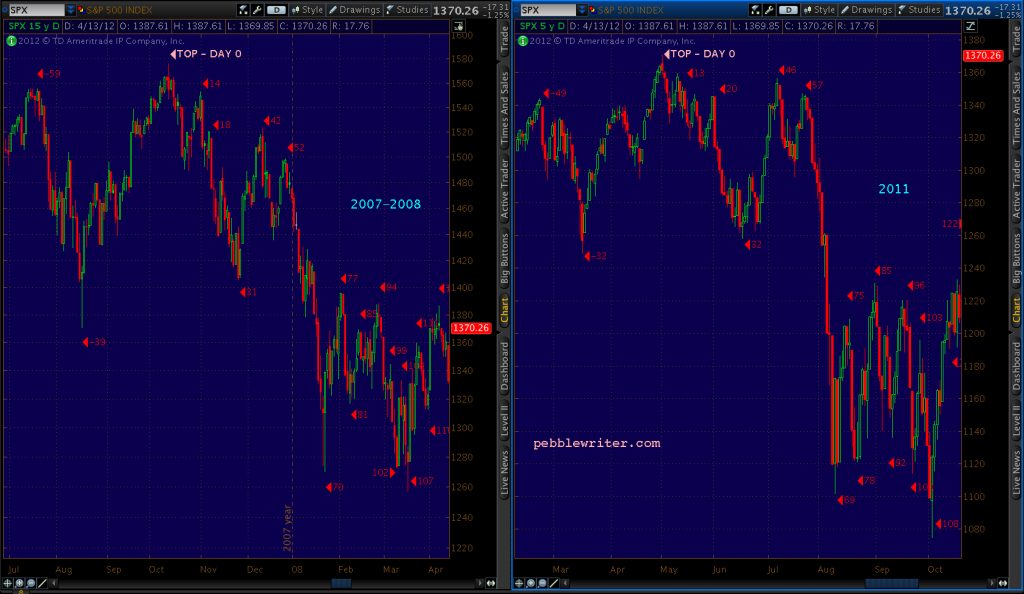
The weekly chart shows a similar pattern. I’ll develop similar charts for our other factors as I work on the big picture post scheduled for next Monday. Our analog has pretty clearly broken down. This might or might diminish the risk of a sudden crack in the market (remember last December!)
More later.