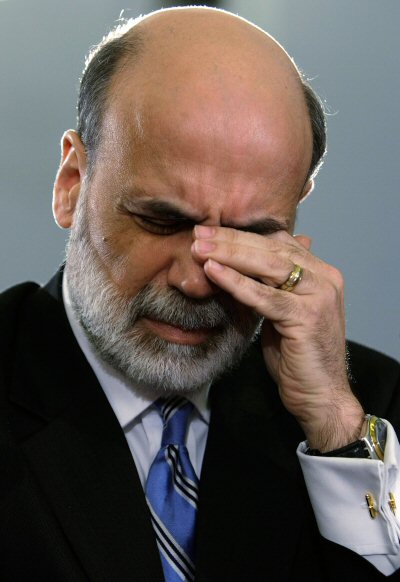
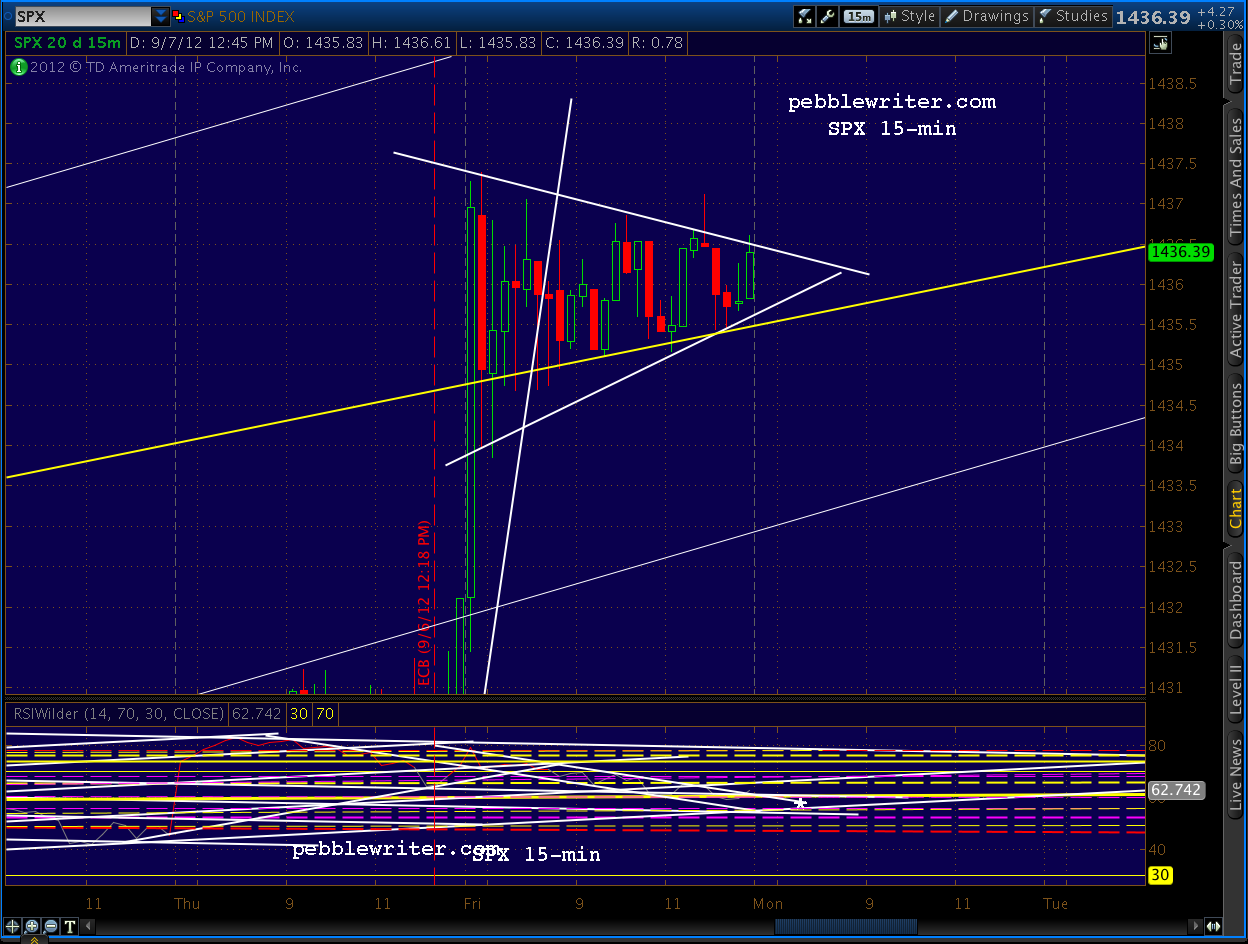
The World According to Ben is inflationary. It is confident. Its citizens consumers buy stuff today because it might be too expensive tomorrow — or, just for grins. It’s a world plagued not by irrational fears, but by irrational exuberance. It’s a return to those thrilling days of yesteryear, when nothing bad ever happened, as long as you owned your house (preferably 2-3) and borrowed lots of money to fill that house with plasma TV’s and Porsche’s.
But, we’ve been down that road before. Seems to me it didn’t end terribly well. Fortunes were lost, families were torn apart, lives were ruined when the bubble burst. Ben would like us to think this time will be different, that the Fed is now watching so closely that such a thing could never happen again.
But, isn’t it interesting that CPI just posted the biggest monthly spurt in over 2 years? And, of course, that was before Benny’s helicopter even lifted off. As Zerohedge put it:
“In other words, the food inflation which is already spreading through the economy courtesy of the record drought, is about to be supported by some brand new Fed-generated inflation. Luckily, as yesterday, nobody uses gas or food.”
Here’s the chart of the day year. For those unfamiliar with Bat Patterns, learn more HERE.
 Not all Bats mark huge reversals. Since we could put in a Point B at the .618 retracement, there’s the possibility we’re constructing a Crab Pattern that ultimately targets the 1.618 (2138.)
Point B could also have been the .786 reversal at 1370 in May 2011, which would indicate a Butterfly Pattern targeting the 1.272 (1823) or the 1.618. On a scale this large, these are obviously patterns that could take years to play out. And, we never use harmonic patterns in a vacuum; their targets must be supported by other technical analysis.
The last really big Bat Pattern we completed was in January of 2007, when SPX had retraced 88.6% of its 2000 – 2002 plunge from 1552 to 768.
 There was a relatively minor pullback of only 98 points; but, it was certainly enough for traders to capitalize on. Note the pullback to just below the previous Fibonacci level (the .786) was a nicely formed Crab Pattern — one of our other favorites.
 Bottom line, be ready to short with some gusto at 1472.43.
CHARTS: 9:40 AM
The dollar came oh-so-close to hitting our 78.818 target this morning. Recall that this is the .886 of the larger red Bat Pattern (lot of Bats going around) and should provoke at least a bounce — maybe much more.
The daily RSI shows how very oversold it is, but that doesn’t mean it can’t go lower — simply that it is likely nearing at least an interim bottom.


Meanwhile, SPX is nearing our 1472 target. I will ease some stops into the equation as we approach it, as I’d like to remain long for as long as possible. This is a 35 point gain since we went long yesterday at 1437 with the Fed’s announcement.
Note, this is a biggie — the .886 of the Oct 07 – Mar 09 crash from 1576 to 666. It’s a big ol’ Bat Pattern that should provoke quite a reaction. But, lots of folks are watching it, so it’s possible some of them might jump the gun and sell before actually tagging it. Then, again, we could be seeing a lot of short covering still; and, we could just as easily overshoot it.
We’ll watch the RSI’s for any sign of weakness. Having topped 1464.71, it will ideally turn into support. If we get a reaction, I’m thinking the green channel line we just topped would be a good initial downside target (1439ish.)
If you can watch the market like a hawk, the 5-min can be more effective than a round number stop. Market makers know where the stops are (yes, yours too!) and love to trip them on the way to their ultimate target.

 Whole lot of overbought going on in the RSI above…
 Note that the dashed purple channel line cutting across our path at 1472.43 is one of those blue channel lines from the 30’s we discussed yesterday. This one just happened to intersect with the 1422.38 high from April.
UPDATE: 10:10 AM
DX just tagged the .886 we discussed above. Should get a bounce here, and SPX (1469) should tag 1472 any minute. Can’t resist a few Sep 146.5 calls at .72, just for grins.

UPDATE: 10:20 AM
Going ahead and pull the plug on my longs here at 1474. The 5-min, 15-min and 60-min charts are all showing negative divergence. I’ll place stops at 1475 or so, trailing lower as need be, just in case it makes another run higher. But, this should be the start of a nice downturn.

UPDATE: 12:25 PM
Back online. I don’t know if it’s my computer, WordPress, Firefox or GoDaddy, but things had slowed to a crawl here. Had to shut down, run Disk Utility, etc. Things seem to be running much better now, so probably my computer — which has seen very heavy use during the several 20-hour workdays this past week.
SPX is back to 1469 after dropping as low as 1465. This is likely a bump on the way lower, but I want to remind anyone else who’s short to please use stops. It would be shame to give back the 37 points we’ve scored since yesterday just because the market doesn’t feel like reversing at the .886.
I don’t think it’ll happen…just like I didn’t think the Fed would pull the trigger on QE yet. The point is, it could. And, it pays to play it safe — especially if you can’t sit glued to a monitor 24/7.
 I’m watching the 5-min RSI, wondering if it’ll turn at the broken trend line. The channel on the 60-min RSI shows the immediate downside potential.
 Not to mention the price channel itself…
 Remember, the upper bound of that channel is also a very significant TL. Viewed in this manner, I could make a case that we’re back testing the previous channel that ran from Aug 5, 2011 to the 1422 peak.

UPDATE: 1:00 PM
Some initial downside targets…
 Each of the dotted yellow lines above is a Fan Line from the 2007 high. FL A is through the most recent high of 1426.68 and currently sits at about 1425 — a 49-pt pullback from this morning’s high. It also has the benefit of keeping the Elliott Wave folks happy with the upside case, as it would keep SPX higher than the April 1422 high.
Fan Line B is through that 1422 high, and currently sits around 1407.50. It intersects with the lower bound of our red channel on Sep 24 and would potentially keep the channel alive. It also intersects around there with the .886 of the current pattern — a legitimate pullback as we push toward the 1.618 extension of a potential Crab Pattern at 1518 (just saying…)
Fan Line C is through the April 2 high, but without the shadow. It’s obviously the most extreme of the three, and would cause SPX to lose the channel it’s currently in. It also intersects with the Big Bat’s (1576-666) .786 — the next major Fib lower (of May 2011 1370 high fame) around December 31 — a long, slow decline.
Of the three, I’m most attracted to B. I think it’ll be appealing to TPTB to keep this rocket ship on track, and what better way than to keep it in this incredibly steep channel to the moon. It also intersects with one of our big red channel lines [see: What A Wonderful World] that originates at the October 2007 shoulder, so it could be seen as a back test of that.
Any pullback should be at least to 1444, the broken green and red channel lines from our study yesterday and the mid-line of the channel we’ve been in since June 4 at 1266.
This isn’t a formal forecast yet, just intra-day noodling from your humble and very sleep-deprived servant. But, it has appeal. More this weekend on the forecast.
UPDATE: 2:00 PM
Probably a little premature, but here’s a potential channel for the 15-min chart.
 We’re caught a little bounce on that little RSI TL, but the channel’s still intact. The 5-min RSI indicates we might push lower. I’m watching to make sure RSI doesn’t push up through the downward sloping TL.
 Meanwhile, the 60-min still shows plenty of room to the downside…
 …as does the daily:

UPDATE: 2:45 PM
Here’s why the market’s currently stuck. The differences on the 5-min chart are subtle, but will decide whether we stay in the narrow downward channel or not. Which will play out? Day traders should be thinking about stops here.


UPDATE: 3:10 PM
It isn’t going to go down without a fight. Refining the above charts a little… The bottom of this little channel is currently around 1460.

UPDATE: 3:15 PM
Updated VIX charts show a good chance of a bounce off the yellow channel line and the .886 of the recent 13.3 to 18.96 ramp (small purple pattern.)

The RSI certainly looks ready to bounce. New channel up, or a pause on the way down? Given the way negative divergence has worked with VIX, a higher low on RSI could easily correlate with a lower value — maybe retest the 13.3 lows in conjunction with higher equities after the Bat reaction we get?
I feel a forecast coming on.

UPDATE: 3:30
We certainly called the dollar right. It slightly exceeded our 78.818 target and has bounced nicely. Also, looks like a good new channel coming up through this morning’s low — TL “D” as we speculated earlier.
 Those SPY 146.5 puts I bought this morning at .75 are currently trading at 1.27. Nice…
Here’s our updated 5-min SPX chart. That thin red TL is the 2nd highest channel line in the red channel up from 1266.
A close at these levels would leave us with a shooting star candle on the day we completed a five-year Bat Pattern. I like those odds, and will hold short through the weekend.
 It’d be really something if we were to close down on the day…
UPDATE: 5:00 PM
FORECAST ALERT!!!
I’ll dig up the actual numbers this weekend, but here’s a back-of-the-envelope calculation that intrigues me. Many observers have noted the diminishing impact of each successive QE exercise. What if…
- QE 1: 666 to 1228 = 562 points.
- QE 2: 1010 to 1422 = 412 points (412 = 73% of 562)
- QE 3: 73% of 412 points is 300 points. 1266 + 300 = 1566.
It just so happens that 1566 is a stone’s throw away from 1553 — the Crab Pattern 1.618 extension of last year’s plunge from 1370 to 1074. It also happens to be the apex of the rising wedge we broke in April.
Darned if it wouldn’t also make for a very nifty double-top (not to mention a perfect right shoulder for el patrón de cabeza y hombros grande) somewhere around the time we tumble off the fiscal cliff with our new, lower credit rating.

I definitely feel a forecast coming on. Better lie down and let it pass.
Have a great weekend, everyone!
P.P.S. one last chart… I don’t always watch it, but today AAPL got within 3.02 of a 1.618 extension of this week’s 683-656 drop and 3.58 of a 2.618 extension of July’s 620-570 drop.
 It also tagged a channel line that dates all the way back to September 2002.

 Monday could be very interesting…
P.P.S.
I had a couple of emails regarding the delay in my 10:20 AM update. I thought that update had posted when I had to reboot my computer (see the 12:25 update.) So, my apologies.
It’s just me here, folks. No trading desk, no hot receptionist, no tech guy, no gofers. So, on a day when I put up 30 charts and write 2,000 words — on the heels of a 30-chart and 4,000 word post deconstructing the four major crashes over the past 84 years (and a contest, what was I thinking?) — stuff is gonna happen.

My wife tells me I’ve slept a total of 20 hours over the past four nights (which kind of explains this rant.) If he were alive today, I’m sure Lloyd Bridges would agree it’s been a long, long week. I should have suspected as much when my web-hosting service GoDaddy went kaput right in the middle of Monday’s session.
On the bright side, we reached our 1472 target and scored 46 points since the Fed announcement yesterday. Now, some of you might have missed: (1) the dozens of times I’ve named the 1472 target since March 18 [see: Big Picture]; and, (2) the dozen charts and mentions in yesterday’s post; and, (3) the three mentions and five charts beginning at 9:40 this morning.
A few of you might have waited until my 11:47 email to act. But, you still could have sold/shorted near 1470. Sure, you would have only made 44 points this week instead of 52. But, that’s still 3.1% in one week.
It’s not as nice as last week’s 3.6%, but it brings our total since March to 61%. That doesn’t suck too much, especially for a portfolio that didn’t involve leverage or praying to Tim Cook (AAPL was up a measly 16% over the same period.)
I guess all I’m saying is I’m pedaling as fast as I can. Pebblewriter.com is a labor of love that, at almost six months old, doesn’t yet cover the bills (my college-bound girls eat a lot.) Maybe some day I’ll wax poetic from the Orient Express or an Oceanis 58 docked in Saint-Tropez, and go weeks between trades. But, in the meantime, I trade for a living.
If you’d like me to sleep more, trade less and get e-mails out in a snappier fashion, let your friends and colleagues know about our little experiment. It’s a win-win with a very simple equation: the more members we have, the more I can focus on the blog.
Thanks.
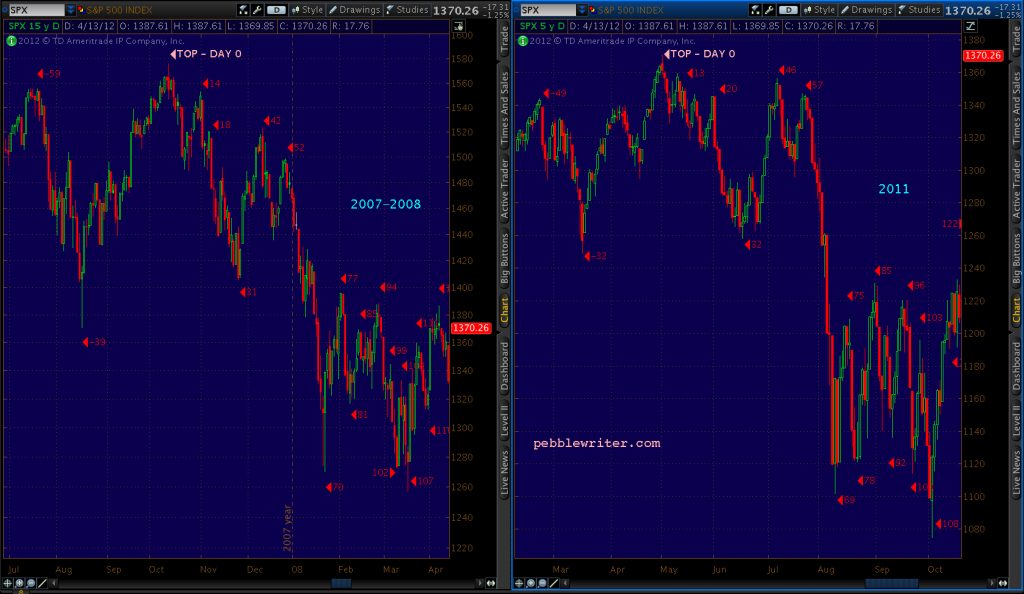


 I’m charting a new, broader channel in red. It’s speculative at this point, but it corresponds with a 1.618 extension of yesterday’s high to its low.