Author: pebblewriter

  • Now What?

    First, a quick overview…

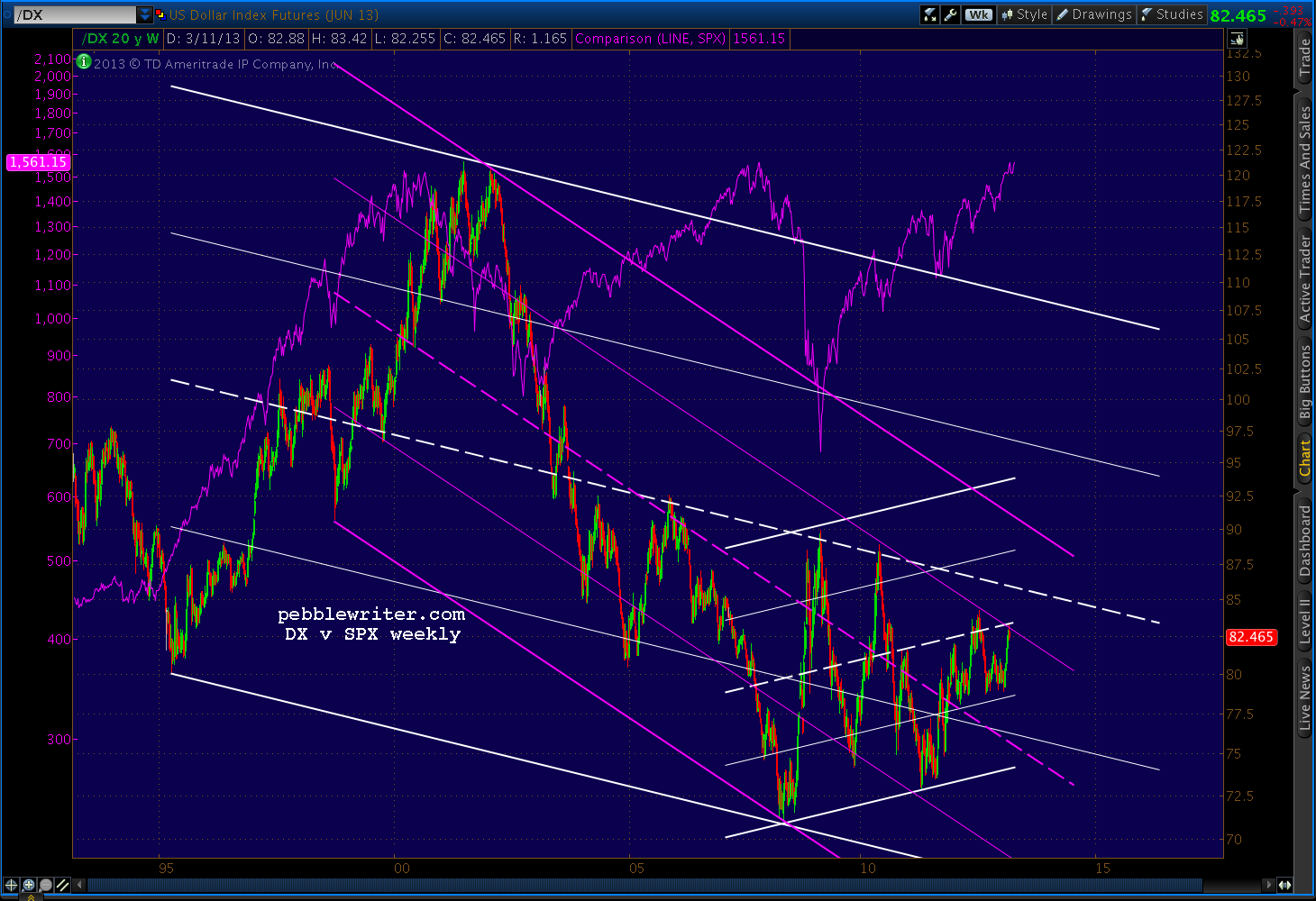
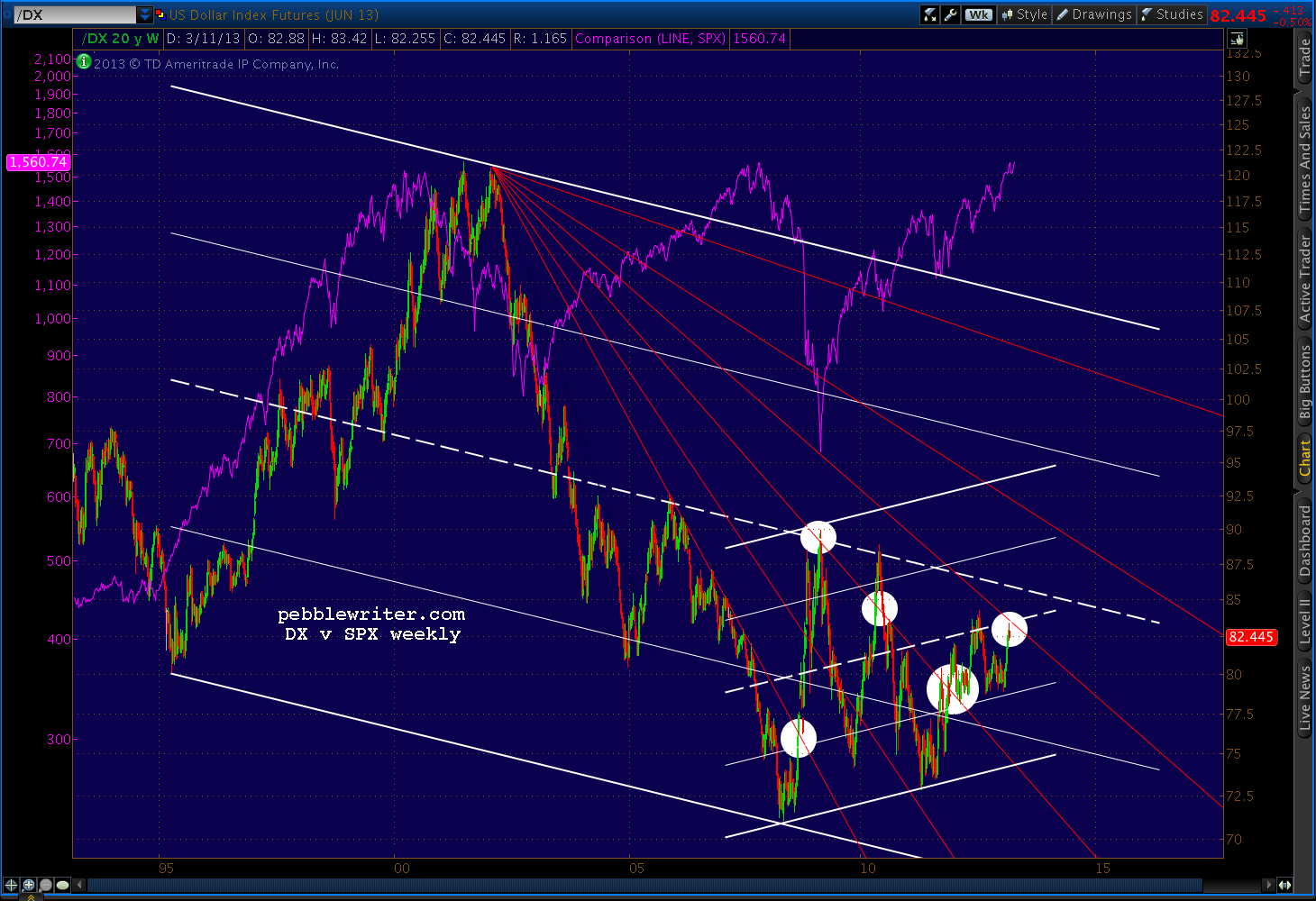
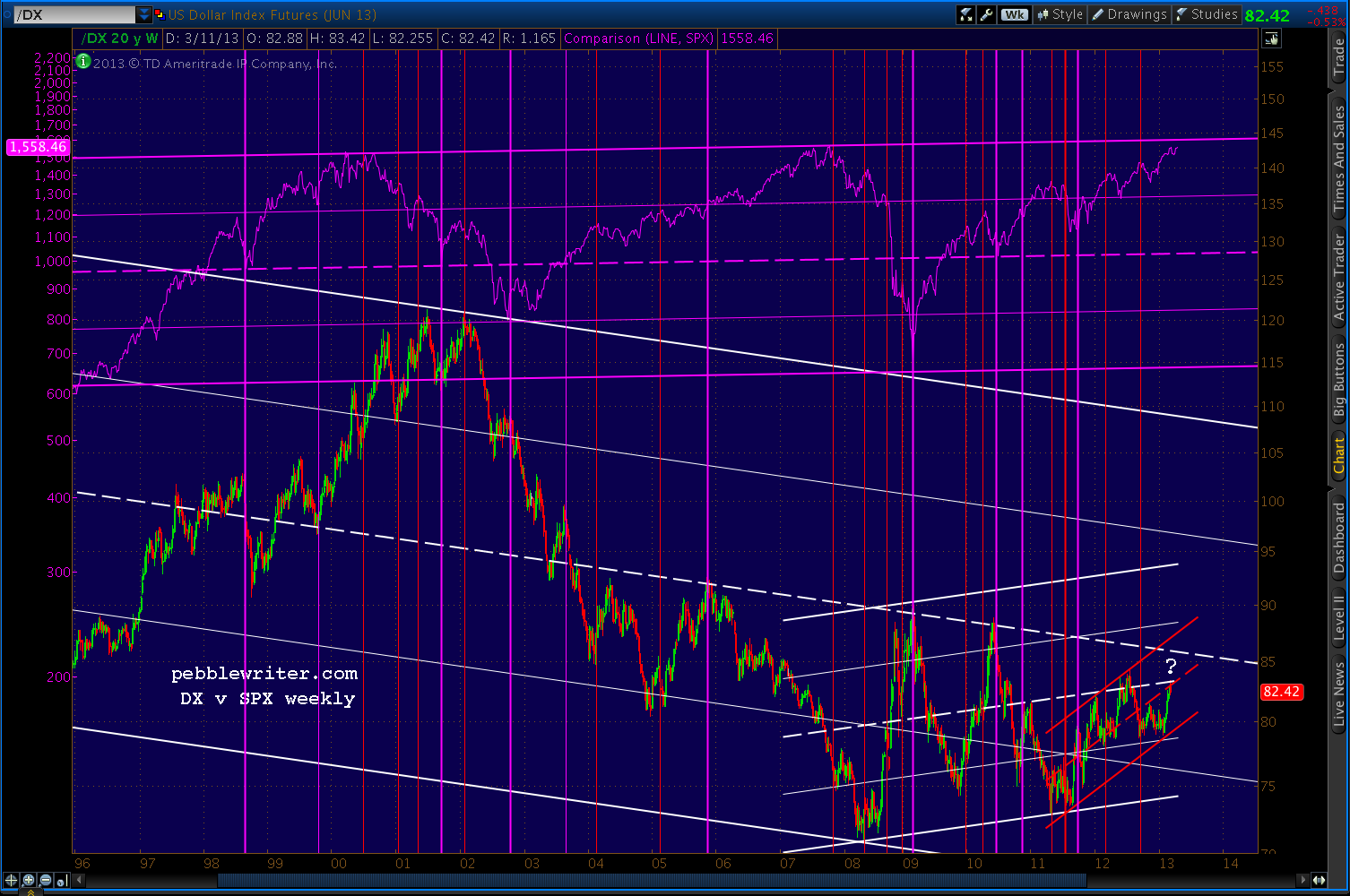
    The dollar got clobbered overnight, knocking it temporarily out of the white channel that’s guided it since Jan 11.

    But, interestingly, its RSI channel is doing just fine, thank you.

    The EURUSD continues to levitate, but still hasn’t broken the last important interim top put in on Feb 24.  It is also bumping up against two 25% channel lines, so could very well stall out here at the .886.

    There is still ample negative divergence regardless of which channel ultimately wins out.


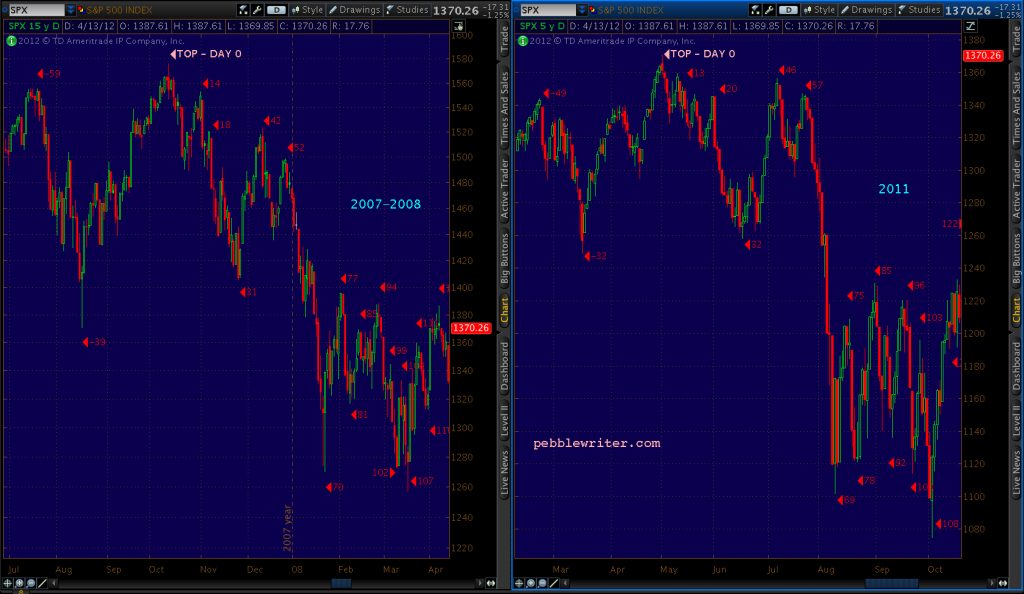
    With the market exceeding the recent 1474 highs, the analog that did so well for us since last April is officially dead.  This begs the question: “now what?”  I see three big issues hanging over the market right now:

      1. earnings season —  AAPL in particular
      2. the US budget/debt ceiling imbroglio
      3. new highs justified?

    Earnings

    GOOG and IBM both gapped up this morning, but the earnings that can really move the market — AAPL — comes after the close.  We’ll take a fresh look at the AAPL chart later today.

    Budget/Debt-Ceiling

    In a few hours, the House will probably pass a measure to postpone the debt ceiling debate until May.  Reid and Obama have both said they’re on board, so this appears to be a done deal.  If House Republicans don’t fall in line, as occurred with “Plan B,” the market will sell off precipitously.

    New Highs

    The market’s strength has caught many off guard, including yours truly.  Many are calling for new all-time highs for SPX. The 2007 high of 1576 is now only 84 points away, so a few good sessions could do it.

    We’ll take a fresh look, focusing on the harmonic and chart pattern picture as well as the establishment agenda.  “What’s that?” you say.  Say all you want about random walks, CAPM, dividend discount models and Dow Theory.  Like any government-managed enterprise, the market is subject to the policy goals and needs of those who attempt to control it.

    Even to my cynical ears, this sounds a bit like rants from the tin-foil hat crowd.  But, consider the news on Egan-Jones yesterday.  This is one of the biggest stories of the month, yet predictably earned only this from WSJ/Marketwatch:

    CNBC was slightly more generous, yet still presented only the SEC’s side of the story.  It’s a story that deserves to be told because it speaks volumes about the degree to which the market is presently being controlled.  And, I’m not just talking about quantitative easing, though I suppose we’d have to consider QE exhibit #1.

    Last summer the market crashed 22%.  It was an analog (replay) of the 2007 top, so we saw it coming in plenty of time to profit quite handsomely.  But, it was a huge wake-up call for The Powers That Be (TPTB) or Plunge Protection Team, Wall Street Cabal — whatever you want to call it.

    With virtually unlimited power and unlimited resources, why couldn’t they prevent something like that from happening?  More importantly, if the top was a replay of the 2007 top, might the rest of 2011 play out like 2008-2009?

    It didn’t, because they learned from the crash of July-August.  First, they tweaked the markets just enough to bust important chart patterns that were playing out.  Second, they tweaked the rules to provide for more time to contain any damage which might otherwise occur (circuit breakers, etc.)  Third, they attacked those who had “caused” the crash.

    S&P CEO Deven Sharma was one of the first victims.  In the wake of the 2007 financial crisis, S&P was rightly pilloried for having pulled its punches — particularly on mortgage and banking related debt.  This was no surprise to anyone who’s ever worked on Wall Street — which pays for these supposedly unbiased views.

    An infamous exchange between two S&P analysts in April 2007 aptly illustrates:

    “BTW, that deal is ridiculous.”

    “I know, right . . . model def(initely) does not capture half the risk.”

    “We should not be rating it.”

    “We rate every deal. It could be structured by cows and we would rate it.”

    Imagine if Hollywood studios funded the reviews of their movies.  Would you care if they received thumbs up or down?  So, in August 2011 S&P found religion and bravely downgraded US debt.  Seventeen days later, Sharma was fired and replaced with the COO of Citibank, the bank whose existence relies on the absence of any future downgrades.

    Egan-Jones beat S&P to the punch, downgrading US debt on July 16.   Two days later, the SEC’s Office of Compliance Inspections and Examinations called looking for information on the downgrade.

    On October 12, Egan Jones was formally notified of a Wells Notice — they were being investigated.  On April 24, the SEC filed a cease and desist order against Egan-Jones — the only rating firm not on the take — stating the action was “necessary for the protection of investors and in the public interest.”

    The financial establishment’s interests, sure.  But, to frame this obvious smack down as “in the public interest” is laughable alarming.  Egan-Jones was the one rating firm with the balls to point out the country’s crumbling financial condition and stick to their guns.  Now they’ve been branded as deceitful, dangerous.  George Orwell spoke the truth in 1984:

    “In a time of universal deceit, telling the truth is a revolutionary act.”

    That other deep thinker, Jim Morrison, provided a similarly profound observation:

    “Whoever controls the media controls the mind.”

    The extent to which the market has been manipulated is deserving of its own post.  But, this Zerohedge article, forwarded by a member, is a great preview.

    Okay, so I know what you’re thinking: if the market is so heavily manipulated (and, presumably, insulated from downturns) why bother trying to beat it?  Simple.

    1. Chaos theory tells us they won’t have enough fingers to plug every hole in the dike (TPTB have similar “never again” strategy sessions after every crash.)
    2. Even when things do run as programmed, we can still effectively capture enough significant swings in the markets enough of the time to boost returns and, more importantly, try to avoid huge downdrafts.

    Over the very long-term, stocks return 8-10% — depending on the time frame examined.  But, sadly, most of us are limited to 40-60 years of investing.  And, a 60% crash right before starting a business, buying a home or beginning retirement could be devastating.

    So, we’ll keep plugging away, letting the markets tell us where they want to go…while trying to get there first.

    So, the question is “Now What?”  We’ll start by looking at the harmonic picture.  As detailed in our last review of all the previous tops, harmonic patterns are very likely to come into play.  So, we’ll start with the charts, then move on to the agenda question and, last take a look at AAPL.
    Since we’ve exceeded the range at which this rally could be considered a double top, we’re probably going higher still. So, we’ll examine the 1.272 and 1.618 extensions.

    In terms of a trading strategy, I’d be comfortable going long here at 1491.  But, disappointing AAPL earnings could knock the stuffing out of the market.  So, those with weak hearts should probably stay on the sidelines until tomorrow morning.

    The most recent patterns show a few possibilities, some of which are clumped together in fairly narrow ranges.  The largest of the patterns — the yellow grid — shows a 1.272 Butterfly Pattern extension at 1510.19 that intersects with the 2.24 extension of the decline (purple grid) from 1448 – 1343.

    A Butterfly Pattern is a good bet, as the Dec 18 reversal at 1448 pretty much nailed the .786 Fib level Point B (1446.44) which Butterfly Patterns require.

    1510.19 also falls within the confines of the thin red line — the TL connecting the Apr 2 and Sep 14 highs that would probably satisfy the EW requirements of an ending diagonal.  I know you’re out there, my Waver friends.  Please weigh in, as I know only enough EW theory to be dangerous.

    The white pattern is appealing enough, but I would have to consider it secondary in importance to the yellow since it began at a less momentous point X.  Ditto for the grey pattern.

    Although it should be noted that we faced a similar dilemma when choosing between the Point X’s for the Butterfly patterns beginning in 2011 [see: All the Pretty Butterflies.] In the end, it was a point similar to the white pattern 1.0 Fib at 1464.02 that determined the April 2 turn.  It featured a Point B closest to the .786 Fib.

    Zooming out, we can see that the 2011 highs could very well still influence the outcome of the current top.  The chart that includes everything is a little busy…

    …so I’ll clean it up by eliminating the interior retracement levels and switching to weekly.

    The target areas can be more easily seen in this close up.

    Note that the large red pattern, the one whose 1.272 extension helped me accurately forecast the April top, comes into play at its 1.618 extension of 1515 – only a few points away from the 1509-1510 level discussed above.

    This is promising, as patterns that influence markets once (that was an 11% correction, after all!) are more likely to do so again.  And, patterns that the market completely ignores — such as the yellow and white patterns from May and July 2011 — are less likely to suddenly leap into a position of authority.

    And, there’s also a purple 1.618 extension (set up by the 1422 – 1266 decline) at 1518.57.  Again, this is close enough to be considered significant.

    If 1520 is exceeded, then we’ll look at the next higher grouping: 1553-1555.  This “group” is basically the two yellow 1.618’s.  Again, the larger pattern’s 1.272 had no influence on the market.  The smaller pattern’s 1.272 is the one coming up at 1519.

    Summary

    My leading harmonic forecast is for 1509-1515.  I can’t imagine getting this close to 1500 and not snagging it for the trophy case.  And, I like the idea of dancing with the harmonic patterns that brung us.

    My secondary goal is slightly higher at 1553-1555, so there should be opportunities to jump back in and capture most of any upside above 1520 if/when appropriate.  Such a move would likely follow a reversal from 1509-1515 back down to 1474ish and would constitute a fifth wave rather than the ending diagonal suggested above.

    If AAPL’s earnings stink up the joint after the closing bell, going long won’t have looked very smart.  But, judging from the steadily appreciating share values, I’m guessing that a relatively positive result is already being leaked.

    Chart Patterns

    I won’t rehash the stuff already posted in the past couple of weeks.  Just take a look at the rising wedge that would be confirmed by a reversal at 1510 as early as tomorrow.  The target would come at the .886 of the base to apex price range and .618 of the time range (almost too good to be true.)

    We’re currently very close to the .786 of 1498, which tells me there’s a decent chance of a run up to 1500ish into the close.

    UPDATE:  3:45 PM

    AAPL is up almost 9 points at the moment.  A rally past 1426 would take it up out of the falling white channel it’s been in since last August.

    Anything over 515 would take RSI above the white and purple RSI channel midlines.   So, as expected, much is riding on the earnings report and how it’s perceived.

    We’ll watch these RSI channels, though. A return to the top of the yellow (and, especially the white) channel would surely spell a reversal.

    The Agenda

    I think it’s pretty straight-forward — bag an important new high, but without setting the bar so high that expectations can’t be managed.  At 1510, SPX clears 1500 but buys some time before the pressure of “will it exceed 1576?” comes to bear (no pun intended.)

    Then, get through the budget mess (or, more kicking of the can) and see where we are.  If we get a sequester, so be it.  The establishment will be well positioned ahead of time and the correction will be managed.

    After the shock of it wears off and prices have firmed in the 1200-1300’s, time to establish the next leg higher.

    Now, the big question is whether TPTB can engineer such a move without it getting out of hand — as it often does.

    Stay tuned.

  • Race to the Bottom: Jan 22, 2013

    Lots of big earnings announcements today:  JNJ, VZ, DD, TRV, DAL all missed, while GOOG, IBM, TXN, CA and AMD will report after the close.   It’s getting tougher to ignore slowing revenue growth, though the misses were almost universally blamed on Hurricane Sandy.

    But it’s the currencies that are getting most of the attention lately, with the yen making headlines all weekend. The BOJ followed through on expectations, confirming they will continue unlimited QE in 2014 once the current program ends in December.  They also embraced a 2% inflation target though, as many observers have pointed out, they’ve failed to even come close to the current 1% inflation target.

    USDJPY is the pair I watch the closest.   A weakening yen obviously strengthens the dollar index (the yen is 13.6% of DX) but it is easily offset by euro strength (57.6% of DX.)  Nevertheless, the pair’s importance shouldn’t be discounted, as it heavily influences trade.

    The two dominant chart features are the falling channel (purple) since 1998 and the falling wedge (yellow, dashed) since 2001.

    The pair broke out of the falling wedge in January 2012, but recently began reacting with the channel midline at a price level just beyond our target range of 87-89.  If you believe the BOJ, the pair will blow through this resistance and continue up to 95 without a hiccup.

    In fact, the daily RSI over the past six months suggests today’s little 1.2% correction might be all we get.

    But, if we back out just a bit, we can see this isn’t necessarily the case.

    continued for members(more…)

  • Ay, There’s the Rube

    Oil is often viewed as a proxy for economic health.  In a growing economy, energy consumption increases.  This increased demand generally pressures prices higher.  Likewise, a decline in oil prices often accompanies declining demand.

    That’s a greatly oversimplified view, of course.  It ignores such important issues such as Middle East tensions, weather and refinery anomalies, etc.

    But, the most important of these external factors is the US dollar — the currency by which oil is traded globally (for now.)

    A weakening dollar is great for the many US companies that export overseas.  In general, it makes dollar denominated assets — such as stocks, real estate, etc — more attractive to overseas investors which helps the US attract and retain capital.

    But, it makes foreign-sourced oil much more expensive.  This isn’t an issue if you travel everywhere via America’s world-class public transportation system.  But, it really sucks for the guy with a 3-ton SUV — or anyone who consumes anything made overseas, for that matter.  Imports are about 18% of GDP.

    So, what’s a central banker to do?  Boost stocks and investment in US assets, and there’s a pretty good chance you blow the budget of every American consumer.  (Of course, it only really affects those who eat and drive — hey, buy a Chevy Volt already!)

    Boost the dollar to make gas and food more affordable for the 50 million Americans living in poverty (1 in 5 children, 2 in 5 African American children), and you risk a true disaster — a stock market decline.

    Never fear… Bernanke and his fellow Guardians of the American Dream know whose bread to butter.

    The chart below shows how crude light, the US dollar and the S&P 500 correlated over the past seven years.  In 2006 and 2007, oil and the stock market soared pretty much in sync while the dollar took it on the chin.  When SPX topped in late 2007, oil kept right on soaring — because the dollar was still plunging.  Nationwide, gas hit $4.12/gallon in the summer of 2008.

    We’re all conditioned to think of dollar strength as a function of risk off.  But, as the financial crisis worsened, the dollar couldn’t catch a bid.  Money fled to the euro, the swiss franc, the sterling — anywhere but the dollar. There were several best-sellers on bookstore (remember those? shelves that advised putting every last cent into the euro.

    From October 2007, when SPX peaked, until July 2008, stocks and the dollar moved pretty much in tandem.  But, as euro zone problems became more apparent, the dollar finally bottomed.  In August, as stocks began sliding again, the dollar finally took off.  Now deemed a safe haven, DX soared 27% by March of 2009, while stocks shed another 54% in value (58% in all.)

    Of course, this did a number on oil — already reeling from declining global demand.  CL plunged an astounding 78% in only six months — from 147 to 33.  Fortunately for the stock market — and especially the oil industry — Ben Bernanke came to the rescue.  The first round of QE was a resounding success and both promptly reversed.

    In the first three months alone, CL more than doubled to 73.  SPX added on a respectable 44%.  And the dollar took one for the team, shedding an initial 13% on its way to an 18% loss.

    So, why the history lesson?  By now most of you have noticed a slight discrepancy over the past 3 1/2 years.  Oil and the dollar have formed triangles.  They’ve had their ups and downs, but in general the highs have been getting lower and the lows getting higher.  I use the term “coiling” because eventually prices won’t be able to compress anymore.

    This pent-up energy will eventually be released in the form of sharply higher or lower prices, though it won’t necessarily happen tomorrow.   Both have drawn close to one side of the pattern, but there’s still plenty of room for a reversal.

    Oil, if it doesn’t suddenly shoot higher, will probably bounce back down.  Likewise, the dollar is poised to bounce higher.

    Stocks, on the other hand, have made a series of higher highs and higher lows in what’s known as a rising wedge.  These patterns also can’t last forever, and they almost always resolve to the downside.

    Prices are much closer to the upper bound than the lower, which also suggests the next major move will be lower.  In fact, when rising wedges break down, they typically target their origin. Needless to say, a return to 2009 or even 2010 prices would be a huge blow to the rosy scenario TPTB are crafting.

    Does oil offer any hints as to which way prices are likely to go?   I’m drawn to a few periods in particular.  From June 2009 to May 2010, oil gained 19% compared to SPX’s 27%.  Yet, they both shed roughly 20% in the May – June 2010 correction.

    We had another round of QE, which collapsed the dollar and sent stocks up 36% and oil up 70% through May 2011.  This time, SPX corrected 22% and oil 35% (through Oct 2011.)

    At that point, CL sold off strongly — dropping 23% through the end of June.  SPX, however, lagged.  It lost 8%, then promptly regained 90% of it in the next three weeks (compared to CL’s 40% retracement.)  When the slide continued, however, SPX caught up — in spades.

    It lost 80% of its gains from June 2010, while CL only lost about half that.  SPX then went on to make three new highs in a row, adding 38% through today’s close.

    CL managed an 88% retracement of its May-October losses for a 47% gain through Feb 2012, and has made two lower highs (each a 61.8% retracement of the previous high) since then.  Total gain from Oct 2011: 27%.  And, it’s been a fairly neutral currency market.

    I can’t help wondering what the oil and currency markets know that the stock market doesn’t.  A look at the CL charts indicates more downside.  Will SPX again play catch-up?

    Even ignoring what I suspect about the dollar and equity markets, CL presents a bearish picture.

    Whether it breaks down or out, CL is obviously at a turning point.  We’ll keep an eye on it…


  • Charts I’m Watching: Jan 17, 2013

    This morning’s post started out as an observation from a long-time member (hat tip to Beach Justice) and turned into a meaningful detour.

    PW – Does the candle pattern off of the recent 1400 low look a lot like the candle pattern from Sept 6 to Sept 24 to you?  We have a couple big green ones, one smaller green one on top that hit the high, then a bunch of tiny consolidating candles before it moved lower.  Also, always good to see another Ghostbusters reference, love it [2nd hat tip!]

    I took a look and was impressed by the similarities.  As BJ pointed out, they had very similar form.  But, it went beyond that.

    The September 2012 high was a big Crab Pattern that measured 77.95 from top to bottom and took 17 sessions from inception (the interim high at 1426) to the top.

    The latest high is also shaping up as a Crab Pattern.  It’s been going for 19 sessions and measures 75.85 points (so far.)

    Interestingly, had the first pattern stopped on a dime at the .886 Fib retracement of the 2007-2009 crash (i.e. 1472.43), it would have measured 75.86 points in all.  Hmm….

    Not one to believe in coincidences, I set out to look at other tops over the past few years.  This is where it got really interesting.

    In May of 2011, SPX completed an important top that looked sort of familiar.  That’s the same sized shaded box, BTW, just for comparison purposes.

    This Crab Pattern top also took 17 sessions to complete and ranged 75.88 points. Hmm…

    With all that out of the way, let’s turn our attention 2007 — the really interesting double top.

    These two were slightly smaller in price range (68.96 and 71.72 points) but still lasted 16 and 17 sessions.  The first completed a Butterfly Pattern rather than a Crab.  I attribute this to the horizontal resistance stemming from the 2000 top at 1552.87 (red, dashed line.)

    I find it very interesting that the 2nd top came in the wake of a completed Inverted H&S pattern — much like what happened on Jan 2 of this year.

    There was a fifth pattern that looks somewhat similar: April of 2012.  By transposing the shaded box over this pattern, we can see that this one is slightly larger.  It slightly exceeded the 1.618 extension, completing a Crab Pattern in only 13 sessions, then moved sideways for a few days, reaching its 1422 high near the 2.24 extension in a total of 23 sessions.

    I suspect this was the result of the proximity of two competing harmonic patterns and the lack of a nearby major Fib level.  The closest was the .786 at 1381.50 — which this pattern tagged at the entry point to the topping pattern.

    The dip and subsequent rise to complete the Crab Pattern crossed back over the .786 Fib, and offered two viable alternative targets that likely confused many harmonics watchers [it did me, as detailed in All the Pretty Butterflies.]

    So, what does this all mean when the market is set to establish a new high that breaks the pattern?

    continued for members(more…)

  • The Excitement Continues

    In retrospect, this might have been a good week to go on vacation, commit the Dewey Decimal system to memory, heck…even schedule a colonoscopy.  Anything would be more exciting than the water torture of watching this market go nowhere and do nothing.

    We all know there’s a fiscal showdown coming.  We know it could get ugly.  We also know the consequences of a failure could be enormous, while the consequences of success…well, is there really any point to discussing it?

    Any outcome that doesn’t involve an actual default (that lasts more than a day), human sacrifice, dogs and cats living together and mass hysteria will be hailed as a great victory for our democrapitalist system.

    The Fed will celebrate by setting the discount rate at -2.5% and buying all remaining government debt.  Lobbyists will be given their own monument on the mall (come to think of it, they already have one called the Capitol Building.)  And, banks will be given a tax credit for every homeowner they evict (delinquent or not) as long as they provide a toaster to each newly homeless family.

    The income tax system will be greatly simplified. The new 1040 will take only seconds to complete, a “giveaway” for individual taxpayers.

    While, large corporations will continue to be burdened by excessive and unnecessary regulations as well as grossly unfair tax rates.  The only exceptions will be a select few which qualify for the Congressionally Recommended Assistance Program (C.R.A.P.), including those which:

    1. are able to evade taxation in other jurisdictions
    2. employ an accountant
    3. have donated to a Congressman
    4. might otherwise owe taxes
    5. believe taxes are for Muppets
    6. don’t really feel like paying taxes

    Healthcare will be free for all, but office visits will require the donation of a body part.  Social Security benefits will be increased, but will require the conscription of one’s offspring in the volunteer military which, by then, will surely have preemptively attacked Iran (in a bid for energy independence, America will annex OPEC.)  And, of course, new SEC regulations will prohibit the selling of stocks.

    Okay, maybe I’m exaggerating.  When was the last time a bank gave away a toaster?

    *  *  *  *  *  *  *  *

    AAPL, the subject of much navel gazing lately, rebounded where we expected it to [see: AAPL: Flirting with Disaster.]

    Yesterday’s question du jour was where the stock would rebound to:

    If AAPL back tests to 501 [the H&S neckline] and continues down, SPX should follow.  If, however, AAPL blows through 501, it increases the odds of new highs for SPX.

    This morning, AAPL did poke up beyond the former neckline, reaching 504.50 just a little while ago.  It’s clearly threatening to go higher, and has plenty of room within the white channel — the upper bound of which is 533.  It remains to be seen whether or not the neckline will hold.

    The RSI chart, besides showing no positive divergence, shows the resistance that must first be overcome.  While the purple and falling white channels show plenty of downside potential, the upside would require a break of the rising white channel bottom.

    UPDATE:  1:35 PM

    Nice comment from Beach Justice below, comparing the price action from last September to that of the past two weeks.  Seeing them side by side on a graph, the similarities are obvious.

    The shaded box from September incorporates the 1426 high leading into the pattern, the interim low at 1396, and the ultimate high at 1474.  The entire pattern took 17 sessions to complete and is a Crab Pattern (white) that coincides with the Bat Pattern completion of the 1576 – 666 crash (purple.)

    The shaded box on the right is the same size, meaning it ranges from 1398.11 to 1476.06 over the course of 17 sessions.  Like the September pattern, it has run out of steam (so far) at the 1472.43 Fib.  But, unlike the September pattern, it’s come up a few points (4.87, to be exact) shy of completing a Crab Pattern.

    Interestingly, both patterns are about the same size from top to bottom.  September’s ranged from 1396.56 to 1474.51 for a total height of 77.95.  The current one has stretched from 1398.11 to 1473.96 (so far) for a total of 75.85.

    Interestingly, if the Sep 14 rally had stopped on a dime at the .886 of 1472.43, its size would have also been 75.85 — exactly the same as the current top (as of a few minutes ago.)

    The current top certainly qualifies as a double-top, with a high 55 cents shy of September’s high.  But, what happens from here?  This is where it gets really interesting.

    continued for members(more…)
  • Should We “Like” Facebook?

    The last time I posted about FB was October 24 [see: CIW Oct 24, 2012], when I happened to hear Donald Trump repeatedly mention the stock as he was being interviewed about something else all together.

    BTW, interesting chart on Facebook.  I knew something was up when I heard Donald Trump touting the stock on the radio.

    He…still managed to mention the large position he’d been buying about 5-6 times.  More likely he was going for the ol’ pump and dump.

    It’s hard to escape the power of channels.

    The channel in question had been stretched to the limit by the gap up from 19.5 to that day’s 24.5 high and looked like this:

    The channel de-friended FB, smacking it back down to below 19 within the next two weeks.  But, since then, the amazingly positive stock market to the moon has taken hold, trumping that falling channel.   The stock has retraced about half the losses since its 45 high (the white Fib levels below.)

    Unfortunately, it’s also traced out a Rising Wedge — not to mention a Bat Pattern from its June highs (the purple Fibs above.)  As such, it is likely to weaken considerably here — with a drop to at least the bottom of the rising wedge — currently at 27.75 or so.

    Judging from the charts, though, I’d say FB is a good candidate for a breakdown of its Rising Wedge.  Often, this results in a new channel that features a lower bound parallel to the upper bound of the wedge.

    The mid-line of the proposed channel is at 27 (a 10% drop from current prices), and the bottom is way down at 22.75.  The good news is that the channel is obviously rising, so these potential targets are also on the rise.

    The bad news, however, is that the charts indicate the trend may well have changed and the downturn could be more significant than just 10%.  4-hr MACD just crossed over yesterday (60-min is already negative.)

    And, the rising daily RSI channel is probably yielding to a falling channel — signalling a trend change to go with the obvious negative divergence.  Though, we won’t know for sure until RSI reaches the bottom of the white channel.

    Bottom line, the road ahead should be very bumpy.

    Stay tuned.

  • AAPL: Flirting with Disaster

    Not since the summer of 1666, as young Zack Newton sat pondering gravity, has so much attention been paid to a falling apple.

    Should we care about AAPL’s deteriorating powers of levitation?  The $200/share drop since its September highs, especially on the heels of a new dividend and share buyback program, has been unnerving.  But, if you invest based on fundamentals, it’s a solid company selling at 11 times earnings and a 62% 5-year CAGR — which happens to be on sale.

    If you pay attention to chart patterns, however, AAPL is flirting with disaster.  It’s a mere point or two from completing a Head & Shoulders pattern that targets the low 300’s. [To read about how H&S patterns work, click HERE.]

    Even if you don’t give a darn about chart patterns, know that many other investors do.  The four tags of the white trend line (the neckline) in the past month are ample proof.  So are the many previously completed patterns that weighed on AAPL.

    In January 2008, AAPL completed a H&S pattern that saw share prices drop from 200 to 115 in a few short weeks.

    Buyers at 115 were rewarded with a rebound to 190, then punished by a plunge to 78 as the rebound completed a right shoulder in a much larger H&S pattern.

    Not every pattern plays out, of course.  Consider the pattern below — a well-formed pattern that targeted much lower prices.

    Instead of a big drop off, AAPL found channel support before much damage was done.  Prices rebounded to new highs where they formed a new pattern (in white) which did play out.

    Like any other chart pattern, H&S patterns don’t occur in a vacuum.  Channels and harmonics often influence the ultimate outcome.

    The channel that saved the day in 1995 is still with us, though it most recently offered resistance to higher prices instead of a floor.  It’s the white channel in the chart below.

    The much smaller, steeply rising purple channel, on the other hand, has kept prices rising — putting AAPL back on track after two significant sell-offs.  It’s currently around 445 — within a few points of the Crab Pattern 1.618 extension of the failed mid-November rally.

    If the current H&S pattern plays out and AAPL drops below the purple channel support, there’s another, less bullish channel that could come into play — seen in yellow below.

    The next lower channel line is in the vicinity of the purple line referenced above: 430 or so.  But, if gravity takes hold, mid-line support doesn’t show up until around 300.  Ouch.

    There are a dozen or more other patterns that could easily influence AAPL’s future (consider, for instance, the grey channel I’ve sketched in — the mid-line of which marked this morning’s lows.)  There are also many fundamental events that could strengthen the price.

    The company’s current share buyback scheme, for instance, is only $10 billion — about the average daily volume at $500/share.  But, with $120 billion in cash on the books and virtually no debt, the company could easily expand it to a more meaningful level.

    If this most widely held stock were to crash, could the rest of the market be far behind?  I think there’s little question it would. Such an outcome would spell disaster for the bullish story line that TPTB have been working so diligently to construct.

    Might they join company insiders in supporting the stock here at 500?  It would be a lot cheaper than another round of QE and, in the end, probably more effective.

    Stay tuned.

    UPDATE:  1:00 PM

    This morning, AAPL reached the downside targets we identified back on November 27 [see: Update on AAPL: Nov 27, 2012.]   My thoughts at the time were that AAPL (then at 590) was about to reverse and retreat to the 500 area where we were likely to get a bounce before breaking down to 472-493, with 486 being the sweet spot.

    Here’s the chart I posted back then, showing 486 as the (Crab Pattern) 1.618 extension of the 570 – 705 rally between July and September.

    AAPL did, in fact, reverse at 594 a few sessions later — forming a now-obvious right shoulder.  It bounced not once but twice at 500ish before completing the Crab Pattern this morning.

    The chart below shows the actual price moves overlaid on that Nov 27 forecast.

    With this morning’s plunge, AAPL also tagged the .618 of the 354 – 705 rally (from the Oct 4, 2011 low) and the 1.272 of the small Butterfly pattern discussed above.  The fact that it did so without a comparable sell-off in the general markets is potentially significant.

    I certainly won’t discount the possibility of a bounce off the 1.272.  But, a close below 500 does significant damage to the upside case.

    continued for members(more…)
  • Charts I’m Watching: Jan 14, 2013

    ORIGINAL POST:

    The dollar is making a stand at the upper end of the target range I charted Friday, but hasn’t yet broken out of the steep falling channel.  While there was a turn at the .618 Fib that would justify a .786 completion (a Gartley), the more obvious Point B was at the .382.

    In a perfect world, this would signal DX has further downside potential to the .886 for a Bat Pattern completion — though, obviously, not every corrective wave has to be a harmonic pattern.

    The EURUSD similarly reached a common turning point at the 1.272 extension of the latest move down from Dec 19 (or Jan 2, take your pick.)

    But, as can be seen, the rally from last week features no potential Point B whatsoever.   It’s hard to call this a Butterfly Pattern in the absence of an actual pattern.

    Furthermore, the tails on the daily candles offer an even more aggressive upper bound for the rising wedge we’ve been charting for the past several weeks.

    Equities are pointing to a soft opening, but nowhere near what one would normally expect with horrid AAPL news on the tape — much less the approaching budget showdown.

    Regular readers are well aware of the importance of the 500 price level for AAPL.  As we’ve discussed many times, the completion of the H&S pattern could have dire consequences for AAPL and the entire market.

    continued for members(more…)

  • Update on Everything: Jan 11, 2013


    Around the horn with major indices and currencies…  Like SPX, most are at a threshold where they must either break down or break out (I think “break down,” but we’ll know soon enough.)

    Coming up: VIX, RUT, COMP, NYA, NDX, DJIA, FTSE, SPX, DX, EURUSD, USDJPY, AUDUSD, CL, GC, SI.  And, yes, I’m happy to take requests — first come, first served after the above are done.

    *  *  *  *  *  *  *  *

    VIX

    continued for members(more…)

  • Charts I’m Watching: Jan 10, 2013

    Draghi’s press conference was beyond positive — mostly rhetoric, of course, but it sounded good. The ECB sees conditions improving, blah, blah, blah even as euro zone unemployment continues to set record highs and bank health hits record lows.

    Facts might eventually enter the equation or not, but in the meantime it’s enough for currency investors to disregard the lack of a rate cut and bid up the EURUSD almost a full 1% on the session.

    The dollar is likewise plunging, reaching 80.055 moments ago.

    Jobless claims were reported slightly higher than expected, perhaps giving Fed intervention fans hope that the punchbowl won’t be removed as quickly after all.

    The eminis are up 8 points at this time, suggesting SPX will likely surpass the recent high of 1467.94.  I’ll likely go long on any move over 1468, but with tight stops as there is likely to still be negative divergence on the daily chart.

    The previous high of 1474.51 remains the obvious key level for bears to defend and the area at which I would probably close my core short position.  Why bother to continue holding it?

    I have a very strong suspicion that this is one of those rallies on vapor that will quickly fizzle.  The dollar, while selling off big time, will likely hold 80.  And, note that this morning’s slide is still just an A-B-C back test of the recently broken channel.

    There is some indecision, to be sure.  There’s still positive divergence to the upside (relative to Point B) but, now, negative divergence to the downside (on 4hrs or less, not the daily.)

    UPDATE:  9:48 AM

    SPX pushed above 1468 for about one minute and immediately retreated.  This is likely nothing more than a stop clearing exercise.  I’ll hold off adding a long position unless we get a sustained push back through.  My core short from 1462 remains in place, though we’re obviously on high alert for a break-out.

    The dollar has rebounded slightly off its lows, and the euro has stalled for the moment.

    If we set aside the euro (the largest component of the DX) the dollar is showing much more resiliency.  Consider the AUDUSD pair, which has formed a double top (1.0585 Dec 12), but hasn’t broken out of the falling channel or made any new highs since breaking down from the rising wedge.

    Taking a look at the USDJPY, the pair has pushed higher since our Jan 4 top call (despite heavily negative divergence.)  A push above 88.52 would justify switching sides.

    I guess what I’m saying is I have no confidence whatsoever in the euro rally.  It seems quite overdone on both a technical and fundamental basis.  The ECB will print and cut rates before long, despite what Draghi says.

    If the Fed really does hold the line on further easing, this could be disastrous for the EURUSD.  I suspect it’ll be much closer to 1.20 than 1.30 before mid-year.

    UPDATE:  1:20 PM

    The Philadelphia Fed released their revised December survey numbers this morning.  When was the last time a revision revealed that things were actually better than originally reported?

    The original Dec 30 results noted:

    The survey’s broadest measure of manufacturing conditions, the diffusion index of current activity, increased from a reading of ‑10.7 in November to 8.1 this month. This is the highest reading since April and is slightly above the reading before the post-storm decline in November (see Chart). The demand for manufactured goods picked up: the new orders index increased 15 points, from ‑4.6 in November to 10.7 this month. The current shipments index also improved notably, rising by 25 points.

    Labor market conditions at the reporting firms improved marginally this month. The current employment index, at 3.6, registered its first positive reading in six months. The percentage of firms reporting increases in employment (20 percent) narrowly exceeded the percentage reporting decreases (16 percent). Firms also indicated an increase in the average workweek compared to last month.

    The revised data (if it is to be believed) shows the index hit 4.6, not 8.1; and, new orders hit 4.9, not 10.7.  But, the most telling adjustment was employment which, instead of registering the first positive reading in six months at 3.6, remained mired in negative territory at -0.2 — the sixth negative reading in a row.

    Expectations for the future general activity were revised from 30.0 to 23.7 – about where they’ve been for the past year.  And, expectations for future employment dropped from 14.8 to 11.2 — the third lowest reading for 2012 and a very slight improvement from the Hurricane Sandy period.

    click to watch

    This new information helps explain the body language of the Fed employees delivering the “great news” a couple of weeks ago.

    UPDATE:  3:30 PM

    SPX continues to inch higher — only a few points below the previous Sep 14 high.

    continued for members... (more…)