RUT has been under pressure ever since June, shedding 16.8% to tag our downside target of 1078 on Sep 29. While SPX’s Sep 29 lows were higher than its Aug 24 lows, RUT made new lows. It was a more complete looking correction. But, the subsequent bounce has been less than impressive.
When it broke out of its falling channel to complete an Inverted Head & Shoulders Pattern in late November, it had a chance to redeem itself. It was the perfect opportunity: a low volume weekend with USDJPY on the rise. Instead, it gave up 8% over the next two weeks. What happened? More importantly, can it recover?
Want a $1,750 membership for pennies on the dollar? Read on.
A while back, I put together a short film for a friend of mine who ministers to homeless individuals in our community. My whole family chipped in, and it turned out to be a life-changing experience for all of us. It challenged our beliefs about who the homeless are and how they came to be without something that most of us take for granted: a safe, warm place to sleep at night.
Who Are They Homeless?
Many regard their problems as self-inflicted; but, homeless individuals often suffer from chronic physical and mental health issues. Others are victims of crime or domestic violence. Still others have simply not been able to find steady work in this selective economic recovery.
And, a growing number are homeless through absolutely no fault of their own. The National Center on Family Homelessness reports that 1 in 30 children has been homeless in the past year — a significant increase since the 1:50 rate during the depths of the financial crisis.
We live in a pretty affluent area, so we didn’t think it happened around here. But, when kids in my daughters’ schools were asked to raise their hand if they’d ever been homeless, about 1 in 10 responded.
Everybody raised their hand when asked if they knew a classmate who had ever been homeless.
Local government has utterly failed to address the issue. State and federal efforts haven’t been much better. Increasingly, it seems the only solution is caring, concerned folks like you and me.
What Works
Organizations like my friend’s, Pass the Word Ministry, are doing an amazing job with very limited resources. Every weekend, they distribute a hot breakfast and a lunch to go, free clothes, tents, sleeping bags, bikes and bike repair, haircuts and personal hygiene products.
They would do even more if they had more money. Their ultimate goal is to establish not just transitional, but permanent housing for those in need. Many dedicated folks are working to make that happen. But, those is need…need help now.
My family has been blessed this past year. So, I’m personally contributing 25% of December’s profits to Pass the Word. And, I’d like to encourage all of you to contribute to either Pass the Word, or to whichever organization focuses on alleviating homelessness in your town.
Do Well by Doing Good
To reward you for sharing your good fortune, I’m offering an immediate, tangible bonus.
Purchase an annual membership at the regular price and then forward me confirmation of your charitable contribution [pebblescribe at gmail dot com.] In return, I’ll rebate you 5 X your contribution, up to $1,250. That’s a $5 rebate for every $1 you contribute, i.e. a $1,750 membership for as little as $500.
And, for anyone contributing $500 or more, I’ll throw in an hour of one-on-one coaching on technical analysis/charting. Some examples:
To further entice you, this is the good stuff: Chartered Annual Memberships. That means that your annual subscription price will never increase as long as you’re a member of the site.
If you’re already a member, contribute $500 or more and get the hour of 1-on-1 coaching anyway, just as my way of saying thanks. It’s also yours if you get a friend or acquaintance to sign up.
For more information and to make a tax-deductible contribution to Pass the Word, CLICK HERE to be taken to their new website. They’re a 501(c)(3) and they accept PayPal.
To sign up for a pebblewriter.com membership and get your rebate going, visit our membership page HERE.
Whether or not you’re already a member, or already give to Pass the Word or another organization, consider passing this message on to friends, family, or your favorite discussion board. Share the wealth, and pass the word.
Sometimes the moving pieces work in your favor. Sometimes they don’t. With Iran’s announcement that they’ll be back to 500,000 barrels per day within a week after sanctions are lifted, CL wasn’t about to break out of the falling channel it’s been in since October 7.So, the bump that began with the Dec 14 lows has officially fizzled — stalling that particular algo mechanism. Fortunately for TPTB, there are others.
Yesterday’s forecast remains in place. SPX tagged our initial upside target — the SMA200 — and barely fell back before tagging our second — the top of the megaphone pattern.
This was impressive, given that USDJPY clearly broke trend.But, as regular readers know, there is very strong support just below at not only the white .618 at 120.23, but the critical yellow .618 at 120.11. I don’t know anyone who doesn’t expect the pair to be supported there.Besides, CL — the new star on the algo scene — more than made up for USDJPY’s slump with an impressive ramp that saw it break through August 24’s lows.continued for members… (more…)
When USDJPY can’t lever stocks any higher, we can always count on CL. My own, personal, favorite tin-foil-hat theory is that spanking CL prices higher is the Fed/ECB’s way of coercing encouraging the Band of Japan to facilitate the yen carry trade by slamming the yen lower. Wouldn’t you love to be a fly on the wall for that chat?
Well…as luck would have it, a friend of mine was giving Chair Yellen her weekly foot massage this morning, and eavesdropped during a phone call she placed to BoJ Governor Haruhiko Kuroda. She was kind enought to send me this transcript.
Hello, Haruhiko? Janet here. So… the dollar-yen broke trend again, today, and it’s wreaking havoc on the yen carry trade. We can’t have that, Haru. The holidays are here, and this may our last chance to push SPX up over 2138… I know, I know. A cheaper yen makes all your imports more expensive.
But, look, we crashed oil for you. Remember last year, when it was over $100 a barrel? At 30-something, you’re saving an awful lot. What’s that? It’s up 10% in the last month? So, here’s the thing Haru. I’m trying to help you out. But, I can’t very well help you unless you help me, now can I?
I talked to Mario, and with winter coming on, he would also like cheaper oil. And, I would love to make that happen. But, you’re going to have to help me out with the dollar-yen. I’d say anything over 124 ought to do the trick. And — this is important, Haru — it needs to get there in the next week.
You sound hesitant, Haru. Haru– So, look, this is not a suggestion, right? Ever hear the expression “don’t fight the fed!?” Of course, talk to Shinzo. Talk to whomever you like. But, this is the way it is. If the dollar-yen doesn’t start bouncing in the next day or two, get ready for $50 oil again.
Sure, you can go over my head. But, Jamie and Lloyd are arguing for $80! Got it!? That’s great, Haru. My best to your lovely wife Kumiko.
With the yen carry trade being the single biggest driver of the rally since 2012, how is it that the “market” continues to rally even after USDJPY has broken down?
Because, make no mistake about it. The rising white channel has broken down.Fortunately for the bulls, TPTB have several other levers by which to force stocks higher. And, as we discussed in our recent forecast update [see: The Big Picture] this low-volume holiday period is ripe for such a maneuver.
This is The Powers That Be’s favorite time of the year — and, I’m not talking about the Christmas spirit. The extra low volume ensures they are able to do pretty much whatever they want — including, of course, breaking chart patterns.
So, when we see a channel break down with bearish implications, we can’t just assume the “market” is heading south. Such was the case yesterday with SPX. It started the day by nailing our initial upside target — the backtest of the broken white channel — and then reversing to exactly where we expected. From yesterday’s post The Big Picture:
Pre-open: Futures are up 18; so, I’d be long on the open with a hard look at exiting around 2022-28. 9:33: That’s the first target down. I’d close the long here at 2022.74 and short with tight stops (the SMA100 is just above at 2028.08.) The initial objective is 2015-16. 9:58:That’s probably good enough for the short trade. I’d take profits here at 2015.48…
It was good enough for 12.31 points (.61%) so I was happy to go to cash for the day — which, in hindsight, was a good idea.
Because, at that point, the rule book got tossed out the window and some very weird stuff happened — complete with the obligatory melt-up into the close.
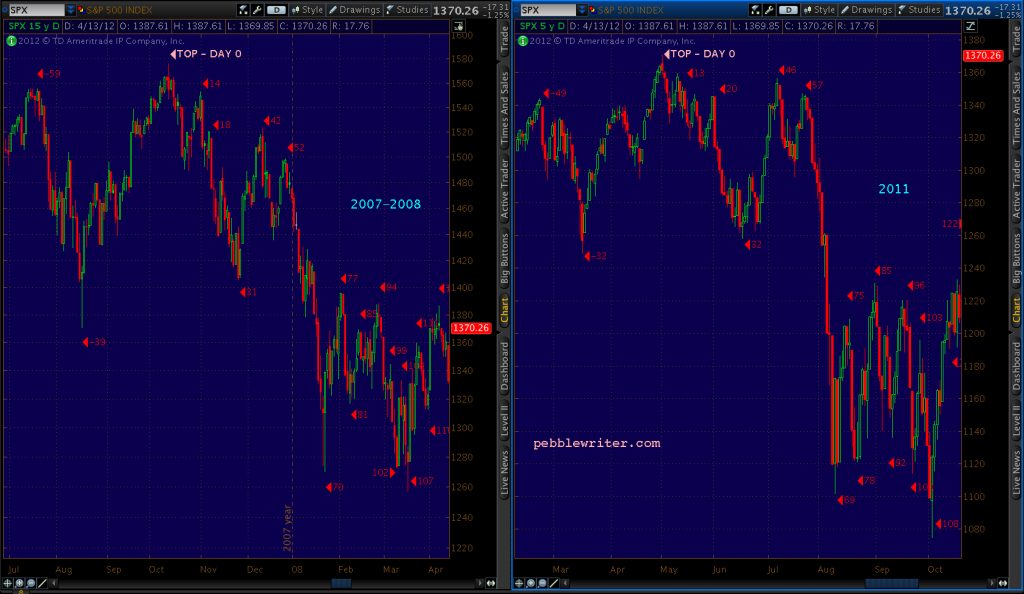
Since the last Big Butterfly Pattern completed on May 20, TPTB have managed to limit the fallout to a relatively minor correction that left the rising channel from 2009 intact. On both a percentage and duration basis, the August plunge wasn’t even as bad as the 2011 one.
That is, of course, if one considers the correction to be over.
NOTE: We still have two annual memberships available at discounted prices. CLICK HERE to save over 2/3 off.
* * * * *
One of the central conceits of Lost, a hit, mind-bending TV show from the last decade, was a protocol in which a sequence of numbers had to be typed into a computer every 108 minutes in order to avoid global catastrophe. When the protocol (a.k.a. pushing the button) was not followed, an alarm would sound, giving the button’s keepers one final chance to avert disaster.
Goosing the USDJPY is the financial world’s version of pushing the button [why? learn more about the yen carry trade.] When stocks are slipping, or merely need to be pushed up past overhead resistance, a quick spike in USDJPY is usually enough to obtain the desired result.
So, it’s troubling to the bullish case when the USDJPY merely goes sideways for nearly a year. It’s even more troubling when the Nikkei 225 alarm goes off, warning of impending disaster. Not only has NKD lost the support of the rising red channel, it has backtested that channel and plunged below its key moving averages.
The culprit, of course, is the BoJ — which has been derelict in its duty of pushing the yen lower (the USDJPY higher) for almost a year. Since it leveled out last December, stocks have not only peaked, but put in some of the most dramatic declines seen since 2011.
Last night, the BoJ disappointed yet again when it announced its latest enhancement to QQE. As Kuroda himself said afterwards, “today’s decision wasn’t additional easing.”
Are you asking yourself “what has the FOMC done for me, lately?” We still have 4 discounted memberships left. Enter the coupon code “FOMC” where indicated and get a one year membership at over 2/3 off. For details and to sign up CLICK HERE.
* * * * *
After all the drama surrounding the Fed’s 1/4% hike yesterday, the charts still point out one truism. It’s still all about the yen carry trade and, specifically, the USDJPY. As long as it’s rising, SPX will have the wind at its back — no matter how little breadth, how sketchy the fundamentals, how many miniscule rate hikes.
So, any analysis of the “market’s” next moves starts with a look at what USDJPY is going to do.

 Instead, it gave up 8% over the next two weeks. What happened? More importantly, can it recover?


