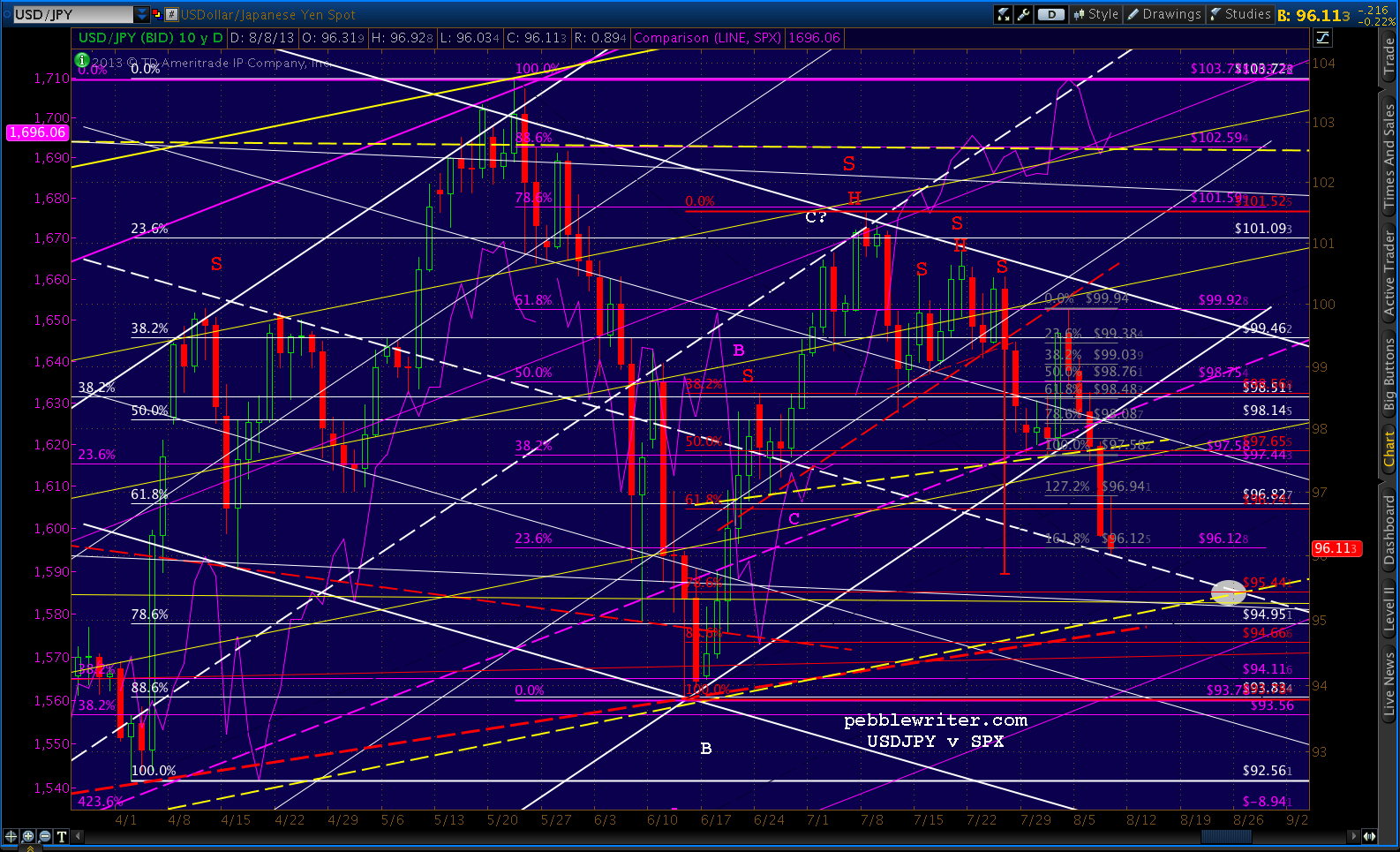
It’s sometimes difficult to keep track of the various channel lines appearing on charts — especially in close-up views. To help with the big picture, here are a few of the key channel systems I’m tracking.
Given their size and scope, there’s plenty of room for error when it comes to whether or not prices have crossed a particular line on any given day. But, smaller channels that can be more precisely drawn almost always tend toward the same slope over time — often nesting, for example, between the 0-.236 or .236-.500 lines.
I’ll update this page from time to time, but the whole point is that these channels don’t change a lot. The market moves in accordance with them rather than the other way around. I’ve layered them to better illustrate which has come into play at various key moments. And, each chart is presented in log scale.
Last, there are usually many ways to draw a channel. The only way to know for sure whether or not a a particular placement is precisely correct is to look at it in hindsight. But, like other chart patterns, they give us important clues as to what to expect.
Channels indicate the prevailing direction and the magnitude of “normal” deviations. And, they point towards something; i.e., they provide a sense of future prices in specific time frames.
Importantly, they tell us when something has changed. If prices shoot above or dip below a well-established channel line, it usually signals a change in direction. Combined with other chart patterns and harmonics, they are an excellent tool with which prices can be forecast.
Enjoy.
* * * * *
The purple channel system depicts potential resistance at the .382 line which, given its influence, could just as easily be drawn as a midline. Either way, it’s obviously important.
 The yellow channel, on the other hand, depicts ongoing support. The entire recovery since 2009 has been contained within a channel (the yellow 0.00 -.146 lines) featuring the same slope as the 1993-2000 bull market (.886 – 1.000.) Note that any time a yellow support line has been crossed, the market suffered — sometimes dramatically.
 The white channel is easier to see in isolation. The move since mid-2009 has been largely contained within the .146-.236 lines. Like the yellow channel, this system depicts support and drops through key lines have often led to large losses.
 Putting all the systems together, the chart starts to look a little crowded. But, it’s pretty clear that they’ve defined most of the major rallies and corrections.
 Major channels’ intersections frequently signal key turning points. Prices have to “choose” one course or the other, which means a continuation of the current price trend or a change in direction. SPX faces such a situation at the present time.
So, what does it all tell us regarding the rest of the year?
continued for members… (more…)


 The USDJPY, in particular, appears to be in real trouble.
 UPDATE: 9:32 AM
 continued for members… (more…)