
Tag: Algorithms

  • Algos: “We’ll Take it From Here”

    More fun and games from the market-rigging department…

    If SPX’s rally has impressed you, check out the Nikkei.  Since its Aug 26 lows, NKD is up a whopping 13.8% — more than twice SPX’s impressive 6.0%.Do what I did and google “Japan” and “economy” for the past month and you’ll see nothing but negative stories including this one which confirms a “worsening economy” even before the effects of the recent 25% increase in the consumption tax have been absorbed.

    So, why the 13.8% rally?  Unlike the Fed, the Bank of Japan makes no secret of the fact that it buys stocks.  In fact, the BoJ and the government pension fund are the two biggest owners of stocks in the Nikkei 225.

    Thanks to negative rates, investors pay the BoJ to hold their cash.  So, it costs the bank nothing to buy up everything in sight.  All they have to do is make sure the stocks never decline in value.  This is accomplished in two ways: (a) buying more stocks (throwing good money after bad); and, (b) by manipulating the currency (the yen carry trade.)

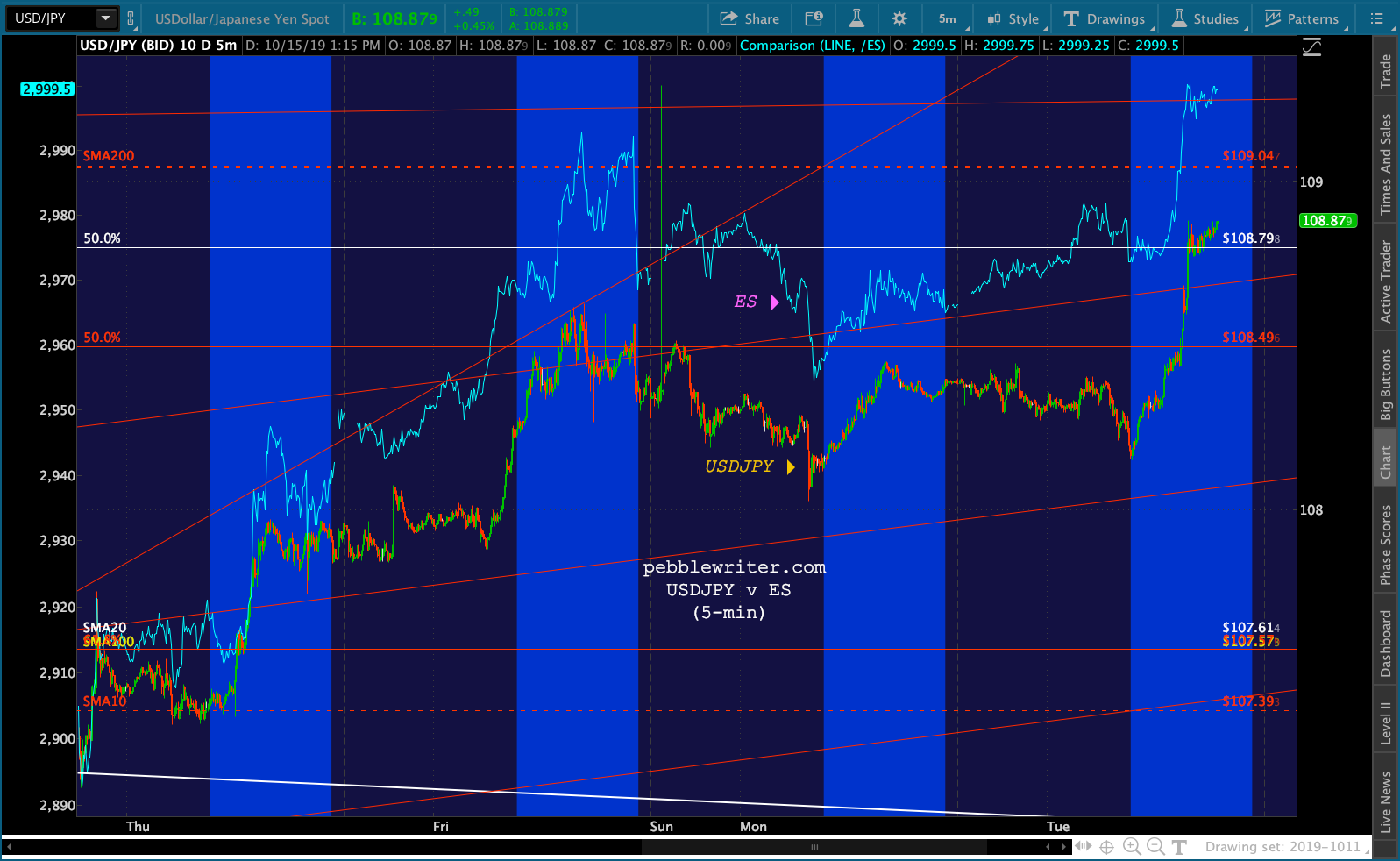
    Lately, the yen carry trade has been working overtime.  At some point the yen could theoretically get too cheap; so, the USDJPY is reset lower most nights when the low-volume futures markets are more easily propped up.

    When the cash market opens, though, the USDJPY takes off.  I’ve highlighted the period between 6:30am and 4:00pm in the chart below.  The effects on the NKD are immediate.  A few nanoseconds later, the S&P 500 futures join in.  The algorithms which drive 90% of all US equity volume watch USDJPY like a hawk.
    What happens if, for some reason, the USDJPY can’t be driven any higher or is busy resetting when extra assistance is needed?  We’ve written often about the benefits derived from hammering VIX futures.  Another favorite of central banks is oil futures.

    As the chart below shows, it works exactly the same way as the yen carry trade.  The only difference is that higher oil prices reverberate through the real economy, affecting nearly every business and consumer in fairly short order.  So, the manipulation requires a little more finesse. The Fed has its own trading desk, presumably with the ability to dabble in the futures market. Their cost of funds is essentially zero as they can print money any time they like.  Imagine how fun it will be when interest rates go negative and investors pay them to drive stock prices higher.

    continued for members(more…)

  • Buy, Machines, Buy!

    I was on the road yesterday, so I listened to CNBC on XM while tooling around town. I lost count of how many pundits sounded downright angry about how the market was melting up. “It makes no sense!” they cried, citing countless statistics from plunging retail sales to plunging earnings expectations. Not one of them brought up VIX.In a market where most of the trading is by computers which are merely responding to preprogrammed signals (aka algorithms) it has become quite simple to nudge the market one way or another.

    Given that COMP has really struggled to get and stay above its SMA200, VIX is telling the computers to buy. It already got the ball rolling by plunging below its SMA200 and is now reiterating the signal by simply breaking down below the red channel bottom.This is a well-worn trick, illustrated best by the period 2015-2016. Every time SPX needed to get back above its SMA200 (in order to delay the 1823 tag until the channel bottom arrived in Feb 2016)……VIX was there with an assist, dropping below its own SMA200 (the red moving average.) When things got really dicey and a big push was needed, VIX broke down below the well-established trend lines (below in red.)Now that it’s doing the same thing again, and oil and gas, interest rates and currencies are all following suit, the message is unmistakable: buy, machines, buy!

    Will the few remaining carbon-based investors also comply?

    continued for members(more…)

  • It’s a Wonderful Market

    SPX and ES had no trouble reaching our initial downside targets — a backtest of their January highs.  We wondered, however, whether the SMA20s, loitering just below, might come into play.

    Sure enough, ES tagged its SMA20 with ease.  But, emini traders strongly resisted a drop through the SMA20 – bad mojo, don’t you know.

    So, SPX only reached 2867.29, just shy of the SMA20 at 2866.27. And, faster than you can shout “help me Clarence!” SPX bounced the 16 points we anticipated, just like it did on Wednesday.

    It was a near miss..or, was it?  As we discussed on Tuesday…

    One little trick we often see on days when it’s difficult to convince the machines to sell/short down to an obvious bounce point such as the SMA10 is to drive the price merely to where the SMA10 will be tomorrow.  The SMA10 will likely increase by another 5 points tomorrow, so getting within 2-3 points is potentially “good enough.”

    As luck the algos would have it, today’s SMA20 came in at…wait for it…2866.27.  January highs and SMA20 were both tagged.  So, all is well, right?  Not so fast.  Futures are currently off 10 points, banks are tanking, oil and gas are slipping, FB is scurrying toward the basement and TSLA has tumbled 15% since Tuesday’s short call.

    In the distance, sirens.  A mob of nervous investors crowds the door.  Might the Building & Loan actually be in trouble?

    Thanks to overeager algos, the S&P 500 has thus far ignored the threats of tariffs, political turmoil, emerging market meltdowns, rising interest rates and historically high multiples. None of that matters as long as corporations can borrow cheap and repurchase their own shares, VIX can be hammered when necessary, the dollar continues rising and oil/gas prices don’t crash.

    If any of those support mechanisms falters, however…  Well, we’ve seen what can happen.  Keep an eye on 2867.29.

    continued for members(more…)