Tag: ECB

  • Contagion

    How bad will it get? That’s the question slamming markets this morning as Credit Suisse is again in the headlines for all the wrong reasons: The Saudi National Bank has cut them off from further financial assistance. The CDS have soared and the stock is getting ever closer to zero.

    Futures were essentially flat after a very nice rebound yesterday – until the news hit.  Now, they’ve given up essentially all of yesterday’s gains and some important technical support.

    continued for members(more…)

  • The ECB Chooses Stagflation

    Futures are off moderately in the wake of the ECB’s decision to impose a 75 bps rate hike – its highest ever – on an economy already reeling from spiraling inflation and weakening economic activity.

    continued for members(more…)

  • Backtest Complete

    Breakouts from well-established falling channels are usually followed by backtests of that channel. This is how bulls put all that nasty bearishness behind them, freeing stocks for another leg up. Except, it doesn’t always turn out that way.  Sure, ES nailed our backtest target. But will it follow through with a respectable bounce?

    continued for members... (more…)

  • Fixing Gas Prices

    Gasoline futures (RBOB) have reached our 200-day moving average target set on March 3 [see: The Devil You Know] after having broken out of a falling flag pattern.  Then…

    …nothing would be as effective at punishing Russia and helping to solve the inflation problem as crashing the oil market…If oil does retreat, stocks should too. Reversing at the .786 would be a good start……as would RB reversing at its 1.618.

    …and now.By falling 33% since then, RB has given the economy several gifts, chief among them the opportunity to bring inflation down – if retail follows suit.  EIA reported 4.272 per gallon for the month of March. July is shaping up as 4.41 – a tiny drop compared to futures prices.

    The YoY increase in retail prices would remain elevated at 45%, down from June’s 60.7% but in line with average increases during Mar-May, when CPI averaged 8.46%.

    Even if RB were to decline further, it face falling comps from August 2021. Retail prices remained steady from July to August. So, the onus is now on retailers to make a difference. And, something tells me they’re rather enjoying their windfall profits.

    The top five oil companies – Shell, ExxonMobil, BP, Chevron and ConocoPhillips – saw their Q1 profits triple from 2021 to 2022. ExxonMobil, for instance, netted $2.7 billion in Q1 2021 and $8.8 billion in Q1 2022. It is expected to report over $10 billion in Q2. Taking into account futures prices, it is obvious that the Russian invasion of Ukraine has provided cover for what’s really just good old American greed.

    Meanwhile, equities markets are trying to make sense of the ECB’s 50 bps rate hike (all the way up to zero!)Hate to tell you, Ms. Lagarde, but 0% in an 8.6% inflationary environment with a 2% inflation target is still wildly stimulative – not to mention delusional.

    continued for members(more…)

  • No Pressure

    Futures are off about 2% following yesterday’s FOMC announcement and press conference – the closest we’ll probably ever get to a mea culpa – which was accompanied by the usual algo nonsense. Suffice it to say, traders have come to their senses and markets are once again reflecting the likelihood of the Fed tightening into a recession.

    Our algo remains on track, with much lower prices to come after whatever this bounce amounts to. Note that tomorrow is OPEX and Goldman estimates that options representing a huge $3.4 trillion in notional will expire ahead of a 3-day weekend. No pressure…

    continued for members(more…)

  • The ECB’s Fantasy World

    You can’t make this stuff up. With May inflation at 8.1% across the euro zone, the Governing Council is leaving rates unchanged with an increase of 25 bps to be unleashed in July to “ensure that inflation stabilizes toward its 2% target over the medium term.”

    Sigh…

    Futures continue forming their triangle with a denouement likely coming after US CPI tomorrow morning.

    continued for members(more…)

  • Deutsche Bank: End of the Road?

    I first began focusing on DB in September 2016, when a consulting client asked me to opine as to whether the stock was circling the drain or represented a buying opportunity.  In our original post [see: Deutsche Bank, Will it Survive?] I concluded that a huge falling channel dating back to 1997 made it a buy at 11.23.

    DB bounced 90% at 11.19, and has since become a favorite trading vehicle of mine — bobbing and weaving predictably enough to have produced some excellent returns over the past two years.

    In our last post to focus on DB [Deutsche Bank: On the Ropes] we noted DB had reached channel support which, if broken, would suggest downside to 10.30 (another test of the huge white channel.)

    DB reached 10.29 on Jun 27, then reversed and nailed our upside target at 13.06.  From July 25’s CIW…

    Had the rising purple channel held, 14.72 was up for grabs.  But, the channel broke down on Aug 9.  As we noted a few days later [see: Currency Crisis on the Horizon] there was little support remaining other than the 10.29 lows.

    We were looking for a deep retracement (10.62) and/or white channel backtest a few days later when DB tested 11 again.Clearly, 10.62 would still look like a decent downside target were it not for the fact that someone (say, a Frankfurt-based central bank) is propping up the stock.

    While it has obviously completed a H&S Pattern that targets well below 10.62 — all the way down to 8.78 — the pattern hasn’t been permitted to play out yet.

    Just yesterday, Reuters reported that Deutsche Bank is looking into “loosening the bond” between its retail and investment banks (good bank, bad bank?), which sounds to me like a precursor to a more dramatic restructuring than has been discussed to date.

    Deutsche Bank is considering an overhaul to loosen the bond between its retail and investment banks, according to three people with knowledge of the matter, a move that could make it easier to merge some or all of the group with rivals.

    The German lender is examining creating a holding company structure, a step that would give it more flexibility to strike merger deals, as it seeks to regain its footing following years of heavy losses and multi-billion-dollar penalties.

    The possibility is likely to be discussed at a meeting of management later this week in Hamburg, other people familiar with the matter said, as the bank’s new chief executive, Christian Sewing, sets a new course for the struggling lender.

    Given the $11 floor under the stock and the increased threat of a merger, spinoff, or other value-enhancing restructuring, continuing to hold short is a riskier proposition.  If it dips below 11, go for it.  Or, consider going long here with stops at 11.

    Either way, DB has been a great trading vehicle for the past two years.  But, it might very well have reached the end of the road.


    (more…)

  • Why the Market Didn’t Correct Today

    Hint: it’s the same reason the “market” hasn’t corrected much at all for the past six weeks.  And, no, there’s no free lunch involved.

    The day started with some tragic news out of Brussels.  ISIS terrorists attacked innocent civilians at the airport and a metro station, killing dozens and wounding hundreds.  Brussels is the de facto capitol of the EU, so the attack understandably sent investors scurrying for cover.  Only, it didn’t last — thanks to crude light (CL.)

    For those who weren’t watching, CL spiked almost 3% in about 90 minutes on absolutely no news whatsoever.  Why?  Because, stocks were selling off.  That’s it.  If you don’t believe me, read on.

    2016-03-22 CL 5 0807 SPX had dropped almost 10 points (0.5%) in the first 5 minutes of trading.  This took it directly to a trend line connecting the last two lows (3/16 and 3/22) seen below in red.  It dithered here for a few minutes, then broke through the TL and started lower — seemingly to backtest a rising channel line or the 200-day moving average.

    2016-03-22 SPX 5 0807But, at exactly the same time that SPX reached that trend line, CL swung into action.  It reversed higher, pushing up through its short-term moving averages and, ultimately, through two falling TLs of its own.  It didn’t stop until it had topped yesterday’s highs.

    This would normally be highly unusual, given that CL had just broken down through a TL (from Mar 15) and reversed at a key Fibonacci level (the white .618 at 41.42.)

    2016-03-22 CL 15 0837But, it is most decidedly not unusual for CL, which has taken over from USDJPY as the single most influential driver of equity algorithms.  Needless to say, SPX reversed back above its broken TL and went on to register new highs for the fifth session in a row.

    How it Works

    Want SPX to stop dropping, or even reverse higher?  How about popping up through important overhead resistance?  All it takes is a sudden spike higher by CL.  The chart below illustrates how commonplace it’s been in the last few sessions.2016-03-22 SPX 1 0837The first instance on the chart above was when CL gapped higher in order to get SPX up past its SMA200.  There were many other instances when CL either reversed or at least propped up SPX (the yellow arrows.)

    Occasionally, an intraday SPX backtest of a Fib is prompted by a CL drop.  But, for the most part, CL’s drops are limited to after-hours — when S&P 500 futures are easily propped up in the light volume.

    When the “market” reopens in the morning, CL has already been reset and is ready to spike higher all over again in order to support SPX for the next 6 1/2 hours.  It’s been going on for months.  But, it’s never been more obvious than since our bottom call on Feb 11 [see: USDJPY Finally Relents.]

    The Unbroken Broken Channel

    CL traced out a rapidly rising (white) channel from Feb 11 to Mar 14, at which point the channel broke down (the red arrow.)  Normally, this would portend a reversal of some significance.

    2016-03-22 CL v ES 5 0931This breakdown occurred as SPX had finally climbed back to its 200-day moving average — a 10.5% rally off its Feb 11 lows.  Again, normally we’d see a significant reversal upon reaching major overhead resistance such as this.  Combined with the CL channel breakdown, it looked like a sure thing.

    Instead, it was limited to a minuscule 13 points.  And, few traders would have had the nerve to participate.  It came on a gap lower following a 3-day, 54-pt rally that saw SPX slice through the SMA100 without blinking and close above the SMA200 two days in a row.2016-03-22 SPX 60 1500Why such a puny reaction?  First, CL not only cut short its decline, it pushed back above its SMA20, SMA100, a TL from June 2015 and the midline of a channel from Oct 2012.  Second, just for good measure, it even gapped right back into the channel from which it had broken down (the yellow arrow above.)

    After already spiking 49.6% (in the face of obviously deteriorating fundamentals) between Feb 11 and Mar 11, this latest CL spike amounted to another 18.2% off the Mar 15 lows.  In those five sessions, it lifted SPX a total of 51 points (2.54%), with each day seeing a new higher high.

    What Happened Today

    Though it’s not particularly unusual, today’s action clearly illustrates the manipulation going on.  Note that CL broke down again from its rising white channel this past Friday.  It seemed destined for a backtest of its 10-day moving average (at least) when it was pressed into duty to prop up SPX.

    2016-03-22 CL 5 1500It bounced around a bit while SPX found its feet, then zigzagged higher until SPX backtested a little H&S neckline (purple.)  When SPX faltered there, CL suddenly popped up through a TL that had connected its overnight highs.  With SPX threatening to reverse lower, CL suddenly broke out through a TL (white) that connected the highs made since last Friday.  This drove SPX up over the neckline.

    With SPX back on track, CL was free to fall back below the white TL.  And, it was time for USDJPY to take over. 2016-03-22 USDJPY 5 1500
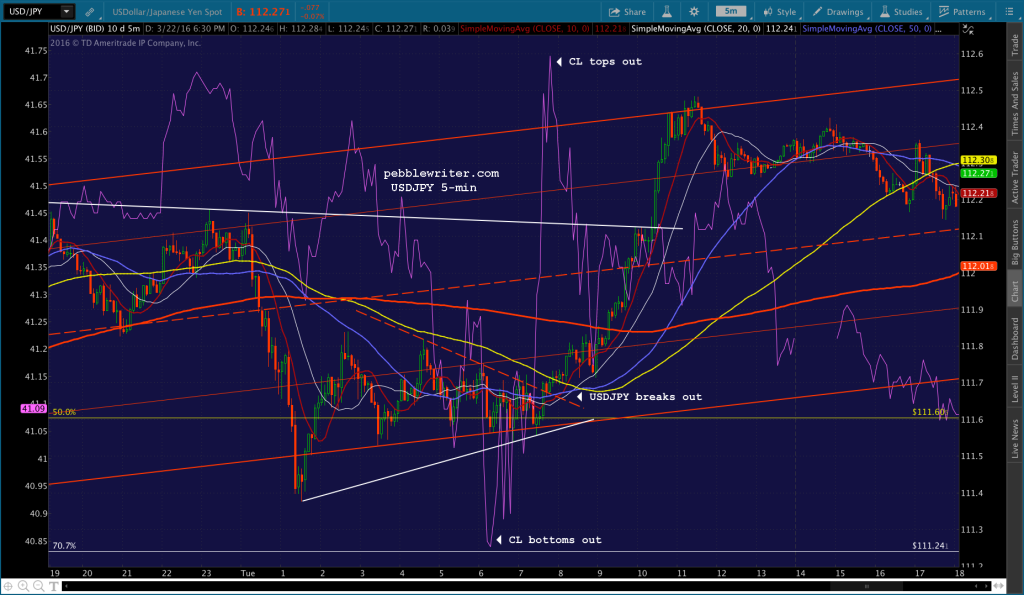
    USDJPY had sprung to life just as SPX had reached the neckline, zooming back to the top of the channel whose bottom it had briefly broken as the terrorist attack hit the newswires.  It was a strong 1% move in about 10 hours, and involved USDJPY breaking out through a TL (red, dashed) it had established overnight, and again through a TL (white) connecting Monday’s highs.

    But, after reaching the top of the rising red channel, USDJPY had nowhere to go.  With oil prices having increased so much over the past month, the Japanese need a strong yen to compensate — hence USDJPY’s flatlining since Feb 11 (there’s that date again.)2016-03-22 USDJPY v SPX 5 1500SPX saw USDJPY’s predicament, and started back down — only to be rescued again by CL, which not so coincidentally maintained an uptrend until the close.  At that point, it was free to reset — which it did.  It’s not free to do it all over again tomorrow if TPTB deem it desirable. 2016-03-22 CL v SPX 5 1500

    What Now?

    Speaking of TPTB, who’s behind this daily manipulation?  Some blame the big banks, which have much at stake in the energy sector.  I favor the central banks themselves, especially the BoJ.  It has a huge equities portfolio.  By my calculations, it costs about 5-10 cents on the dollar to prop up SPX with CL — a bargain if there ever was one.

    I firmly believe that central banks colluded to crash oil in order to keep the yen carry trade alive.  But, it got out of hand.  Oil companies started suffering.  More importantly (to the central banks, anyway) the banking industry started to suffer.  There came a point (probably about Feb 10) that they decided it was time for prices to recover.

    This was tricky, because with a terribly devalued yen (sky-high USDJPY) higher oil prices were a burden Japan couldn’t bear.  This explains why USDJPY has repeatedly returned to the Feb 11 lows (a more valuable yen) while CL and, hence, SPX have soared.2016-03-22 USDJPY v ES 60 1500How long can this go on?  It pretty much depends on us.  The stock “market” has rallied nicely, which benefits those with substantial equity portfolios.  But, the 64% spike in CL since Feb 11 amounts to a tax on everyone else.  The average price of regular unleaded gas has risen over 18% since Feb, making a mockery of central banks’ relentless “we need more inflation!” mantra.
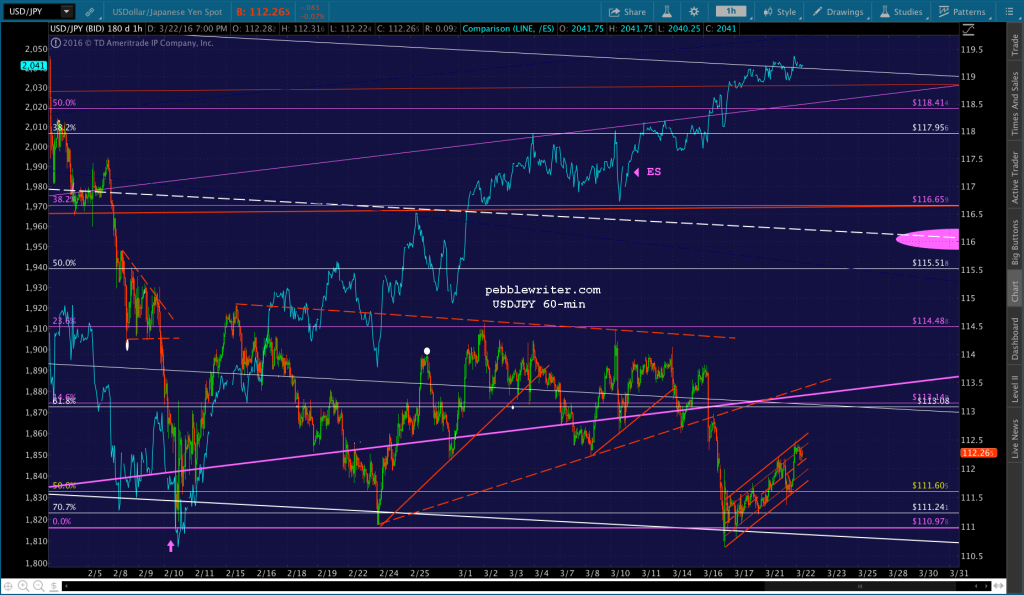
    When rising gas prices are again deemed a problem, or start to show up in official inflation data, CL’s run will be over — not a moment sooner.  At that point, look for the yen carry trade to return in all its glory.  Or, maybe by then, the ECB will have established the euro carry trade.  Or, maybe the whole steaming pile of crap will implode under its own weight.

    As always, there will be winners (the “haves”) and losers (the “have-nots.”)  Guess which constituency TPTB will bend over backwards to protect?
     

  • Down the Rabbit Hole: Part 2

    Alice laughed: “There’s no use trying,” she said; “one can’t believe impossible things.”   “I daresay you haven’t had much practice,” said the Queen. “When I was younger, I always did it for half an hour a day. Why, sometimes I’ve believed as many as six impossible things before breakfast.”
                                        ― Lewis Carroll, Alice’s Adventures in Wonderland


    The market never ceases to amaze me.  Despite all the ingredients being in place for a sizable correction, it’s sailing along as though everything were copacetic.

    Negative divergence abounds.  The correlated currencies are all selling off.  Gold is down.  Silver is down.  Even AAPL is down. Numerous indices have completed bearish Harmonic or Chart Patterns.

    The Fed let slip yesterday that the adrenaline drip will soon be removed — leaving banks without a buyer for their underwater mortgages and the stock market without any downside protection.  They’ve finally admitted what we’ve all known for some time: QE’s effect is diminishing, and the risk is growing.

    The budget showdown is still ahead (the part of the fiscal cliff that really matters.)   The most fractured Congress in modern history, which utterly failed to resolve the important issues, will now turn the task over to an arguably more partisan Congress.

    The country’s AAA credit rating is hanging by a thread at both Moody’s and Fitch.  A downgrade by either would require massive selling by institutions which require at least two AAA ratings in order to comply with their investment policies (especially insurance companies.)

    Unemployment has reportedly declined, but only because we no longer count the dejected job seekers who are leaving the work force in droves.  Include them, and the actual picture is startlingly bleak. (source: Shadowstats.com)

    The EU is officially back in a recession (though it never really left.)  Its banks are being kept afloat by the ECB/ESM, which is exchanging (somehow AAA) paper backed by shaky sovereigns for junk sovereign debt as fast as it can.  Meanwhile, unemployment continues to soar.


    The big 2013 headline that isn’t (yet) is the global derivatives debacle:  $700 trillion — over 10 times the global economy — of unregulated, unpriced, unreported private contracts which have been sliced and diced so many times that no one has the slightest notion what the risk really is — except that it dwarfs the capital of the banks that hold it.

    In my opinion, the only things keeping the economy and the market afloat are the unrelenting screech of MSM fairy-tale “good news” and the Bernanke Put (the Fed’s money printing and plunge protection operations.)

    As long as these two factors can outweigh the negative fundamental picture, the market stands a good chance of rising.  Take one of them away, and the resulting crash will be swift and severe.

    That said, I’ve spent the past two days assessing the current state of our analog and forecast.  I’ve quantified it as best I can in an attempt to eliminate my admittedly negative bias.  I’ll lay it out over the next several hours, a few charts at a time.

    If you’d rather skip to the punchline, I’m still bearish.  In the absence of a push through 1474, I think we’re in for a sizable correction and remain short from 1462.  If 1474 is broken, everything changes.

    For members who enjoy getting their fingers dirty, stay tuned.

    *  *  *  *  *  *  *  *

    About an hour ago, we completed a Bat Pattern which is nestled inside of a Bat Pattern which is nestled inside of a Bat Pattern.


    UPDATE:  3:15 PM

    RSI channels show how much is riding on this moment.  A push through the top of the purple channel brings the red channel mid-line into play.  Could it correlate with 1474, or maybe just the next channel line on the intra-day?

    I’m not sure.  The intra-day 1.272 is 1468.17 and the 1.618 is 1471.61.  A double-top would be a real nut-buster.

    All I know is there’s still negative divergence across the board, so I don’t expect the red mid-line to be broken.

    My apologies for the delay in getting the forecast charts up.  They’ll have to wait until after the close.  I’ve been distracted by the melt-up, checking and re-checking my charts to see what I might be missing.

    continued for members(more…)

  • Draghi’s Press Conference

    Streaming live now on the ECB website.

    Press conference over.  Introductory statement available here.

    Bottom line:  no interest rate change, but ECB will continue LTRO and MRO through at least the end of 2012.

    Based on our regular economic and monetary analyses, we decided to keep the key ECB interest rates unchanged. While inflation rates are likely to stay above 2% for the remainder of 2012, over the policy-relevant horizon we expect price developments to remain in line with price stability. Consistent with this picture, the underlying pace of monetary expansion remains subdued. Inflation expectations for the euro area economy continue to be firmly anchored in line with our aim of maintaining inflation rates below, but close to, 2% over the medium term. At the same time, economic growth in the euro area remains weak, with heightened uncertainty weighing on confidence and sentiment, giving rise to increased downside risks to the economic outlook.

    In previous months we have implemented both standard and non-standard monetary policy measures. This combination of measures has supported the transmission of our monetary policy. Today, we have decided to continue conducting our main refinancing operations (MROs) as fixed rate tender procedures with full allotment for as long as necessary, and at least until the end of the 12th maintenance period of 2012 on 15 January 2013. This procedure will also remain in use for the Eurosystem’s special-term refinancing operations with a maturity of one maintenance period, which will continue to be conducted for as long as needed. The fixed rate in these special-term refinancing operations will be the same as the MRO rate prevailing at the time. Furthermore, the Governing Council has decided to conduct the three-month longer-term refinancing operations (LTROs) to be allotted until the end of 2012 as fixed rate tender procedures with full allotment. The rates in these three-month operations will be fixed at the average rate of the MROs over the life of the respective LTRO. Keeping in mind that all our non-standard monetary policy measures are temporary in nature, we will monitor further developments closely and ensure medium-term price stability for the euro area by acting in a firm and timely manner.


    Lower rates were hoped for, but not expected.  LTRO was necessary and delivered right on schedule — sparking a nice rally.